

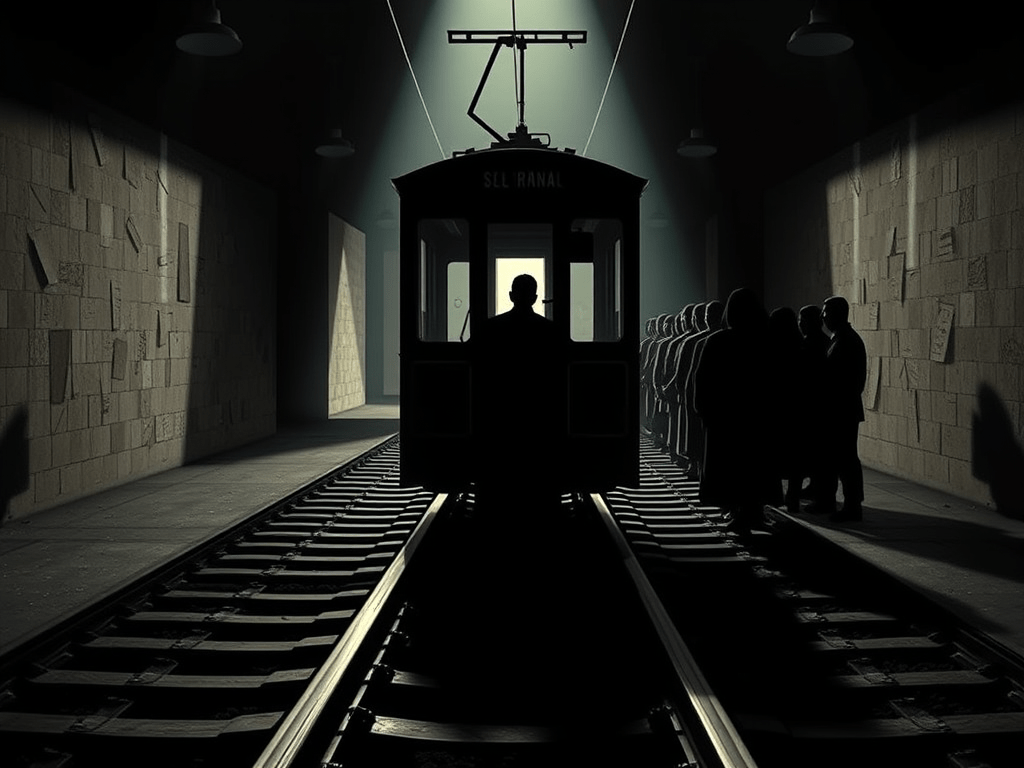
“If someone must be killed, let it be the one whose death causes the least harm.”
This is how the logic of the “lesser evil” simplifies moral dilemmas in times of crisis.
But what if all options are evil?
What if this logic becomes a tool to normalize genocide and political corruption?
One of the most famous philosophical examples of moral dilemmas is the Trolley Problem:
A runaway trolley is heading toward five people. They can only be saved by diverting the trolley onto another track—where an innocent workman stands.
Is it morally permissible to sacrifice one life to save five?
This question, theoretical and abstract as it may seem, found itself at the very heart of American politics—especially during the previous presidential elections—where citizens are constantly asked to choose the “lesser evil” between two parties that both support war, turn their backs on international justice, and flood the American public with poverty, discrimination, and racism.
So does the citizen really have a choice?
Or is he just a passive trolley operator, merely selecting who dies?
Philosophy Enters the Ballot Box
In a 2018 paper published in The Philosophical Quarterly titled:
“Lesser-Evil Justifications for Harming: Why We’re Required to Turn the Trolley,”
British philosopher Helen Frowe defends what she calls the “Requirement Thesis.” According to this view, if a person finds themselves in a position of responsibility to save lives, they are morally obligated to act—even if that involves partial harm—as long as it does not constitute a grave violation of another person’s rights or comes at an unreasonable personal cost.
But Frowe draws a careful distinction between justifying harm and institutionalizing it as an ethical standard. The rule, she argues, should apply in extreme rescue situations—not as a permanent umbrella to justify systematic killing in the name of political pragmatism.
And here begins the painful paradox:
In American politics, the “lesser evil” principle is not treated as an exception—but rather as a permanent marketing tool. Voters are asked to support a war-backing party, simply to block the ascent of another party… that also supports war, albeit more bluntly. This political betrayal is then covered in the language of patriotism, fear, and “realism.”
When Killing Is the Policy of Both Parties
Let us look at a real-world example:
In 2023, the Democratic administration under Joe Biden funded and armed Israel’s war machine in Gaza and Lebanon, despite reports from Amnesty International and Human Rights Watch documenting extensive, indiscriminate force against civilians—amounting to one of the worst genocides in recent history by international human rights standards.
Meanwhile, the Republican Party supports the same genocide—only louder, with greater vulgarity, heightened racism, and unashamed supremacy—masking it in the language of religion, deterrence, and “Israel’s right to defend itself.”
The result?
Massacres are committed.
U.S. taxpayer money is used to arm the killer.
And citizens are asked to choose between two faces of the same bullet.
The Green Party: The Ethical Alternative We’re Told to Ignore
Amid this deadly duality, the Green Party stands as the only morally coherent voice—and yet, it is actively sidelined from the national electoral arena.
The Green Party:
- Rejects corporate funding,
- Demands an end to occupation and genocide,
- Calls for universal healthcare and education,
- Opposes all U.S. foreign wars,
- Explicitly condemns the genocide in Gaza and U.S. complicity in it.
And yet, the media labels it “unrealistic,” bars it from presidential debates, and denies it public campaign funding—despite its qualification. Why?
Because it does not serve the entrenched military-industrial and financial system that dominates U.S. politics.
Abstention as a Political Act
In this landscape, refusing to vote for either major party—or voting for the Green Party—is not apathy, but a principled moral stance.
It is a clear statement:
“I will not be complicit in murder, even if it’s ‘less bloody.’”
Holding onto conscience does not mean withdrawal from the system—it means rejecting participation in a fraudulent choice.
And if moral voices are silenced, that doesn’t mean they are weak.
It means they are dangerous to the system—because they expose its nakedness.
Conclusion: I Will Not Drive the Trolley of Genocide
In the philosophy of “lesser evil,” you may be asked to choose who dies.
But in American politics, the real choice is not between “one or five lives”—but between being a participant in mass murder, or a witness who refuses to be an accomplice.
I will not vote for a killer—no matter how much “less” he kills.
I will not drive the trolley—no matter how loudly they insist it’s the only option.
And I will not surrender my voice to a system that demands “realism,” then buries justice and throws innocent bodies into the river.
📌 Wissam Charafeddine is a writer, activist, and founder of several intellectual and civic organizations in the United States.
📚 Philosophical Source:
Helen Frowe, Lesser-Evil Justifications for Harming: Why We’re Required to Turn the Trolley, The Philosophical Quarterly, 2018. Link
📎 Additional Sources:
- https://www.gp.org
- https://www.hrw.org
- https://www.amnesty.org
- https://www.congress.gov/bill/118th-congress/house-bill/8369

 Dearborn Blog
[…] Posted on April 21, 2025 by W When the Lesser Evil Becomes the Greatest Betrayal: Why I Cannot Vote for a “Less Bloody” Killer… […]
LikeLike