


| Written and shared with Musings readers by Livonia resident and author Wissam Charafeddine As an Arab American activist, author, and educator dedicated to the values of human dignity, justice, and enlightenment, I have long been fascinated by the evolution of human rights across civilizations. Our modern understanding of freedom, equality, and human dignity did not arise overnight; it is the result of centuries of thought, struggle, and legal progress from various cultures, traditions, and revolutions. A declaration is not merely a set of words on paper; when embraced by people, it becomes a powerful force that shapes societies and defines the course of history. Foundational documents—such as the Magna Carta, the Bill of Rights, and the Universal Declaration of Human Rights—have laid the groundwork for the freedoms and protections we enjoy today. Yet no state can endure in justice without being rooted in enduring values and principles—values that uphold human dignity, peace, freedom, security, and equality, rather than mere power or prosperity. Drawing from this vast human heritage, and integrating modern concerns such as environmental protection, animal rights, and sexual freedom, I have authored the Universal Declaration of Human Values—a contemporary framework for a just and humane society. This book serves as both a guide for modern governance and a call to safeguard the progress humanity has painstakingly achieved. In the coming months, I am delighted to accept the invitation of a Livonia champion of Human Rights, Bill Joyner, to launch a special series exploring twenty foundational values that have shaped our global quest for an ideal, just society. Each month, I will present one of these milestones—tracing its history, philosophy, and relevance for us today. |
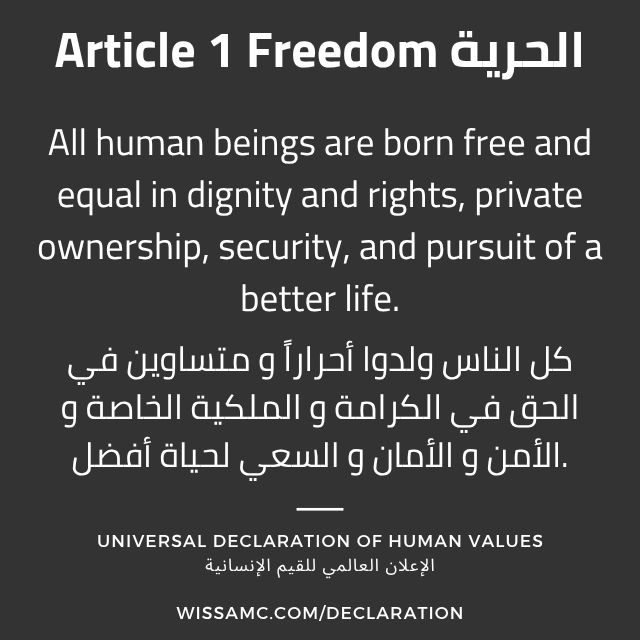
| Article 1: Freedom—the core principle upon which all other rights are built: “All human beings are born free and equal in dignity and rights, private ownership, security, and pursuit of a better life.” This simple yet profound statement distills the essence of what it means to live in a society that respects human dignity. Let us examine its components: “All human beings are born free and equal in dignity and rights.” This declares that every person—regardless of race, gender, origin, or belief—is inherently entitled to rights and respect. No person should be considered superior or inferior by virtue of birth. “Private ownership.” The right to own and control property is a vital pillar of individual liberty, empowering people to manage their resources and make independent choices “Security.” Security is the guarantee that one’s rights, body, and well-being are protected—both by law and society—against violence, oppression, and discrimination. “Pursuit of a better life.” Every human being deserves the opportunity to seek personal fulfillment, improvement, and happiness, free from unjust obstacles. The ideals expressed in this article are not new—they are deeply rooted in humanity’s intellectual and political evolution: Enlightenment (17th-18th centuries): Philosophers like John Locke and Jean-Jacques Rousseau articulated concepts of natural rights, liberty, and the social contract, establishing the modern idea of equal human dignity and freedom. American Revolution (1776): The U.S. Declaration of Independence proclaimed that “all men are created equal” with inalienable rights to “life, liberty, and the pursuit of happiness.” French Revolution (1789): The Declaration of the Rights of Man and of the Citizen enshrined the principles of equality, property rights, freedom of expression, and legal protections for all citizens. Universal Declaration of Human Rights (1948): In response to the horrors of World War II, the global community affirmed these timeless ideals, declaring that every human is entitled to “life, liberty, and security of person.” Modern International Law: Covenants such as the International Covenant on Civil and Political Rights and the International Covenant on Economic, Social and Cultural Rights further refine these principles on a global scale. I invite you to join me on this journey over the next several months as we explore, one by one, the milestones that continue to guide the global conscience toward freedom, dignity, and justice for all. |

 Dearborn Blog