

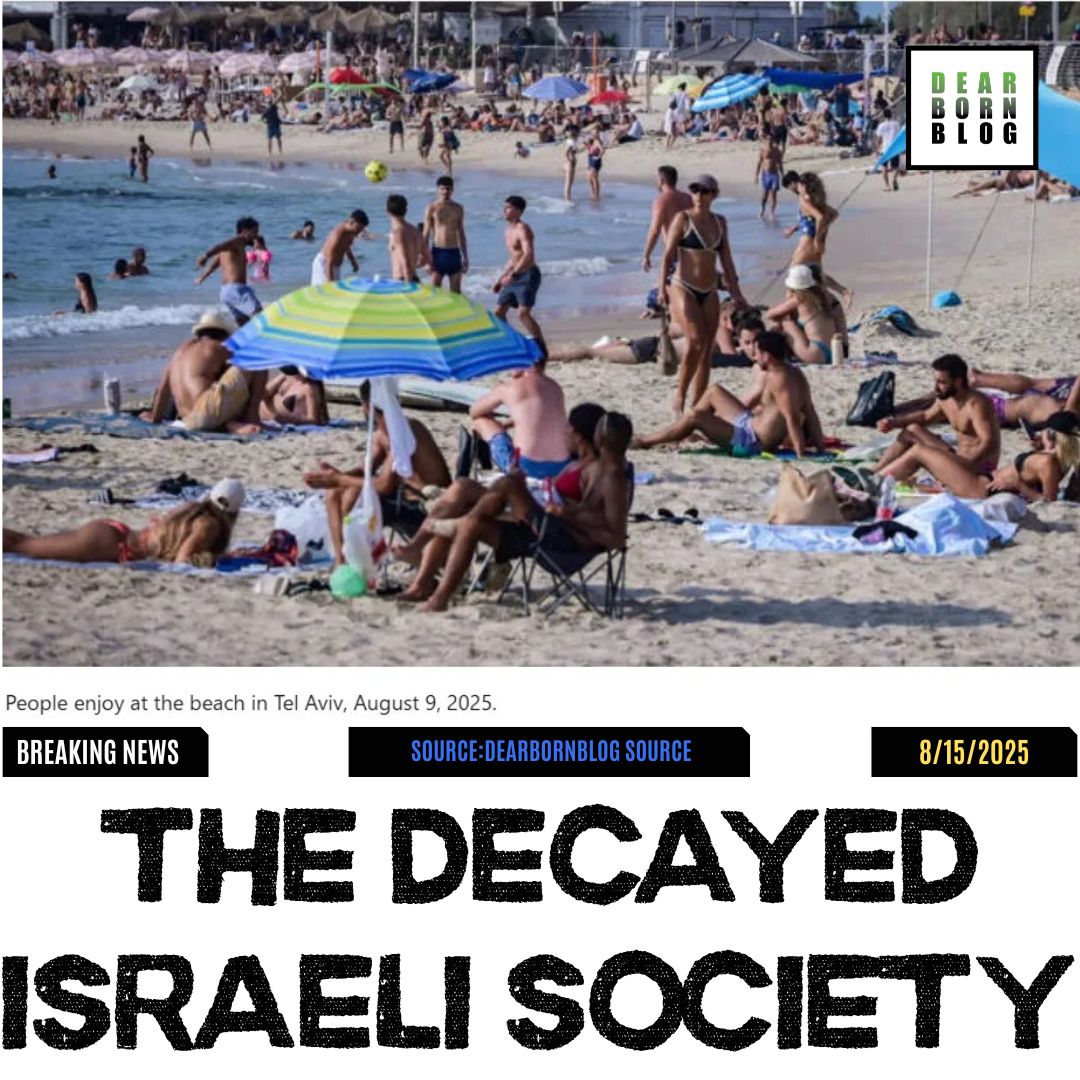
People enjoy the beach in Tel Aviv, August 9, 2025.
A strip of sea and sand; a few miles south, a strip of siege and sand. The same Mediterranean light touches both. Only one side may enter the water.
“Zone of interest” (after Jonathan Glazer’s film) names a moral geography: a private Eden maintained beside a public catastrophe. The point is not historical equivalence; it’s proximity. A society can keep its sunscreened summers if it delegates the nightmare next door to soundproof distance.
This photograph—umbrellas, volleyball, sunscreen—renders a contemporary zone of interest in a single frame. It is not proof of guilt; it is an X-ray of how a dystopia functions: by insulating one population’s leisure from another population’s starvation.
Heat Haze and Moral Haze
Israel is sweltering under a record-breaking heatwave. In recent bulletins, the Israel Meteorological Service and local outlets recorded ~33–35°C in Tel Aviv and ~40–41°C in Jerusalem, with even higher readings inland and in the Jordan Valley (Safed hit 41.4°C, a local record). See coverage from the Times of Israel and Jerusalem Post, both citing IMS data. Times of Israel, Times of Israel update, Jerusalem Post. (The Times of Israel, Jerusalem Post)
On Gaza’s coast, the sea is closed. The UN Office for the Coordination of Humanitarian Affairs reported that on 12 July 2025 the Israeli military reinstated a ban on entering the sea along the entire Gaza shoreline—prohibiting both swimming and fishing. OCHA Situation Update #306; see also the July IPC Alert summarizing fishing bans and food-security collapse. IPC Alert PDF. (UN OCHA OPT, IPCInfo)
So in August’s heat, Israelis cool off in the Mediterranean; Palestinians in Gaza risk being fired on if they approach it—while the food source that water once provided is systematically cut. That is not metaphor. It is policy, written into orders. (UN OCHA OPT)
Pullquote (use Gutenberg “Pullquote” block):
“On 12 July, the Israeli military reinstated the ban on entry to the sea across the Gaza coast, prohibiting swimming and fishing activities.” — UN OCHA (Update #306)
“Both Sides Are Suffering”?
The International Court of Justice ruled in January 2024 that there is a plausible risk of genocide in Gaza, ordering Israel to prevent such acts and enable humanitarian aid; in May 2024, the Court reaffirmed and expanded provisional measures, including instructions related to humanitarian access. Read the Orders: ICJ 26 Jan 2024, ICJ 24 May 2024; UN summaries: Jan, May; news recap: Reuters. (International Court of Justice, United Nations, Reuters)
UN agencies, including OCHA, also document worsening hunger and famine dynamics driven by months of intensified closures and denials. OCHA updates: May–June, June. (UN OCHA OPT, OCHA)
Against this backdrop, the beach photograph asks: Is this what an existential war looks like—or what a managed dystopia looks like?
What the Israeli Public Says—By the Numbers
The moral charge here is heavy; the least we owe readers is clarity via primary sources:
- Opposition to humanitarian aid: The Israel Democracy Institute (IDI) reported (Israeli Voice Index, May–June 2025) that roughly two-thirds of Jewish Israelis oppose increasing the flow of humanitarian aid into Gaza. IDI explainer (June 2025) and the May 2025 questionnaire PDF. (Israel Democracy Institute)
- Minimizing coverage of Gazans’ suffering: A Hebrew University aChord Center survey (reported by Haaretz) found 64% of Israelis see no need for more reporting on Gazans’ suffering. Haaretz; see also the Reuters Institute brief. Reuters Institute. (Haaretz, Reuters Institute)
- Erasure of civilian status: Reporting on a Hebrew University poll indicated ~64% say “there are no innocents in Gaza.” Anadolu Agency. (Anadolu Ajansı)
- Support for expulsion: Haaretz analysis (Penn State survey) found ~82% of Jewish Israelis support expelling Gazans. Haaretz; follow-up analysis: Haaretz op-ed. (Haaretz)
- Apathy toward famine: New IDI polling (July 2025) shows 79% of Jewish Israelis are “not so troubled” or “not troubled at all” by reports of famine and suffering in Gaza. IDI summary (Aug. 5, 2025); corroborated in coverage by Haaretz and others. Haaretz, Times of Israel, Vox analysis. (Israel Democracy Institute, Haaretz, The Times of Israel, Vox)
Stat callout (use a Group + Heading + Paragraph):
79% of Jewish Israelis say they are “not troubled” (or only “not so troubled”) by reports of famine and suffering in Gaza — Israel Democracy Institute (July 2025).
Source: IDI – Israeli Voice Index (Aug. 5, 2025)
You do not need to utter the word genocide to be alarmed by these numbers. Together they sketch a public mood willing to withhold aid, limit coverage of suffering, deny civilian status, and—at the extreme—endorse population transfer. (Other polls simultaneously show rising support for a comprehensive hostage deal that ends the war; the permissive attitudes above, however, remain striking.) (Israel Democracy Institute)
The Apparatus of Forgetting
Hannah Arendt’s “banality of evil” was a warning about routinization. Dystopias need not rely on overt terror; they can be built from permissions: the permitted heatwave, the permitted beach day, the permitted indifference.
Media researchers note how mainstream Israeli TV has often downplayed Gaza’s humanitarian collapse, while smaller outlets expose what the cameras miss. Reuters Institute. When the horror breaches the screen—e.g., hostage videos—the brief window of empathy snaps shut, and the conversation re-centers on one axis of pain. Reuters. (Reuters Institute, Reuters)
The Beach as Philosophy
The beach is a mirror:
- Proximity: How much suffering will we tolerate within earshot of our leisure before we revise the terms of that leisure?
- Permission: Which rules do we accept because they are written, and which do we resist because they are wrong?
- Interest: Where does our zone of interest end—at the edge of our towel, or at the border of our moral community?
Israel’s literal climate and political climate converge. Layers of enclosure—walls, closures, bans on movement by land and sea—make the suffering next door administratively invisible and physically unreachable. The sea ban is almost too on-the-nose: the element that cools one population is weaponized against the other. OCHA #306. (UN OCHA OPT)
“Existential War” or Managed Dystopia?
States at existential risk mobilize every sinew; they do not sustain a logic in which malls and beaches hum while a neighboring enclave is kept in hunger and kept from the water. The dissonance doesn’t prove anything alone; but alongside ICJ warnings, UN famine reporting, and public-opinion tolerance of collective punishment, it points to a society that has normalized indefensible means as acceptable costs. ICJ Jan/May Orders, OCHA updates, IDI polls. (International Court of Justice, OCHA, Israel Democracy Institute)
What a Different Picture Would Look Like
- Lift the sea ban and allow monitored fishing and swimming along Gaza’s coast.
- Surge humanitarian aid in measurable ways—truck counts, calorie flows, not slogans.
- Obligate national outlets to cover both hostages and hunger with equal rigor.
- Political leadership that says plainly: an existential struggle does not entitle us to abolish civilian status on the other side.
Those steps would not erase the image of August 9. They would change what that image means.
References (live links)
- Heatwave/IMS coverage:
- Times of Israel: “Israel bakes in record heat…” and update. (The Times of Israel)
- Jerusalem Post: “Israel faces record-breaking heatwave”. (Jerusalem Post)
- Sea/fishing bans & food security:
- UN OCHA: Humanitarian Situation Update #306 (July 16, 2025). (UN OCHA OPT)
- IPC Alert (July 2025): Gaza Strip Food Security. (IPCInfo)
- International Court of Justice:
- ICJ Orders: 26 Jan 2024 and 24 May 2024. (International Court of Justice)
- UN summaries/news: Jan, May, Reuters. (United Nations, Reuters)
- Humanitarian context:
- OCHA updates: #294 (June 5, 2025), #297 (June 18, 2025). (UN OCHA OPT, OCHA)
- Public opinion:
- IDI (aid to Gaza): Article, PDF questionnaire (May 2025). (Israel Democracy Institute)
- aChord/Haaretz (media coverage): Haaretz; Reuters Institute context: link. (Haaretz, Reuters Institute)
- Hebrew Univ. poll (no innocents): Anadolu Agency. (Anadolu Ajansı)
- Expulsion support (82%): Haaretz feature and follow-up op-ed. (Haaretz)
- Apathy toward famine (79%): IDI (Aug. 5, 2025); coverage: Haaretz, Times of Israel, Vox analysis. (Israel Democracy Institute, Haaretz, The Times of Israel, Vox)
- Media “snapback”:

 Dearborn Blog