

Saturday – 06 September 2025
By Zayd Alfadeel
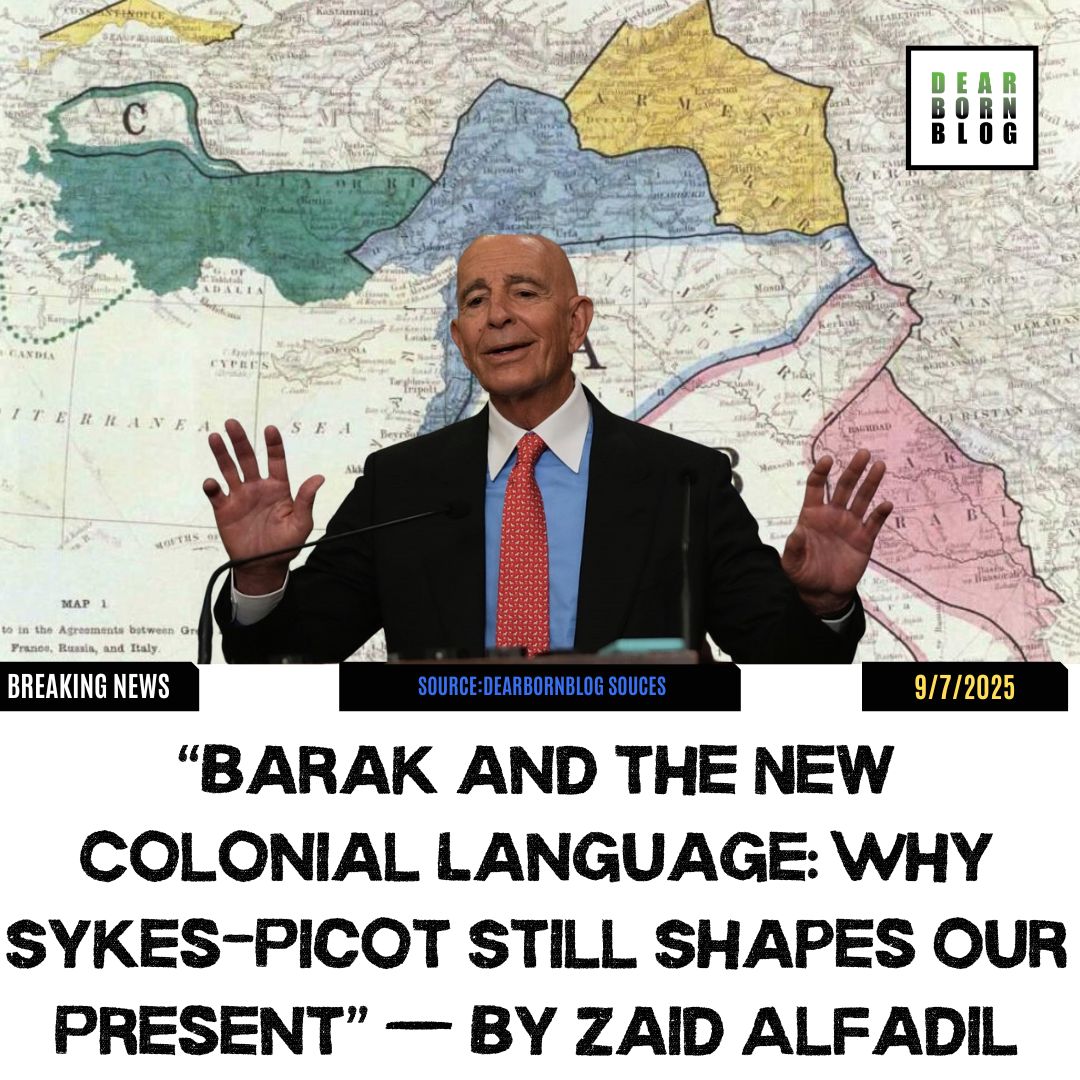
When U.S. envoy Tom Barak declares that Israel is no longer interested in adhering to the national borders established by the Sykes-Picot Agreement, and that these lines drawn have no meaning in the eyes of Netanyahu and his government—and that they “will go wherever they want, whenever they want, and do whatever they want to protect Israelis and their borders”—such a statement indicates the presence of a new colonial spirit that Israel, seemingly under renewed Western sponsorship, seeks to shape.
The very use of the term Sykes-Picot from an Israeli perspective is itself a reference to the old colonial vision that divided the Arab lands. What is worse, however, is the passing of this new colonial vision—one that Israel’s extremist right-wing government seeks to achieve—through an American envoy officially appointed to help calm the region and contribute to peace. Instead, he appears to act as a conduit for the intentions and goals of Israel’s extreme right. It would have been far more proper and expected of him to reject this notion entirely, and to work instead on restraining Israel’s legal, military, and security behavior—rather than covering up its actions, which run contrary to every humanitarian and international law.
His acknowledgement of the right-wing government’s vision—that Israel may go where it wants, when it wants, to do as it pleases, in defense of borders undefined and self-determined—means admitting to a political reshaping of the region. Such a notion is nationally, regionally, and internationally unacceptable.
The truth is that the modern nation-state was founded without our choice or any effective participation from our forefathers, due to the circumstances of their time. Britain and France, as occupying powers, drafted the Sykes-Picot Agreement in 1916, dividing the lands of the Ottoman state in the Arab East, including historic Greater Syria, into four modern states: Lebanon, Syria, Jordan, and Palestine—which Britain later granted to the Jews to establish the State of Israel.
That took place at a time when our people were neither active participants nor fully aware of the colonial designs that looted our wealth. But today is not yesterday. Today, we are stronger and more conscious than before, and it has become our duty to confront any divisive scheme that aims once again to fragment us and erase our acquired national identities, which remain the backbone of our contemporary existence and the foundation of future Arab unity.
In this context, the most dangerous part of Tom Barak’s statement, during his meeting with Mario Nawfal, lies in his assertion that Israel will expand militarily—how it wants, when it wants, and as it wants—in defense of its borders. The question is: What are Israel’s legal and official borders? Does Israel truly recognize the neighboring nation-states acknowledged under the Arab Peace Initiative? Or does it simply disregard them as a legal reality that must be respected and coexisted with?
Unfortunately, the answer is no. Israel, under the political reality driven by its ruling extremist right-wing government, does not believe in peace with its Arab neighbors at all. Its leaders openly declare their determination to establish a Greater Israel. Thus, Barak’s invocation of the term Sykes-Picot borders was not accidental, but rather a prelude to reshaping the regional map—as if the region were an empty, inert space.
It should be noted, however, that Israel, with a population of around 7 million, cannot directly rule the Arab lands in accordance with its imagined vision of Greater Israel. It lacks both the military and demographic capacity to achieve such control. Yet it can dominate land and people by fragmenting the region into hostile, warring parts—a reality already unfolding in Syria and Lebanon, where sectarian, ethnic, and regional divisions are being inflamed. For this reason, I have long stressed that awareness is the greatest weapon with which we can confront Israeli arrogance and the ambitions of this new colonial project. At the same time, it is vital that the region coalesce into a new alliance, which I previously termed in this newspaper as “Saudi Arabia and the Strategic Regional Grip Alliance.”
Finally, I believe that we are facing a new scene Israel seeks—backed by Zionist Western powers—to impose upon the region. Yet I am confident that our Arab leaderships are deeply aware of this reality. I find that Saudi Arabia is capable of confronting Zionist arrogance with wisdom and resolve, through a balanced and powerful international strategy—one that mobilizes the world to support the peace initiative based on the two-state solution. This would compel Israel to acknowledge the reality of contemporary geopolitics and establish a just peace in the region—halting the atrocities and crimes against humanity committed by its extremist right-wing government, whose inhumane conduct has made Israel a pariah state worldwide and on a broad popular scale.
source: https://share.google/2vli2Fj5lZT495mHQ

 Dearborn Blog