

Excerpt:
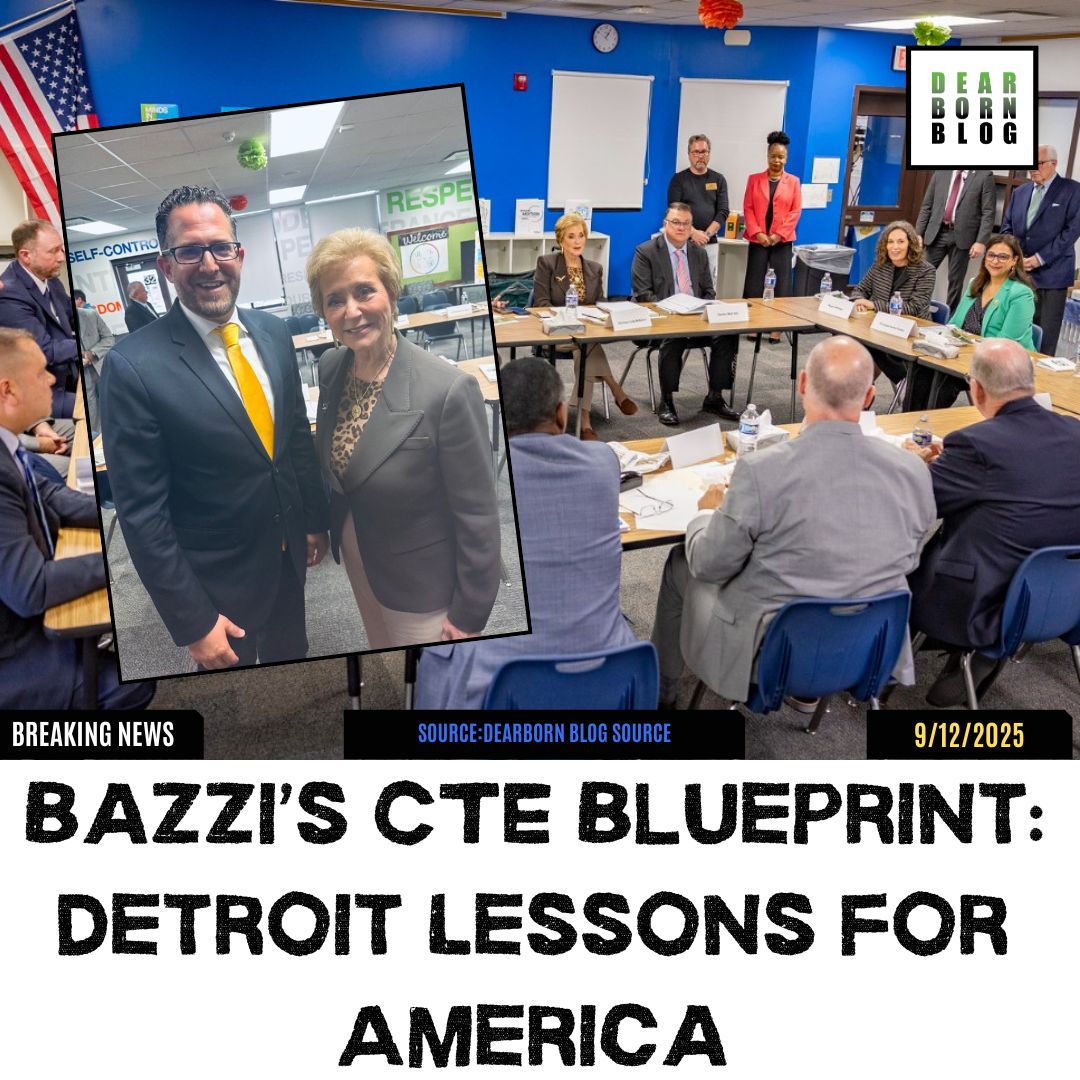
Arab American educator Dr. Ali Y. Bazzi is helping move U.S. education forward from right here in Metro Detroit. Fresh off an extended discussion with U.S. Secretary of Education Linda McMahon during her Michigan visit—and a follow-up consultation invitation to Washington, D.C.—Bazzi’s Career & Technical Education (CTE) focus offers a practical, inclusive path to student success that honors families’ choices and community needs.
Detroit hums with invention. From the first assembly lines to today’s robotics labs, this region keeps finding ways to turn learning into livelihood. That spirit is alive across Hamadeh Educational Services (HES) academies, where President and Superintendent Dr. Ali Y. Bazzi leads a diverse network of public charter schools that blend rigorous academics, bilingual learning, and hands-on pathways into meaningful careers. HES serves thousands of students across Universal Academy, Universal Learning Academy, Star International Academy, and Noor International Academy—tuition-free public school academies (PSAs) rooted in community, culture, and high expectations. [1][8][21][23]
This week, the national spotlight met Detroit. On September 8, 2025, U.S. Secretary of Education Linda McMahon visited Michigan on her Returning Education to the States tour, touring schools and meeting educators and students—including a robust conversation with Dr. Bazzi on expanding CTE, strengthening support services, and improving college readiness. McMahon’s remarks at Hillsdale College the same day underscored a throughline: restore trust in education by elevating leadership, rigor, and real-world outcomes. [2][41][1]
“We had a great meeting with Secretary of Education Linda McMahon to discuss ways to strengthen education across the United States… expanding support services, enhancing CTE, and improving college readiness so every student is equipped for success.”
—Dr. Ali Y. Bazzi, Superintendent, HES (LinkedIn)
For families and students in Dearborn, Detroit, and beyond, the stakes are concrete: Will school help me get a good job, thrive in college, and serve my community? CTE answers yes—with data to match. The latest federal indicators and national research show CTE concentrators graduate at markedly higher rates than the national average, engage more deeply in school, and transition into postsecondary education and quality jobs at strong rates. [3][0][1][19]
By the numbers
96% — Average high school graduation rate for CTE concentrators (vs. ~85% national). [3]
81% — U.S. high school graduates earn at least one CTE credit. [4]
1.4B+ — Approximate annual federal support for CTE via Perkins V. [5]
CTE is not shop class redux—it’s the modern bridge between rigorous academics and applied expertise. Health sciences, information technology, engineering, advanced manufacturing, business and finance, public service, and more: these are courses where students practice the same problem-solving they’ll need on the job and in college. The U.S. Department of Education’s Office of Career, Technical, and Adult Education (OCTAE) tracks these outcomes through Perkins V indicators (like 1S1, the four-year graduation rate for CTE concentrators), making the work visible and accountable. [6][19][5][14]
Secretary McMahon’s Michigan Visit—and Why it Matters
In Detroit, McMahon met with educators and toured public, charter, magnet, and private schools, highlighting locally led solutions and urging school systems to learn from places that are working. Stops included Pembroke Academy, Renaissance High School, Washington Parks Academy, Hillsdale Academy, and a policy talk at Hillsdale College. [7][2][7][22][19]
“These visits reinforced the value of letting schools lead with solutions that reflect the needs and strengths of their communities.”
—U.S. Secretary of Education Linda McMahon, Michigan tour release
McMahon’s Hillsdale speech—“Many Administrators, Few Leaders”—pressed higher education to recommit to truth-seeking, demanding academics, civic formation, career relevance, and leadership that’s accountable to students and communities. Whether you cheer or challenge her frame, the emphasis on results over bureaucracy and opportunity over gatekeeping resonates with families who want school to change lives, not just award credits. [8][1][10][14]
U.S. Department of Education
Dr. Bazzi’s CTE Focus: A Dearborn-to-Detroit Model
At HES, CTE isn’t an add-on; it’s a through-line. The academies combine state-aligned coursework, bilingual education (including Arabic), and hands-on pathways that connect to regional workforce needs. Star International Academy, for example, is a nationally recognized high school with pathways that include health careers (CNA) and STEM-rich programming; Michigan’s own charter school association has highlighted Star’s CTE nursing pathway as a model of hands-on credentialing that leads to licensure and jobs. [9][6][3] Star International Academy +1
The HES network’s “whole child” framing is visible across Universal Learning Academy, Universal Academy, and Noor International Academy as well—rigorous academics, cultural literacy, and extracurriculars that cultivate leadership and service. These schools are tuition-free, open to all, and designed to provide “a technologically innovative, cutting-edge, world-class educational experience.” [10][21][4][20] Hamadeh Educational Services +2 Universal Academy +2
Community Voice
“The future for our children depends on good legislation we put for them. I will do everything in my power to advocate for students and families to ensure they have a choice in their child’s education.”
—Dr. Ali Y. Bazzi (public statement)
What “Career & Technical Education” Actually Looks Like
CTE pathways are structured sequences of courses that culminate in credentials, dual-enrollment credits, or work-based learning. In Michigan, these programs span high schools, PSAs, and area CTE centers, with searchable catalogs of offerings by region. For students, this can mean coursework in engineering, robotics, coding, health care, finance, public safety, or advanced manufacturing—often with industry certifications and clinical placements. [11][15] MI School Data
Nationally, the evidence is clear. According to NCES and ACTE syntheses, CTE concentrators show:
- Higher graduation rates (often ~93-96%, compared to ~85% nationally). [3][4]
- Greater engagement and lower dropout. [3]
- Comparable or higher postsecondary enrollment and strong employment outcomes, especially when programs culminate in industry-recognized credentials. [3][9]
These outcomes carry equity implications. When done well, CTE raises the floor—especially for multilingual learners and first-generation college students—by making academics tangible, relevant, and connected to economic mobility. Perkins V specifically requires states and districts to track outcomes and address gaps. [12][19][5][11]
From Detroit to D.C.: What Bazzi Brought to the Table
During Secretary McMahon’s Michigan tour and in subsequent communications, Dr. Bazzi emphasized three practical levers:
- Expand support services so learners can actually access rigorous pathways (transportation, tutoring, counseling, language access for families). [2]
- Scale CTE and dual-enrollment that connect to in-demand regional jobs and four-year STEM pipelines. [2][0]
- Make college readiness concrete—portfolio-based assessments, real internships, and industry-validated credentials alongside AP/IB. [0]
That agenda lines up with what the research says works. OCTAE’s own data tools (Perkins Data Explorer) and the CTE Research Network point to designs where coursework, work-based learning, and student supports are braided tightly—no silos, no fluff, just clear pathways from the classroom to the clinic, the lab, the worksite, or the university. [13][8][9]
It also resonates with parents’ priorities. When schools show evidence that a student will graduate, earn college credit, and be competitive for good jobs, families across the spectrum respond. Detroit is not an abstraction; it’s a proving ground where school leaders like Bazzi are showing how culture, language, and career pathways can work in harmony.
A Note on Inclusion—and Dearborn’s Perspective
Dearborn is a tapestry: Arab American families, immigrant entrepreneurs, union households, and young people weaving new futures. Education here is not a culture war; it’s a compact with families. When we advocate dignity for every student—including Palestinian students and families who’ve carried trauma and hope into our classrooms—we’re not doing politics. We’re doing education right. That means safety, belonging, rigorous academics, and real opportunities—the same commitments that animate HES’ mission and CTE expansion. [14][17][8]
Secretary McMahon’s Detroit visit sparked many debates, including urgent concerns about Title I and federal supports for vulnerable learners. Local district leaders pressed to protect funding for low-income students, a reminder that bold rhetoric must meet the reality of kids’ needs. In this mix, the value of pragmatic, data-driven leadership—the kind Bazzi demonstrates—becomes even more critical. [15][15] Chalkbeat
“Let schools lead with solutions that reflect the needs and strengths of their communities.”
—U.S. Department of Education, Michigan tour summary
What Comes Next
The work ahead is refreshingly specific:
- Grow CTE seats and supports in health, IT/cyber, advanced manufacturing, and public service—mapping to real labor-market demand in Wayne, Oakland, and Macomb counties. [11]
- Strengthen dual-enrollment and early college so students can graduate with college credits or industry certifications (and less debt). [3][8]
- Expand multilingual family engagement so parents can navigate pathways, aid applications, and apprenticeships in the language they know best. [21]
- Publish transparent outcomes—graduation, credentials, apprenticeships, and postsecondary persistence—by school and program, aligned to Perkins indicators. [19]
From Dearborn’s vantage point, this is not about slogans. It’s about students mastering calculus and coding while earning a nursing assistant license; about Arabic-speaking families finding a welcoming school that honors heritage and accelerates opportunity; about educators who know the neighborhood, the industries, and the next steps. That’s the heart of Dr. Bazzi’s message—and why Washington, D.C., is listening. [16][3][21][1]
Sources
- U.S. Department of Education. “Secretary McMahon: Many Administrators, Few Leaders.” Remarks at Hillsdale College, Sept. 8, 2025. ed.gov. [1] :contentReference[oaicite:14]{index=14}
- U.S. Department of Education. “Secretary McMahon Visits Michigan on the Returning Education to the States Tour.” Press information and Michigan tour page. ed.gov & ed.gov/michigan. [2] :contentReference[oaicite:15]{index=15}
- Association for Career & Technical Education (ACTE). “CTE Works for High School Students” (Fact Sheet, Feb. 2024). acteonline.org. [3] :contentReference[oaicite:16]{index=16}
- Advance CTE. “What is CTE? Fast Facts.” careertech.org. [4] :contentReference[oaicite:17]{index=17}
- Iowa Department of Education (Perkins V overview) — representative reference for federal funding scale; see also CRS Primer on Perkins V. educate.iowa.gov; congress.gov. [5] :contentReference[oaicite:18]{index=18}
- Star International Academy & HES Academies pages (program descriptions and recognition). starpsa.org; hesedu.com/academies. [6] :contentReference[oaicite:19]{index=19}
- CBS News Detroit. “Education Secretary Linda McMahon visits Pembroke Academy…” (local coverage of tour). cbsnews.com/detroit. [7] :contentReference[oaicite:20]{index=20}
- U.S. Department of Education / OCTAE. Perkins Data Explorer & National/State Profiles. cte.ed.gov; announcement of 2022–23 data availability. cte.ed.gov. [8] :contentReference[oaicite:21]{index=21}
- CTE Research Network. “What We Know About the Impact of Career and Technical Education” (2024 systematic review). cteresearchnetwork.org. [9] :contentReference[oaicite:22]{index=22}
- Inside Higher Ed. “McMahon Dings University Leaders, Cites Hillsdale as Model” (context on speech). insidehighered.com. [10] :contentReference[oaicite:23]{index=23}
- MI School Data. “CTE Programs Offered” (state portal). mischooldata.org. [11] :contentReference[oaicite:24]{index=24}
- NCES (U.S. Dept. of Education). “Career and Technical Education in the United States” (indicator & PDF). nces.ed.gov; nces.ed.gov (PDF). [12] :contentReference[oaicite:25]{index=25}
- Advance CTE. “The State of Career Technical Education: 2023.” careertech.org. [13] :contentReference[oaicite:26]{index=26}
- Hamadeh Educational Services (About, Background, President & CEO). hesedu.com; hesedu.com/president-and-ceo; hesedu.com/background. [14] :contentReference[oaicite:27]{index=27}
- Chalkbeat Detroit. “Detroit school district leaders ask Education Secretary Linda McMahon to preserve Title I funding.” Sept. 9, 2025. chalkbeat.org/detroit. [15] :contentReference[oaicite:28]{index=28}
- Hillsdale College Press Release. “Hillsdale College Hosts Secretary of Education Linda McMahon.” Sept. 2025. hillsdale.edu. [16] :contentReference[oaicite:29]{index=29}
- MAPSA (Michigan Association of Public School Academies) profile for HES (mission & values). charterschools.org. [17] :contentReference[oaicite:30]{index=30}
- Times of India (wire education desk). “U.S. Education Secretary Linda McMahon visits Michigan…” Sept. 2025 (tour summary). timesofindia.indiatimes.com. [18] :contentReference[oaicite:31]{index=31}
- OCTAE. “Core Indicators of Performance – Perkins V.” cte.ed.gov/accountability/core-indicators. [19] :contentReference[oaicite:32]{index=32}
- Universal Academy / Universal Learning Academy program pages (whole-child & culture). universalpsa.org; ulapsa.org/academics. [20] :contentReference[oaicite:33]{index=33}
- HES Academies overview (network, grades, locations). hesedu.com/academies. [21] :contentReference[oaicite:34]{index=34}
- Advance CTE / ACTE—Perkins implementation resources (background on funding & accountability). acteonline.org. [22] :contentReference[oaicite:35]{index=35}
- Ali Bazzi, Ph.D. (LinkedIn). “We had a great meeting with Secretary of Education Linda McMahon…” (CTE, supports, college readiness). linkedin.com. [23] :contentReference[oaicite:36]{index=36}
Editor’s note on sourcing: This article relies on primary sources (U.S. Department of Education releases and speech text), reputable education journalism, and organizational research summaries (NCES, ACTE, Advance CTE). Quotations and summaries are attributed with inline footnote numbers and linked in the Sources.
Disclaimer
This article is for informational purposes only. Dearborn Blog has made diligent efforts to verify facts through primary and reputable secondary sources cited above. Education policies and program data can change; readers should consult official sources and local school communications for the latest information. Opinions expressed herein highlight community perspectives on education and student opportunity and are not legal, financial, or policy advice.
From Dearborn to D.C., this is the story of educators and families insisting that every student—including those rebuilding after trauma, those speaking multiple languages, those blazing first-generation paths—deserves a school that delivers dignity, rigor, and a real bridge to the future. That’s the promise of CTE done right. And that’s the promise leaders like Dr. Ali Bazzi are carrying from our community into the national conversation.

 Dearborn Blog