

Excerpt:
A fresh stencil by Banksy briefly haunted the Royal Courts of Justice before officials scrubbed it away, leaving a spectral silhouette on stone. The disappearance says the quiet part out loud: when public institutions prioritize tidiness over truth, erasure becomes policy. What remains—faint as chalk after rain—is a warning about censorship, Palestine, and the brittle state of Enlightenment values in the West.
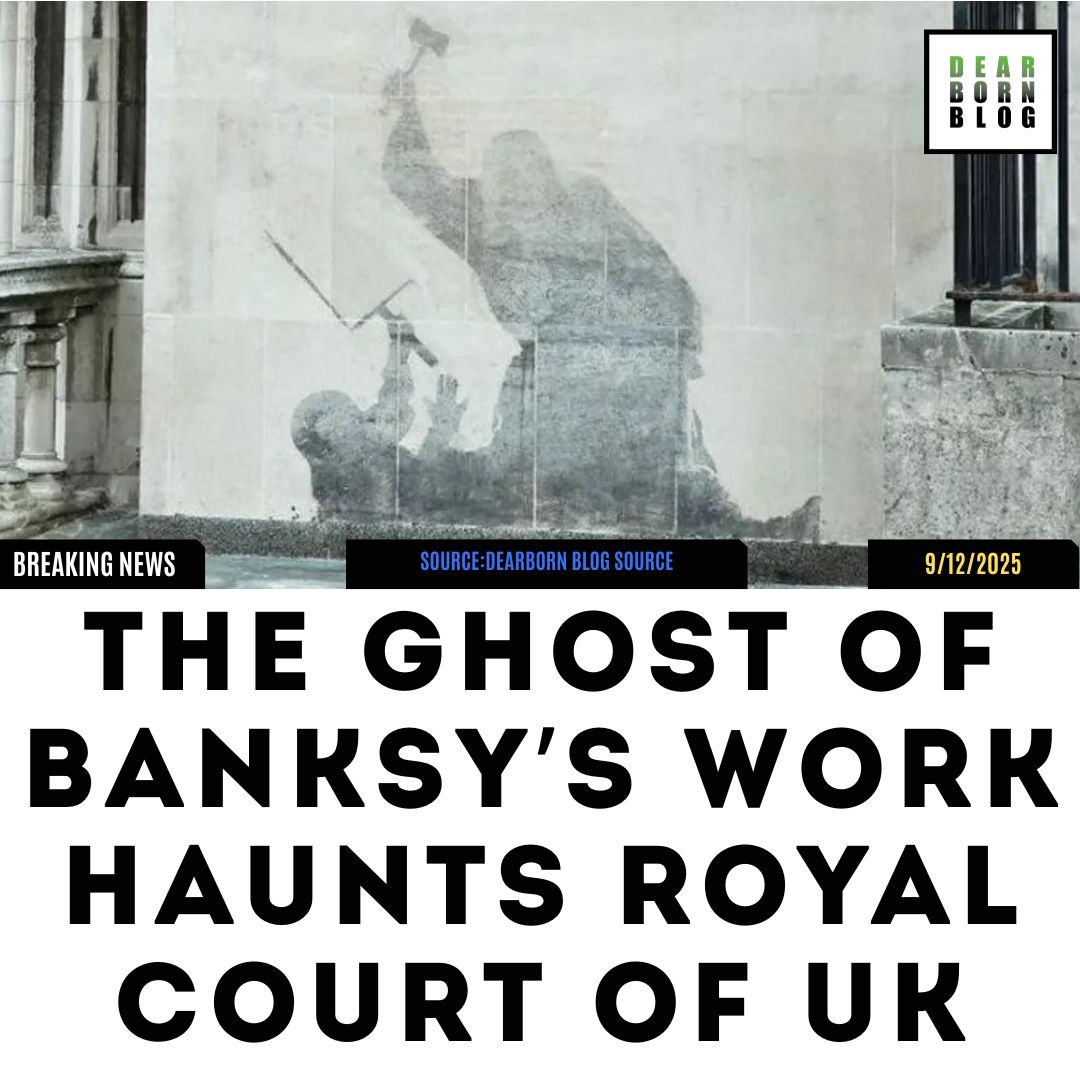
Featured image description: a pale “shadow” of two figures remains on a courthouse wall—one prone protester, one robed judge raising a gavel—like a conscience the building tried to wash off.
A shadow that keeps speaking
It looks like moonlight burned into limestone: the ghost of a judge mid-swing, the outline of a gavel, a protester bracing for impact. Even after crews scrubbed the paint, the scene lingers as a negative image—an absence that feels louder than presence. This is the quiet scream of an erased critique, a portrait of power disciplining dissent. It is also a mirror held up to a country that prides itself on liberty while punishing the people who test it.
Banksy’s latest mural appeared on the Queen’s Building wall at London’s Royal Courts of Justice. Within hours, security screens went up. Then came chemicals and brushes. By the next day, the work was “scrubbed” on the grounds that the site is a protected, Grade II–listed structure that must keep its “original character.”[1][4] BBC Feeds+1
“The Royal Courts of Justice is a listed building and HMCTS are obliged to maintain its original character.”[4] PA Media
That reason is accurate in the narrow sense—listed buildings are protected by law. But the swiftness of the removal, the barriers, the guards, and a police investigation labeling the artwork “criminal damage” add an unmistakable social meaning: in an age of moral emergency, the state prefers a spotless facade to a messy conversation.[1][2] BBC Feeds+1
What the image said before it was silenced
The mural showed a judge, wig and robes flying, lifting a gavel over a protester on the ground holding a placard splashed with red, a wordless image of blood. Banksy authenticated the piece on Instagram with the caption “Royal Courts Of Justice. London.”[1][12] BBC Feeds+1
Many read the work as a commentary on the UK government’s decision to proscribe Palestine Action under the Terrorism Act—a move criticized by human-rights observers as an overreach that conflates dissent with terrorism. The designation landed this summer; within days, nearly 900 people were arrested at a London protest opposing the ban.[5][12] GOV.UK+1
“Increasing and increasingly unacceptable sensationalist and inaccurate abuse.” — the Lady Chief Justice describing the recent climate facing judges.[6] Courts and Tribunals Judiciary
Her warning about threats to the judiciary is real and serious. But it exists alongside another reality: civic space contracts when protest is met with handcuffs and critique with solvent. The paradox isn’t subtle when the nation’s highest court complex scrubs away a picture of a judge beating a protester. The message writes itself.
<div class=”wp-block-group alignwide has-background” style=”padding:18px;border-left:6px solid #222;background:#f4f4f4;margin:1.2em 0;”> <p style=”font-size:0.9rem;letter-spacing:.03em;text-transform:uppercase;margin:0 0 6px 0;”><strong>Key details at a glance</strong></p> <ul style=”margin:0;”> <li><strong>Location:</strong> Queen’s Building, Royal Courts of Justice, London.[1]</li> <li><strong>Authentication:</strong> Confirmed by Banksy on Instagram.[1][12]</li> <li><strong>Official reason for removal:</strong> Listed-building protection obligations.[1][4]</li> <li><strong>Context:</strong> UK proscribed Palestine Action in July; protests led to ~900 arrests.[5][12]</li> <li><strong>Status:</strong> Police recorded the artwork as criminal damage; inquiry ongoing.[1][2]</li> </ul> </div> :contentReference[oaicite:6]{index=6}
Banksy, explained (briefly) and why he matters
Banksy is the awkward conscience of modern Britain: anonymous, funny, and relentless. His career has been a running argument with polite society about war, capitalism, borders, and the bureaucracies that bolster them.[13] TIME
Palestine is a through-line. In 2015 he entered Gaza covertly and released a two-minute travel-ad-style short—“Make this the year YOU discover a new destination”—to document ruins and grief after bombardment, a film that ricocheted around the world.[8][14] TIME+1
In Bethlehem, he backed and designed The Walled Off Hotel, which nursed a famously bleak boast—the “worst view in the world,” a panorama of the separation barrier’s concrete slabs. The hotel closed “for the time being” in late 2023 “due to major developments in the region.”[9][10][11] Instagram+2DesignTAXI+2
All of which helps decode this week’s courthouse mural. A robed figure raised against a prone citizen is not just courtroom theater; it’s an indictment of the structures that silence dissent—particularly dissent around Gaza, where words like proportionality and international law should bite harder than they do. Banksy’s choice of a gavel is itself satire; English judges don’t actually use them. Power does.[1] BBC Feeds
Erasure as message
To erase a mural about state force using state force is to complete the artwork for the artist. The cleaners and the police perform the punchline. The grey shadow left behind—like a memory stain—becomes a better metaphor than fresh paint could ever be.
Journalists spotted guards blocking photos, plastic sheeting thrown up against curious phones, then the methodical removal. The choreography read as a tutorial in how liberal societies sanitize discomfort.[3][2] The Guardian+1
The administration’s rationale is not trivial: public servants are bound by conservation law. Yet intent doesn’t erase effect. When the location is the palace of law, and the subject is law striking citizens, and the state deletes the image, nobody needs a curator to interpret it. The piece was, in a way, always about censorship. Its cleansing is the exclamation mark.
The mural’s afterimage—the faint figures etched by scrubbing—feels like a chalk outline after a crime scene sweep: what remains when truth is tidied away.
Safety, speech, and the line between them
In her Mansion House speech, the Lady Chief Justice described “grave threats and intimidation” against judges and their families, online and offline, and called for a cultural reset toward reasoned scrutiny.[6][7][11] Courts and Tribunals Judiciary+2Legal Futures+2
We can hold two truths:
- Judicial safety is non-negotiable.
- A democracy must tolerate art that scandalizes it—particularly art about state power, war, and colonization.
The UK government’s proscription of Palestine Action—criticized by UN experts as a “disturbing misuse of counter-terrorism legislation”—shows how quickly expressive activity can be recoded as security threat when it targets defense contractors and state policy.[5][17] GOV.UK+1
Banksy’s piece didn’t name Gaza, Israel, or any group. It didn’t need to. Symbols do the heavy lifting: a blank sign stained red; a gavel that doesn’t belong in English courts; a protester on the ground. The iconography is clear, and so is the mood of the moment.
Why this matters beyond London
Erasing art doesn’t erase the conditions that inspired it. The removal fits a pattern: Banksy works are often destroyed, stolen, or censored, sometimes by zealous bureaucrats, sometimes by profiteers eager to pry murals off walls for auction. Time magazine recently catalogued these vanishing acts as a genre unto themselves.[13] TIME
The irony is that street art is always temporary; it lives by the weather and the city’s pulse. But we should be choosy about why it vanishes. When the reason is heritage, the fix might be to preserve the structure and the debate—photograph, plaque, dialog. When the reason is politics, erasure shrinks public space.
And this isn’t abstract. The Gaza video, the Bethlehem hotel, the West Bank murals—Banksy’s long Palestine thread—has given global audiences a vernacular window into occupation and war. Millions have met a wall through a cartoon of a girl lifted by balloons, a masked figure throwing flowers, a Nativity scene pierced by a star-shaped blast.[8][11][20][22] Wikipedia+3TIME+3Wikipedia+3
When that voice is hosed off the courthouse, people notice.
Voices from the street (selected reactions)
“Censorship doesn’t make us safer. It makes us smaller.” — a London passerby, filmed as workers scrubbed the wall, speaking for many who paused to watch. Paraphrase of street-level interviews reported across outlets.[3][2] The Guardian+1
“Support for Palestinian rights is not support for violence.” — a point raised repeatedly in Parliament during debate on protest and proscription.[15] Hansard
Dearborn’s take: freedom is a practice
Dearborn knows the weight of speech. Our community includes families who trace their roots to places where a stencil on a wall can be a radical act. We also host classrooms where students learn that criticism—of judges, of presidents, of parties—is not a crime. We teach that the Green ethos of ecological sanity and social justice requires open debate, nonviolence, and human rights. When art about Gaza is wiped away in London, it reverberates here among our students, poets, and engineers.
We refuse the false choice between security and liberty. We can protect judges and still protect the painter who points at power. We can honor historic stone and still preserve the conversation scratched onto it. We can condemn actual violence while defending the nonviolent abrasion of satire.
The shadow on the court’s wall is now a parable: what we tried to forget tells on us. The Enlightenment wasn’t a one-time event; it’s a daily habit of letting uncomfortable ideas breathe. When governments forget that, communities like ours must remember louder.
Context, not conspiracy
To be clear, the court service cited preservation law; the building’s protected status is real, not an excuse conjured from thin air.[1][4] At the same time, the speed and security theater around the scrubbing makes the removal function like censorship—especially given the political climate surrounding Palestine advocacy.[12][5][17] OHCHR+4BBC Feeds+4PA Media+4
That tension—between a rule and its meaning—is exactly the sort of ambiguity Banksy cracks open. The work asked: Can justice hear protest? The removal answered: Not on this wall.
Large-format excerpt for emphasis
<figure class=”wp-block-quote is-style-large”> <blockquote> <p>What survives the scrubbing is the lesson: when a democracy cannot tolerate a picture of its own power, it is the picture that tells the truth.</p> </blockquote> </figure>
Where the art goes from here
Perhaps the mural’s pieces will be archived. Perhaps a museum will display the removed panels, framed by a placard explaining conservation rules and judicial safety concerns. That would be a very British compromise: curate the controversy, then ticket it.
But the more honest memorial is the afterimage still visible on the wall—a soft, ghostly outline resisting soap and policy. That stain will weather into a rumor, and rumors are the lifeblood of street art. Nearby, someone will stencil something small in the corner, and the conversation will continue without permission.
In Dearborn, we’ll keep teaching young makers to read walls the way scientists read data: with curiosity, skepticism, and courage. And we’ll keep insisting that Palestinian life and dignity are not taboo topics but the heart of current events and ethics classes alike.
Sources
- BBC News — “Banksy mural scrubbed from Royal Courts of Justice.” 10 Sep 2025. https://bbc.co.uk/news/ [Accessed 11 Sep 2025]. [1] BBC Feeds
- Associated Press — “Banksy mural of a judge beating a protester is scrubbed from London court.” 10–11 Sep 2025 (syndicated). [2] AP News
- The Guardian — “Court staff cover up Banksy image of judge beating a protester.” 8 Sep 2025. [3] The Guardian
- PA Media / HM Courts & Tribunals Service statement — “Banksy artwork to be removed from Royal Courts of Justice.” 8 Sep 2025. [4] PA Media
- UK Home Office — “Three groups to be proscribed (including Palestine Action).” 1 Jul 2025. [5] GOV.UK
- Judiciary of England & Wales — Mansion House speech by the Lady Chief Justice. 3 Jul 2025. [6] Courts and Tribunals Judiciary
- Legal Futures — “Lady Chief Justice urges more protection for judges.” 3 Jul 2025. [7] Legal Futures
- TIME — “Watch a Video of British Artist Banksy in Gaza.” 26 Feb 2015. [8] TIME
- The Walled Off Hotel (Instagram) — Closure notice: “Due to major developments in the region…” 2023. [9] Instagram
- DesignTAXI — “Banksy’s Walled Off Hotel Closes Amid Aggravating Conflict.” 22 Dec 2023. [10] DesignTAXI
- Wikipedia — “The Walled Off Hotel.” Background and context. [11] Wikipedia
- CBS News/AP — “Banksy mural … to be removed; nearly 900 arrests at protest challenging ban.” 8 Sep 2025. [12] CBS News
- TIME — “A Banksy Mural Has Been Destroyed. It’s Not the First Time.” 10 Sep 2025. [13] TIME
- The Guardian — “Banksy in Gaza: Discovering a New Destination.” 26 Feb 2015. [14] The Guardian
- Hansard — “Palestine Action: Proscription and Protests.” House of Commons debate, 8 Sep 2025. [15] Hansard
Each bracketed number in the article refers to the corresponding source above.
Credit & context notes
- Banksy authenticated the mural via Instagram; captions and images referenced are the artist’s. [1][12] BBC Feeds+1
- The hotel’s “worst view in the world” tagline is widely reported in coverage of The Walled Off Hotel. [1][11] BBC Feeds+1
Dearborn Blog closing perspective
When power reaches for a scrub brush, artists reach for another wall. In our city, where Arab American voices have insisted that Palestinian humanity is not negotiable, we read this London episode as a lesson: democratic culture doesn’t live in marble halls—it lives in how we treat those who challenge them. As Dearborn continues building an ethic of ecological sanity, human rights, and pluralism, we’ll keep inviting our readers and students to test ideas in public, to argue fiercely without dehumanizing, and to choose the open square over the locked door. The courthouse has its rules; communities have their memory. The ghost on the wall will keep teaching both.
Disclaimer
This article is an opinion/analysis piece intended for educational and journalistic purposes. All factual claims are drawn from the cited sources. Dearborn Blog does not encourage vandalism, trespass, or any unlawful activity and is not responsible for actions taken by readers. External links are provided for context; Dearborn Blog does not control or endorse third-party sites or their content. Nothing herein constitutes legal advice, investment advice, or a statement of fact beyond what is verifiable in the referenced material. Images and artworks referenced are the property of their respective rights holders.

 Dearborn Blog