

Excerpt:
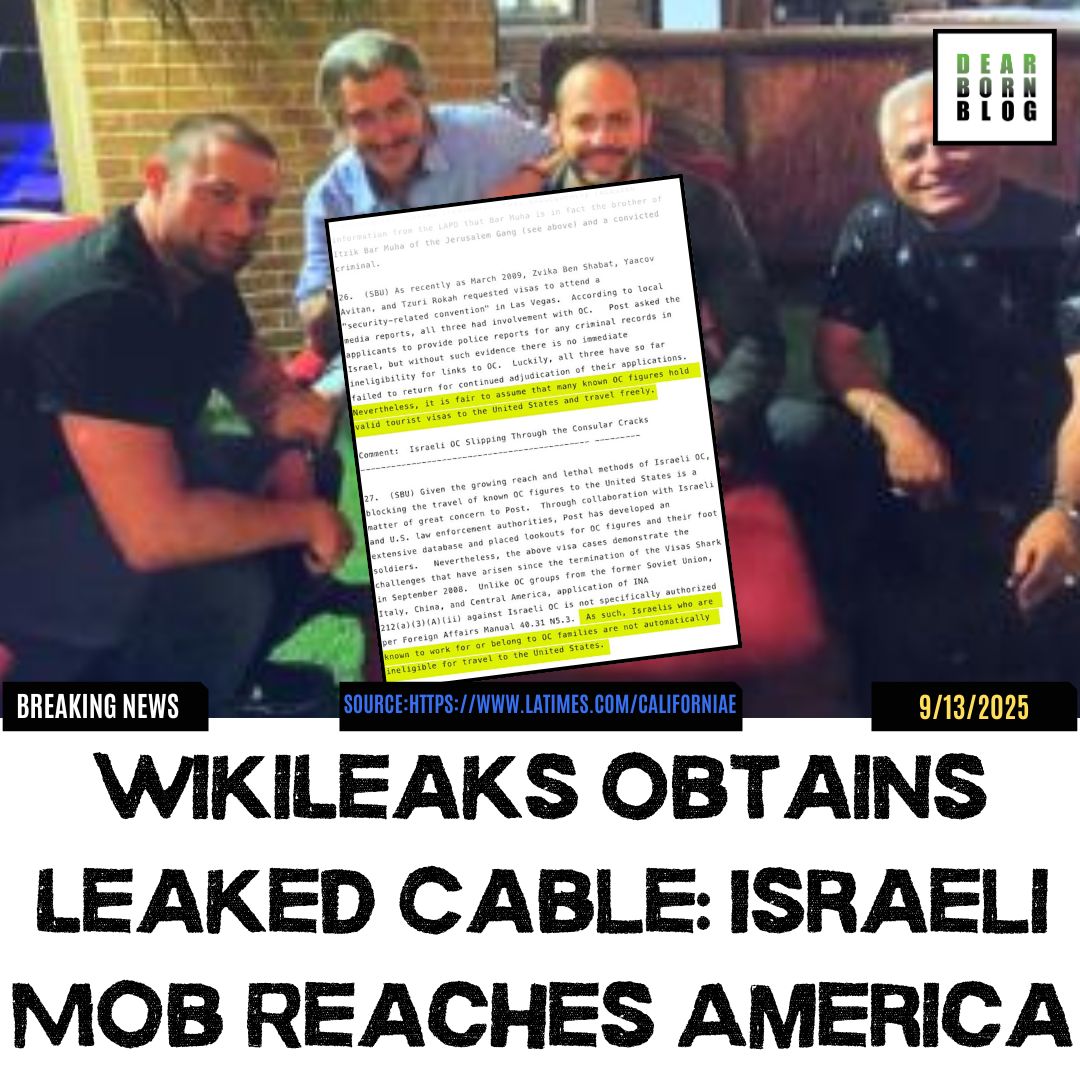
A U.S. embassy cable released by WikiLeaks details how Israeli organized crime evolved from neighborhood rackets into a transnational enterprise with “direct impact inside the United States.” This piece unpacks what the cable says, how law-enforcement responded, and what communities like Dearborn can demand—firm action against criminal syndicates without stereotyping, collective punishment, or political spin. [1] WikiLeaks
“Organized crime in Israel now has global reach, with direct impact inside the United States.” [1] WikiLeaks
The line lands like a gavel. In a 2009 diplomatic cable from the U.S. Embassy in Tel Aviv—later published by WikiLeaks—American officials warn that Israeli organized crime (OC) had outgrown strip-mall gambling rooms and back-alley rackets to become a violent, globalized business model spanning narcotics, human trafficking, cyber-fraud, and money laundering. The cable sketches a picture of syndicates whose methods moved from “old-school” muscle to IDF-honed explosives know-how and financial engineering—exporting violence and graft and, yes, touching U.S. soil. [1] WikiLeaks
This is not a story about a people. It’s a story about power, profit, and the familiar physics of organized crime: follow the money, and you find the network. Our Green-minded lens asks different questions than the fear merchants: Which systems failed? Which rules were bent? Which institutions need reform? And how do we protect civil liberties, immigrant communities, and the Palestinian people—so often smeared by association—while pursuing actual criminals with rigor?
What the cable says—plainly
The cable titled “ISRAEL: A PROMISED LAND FOR ORGANIZED CRIME?” offers four core claims that still deserve attention:
- Escalating, public violence at home.
U.S. officials recount assassinations and bombings on Israeli streets (like the 2008 car-bomb killing of Yaakov Alperon), illustrating a shift from low-profile rackets to headline-grabbing attacks. [1] WikiLeaks - A new breed of OC.
Beyond protection and loan-sharking, groups moved into tech-enabled schemes—credit-card and stock fraud—and integrated into international drug routes and casino empires across Eastern Europe. [1] WikiLeaks - Global footprint, U.S. exposure.
The cable states explicitly: Israeli OC “now has global reach” with “direct impact inside the United States,” and that some figures traveled to or tried to travel to the U.S. despite law-enforcement scrutiny. [1] WikiLeaks - Mixed law-enforcement response.
Israel created Lahav 433, an “Israeli FBI” style unit, and launched raids and prosecutions. Yet journalists and officials cited in the cable questioned whether piecemeal crackdowns matched the syndicates’ sophistication. [1][5] WikiLeaks+1
“Judges in Tel Aviv, Jerusalem, and Haifa have been assigned police protection,” the cable notes, underscoring how hard-edged this crime war had become. [1] WikiLeaks
By the numbers
• 16 crime families and 78 individuals tracked by U.S. consular staff at the time the cable was written. [1]
• 700,000 ecstasy tablets tied to a single case involving Ze’ev Rosenstein—extradited to the U.S. in 2006. [6][9][11]
• 12 suspects in the largest Israeli-led trafficking ring (2009), smuggling “thousands of women,” with later convictions. [8][10][12]
When the U.S. saw it up close
The cable isn’t just theory. U.S. prosecutions across the 2000s–2010s tell the other half of the story.
- Ze’ev (Zeev) Rosenstein—described by U.S. officials as a prolific ecstasy trafficker—was extradited from Israel and appeared in federal court in Miami in 2006 on conspiracy charges. [6][11] DEA+1
- The Abergil organization. In 2011, brothers Itzhak and Meir Abergil (and associates) were extradited to Los Angeles—the first such extradition under Israel’s racketeering statute paralleling America’s RICO law. The case linked the network to embezzlement, extortion, kidnapping, money laundering, drug trafficking, and a murder in California. [2][13][15][16][22] U.S. Department of State 2001-2009+3Department of Justice+3Jerusalem Post+3
- Human trafficking rings. In 2009, Israeli police arrested a dozen suspects in what they called the country’s largest trafficking network, ultimately leading to Rami Saban and others being convicted in 2012 for a sprawling operation that moved women from former Soviet states to brothels in Israel, Cyprus, and beyond—sometimes via Egypt and the Sinai. [9][14][19][4] Sherloc+3Haaretz+3Jerusalem Post+3
In other words, cross-border OC wasn’t a speculative fear; it materialized in U.S. indictments, extraditions, and convictions.
Law-enforcement: progress and gaps
Israel’s Lahav 433—founded in 2008—consolidated anti-OC and corruption units under one roof. Israeli press at the time credited police with a wave of arrests, while also publishing internal critiques of management and resourcing. The picture is the same we’ve seen in many countries: specialized units help, but OC is adaptive and hydra-headed. [5][7][8][23] Jerusalem Post+3Wikipedia+3Jerusalem Post+3
For the U.S., the cable points to a quieter vulnerability: visa screening and information-sharing. Officials said some figures slipped through because they lacked disqualifying convictions, not because the risks were invisible. That’s a policy gap, not a public-panic opportunity. The solution is rigorous, rights-respecting vetting—anchored in evidence, not ethnicity or faith.
Security built on stereotypes is brittle. Security built on facts is resilient.
Keep the focus where it belongs
There’s a temptation—especially in hot political climates—to smear entire communities with the brush meant for criminals. We reject that. Dearborn, a city that lives at the crossroads of Arab, Muslim, and immigrant America, knows exactly how sloppy insinuations harm real people while doing nothing to stop actual crime.
A reality-based, Green approach doesn’t play that game:
- Target the networks, not the neighbors. Stronger financial-crimes analysis, cross-border RICO cooperation, and independent anti-corruption watchdogs are the pressure points that matter.
- Shield civil rights and due process. No “special treatment”—positive or negative—based on identity. Evidence first, always.
- Separate policy from propaganda. Conflating OC with Palestinian solidarity is a rhetorical trick used to delegitimize dissent against occupation and war. Stand up to it.
The same commitment to justice that drives Dearborn residents to demand an end to the Gaza siege and occupation also demands clean policing at home. Pro-Palestine doesn’t mean soft on crime; it means pro-human rights across the board.
Why this matters now
Transnational OC thrives in the same grey zones where money crosses borders faster than accountability:
- Digital finance and fraud amplify reach.
- Private security, PMCs, and cyber-tools blur lines between state and syndicate power.
- War economies—including the ongoing devastation in Gaza—create black markets where trafficking and smuggling metastasize.
Communities like ours have a stake in mature public conversation: reject xenophobia, demand professional policing, and insist on transparency in U.S.–Israel security cooperation. That includes asking whether any equities—intelligence relationships, defense contracts, or political optics—have ever slowed the routine application of U.S. law to foreign OC figures. If so, fix it. If not, say so and show the receipts.
A Dearborn-centered, Green platform for action
Here’s what a practical, principled agenda looks like:
- Evidence-based travel screening. Upgrade interagency data-sharing between State, DHS, FBI, and allied services to prioritize verified OC indicators (RICO predicates, financial-crimes flags, trafficking ties), not guilt by association.
- Financial transparency. Push for beneficial-ownership registries, audit trails for high-risk cross-border transfers, and stronger enforcement of anti-money-laundering rules across U.S. real estate and private-fund vehicles.
- Victim-first trafficking response. Partner locally with service providers so trafficking survivors receive protection, not prosecution—a stance consistent with Green values and community safety.
- Civil-liberties guardrails. Build oversight into task forces. Safeguard against predictive-policing biases that disproportionately target Arab and Muslim communities.
- No political exceptionalism. Whether it’s Italian, Israeli, Russian, American, or any other passport—organized crime is organized crime. Apply the law evenly.
This is how we live our values: solidarity with Palestinians seeking freedom and dignity; solidarity with Israelis who oppose corruption and violence; solidarity with Americans who just want their kids safe and their democracy uncorrupted.
The story behind the story
“Post is currently utilizing all available tools to deny Israeli OC figures access to the United States…to prevent them from furthering their criminal activities on U.S. soil.” [1] WikiLeaks
The cable also documents the evolution of Israel’s response—the creation of Lahav 433 and a cascade of arrests, with notable wins against online gambling and trafficking rings. These aren’t Hollywood mob capers; they’re spreadsheets and shell companies, judges needing bodyguards, and victims who deserve more than a footnote. [5][8][23][9][14][19] Haaretz+5Wikipedia+5Jerusalem Post+5
U.S. prosecutions, particularly the Rosenstein and Abergil cases, show the system working—slowly, imperfectly, but working—when political will meets professional policing. [6][11][2][22] Los Angeles Times+3DEA+3Department of Justice+3
“Known Israeli organized crime bosses are able to travel freely to the United States…because the State Department has failed to apply US law to them,” one 2011 analysis argued—raising hard questions about consistency. Whether you agree with that critique or not, consistency is exactly what rule of law requires. [20] The Electronic Intifada
Dearborn’s bottom line
Dearborn isn’t a spectator. We are a civic laboratory. We host interfaith coalitions against hate, campaigns for immigrant rights, and loud, democratic debates about foreign policy. We also pay taxes that fund law enforcement. So here’s our compact:
- We want the United States to combat organized crime effectively and even-handedly.
- We want policies that protect our families without profiling our neighbors.
- We want the same moral clarity applied abroad—ending the occupation, lifting the siege, and pursuing accountability for war crimes—that we demand at home against trafficking, laundering, and violence.
That’s not contradictory. That’s coherence.
Sources
[1] U.S. Embassy Tel Aviv Cable (2009): “ISRAEL: A PROMISED LAND FOR ORGANIZED CRIME?” (WikiLeaks Public Library of U.S. Diplomacy). WikiLeaks
[2] U.S. Attorney’s Office, Central District of California (2012): Update on Itzhak Abergil, Meir Abergil, Israel Ozifa extraditions under racketeering law (RICO parallel). Department of Justice
[3] Jerusalem Post (2009–2010): Coverage and analysis of Lahav 433 operations and internal critiques. Jerusalem Post+2Jerusalem Post+2
[4] DEA / U.S. DOJ (2006 & 2004): Ze’ev Rosenstein extradition/charges tied to ecstasy trafficking to the U.S. DEA+1
[5] Wikipedia (overview, cited to Israeli media and police): Lahav 433 entry (for structural background), cross-checked against Israeli press. Wikipedia
[6] Haaretz & UNODC/SHERLOC (2009–2014): Reporting and case summary on Rami Saban human-trafficking network and subsequent convictions. Haaretz+2Haaretz+2
[7] Los Angeles Times (2011): News report on Abergil brothers’ extradition to U.S. and alleged crimes in L.A. Los Angeles Times
[8] Electronic Intifada (2011): Analysis of visa policy consistency raised by the cable’s implications. The Electronic Intifada
Note: Citations are provided both inline and as a consolidated list for reader verification.
Selected passages
“The old school of Israel OC is giving way to a new, more violent, breed of crime…featuring knowledge of hi-tech explosives…and a willingness to use indiscriminate violence.” [1] WikiLeaks
“The January 2011 extradition was the first of its kind under Israel’s racketeering law…parallels the United States federal racketeering statute known as RICO.” [2] Department of Justice
“Police have cracked what they say is Israel’s largest human-trafficking ring, allegedly responsible for smuggling thousands of women…” [6] Haaretz
Dearborn Blog’s take
We support transparent, accountable policing—rooted in evidence, respectful of civil rights, and blind to identity. We oppose war economies and apartheid systems that breed impunity and black markets. We stand pro-Palestine because freedom and equal rights are security’s best foundation—and because justice can’t be selectively applied.
A Green horizon is not naïve about crime; it’s rigorous about causes. Clean money rules, independent oversight, whistleblower protection, and de-escalation of endless war aren’t soft—they are smart. Dearborn understands this balance better than most because we live the consequences when politicians reach for easy narratives.
So let’s keep the focus tight: Stop organized crime. Protect civil liberties. End collective punishment. Demand one standard of law. That’s how we keep our neighborhoods safe and our politics honest.
Disclaimer
This article summarizes information from publicly available sources, including government documents and reputable news outlets. Allegations described here remain subject to court findings and due process. Dearborn Blog does not endorse or imply guilt of any individual or group not convicted in a court of law, and we reject any use of this reporting to stigmatize communities based on nationality, ethnicity, or religion. Readers are encouraged to consult the original sources for full context.

 Dearborn Blog