

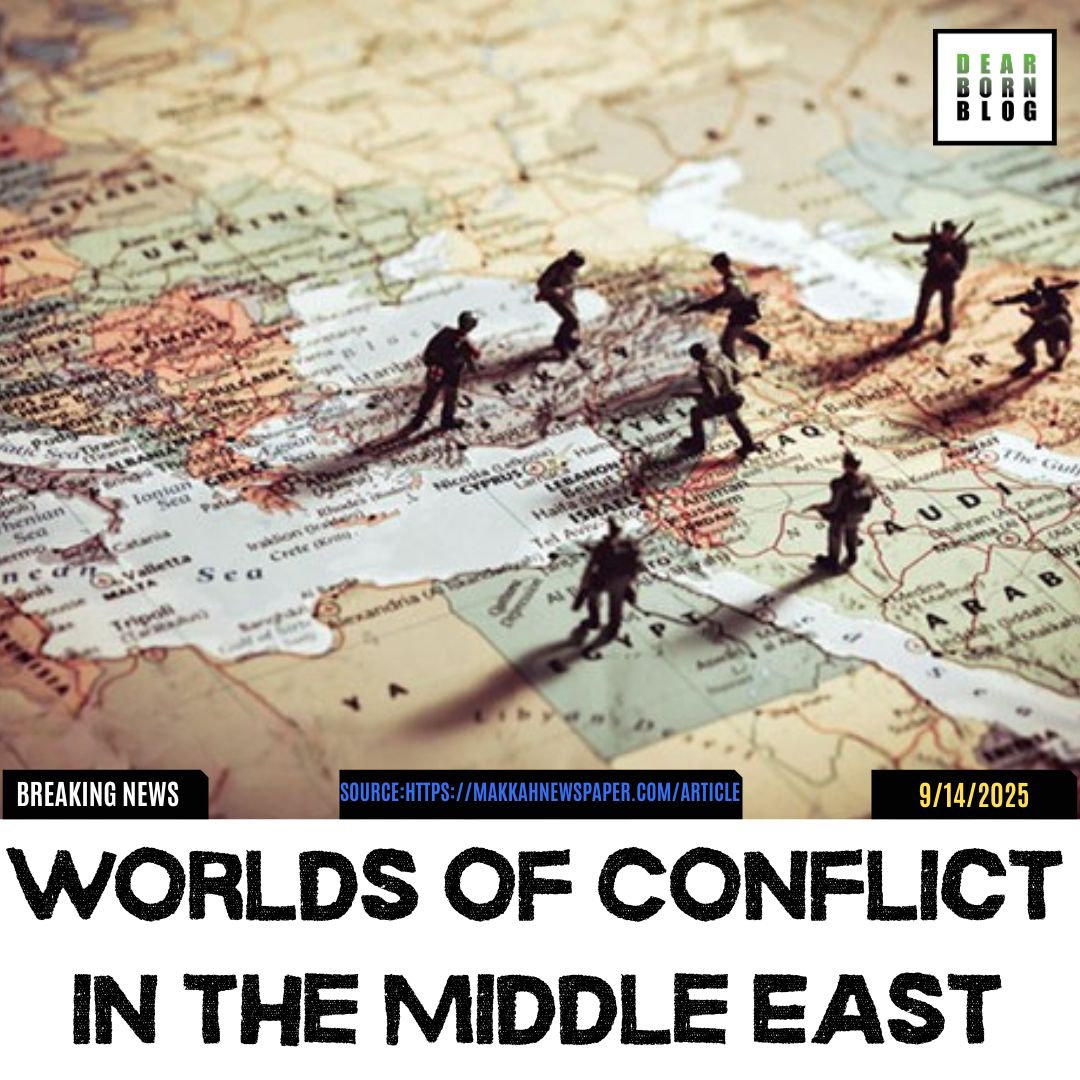
Worlds of Conflict in the Middle East
Saturday — 13 September 2025
Zaid Al-Fadil
Deep discussions on the world of conflict in the Middle East are kicking off this week in the Jordanian capital, Amman, organized by the Private University of Applied Sciences and the Ilaf Center for Studies and Research. They come against the backdrop of the rampage by Israel’s government under Netanyahu — its brazen assault on the State of Qatar, earlier strikes on the Islamic Republic of Iran, its occupation of new parts of Syria and Lebanon, and, before and after all that, its continued commission of what amounts to the crime of genocide against the Palestinian people in Gaza and its ongoing assaults on Palestinian society in the West Bank — together with repeated threats toward every country in the region, from Pakistan to Turkey.
Given all this, and with continued American support for Israel and Washington’s turning a blind eye to the crimes carried out by Netanyahu’s political and military leadership, one can draw a map of the Middle East and identify its likely future features: left unchecked, Netanyahu and his government will run wild as they please, and the result will be a blazing war — one whose sparks will not spare the West or the world at large.
In the past, and even before Israel’s criminal attack on Qatar — an attack based on weak, legally and diplomatically unacceptable, and certainly militarily unjustifiable pretexts — the conflict was more or less confined to a particular political framework and a limited geographic scope. But today Israel has, in the arrogance of its delusions of power, expanded the geostrategic frame of the conflict with reckless political folly. The attack on Qatar is an attack on the entire Gulf Cooperation Council system; it is an attack on the American alliance system as well. That has negatively affected the nature of security relations between the United States and its regional partners other than Israel — chief among them the GCC — and has put them, and President Trump in particular, in an embarrassing position. Perhaps that explains why Washington did not block the U.N. Security Council’s condemnation of Israel’s blatant attack on Qatar by using a veto, as it has sometimes done in the past.
And despite Israel’s failure in its criminal mission, its leaders have continued to confirm their intention to persist in attacking Qatar, Turkey, and others under the pretext of eliminating Hamas’s political leadership — a possibility that all regional governments must take very seriously. They should intensify political and economic pressure on the United States and the West more broadly to rein in Israel’s runaway behavior and its disregard for the rule of law. If they do not, the region will enter a dark tunnel that will have grave consequences for the entire world — consequences that reasonable people of all persuasions, including sensible people inside Israel (if there are any who think with reason), should want to avoid. They should step away from foolish shows of force and the genocidal crimes being committed by their extremist government, crimes that destroy Israelis first and make them pariahs everywhere and at all times.
In this context, as a historian I used to stop and wonder at the historical hatred and antipathy directed worldwide toward Jews. But when I saw the present reality, I understood the reason and accepted it: Jews, the author claims, have domesticated hatred in their genes, and when they behave like predators that hatred wells up from their veins, and they commit the worst crimes against others. This is what is happening today to the people of Gaza and to the Palestinian people in general, and even to other members of the Arab nation, both Muslims and Christians.
Faced with that, the peoples and governments of the region have no choice but to unite: Israel is an enemy of everyone — beginning with Pakistan, passing through Iran and the Arab states, and reaching Turkey — and it will not hesitate to attack any country. The time has also come to declare the failure of the Abraham Accords project, which should have been implemented tangibly in Jerusalem first and foremost, before being promoted by the Zionist West.
It is also time for Arab states that signed peace agreements with Israel to cut ties with it, so that this will be a deterrent and a message to the Israeli people that their extremist government is throwing them into danger and betraying and breaking the hands of those who extended peace to them and sought to achieve it with dignity and justice in the region. Is there a way to achieve that?

 Dearborn Blog