

By Dearborn Blog
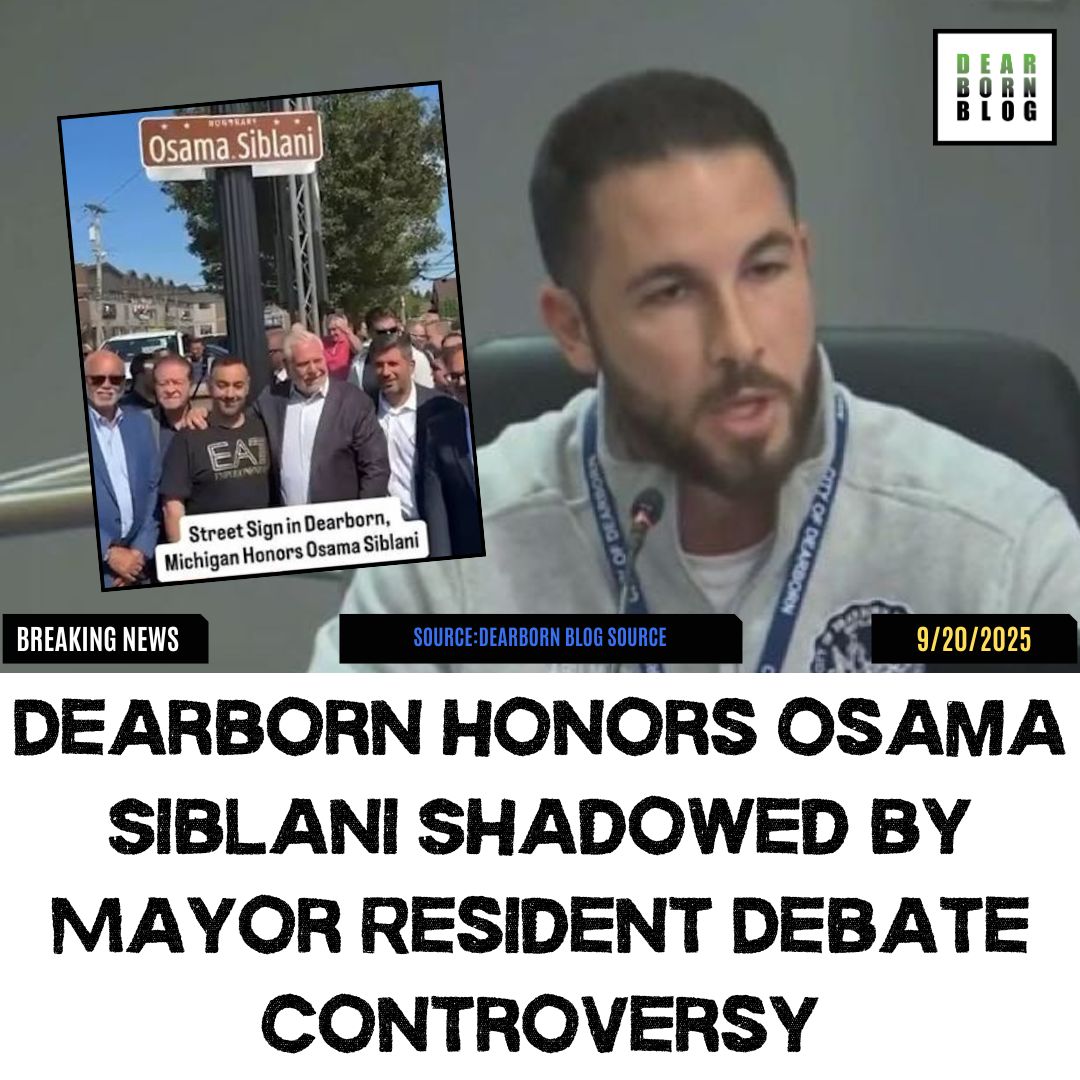
In early September 2025, Wayne County officials unveiled two honorary street signs in Dearborn bearing the name Osama Siblani — at the intersections of Warren Avenue and Chase Road, and Warren the Schaefer Road. ArabAmericanNews+2ArabAmericanNews+2 The stretch of Warren Avenue between Chase and Schaefer is now recognized in his name in a rare and symbolic honor acknowledging decades of service to Michigan’s Arab American community. ArabAmericanNews+1
But the ceremony was followed by a sharp confrontation. Edward “Ted” Barham, a Christian resident and minister, spoke at a Dearborn City Council meeting on September 9, questioning whether it was appropriate to publicly honor Siblani, whom he accused of expressions supportive of militant groups, such as Hamas and Hezbollah. MEMRI+3Fox News+3Detroit Free Press+3 Mayor Abdullah Hammoud responded by calling Barham a “bigot,” an “Islamophobe,” and telling him that “although you live here, you are not welcome here.” MEMRI+3Detroit Free Press+3Fox News+3
This moment has drawn national media attention. Conservative outlets like Fox News have emphasized Barham’s allegations of violence incitement and depicted Hammoud’s remarks as intolerant toward dissenting voices. Other groups have focused on what Barham said about some of Osama Siblani’s past speeches and whether certain expressions (e.g. “blood of the martyrs,” or “fight with stones, with guns… drones, rockets,” etc.) cross a line. Fox News+3Fox News+3MEMRI+3 Meanwhile, others see this as part of a longer struggle for recognition and respect for Arab American voices — and push back against what they characterize as selective or decontextualized reporting. MEMRI+3ArabAmericanNews+3ArabAmericanNews+3
Osama Siblani: Why the Sign is Deserved
To understand the weight behind this sign, we need to review the accomplishments of Osama Siblani and the institution he built — from the perspective many in Dearborn and across Michigan hold.
Migration, perseverance, and founding The Arab American News. Siblani emigrated from Lebanon in 1976, went to the University of Detroit Mercy, earning a degree in electrical engineering in 1979, then five years later (in 1984) founded The Arab American News (Sada al-Watan) — a bilingual weekly in Arabic and English. ArabAmericanNews+2Michigan Journalism Hall of Fame+2 At that time, and for years after, Arab American stories were often absent, ignored, or caricatured in mainstream U.S. media. The newspaper offered a voice — local, cultural, political, civic — for a community that often felt underrepresented. ArabAmericanNews+2ArabAmericanNews+2
Recognition. Among his many honors, Siblani was inducted into the Michigan Journalism Hall of Fame in 2013 — the first time someone from an ethnic media outlet earned that distinction. Michigan Journalism Hall of Fame+2ArabAmericanNews+2 He also received the “Spirit of Diversity in Journalism” award from Wayne State University in 2010. ArabAmericanNews+1 These are not merely symbolic: they reflect a peer recognition of both impact and ethical commitment over decades.
Community building, civic and political inclusion. Over 40+ years, Siblani’s paper and his leadership have helped the Arab American community in Michigan to have a seat at many tables: in local government, civic organizations, media, and public policy. He has often served as one of the first points of contact for Arab American perspectives, especially in times when Arab and Muslim communities felt marginalized or poorly understood. The sign-waving and community attendance at the Warren Avenue ceremony was large; local leaders at the event repeatedly emphasized that this honor is not just for Siblani alone but for generations of Arab Americans who sought representation. ArabAmericanNews
That is why Wayne County’s decision to name part of Warren Avenue after him carries deeper significance. According to the reporting, Wayne County “rarely” renames streets after individuals; this was only the second time in over a decade that such an honorary naming was done. ArabAmericanNews
The Criticisms & Context: What Barham’s Concerns Entail, What Has Been Reported
Barham’s objections are anchored in a few claims:
- He alleges that some of Siblani’s public statements glorify or support militant resistance, possibly including language that could be interpreted as encouraging or normalizing violence. Specific quotes attributed to Siblani (through Barham and media citing MEMRI, ADL, others) include: “blood of the martyrs irrigates the land of Palestine … everyone should fight within his means … stones, guns, planes, drones, and rockets…” etc. Free Beacon+4Fox News+4MEMRI+4
- Barham said that honoring someone with such statements is provocative, especially in public, and may send the wrong message. Fox News+1
Critics of Siblani (including organizations like the Anti-Defamation League) have similarly pointed to some of his speeches where he uses militant imagery or characterizes certain groups as “freedom fighters,” or at times makes statements that are controversial in their framing of Israel, resistance, occupation, etc. Free Beacon+3ArabAmericanNews+3Detroit News+3
Supporters argue that many of those statements are taken out of fuller context, are rhetorical or symbolic, directed at political rhetoric or foreign policy, not calls for violence in Dearborn, and that Siblani has also repeatedly defended his right to free speech, pointing to marginalized voices, injustices, and the need for political freedom for Palestinians. ArabAmericanNews+1
The Role of Mayor Hammoud & the Politics of Response
Mayor Abdullah Hussein Hammoud, first Arab-American and Muslim mayor of Dearborn, has a track record of navigating complex identity, policy, and civic issues. Wikipedia+1 His embrace of the sign-unveiling, attendance at the Wayne County ceremony, and his praise for Siblani’s role in giving voice to Arab Americans reflect a commitment to recognizing those whose contributions are easy to overlook. ArabAmericanNews+1
At the same time, Hammoud’s choice of words toward Barham and the tone he used during the council meeting have stirred concern. Labeling a resident “not welcome,” calling him a “bigot,” challenging the legitimacy of his objections — all of these are emotionally and politically charged gestures. Some view them as necessary pushback against what they see as Islamophobia or bias; others see them as overreach or as undermining the idea that all residents should have the ability to raise concerns. MEMRI+3Detroit Free Press+3Fox News+3
Dearborn Blog’s View: Commendation, Critique, and Call for Civility
Dearborn is not just a place with many faiths, ethnicities, cultures — it is a place where identities intersect and sometimes clash. What we witnessed in this episode is part of a larger story: who gets honored, who gets to speak, what counts as public memory, and how power is exercised in these moments.
What deserves praise
- Recognition of contribution. Honoring Osama Siblani in this manner is entirely justified. His decades of service through The Arab American News, his willingness to speak truth to power, his role in building civic engagement in the Arab American community — all are worthy of both respect and public commemoration.
- Standing up to bigotry. Mayor Hammoud deserves credit for defending his city’s cultural, religious, and ethnic diversity. In a moment when Islamophobia and anti-Arab sentiment remain very real, silence or equivocation would send a worse message.
- Elevating Arab American presence. This sign is not just about one man; it is about representation. Signage, naming, public acknowledgments matter. For young Arab Americans, for immigrants, for all who feel excluded, seeing names, faces, stories in public life is part of inclusion.
Where caution and improvement are needed
- Civic tone and inclusive governance. Even as one defends against bigotry, public leaders have responsibilities. Telling a citizen that they are “not welcome” — even if emotionally satisfying in some way — risks alienating, diminishing trust, and driving division. Out of principle, disagreement should be engaged, not silenced.
- Precise language, full context. When criticizing someone’s statements, it helps to present the full context. Media outlets, too, should avoid cherry-picking quotes. Siblani’s critics raise legitimate questions about certain remarks. But demographic fears of “terrorism” can turn inflammatory without nuance.
- Ensuring space for dissent. Democracy depends on allowing residents to express concerns, even ones we may find hurtful or wrong. If public honours are going to happen, transparent processes and open communication help build legitimacy — both among supporters and skeptics.
Our Conclusion: Embracing Respect Without Silencing Debate
Dearborn Blog holds this balanced position:
Yes — Osama Siblani has earned this recognition. The Warren Avenue sign is more than a street name; it is a symbol of decades of struggle and achievement, of giving Arab Americans a media platform, a voice in politics, and a seat at the public table.
Yes — Mayor Hammoud’s defense of the community, and his willingness to confront Islamophobia and bigotry, is necessary and commendable.
However — public officials must strive to uphold the dignity of all residents, even those with whom they sharply disagree. Words that exclude or stigmatize weaken communal bonds. Civic leadership demands both courage and generosity: courage to honor what is just; generosity to respect differing views, even if they are uncomfortable.
As Dearborn continues to grow and embrace its diversity, moments like these can become opportunities not only for recognition but also for deepened dialogue. Let this be a reminder that symbolic honors are powerful, but so are the daily practices of inclusivity, listening, and respect.
Suggested Actions Going Forward
- Public forum or town hall where residents can ask questions about the sign, hear Siblani’s own statements and context, and express concerns. Transparency builds trust.
- Media literacy efforts to help people parse what is being reported: what is direct quote, what is interpretation, what is context (audiences, tone, audience expectations, metaphor, symbolic speech, etc.).
- Guidelines for civic discourse in City Council or public meetings: allowing respect for free speech while maintaining decorum; perhaps training for elected officials in managing contentious speech.
- Educational outreach about the history of Arab Americans in Michigan — their contributions, their struggles — to broaden understanding, reduce stereotyping, and build real solidarity.
References & Sources
Below are some of the principal sources for this report, which readers may consult for more detail:
- “Wayne County names Warren Avenue in the heart of Dearborn after Osama Siblani, honoring his journalistic and political legacy.” The Arab American News, Sept. 12, 2025. ArabAmericanNews+1
- “Dearborn street sign honors Arab American leader Publisher Osama Siblani.” Free Press (Detroit), Sept. 9, 2025. Detroit Free Press
- “Dearborn mayor tells resident he’s not welcome over Osama Siblani sign controversy.” Detroit News, etc. Detroit Free Press+1
- Coverage of Ted Barham’s statements and interview: Fox News Digital, etc. Fox News+2Fox News+2
- Osama Siblani’s induction into the Michigan Journalism Hall of Fame; and “Spirit of Diversity in Journalism” award. ArabAmericanNews+3Michigan Journalism Hall of Fame+3CBS News+3
- Criticism from ADL or groups citing Siblani’s remarks; and counter-arguments from Siblani and his supporters. Free Beacon+3ArabAmericanNews+3Detroit News+3
Dearborn is more than a location on a map. It is a tapestry of stories, memories, faiths, identities. Honoring one thread does not mean unraveling others. In the sign for Osama Siblani, Dearborn has taken a step toward recognizing what has long been ignored. Let us walk from here with both pride in that step and humility in the journey ahead.

 Dearborn Blog