

Excerpt:
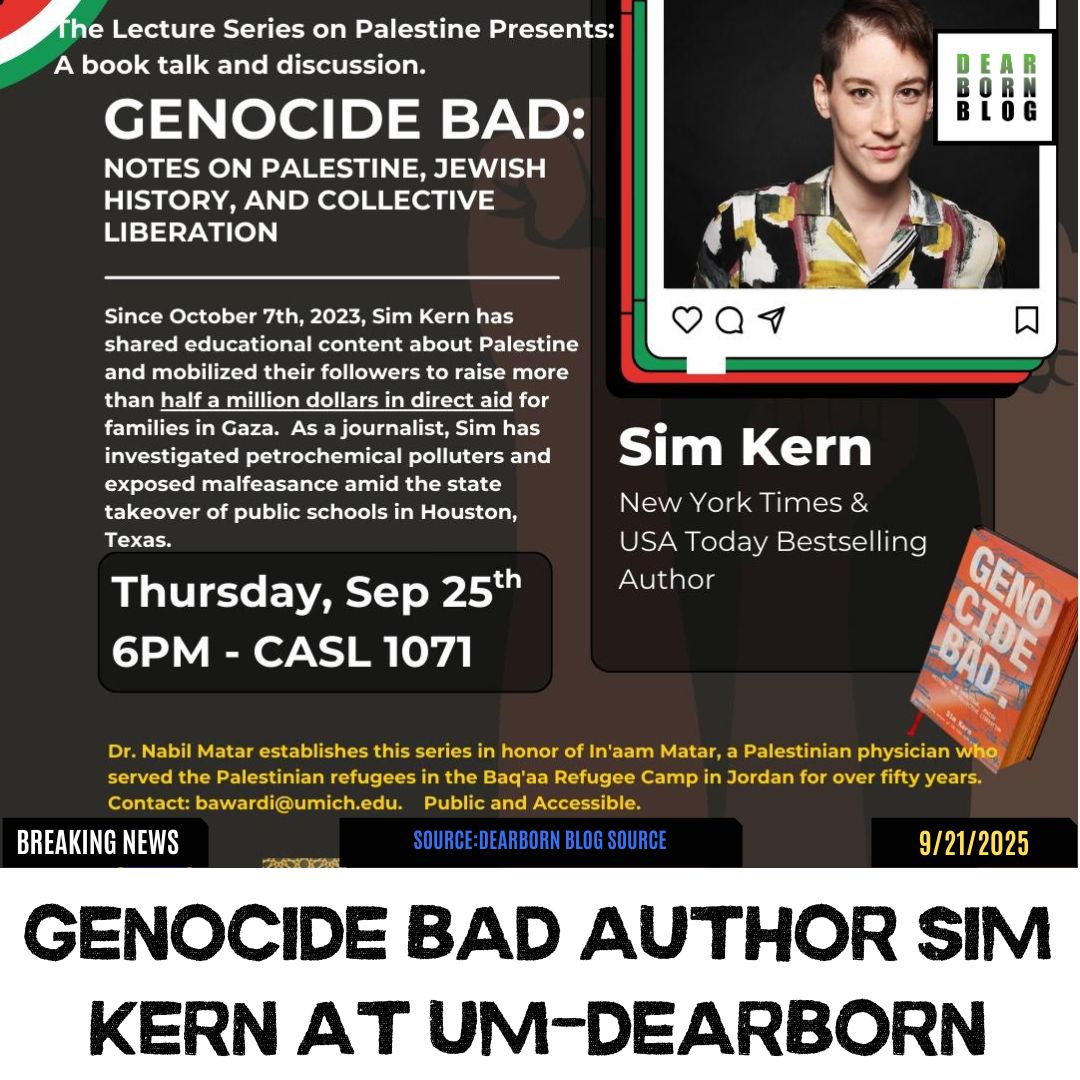
UM-Dearborn hosts Genocide Bad: Notes on Palestine, Jewish History, and Collective Liberation with bestselling author and journalist Sim Kern—a conversation shaped by the city of Dearborn’s Arab American majority, the University’s long-standing scholarship in Arab American studies, and the moral urgency of Palestinian human rights. The evening is organized as part of The Lecture Series on Palestine, curated locally by Dr. Hani J. Bawardi and established in honor of Dr. In’aam Matar, a Palestinian physician who served refugees in Jordan’s Baq’a camp for over half a century (per event materials). It’s an invitation to think clearly, argue honestly, and act with compassion.
Event Details
What: Genocide Bad: Notes on Palestine, Jewish History, and Collective Liberation — book talk and discussion with Sim Kern
When: Thursday, September 25, 6:00 PM
Where: UM-Dearborn, CASL 1071
Access: Public and accessible (per event announcement)
“Education is the slow art of changing what we think we already know.”
— Dearborn Blog editorial stance on civic learning
Why This Night Matters—in Dearborn, on Campus, and Beyond
Dearborn is not a neutral backdrop. It is the beating heart of Arab America, a place where global headlines reverberate as family stories. The Detroit Free Press reported that a majority of Dearborn residents identify as Middle Eastern or North African (MENA), reflecting a community for whom questions of war, displacement, and civil rights are not abstractions but living memory.[1]
Detroit Free Press
At the county level, Wayne County—home to Dearborn—has the highest MENA share of residents in the United States, according to the U.S. Census Bureau.[2]
Census.gov
UM-Dearborn’s campus has leaned into that reality for years: the Center for Arab American Studies (CAAS) anchors scholarship, community partnerships, and public programs that foreground Arab American histories and voices.[3]
University of Michigan-Dearborn
In the wake of the 2023–present Gaza crisis, the University even created spaces for collective reflection and art-making to help students process the war’s impacts—a model of academic care and civic pedagogy.[4]
University of Michigan-Dearborn
Against this backdrop, bringing Sim Kern to campus is not just another literary event. It’s a civic moment for Dearborn—an honest conversation about history, media literacy, and the ethics of solidarity.
About Sim Kern
Sim Kern is a New York Times and USA Today bestselling author whose latest book, Genocide Bad, is published by Interlink/Olive Branch Press. It’s described by the publisher as “part activist memoir, part crash course in Jewish and Palestinian history,” laying out ten essays that interrogate propaganda and argue toward collective liberation.[5]
Simon & Schuster
+1
Kern’s public voice is unusual in the U.S. media ecosystem: a Jewish, anti-Zionist writer who pairs historical analysis with organizing and mutual aid. Publisher and bookstore listings, along with the author’s official bio, note that since October 7, 2023, Kern has used their platforms to raise more than half a million dollars in direct aid for families in Gaza, while posting daily educational videos on Palestinian history and the politics of Zionism.[6–8]
Simon & Schuster
+2
Simon & Schuster
+2
Kern also founded the Trans Rights Readathon, a decentralized online action that raised more than $230k–$250k for trans-supporting organizations in its first year—proof that digital storytelling, when aimed at outcomes, can move resources as well as hearts.[9–10]
Trans Rights Readathon
+1
As a journalist, Kern has investigated petrochemical pollution and the failures of public oversight in Texas, writing for One Breath Partnership and other outlets.[11]
One Breath Partnership
That civic-science sensibility surfaces in their fiction, too, where climate, power, and community collide. At UM-Dearborn, Kern will speak about Genocide Bad and the broader stakes of teaching interconnected histories—Jewish, Palestinian, American—with clarity and care.
“History is not a weapon to win arguments; it is a mirror that asks who we are becoming.”
— From Dearborn Blog’s editorial notes on historical literacy
About Dr. Hani J. Bawardi
The evening is locally curated by Dr. Hani J. Bawardi, Associate Professor of History at UM-Dearborn and a leading scholar of Arab American political history.[12–13]
University of Michigan-Dearborn
+1
His book, The Making of Arab Americans: From Syrian Nationalism to U.S. Citizenship (University of Texas Press), tracks how early 20th-century organizations—like the Free Syria Society and the Institute of Arab American Affairs—shaped an evolving Arab American civic identity and pushed for representation long before 1967.[14]
University of Texas Press
Bawardi’s public work extends beyond the page. In 2022, UM-Dearborn profiled his successful efforts to help restore the historical record of America’s oldest Arabic-speaking settlement (on Washington Street, New York City), a project that secured $1.5 million to commemorate and educate—a reminder that cultural memory requires both scholarship and institution-building.[15]
University of Michigan-Dearborn
When Bawardi convenes a conversation, the goal is not performance; it’s pedagogy. Expect sharp questions on narrative framing, media responsibility, and how students can practice intellectual courage in polarized times.
A Series Rooted in Care: In Honor of Dr. In’aam Matar
Per the event announcement, The Lecture Series on Palestine is established by Dr. Nabil Matar in honor of Dr. In’aam Matar, a Palestinian physician who served refugees in the Baq’a camp in Jordan for more than fifty years. While details of Dr. In’aam Matar’s career remain largely preserved in family and community memory, the dedication is apt: the Matar name is tied to decades of scholarship and public lectures on Arab-European relations (see, for example, the University of Minnesota’s “Matar Family Lecture”).[16]
College of Liberal Arts
The point is simple: public learning matters. Honoring a physician who served displaced Palestinians connects the campus to a lineage of service and scholarship—medicine, history, literature—each a different language for saying “we owe one another care.”
What Genocide Bad Contributes
Publishers describe the book as a spanning, historically grounded set of essays that challenge common myths about Zionism, trace lines from biblical claims to modern policies, and insist that liberation is not a zero-sum game.[5]
Simon & Schuster
+1
That might sound hefty; that’s because it is. But the book is winning an audience for mixing archival rigor with online pedagogy—an accessible path for students who are new to the material and for community members who want to move past talking-point trench warfare.
“Decency is not partisan. Opposing mass death and dispossession is the floor of moral life.”
— Dearborn Blog
The Dearborn context matters here. Local families have relatives in Gaza and the West Bank; grief and solidarity circulate at grocery stores, mosques, churches, and soccer fields. National outlets have documented how Dearborn residents have organized protests, demanded a ceasefire, and pushed elected officials to align policy with humanitarian law and basic human rights.[17–18]
AP News
+1
A campus event that treats Palestinian history seriously is not controversial here; it is educational due diligence.
Snapshot: The Civic Context
Community & Campus by the Numbers
- 54.5% of Dearborn residents identify as MENA—America’s highest city share.[1]
- Wayne County holds the highest MENA percentage of any U.S. county.[2]
- UM-Dearborn maintains a Center for Arab American Studies, sustaining research, teaching, and public programs.[3]
What Greens Will Notice
Dearborn Blog’s editorial stance is pro-human rights, pro-peace, and pro-democracy—principles at the core of the Green Party platform. Events like this align with that tripod:
Grassroots democracy: Honest history empowers citizens to judge policy—not by party spin, but by evidence and ethics.
Social justice and equal opportunity: When communities living the aftershocks of war speak, the fair response is to listen and support material dignity—housing, healthcare, education.
Ecological wisdom: Kern’s climate reporting reminds us that environmental harm and militarized extraction often travel together; a livable world requires demilitarization and environmental justice.[11]
One Breath Partnership
Greens should read Genocide Bad, ask hard questions, and support campus forums that refuse to collapse complexity into slogans.
What to Expect at the Talk
Historical clarity. Kern’s essays braid Jewish histories, Palestinian experiences, and the modern state’s policies without dehumanizing anyone.
Media literacy. How to navigate viral narratives, disinformation, and the tug of identity politics.
Mutual aid as praxis. Kern’s fundraisers and the Trans Rights Readathon model how online communities can move resources where institutions fail.[6–10]
PublishersWeekly.com
+4
Simon & Schuster
+4
Simon & Schuster
+4
Local stakes. With Dearborn’s demographics and UM-Dearborn’s academic infrastructure, conversations here ripple nationally.
“Universities are where plural histories become shared futures.”
— Dearborn Blog
How This Advances Learning at UM-Dearborn
The Lectures on Palestine have appeared in CAAS programming archives and partner groups’ flyers, reflecting a continuing campus practice of public education on the region’s histories and current events.[19]
University of Michigan-Dearborn
Whether students take POL 385: Israeli-Palestinian Conflict or encounter these topics in humanities classes, UM-Dearborn frames learning as a civic craft—reading sources, testing claims, and building arguments without erasing human suffering.[20]
Coursicle
That is the kind of university Dearborn deserves: one that puts curiosity before tribalism, data before demagoguery, and neighborliness before nihilism.
If You Go
Arrive early. Seating in CASL 1071 is limited.
Bring questions. Ask about sources, historiography, and how students can responsibly use social media to amplify credible information.
Support local orgs. If you are moved by the discussion, donate to aid groups vetted by campus/community partners.
Read more. Start a study circle around Genocide Bad and The Making of Arab Americans; compare notes with courses in history, political science, and religious studies.[5,14]
Simon & Schuster
+2
Interlink Books
+2
Sources
Niraj Warikoo, “Arab Americans now a majority in Dearborn, new census data shows,” Detroit Free Press, Sept. 26, 2023. https://www.freep.com/story/news/local/michigan/wayne/2023/09/26/arab-americans-now-a-majority-in-dearborn-new-census-data-shows/70929525007/
Detroit Free Press
U.S. Census Bureau, “2020 Census: 3.5 Million Reported Middle Eastern and North African Population,” Sept. 21, 2023. https://www.census.gov/library/stories/2023/09/2020-census-dhc-a-mena-population.html
Census.gov
UM-Dearborn Center for Arab American Studies (program overview and contacts). https://umdearborn.edu/casl/centers-institutes/center-arab-american-studies
University of Michigan-Dearborn
UM-Dearborn News, “Coming together to understand the Middle East crisis,” Nov. 6, 2023. https://umdearborn.edu/news/coming-together-understand-middle-east-crisis
University of Michigan-Dearborn
Interlink/Olive Branch Press publisher page for Genocide Bad; Simon & Schuster distributor page. https://interlinkbooks.com/product/genocide-bad-deluxe-edition/
; https://www.simonandschuster.com/books/Genocide-Bad/Sim-Kern/9781623716363
Interlink Books
+1
Simon & Schuster — Author Page: Sim Kern (bio noting $500k+ direct aid raised for Gaza). https://www.simonandschuster.com/authors/Sim-Kern/231725022
Simon & Schuster
Simon & Schuster — Book Page: Genocide Bad (description mentioning $500k+ raised). https://www.simonandschuster.com/books/Genocide-Bad/Sim-Kern/9781623716363
Simon & Schuster
Charis Books & More event listing for Sim Kern (reiterating $500k+ figure). https://charisbooksandmore.com/book/9781623716363
Charis Books and More
Trans Rights Readathon official site/FAQ (founded by Kern; totals). https://transrightsreadathon.carrd.co/
Trans Rights Readathon
Publishers Weekly, “Author Sim Kern Launches #TransRightsReadathon,” Mar. 20, 2023. https://www.publishersweekly.com/pw/by-topic/industry-news/trade-shows-events/article/91797-author-sim-kern-launches-transrightsreadathon.html
PublishersWeekly.com
One Breath Partnership, author page and reporting by Sim Kern on petrochemical oversight. https://onebreathhou.org/authors/sim-kern/
One Breath Partnership
UM-Dearborn Social Sciences Faculty Page (Bawardi appointment and teaching areas). https://umdearborn.edu/casl/departments/social-sciences/faculty-staff
University of Michigan-Dearborn
UM-Dearborn Profile: Hani Bawardi (faculty bio). https://umdearborn.edu/people-um-dearborn/hani-bawardi
University of Michigan-Dearborn
University of Texas Press, The Making of Arab Americans: From Syrian Nationalism to U.S. Citizenship (2014). https://utpress.utexas.edu/9781477307526/
University of Texas Press
UM-Dearborn News, “Professor preserves Arab American stories by restoring forgotten history,” Feb. 28, 2022. https://umdearborn.edu/news/professor-preserves-arab-american-stories-restoring-forgotten-history
University of Michigan-Dearborn
University of Minnesota, “Matar Family Lecture 2024.” https://cla.umn.edu/asian-middle-eastern-studies/news-events/events/matar-family-lecture-2024
College of Liberal Arts
AP News, “Biden aides meet in Michigan with Arab American and Muslim leaders,” Feb. 2024 (Dearborn context). https://apnews.com/article/5bf3f88529d625a129e786bab29c4fde
AP News
The Guardian, “Arab Americans in Dearborn are resilient in the face of Islamophobia,” Feb. 11, 2024. https://www.theguardian.com/us-news/2024/feb/11/unlike-911-were-fighting-back
The Guardian
Suggested Citation (for blogs/newsletters)
“Genocide Bad at UM-Dearborn,” Dearborn Blog, September 2025.
Disclaimer
This article is provided for educational and informational purposes only. Event details are based on publicly available announcements and organizer materials. Views expressed herein reflect the author’s analysis and the editorial voice of Dearborn Blog. This article does not constitute legal advice or an official position of the University of Michigan–Dearborn or any event sponsor. All external facts are attributed to their sources; readers should consult original documents for the most current information.
Closing Note: From Dearborn to the World
Dearborn’s civic culture is not a spectator sport. It is a community habit: show up, listen, challenge, learn. An evening with Sim Kern—hosted by UM-Dearborn, powered by Dr. Bawardi’s scholarship, and dedicated to the memory of Dr. In’aam Matar’s lifetime of service—reminds us why universities exist: to make room for the hard conversations that push us toward justice. In a city where diaspora pain and hope share a sidewalk, that kind of learning is not optional; it’s our common work.

 Dearborn Blog