

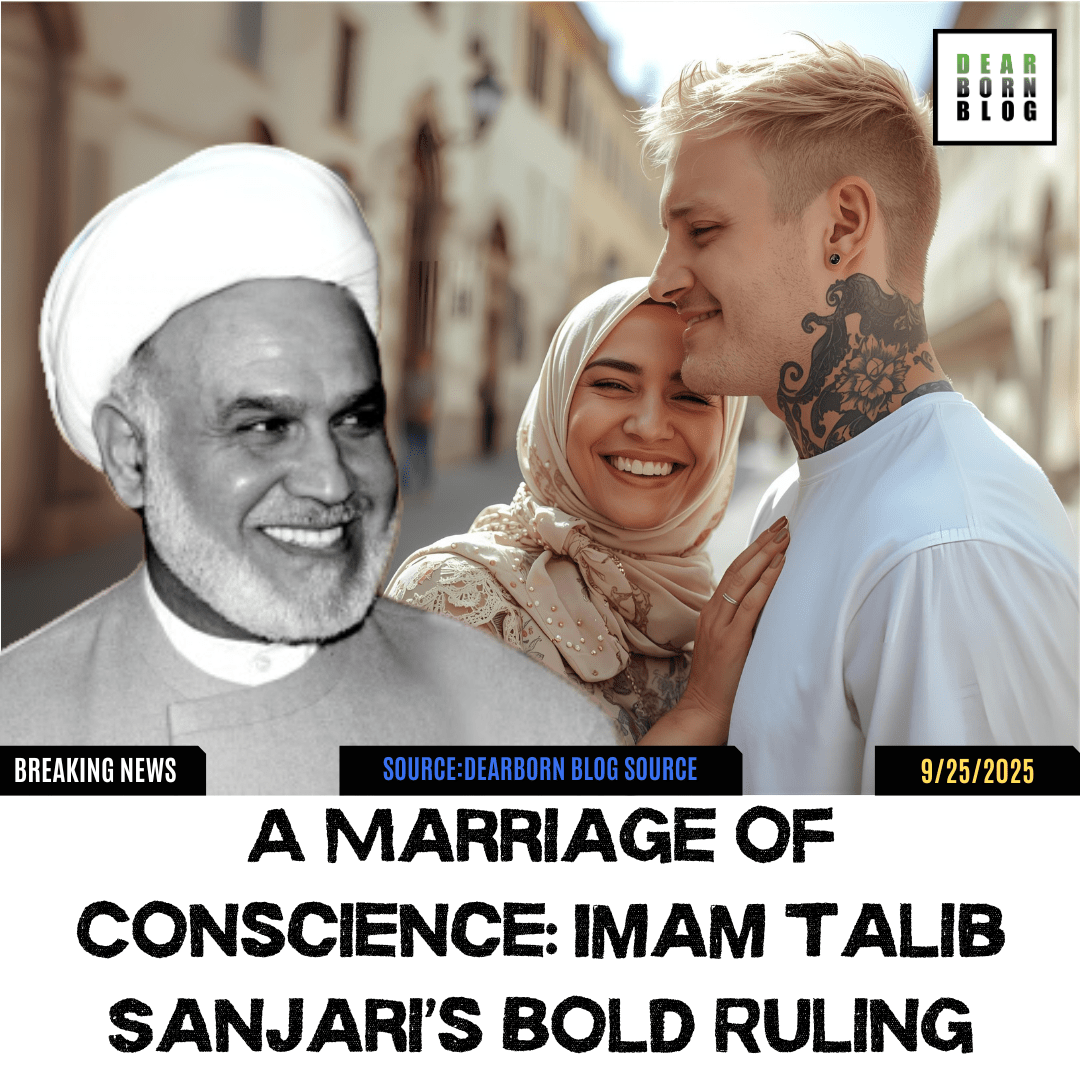
In Dearborn’s living rooms and lecture halls, a quiet revolution is underway: Imam Talib Sanjari—a classically trained Iraqi cleric who settled among us—has argued that a Muslim woman may marry a non-Muslim man when justice, dignity, and today’s plural civic realities are honored. His stance challenges a centuries-long consensus, ignites serious debate, and calls us back to a Qur’anic ethic rooted in reason and public good. This essay maps the terrain—what Sanjari actually says, what mainstream institutions still hold, how law and lived life have shifted, and why Dearborn’s conversation matters for human rights and Green values. [1]
Dearborn isn’t just a dot on a map; it’s a living laboratory where faith, freedom, and pluralism bump shoulders at the coffee line. So when an imam right here—Imam Talib Sanjari—uses the tools of classical learning to issue a radically contemporary judgment (fatwa) on interfaith marriage, people notice. Specifically, he supports the validity of a Muslim woman marrying a non-Muslim man under today’s conditions, arguing that the Qur’an’s spirit and the public interest (المصلحة) require us to distinguish between ancient wartime contexts and our modern civil rights order. The record is clear: in an interview conducted in Dearborn and published by Raseef22 in 2017, Sanjari affirms this position as part of a broader project to recalibrate Islamic jurisprudence with reason and justice at the helm. [1]
To grasp the stakes, we need both the telescope and the microscope. The telescope: how Muslim legal traditions reached their long-standing consensus that women may not marry outside the faith. The microscope: how Sanjari and a small circle of reform-minded scholars say the facts on the ground have changed, and therefore so must our rulings.
“Sanjari supports a Muslim woman marrying a non-Muslim … and rejects gender-unequal inheritance, appealing to ‘for them are rights similar to those upon them in kindness’.” [Short excerpt from Arabic article, translated.] [1]
That line—reported and attributed—summarizes the pivot: a method, not just a verdict. He’s not waving away the Qur’an; he’s re-opening the door of how rulings are derived from it in light of context, purpose, and harm-benefit analysis.
The classical position—and why it dominated
Mainstream institutions—from Al-Azhar and Egypt’s Dar al-Ifta to well-known Sunni and Shi‘i jurists—continue to declare that a Muslim woman’s marriage to a non-Muslim man is impermissible. Their reasoning typically cites two Qur’anic anchors: 2:221 (prohibiting marriage with “polytheists”) and 60:10 (separating believing women from their non-Muslim husbands in a wartime migration scenario), alongside concerns about religious guardianship and children’s religious identity. [10][13][20][15]
- Dar al-Ifta (Egypt) publishes multiple advisories asserting prohibition and explaining it through notions of guardianship and mutual religious respect. [13][7]
- Al-Azhar leadership has repeatedly reaffirmed the ban in public statements when the topic resurfaces in media debates. [20]
- Major fatwa websites and classical fiqh manuals enshrine what’s often described as ijmā‘ (consensus). [15]
Even the European Council for Fatwa and Research (ECFR)—known for pragmatic “minority fiqh”—has not issued a blanket permission for initiating such marriages. At most, it historically allowed newly converted women in Europe to remain with their non-Muslim husbands to protect family stability—a status-quo mercy, not a green light to start such unions. [14]
So yes, the center of gravity in the inherited tradition is prohibition.
The reformist counter-case—what’s actually new
Sanjari’s argument—documented in that Dearborn interview—says the subject-matter has changed: we no longer live in warring confessional blocs where a woman’s marriage equates to defection from the political camp of Islam. In civil democracies with constitutional rights, coercion is outlawed, women’s legal agency is recognized, and religious minorities aren’t by definition hostile. In that world, he says, the older basis for a ban no longer applies. [1]
He frames it this way (summarizing the interview’s thrust):
- The Qur’an forbids marriages that would materially imperil a believer’s faith and rights; in the Prophet’s city-state, crossing into a militant enemy camp did exactly that.
- Today, interfaith marriages unfold inside legal systems that protect a woman’s beliefs, property, and safety. The feared harms aren’t structurally baked in.
- Therefore, public interest and equality before the law should guide a new derivation—keeping faith with the Qur’an’s justice goals, not just medieval applications. [1]
This method resonates with a broader current of Muslim reformers in North America and Europe. Organizations like Muslims for Progressive Values (MPV) actively solemnize interfaith unions—including those of Muslim women—arguing there’s no unequivocal Qur’anic ban and that pastoral practice should serve human dignity, consent, and fairness. [1][4][6][12] That’s not a traditional fatwa council, but it is a living practice that many Muslim families in the diaspora recognize.
Meanwhile, law itself is evolving. In 2017 Tunisia abolished its civil restrictions on Muslim women marrying non-Muslims, advancing equal citizenship while leaving religious institutions free to teach their views. [9][15] Civic law and sacred law aren’t the same species—but when law moves, lived reality does, too.
A Dearborn conversation with global consequences
Dearborn is where theory meets breakfast. Marriages, custody, healthcare proxies, inheritance, immigration paperwork—real people need real rulings that do not break families. It’s unsurprising, then, that Sanjari’s perspective emerged here, in a city that’s both deeply Muslim and profoundly American. [1]
“The Qur’anic law is not every word between two covers; it is the principles fit for our time… Reason and benefit must govern derivation.” [Short excerpt, translated.] [1]
Wissam Charafeddine and the IRSHAD network add a complementary note. In Irshadiyat (Book and Arabic series), Charafeddine summarizes the Sanjari approach: the Qur’anic ban targeted a specific political-military reality (hostile camps). Where that reality is gone, the ruling shifts with the subject’s change—a bedrock usūl principle. He argues that a woman’s Islam is her own, not her husband’s; children choose faith as moral agents; the parents’ duty is teaching ethics and critical reason, not coercing belief. (Translated summary based on the book’s presentation.) [3]
Let’s be honest: this is not the mainstream. But it is intellectually serious, textually engaged, and morally focused on reducing harm—exactly the sort of debate cities like ours should welcome.
Numbers to keep in mind
- 2017: Tunisia ended its civil ban on such marriages, signaling a regional legal shift toward equal citizenship. [9][15]
- 2:221: Often cited verse on “polytheists” in marriage; reformers argue context matters and “People of the Book” aren’t the same category. [10]
- 1 city: Dearborn—where Sanjari articulated his method publicly, anchoring the debate in local reality. [1]
What critics get right—and what they miss
Critics warn that interfaith marriages can create household conflicts, pressure over children’s religious identity, and a subtle power imbalance that jeopardizes a woman’s practice. Those risks are real and deserve frank pastoral planning. Traditional jurists also remind us that texts on guardianship (wilāya) and household religious leadership come into play—hence the classical caution. [13][20][15]
But risk isn’t destiny. In a rights-based order with enforceable contracts, a woman can—if she wishes—build in non-coercion clauses, holiday accommodations, dispute resolution mechanisms, and financial protections. Those instruments did not exist (or weren’t enforceable) in the pre-modern settings that shaped early rulings.
Moreover, the ECFR’s mercy clause—allowing a convert to remain with her non-Muslim husband—already cracks open the door. If the goal is family stability and harm reduction, and if the woman’s conscience and practice are intact, then the logic that keeps an existing marriage could—under certain conditions—support initiating one as well. That’s Sanjari’s wager. [14]
A Green, pro-rights framing
Dearborn Blog is unapologetically pro-human rights, pro-Palestine, and pro-Green Party values—democracy, social justice, ecological wisdom, and nonviolence. That translates here into four actionable commitments:
- Conscience and Consent. Adults choose whom to marry. Coerced uniformity isn’t piety; it’s politics in clerical dress.
- Equality before the law. If a Muslim man can marry outside the faith, parity for Muslim women is the ethical default unless clear, present harm is proven, not presumed.
- Care for the vulnerable. Pastoral practice should prevent loneliness, legal limbo, and family fracturing. That’s why realistic contracts and community support matter.
- Context-aware fiqh. When facts change, rulings change—without abandoning the Qur’an’s moral grammar. That’s not “watering down”; it’s intellectual honesty.
This isn’t about “East vs. West.” It’s about living truthfully within the world we actually inhabit—one where Muslims are neighbors, coworkers, spouses, and citizens among other communities, including in Dearborn.
What couples—and mosques—can do tomorrow morning
- Know the texts. Read Qur’an 2:221 carefully in context; consult diverse tafsīr; understand the classical proof-texts and the reformist counters. [10]
- Map the law. If you’re in Michigan, your civil marriage secures rights; religious ceremonies are pastoral. Distinguish legal from liturgical.
- Contract clearly. Spell out religious holidays, dietary respect, children’s ethical education, and dispute resolution.
- Seek credible counsel. Traditional or reformist, pick a counselor who is transparent about method and willing to put harm-reduction first.
- Don’t romanticize. Interfaith marriages are as beautiful and as hard as any other. Love is not a substitute for logistics.
Where Dearborn goes from here
The old juristic consensus isn’t going to evaporate because an imam in Dearborn wrote a book or gave an interview. Nor should it; living traditions need loyal opposition, not burning of libraries. But our city, with its stubborn hospitality and civic muscle, is precisely the place to model respectable disagreement—to let couples own their conscience, to let scholars argue cleanly, and to keep the doors open.
In that spirit, Imam Talib Sanjari’s fatwa is not a demand; it’s an invitation—to study harder, to center justice, to treat women as full moral agents, and to make our religious conversation at least as modern as our mortgage paperwork.
“The goal is not to change the Qur’an; it’s to change how we derive rulings so they serve reason and benefit.” [Short excerpt, translated.] [1]
At the end of the day, Dearborn’s voice matters because Dearborn lives the question. We champion human dignity at home and abroad; we stand with peoples under siege; we push our politics to be greener, fairer, and less cruel. That same energy can animate our internal debates: less fear, more courage; fewer shibboleths, more substance.
If a marriage is built on mutual respect, explicit fairness, and a shared civic horizon, then it deserves our blessing—or at least our non-interference. That’s not a Western idea. That’s a Dearborn idea.
Sources
[1] Raseef22 – “Thawrat al-‘Aql ‘alā al-Turāth al-Islāmī… Tajribat al-Shaykh Talib al-Sanjari” (interview conducted in Dearborn; Sanjari supports a Muslim woman’s marriage to a non-Muslim; outlines method based on reason/public interest). Published Nov 9, 2017. https://raseef22.net/article/126389. رصيف22
[2] Dar al-Ifta (Egypt) – “A non-practicing Muslim woman marrying a non-Muslim man” (advice acknowledging prohibition; pastoral guidance on existing cases). https://www.dar-alifta.org/en/fatwa/details/10645. موقع دار الإفتاء المصرية
[3] Dar al-Ifta (Egypt) – “Why a Muslim woman can’t marry a non-Muslim?” (doctrinal explanation of the prohibition). https://www.dar-alifta.org/en/fatwa/details/6167. موقع دار الإفتاء المصرية
[4] The New Arab – Coverage of Al-Azhar controversy (2020) clarifying that Al-Azhar and Dar al-Ifta maintain prohibition. Nov 20, 2020. The New Arab
[5] Quran.com – 2:221 (often cited verse on marrying “polytheists”). https://quran.com/en/al-baqarah/221. Quran.com
[6] Dialogue Across Borders – Report on ECFR allowance for a convert woman to remain with her non-Muslim husband (status-quo, not initiation). 2001. dialogueacrossborders.com
[7] Al Jazeera – “Tunisia lifts ban on Muslim women marrying non-Muslims.” Sep 14, 2017. Al Jazeera
[8] France 24 – “Tunisia ends ban on Muslim women marrying non-Muslims.” Sep 14, 2017. France 24
[9] IslamWeb (Fatwa) – Representative classical view describing consensus on prohibition. Islamweb
[10] Muslims for Progressive Values (MPV) – Marriage services and practice solemnizing interfaith unions (including Muslim women). https://www.mpvusa.org/marriage-services; https://www.mpvusa.org/interfaith-families-1; curated media on interfaith marriage. mpvusa.org+2mpvusa.org+2
[11] Irshadiyat – Series page by Wissam Charafeddine noting the book project and context for the reformist methodology summarized above. https://wissamc.com/speaker/islamandsecularism/irshadiyat/. Wissam Charafeddine
Notes on quotations and translations
- Arabic quotations from [1] are excerpted and translated by Dearborn Blog for brevity. Direct quotes are kept short to respect fair-use limits.
- The discussion of Irshadiyat [11] summarizes an argument presented in Arabic; readers are encouraged to consult the original work for fuller context.
Disclaimer
Dearborn Blog is a community platform for news, ideas, and dialogue. The views expressed here synthesize and analyze publicly available sources for informational purposes only and do not constitute religious, legal, or counseling advice. Individuals should consult trusted advisors—religious and legal—before making personal decisions. We strive for accuracy but cannot guarantee completeness; please follow the links and read in context. We welcome respectful corrections and additions from readers and scholars.

 Dearborn Blog