

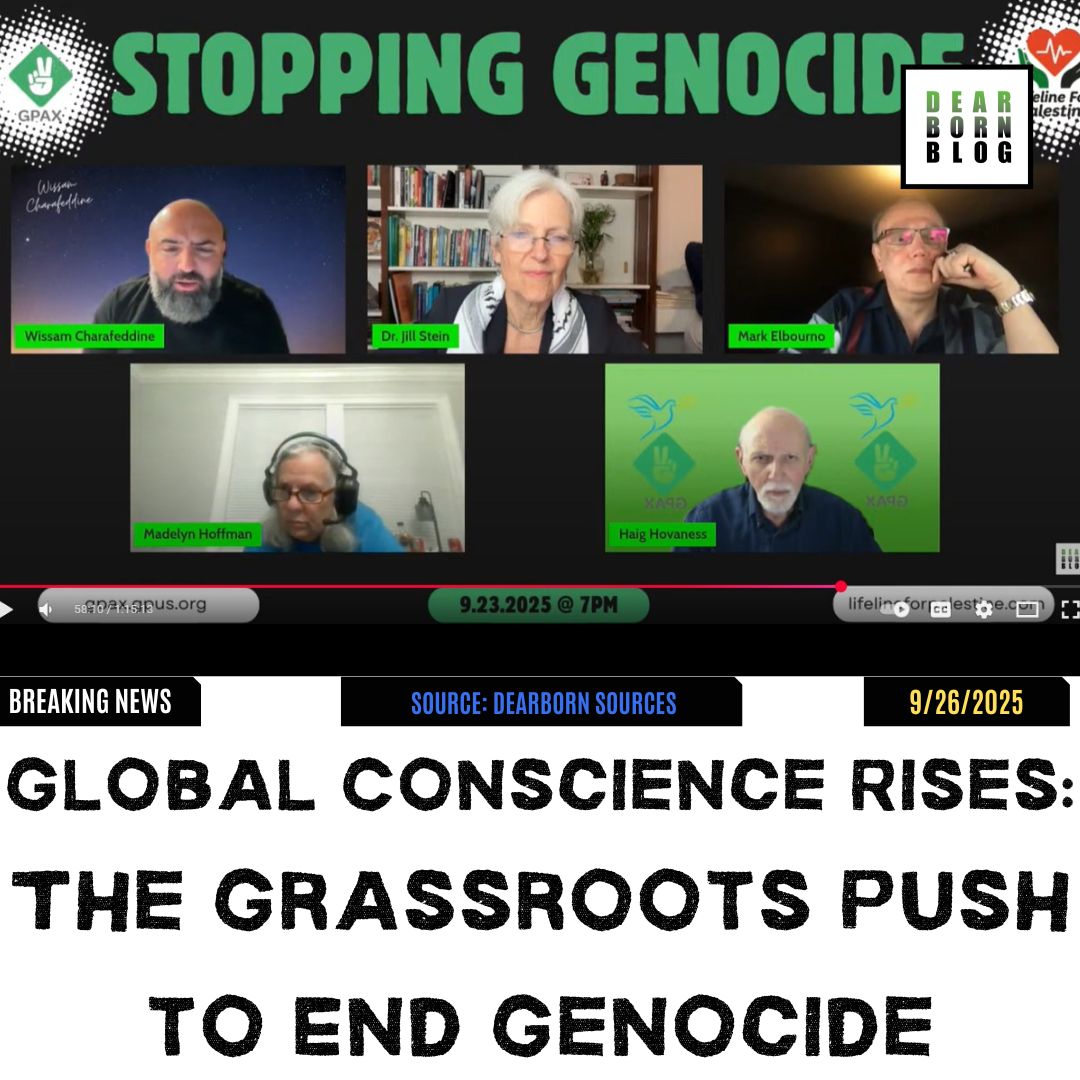
Excerpt: As the world watches the unfolding catastrophe in Gaza, the silence from mainstream Western powers is being shattered by a powerful, multi-pronged effort led by the Global South and principled political movements. The Green Party, in partnership with Palestinian-led advocacy groups, is spearheading a concrete, veto-proof plan at the United Nations to deploy a multinational Protection Force and finally hold perpetrators accountable. This is the moment for Dearborn’s moral clarity to lead the way and join a worldwide chorus demanding action, not symbolism.
The battle for Palestinian human rights has reached a pivotal moment in the halls of global power. For too long, the US veto at the United Nations Security Council has functioned as an impenetrable shield, safeguarding the machinery of ethnic cleansing and military occupation in Gaza and the West Bank [2]. Yet, in a recently held urgent briefing, “Stopping Genocide — An Urgent Briefing & Action Hour,” organized by the Green Party Peace Action Committee (GPACS) and the Lifeline for Palestine coalition, speakers laid out a clear, actionable pathway to bypass this institutional block and fundamentally alter the geopolitical calculus. This is not merely symbolic diplomacy; this is a direct, concrete campaign to deploy a protective force and enforce international law.
The Deafening Silence vs. The Moral Imperative
The core of the issue, as speakers emphasized, is the deliberate complicity of the political establishment. Wisam Charafeddine, a leader in the nascent Arab-American and Muslim-American caucus, powerfully captured this betrayal:
“Silence in the face of genocide is not the absence of noise; it is the loudest calamity of our time… The calamity of silence is not neutral; it is complicit. Each unspoken word becomes mortar in the wall of occupation” [1].
This “deafening silence” from the two dominant US parties stands in stark contrast to the historical stance of the Green Party, which, as an institution “from the people to the people,” has consistently recognized the current catastrophe as a settler-colonial project fueled by billions in American tax dollars [1]. The money that could be building schools in Detroit or hospitals in desperately needed areas of the United States is instead “transformed into missiles raining on Gaza’s children” [1].
This moral chasm defines the urgency of the moment. For Dearborn, a community historically rooted in peace and justice advocacy, this clarity resonates deeply. The failure of status-quo politics to heed the overwhelming humanitarian and moral crisis demands that citizens turn to third-party movements committed to principles over corporate or imperial expediency.
Uniting for Peace: The Veto-Proof Strategy
The most significant element of the emerging global action is the proposed use of the UN General Assembly’s Uniting for Peace resolution. This mechanism is the international community’s tool to circumvent the paralysis caused by a Security Council veto, particularly when that veto is used by a permanent member to shield itself or an ally from accountability in an act of aggression or mass atrocity [2].
First adopted during the 1956 Suez Crisis to compel the withdrawal of French, British, and Israeli forces, Uniting for Peace allows the General Assembly to recommend collective measures, including the use of armed force or a protection force, if the Security Council fails to act on a threat to international peace. Critically, resolutions passed under this mechanism require only a two-thirds majority in the General Assembly, where the United States possesses only a single vote.
The urgency of this move is underpinned by international judicial processes. A year ago, the UN General Assembly passed a resolution demanding Israel comply with an International Court of Justice (ICJ) ruling and end its occupation and genocidal acts within one year. That deadline expired on September 18, 2025. With that deadline breached, the moral and legal basis for the General Assembly to take decisive, enforceable action is now indisputable. The Global South is not waiting for US approval; they are moving to enforce international law [4].
Petro’s Call: A Powerful Army for Protection
The necessary political sponsorship for this resolution has arrived from a powerful voice of the Global South: Colombian President Gustavo Petro. Speaking at the UN General Assembly, Petro confirmed his intent to sponsor a resolution calling for a Protection Force [3].
This proposal is explicit: it is not for the symbolic “Blue Helmets,” who often operate under the constraints of the Security Council and lack necessary training or authority. Instead, Petro called for the creation of a:
Powerful Army of Countries that Do Not Accept Genocide
Petro’s demand is for a force deployed under the Uniting for Peace mechanism, meaning it would operate with the consent of Palestine and be focused on three immediate objectives:
Protecting Palestinian Civilians: Creating safe zones and securing population centers from continued assault.
Ensuring Aid Delivery: Opening humanitarian corridors by land and sea, and securing the flow of food, water, and medicine under UN oversight.
Preserving Evidence: Documenting war crimes and preparing the ground for future international accountability [1].
The call to action is clear: the grassroots must now apply “pressure on UN representatives” to ensure the resolution not only passes but includes the crucial element of a physical Protection Force [1].
From Gaza to Dearborn: Mark Alboro’s Lifeline
The Lifeline for Palestine initiative, a key organizer of the urgent briefing, embodies the deep, personal connection between the crisis abroad and the Arab-American community here in Dearborn. Mark Alboro, Treasurer of the US Green Party and a co-founder of the Arab-American and Muslim-American Caucus, shared his powerful, heartbreaking personal story. As a person originally from Gaza, the current events are not abstract—they are fundamentally personal.
“I couldn’t actually stay silent… I’m originally from Gaza. So what’s happening right now in Gaza is not something I feel bad for them or or I feel sympathy or empathy for for them. This is home. This is where my parents were born, this is where my grandparents were buried, this is where my cousin lives. So it hits home to me” [1].
Alboro’s political awakening, catalyzed by the catastrophe in 2023, led him to the Green Party, a political home that was “fighting my fight before I even woke up to fight it” [1]. This commitment, deeply rooted in the anguish of a son of Gaza, is precisely the kind of principled, uncompromising action that the Dearborn community champions.
The Arab and Muslim-American population of Dearborn has historically been an engine of political discourse and a crucible for principled political opposition. When the two major parties abandon universal human rights, the moral urgency of the moment compels this community to seek out political vessels, like the Green Party, that align with their core values of justice and peace. The existence of the Arab-American and Muslim-American Caucus within the Green Party highlights a critical realignment: the party platform’s deep-seated anti-militarism and commitment to international law has made it a natural ally for a community that sees the direct, devastating impact of US foreign policy.
680,000
Deaths claimed in Gaza, according to one figure cited in the briefing, underscoring the scale of the “modern-day holocaust” [1].
Rejecting Symbolic Distractions
The speakers at the briefing were quick to caution against performative gestures that offer political cover without saving lives. While a number of nations—including France, the United Kingdom, and others—have recently moved to formally recognize the State of Palestine, this symbolic recognition is deemed insufficient and potentially a distraction from the immediate need to halt the killing.
As Dr. Jill Stein noted, recognition “is important, it needs to happen, it should have happened a long time ago, but it’s being used now to distract from actual… traction on the ground” [1].
The same skepticism was applied to the latest Saudi-French proposal for a “temporary international stabilization mission.” Advocacy groups have accurately nicknamed this counter-proposal a “genocide stabilization force,” arguing that a “stabilization” effort that fails to secure civilian life or dismantle the structures of occupation is merely an attempt to contain the crisis until the genocidal project is complete [1].
The only way forward, endorsed by the Palestinian NGO Network (PINGO) and the Green Party, is the full enforcement of international law through the Uniting for Peace Resolution, including the deployment of a Protection Force, along with comprehensive sanctions, a complete military embargo on Israel, and the establishment of a war crimes tribunal [4, 5].
The Global South Coalition: The Hague Group
The push for a UN Protection Force is not an isolated Green Party platform point; it is the culmination of organized solidarity across the Global South. This international coalition, known as The Hague Group, was inaugurated in early 2025 and comprises over 30 countries, including powerhouses like South Africa, Colombia, Bolivia, Malaysia, and Turkey [4].
The Hague Group is committed to translating international legal obligations into coordinated diplomatic and legal action. Their foundational document calls for:
Upholding UN resolutions demanding an end to occupation.
Preventing the transfer of military aid and arms to Israel.
Prohibiting vessels suspected of carrying military cargo to Israel from docking at their ports [4].
This coalition, with its immense political and economic leverage, provides the necessary backbone to support the Protection Force resolution. Their collective voice has the two-thirds majority needed in the General Assembly, ensuring that the will of the majority of the world’s nations is not thwarted by a single, powerful veto.
Dearborn’s Global Leadership
The entire movement, from the Green Party’s principled stand to Petro’s UN sponsorship, aligns perfectly with the political identity and moral foundation of the Dearborn community.
Dearborn has long stood as a national focal point for Arab-American identity, political mobilization, and peace activism. The struggle to achieve justice for Palestine is not an abstract foreign policy issue here; it is the central organizing principle for thousands of families whose heritage and sense of global justice are directly engaged. The briefing highlighted that this grassroots action is what ultimately holds political leaders accountable [1].
This is the time for Dearborn to leverage its moral authority. The political energy that drives local and regional activism must be channeled into the precise international mechanism detailed in the Green Party briefing:
Mobilize for the Vote: Citizens must contact their UN missions, particularly those from countries that have historically voted with the majority in the General Assembly, and demand they actively support Colombia’s Uniting for Peace resolution for a Protection Force.
Reject Complicity: Continue to hold local, state, and national political figures accountable for their complicity in funding or providing diplomatic cover for the ongoing genocide, as the Green Party has done.
Amplify Lifeline: Use the extensive community networks in Dearborn to amplify the Lifeline for Palestine campaign, ensuring that the global grassroots effort has the necessary political pressure and visibility.
The voice of Dearborn is a voice that rejects the convenience of silence and the corruption of selective morality. It is a voice that understands, intimately, the cost of imperialism and colonialism. When Mark Alboro speaks of Gaza being “home,” he speaks for a sentiment shared across Detroit and Dearborn. This is the moment to transform that righteous outrage into concrete political action. By joining the Green Party and the Global South in this urgent demand for a Protection Force, Dearborn can help ensure that the UN General Assembly fulfills its mandate and finally brings the machinery of genocide to a decisive halt. The path to Free Palestine is the path to freeing us all [1].
Source List and Citations
The following sources were used for this article, detailing the political, legal, and personal dimensions of the movement to stop the genocide in Gaza.
[1] Video Recording and Transcript:
Title: Stopping Genocide — An Urgent Briefing & Action Hour
Channel: Dearborn Blog
Source URL: http://www.youtube.com/watch?v=RLWkwI93P70
Speakers & Key Timestamps: Wisam Charafeddine (00:09:07-00:10:17), Mark Alboro (00:19:24-00:20:03), Dr. Jill Stein (00:30:54-00:32:09, 01:11:18-01:12:08).
[2] Legal Analysis of Uniting for Peace:
Title: Uniting for Peace in Gaza: A Test for the General Assembly
Source: Opinio Juris
Publication Date: September 17, 2025
URL Context: Analyzes the legal precedent of Resolution 1001 (ES-I) during the 1956 Suez Crisis and the subsequent UN peacekeeping force, arguing for the General Assembly’s authority to recommend a peace operation.
[3] Colombian President Gustavo Petro’s UN General Assembly Speech:
Title: Colombia | General Debate (80th Session of the UN General Assembly)
Source: United Nations General Debate Press Release (GA/12709)
Publication Date: September 23, 2025
URL Context: Confirms President Petro’s call for a General Assembly vote to establish a non-Blue Helmet “peacekeeping force” of countries that reject genocide.
[4] The Hague Group and Global South Coalition:
Title: The Hague Group: Global South Nations Unite for Palestine
Source: Human Rights Research Center
Publication Date: February 6, 2025
URL Context: Describes the formation of the coalition, including Colombia, South Africa, and others, and their collective pledge to enforce international law, prohibit arms transfers, and support the ICJ case against Israel.
[5] Lifeline for Palestine and NGO Network Advocacy:
Title: The Hague Group’s proposals, not hollow recognition of Palestine statehood, are the way forward
Source: The Arab Weekly
Publication Date: August 19, 2025
URL Context: Supports the concrete action proposals of The Hague Group over symbolic recognition, reinforcing the PINGO network’s rejection of “hollow declarations” and calls for tangible action to end impunity.
[6] UN Human Rights Council/Genocide Findings and Two-State Efforts:
Title: As the world frets over Palestine’s status, Israel flattens Gaza
Source: The Washington Post
Publication Date: September 19, 2025
URL Context: Provides context on the UN commission finding “clear evidence that Israel has committed genocide in Gaza,” and details the debate over the effectiveness of the French/Saudi two-state initiative versus real action on the ground.
[7] UN General Assembly Two-State Resolution:
Title: U.N. General Assembly overwhelmingly votes for a two-state solution to the Israel-Palestinian conflict
Source: CBS News
Publication Date: September 13, 2025
URL Context: Details the General Assembly vote on the French/Saudi-sponsored “New York Declaration” (142-10 vote) and the debate over the proposed “temporary international stabilization mission” (referred to critically as the “genocide stabilization force” by activists).
Disclaimer: The views and opinions expressed in this article are derived from the content presented in the “Stopping Genocide — An Urgent Briefing & Action Hour” webinar, alongside publicly available sources. The Dearborn Blog is committed to providing objective analysis in alignment with the community’s values of peace, justice, and adherence to international law, and this article reflects the principled, pro-Green Party, and pro-Palestine perspectives articulated by the speakers. This content is for informational purposes only and should not be construed as legal or definitive political advice. The Dearborn Blog assumes no liability for the interpretation or use of the information contained herein.

 Dearborn Blog