

Excerpt:
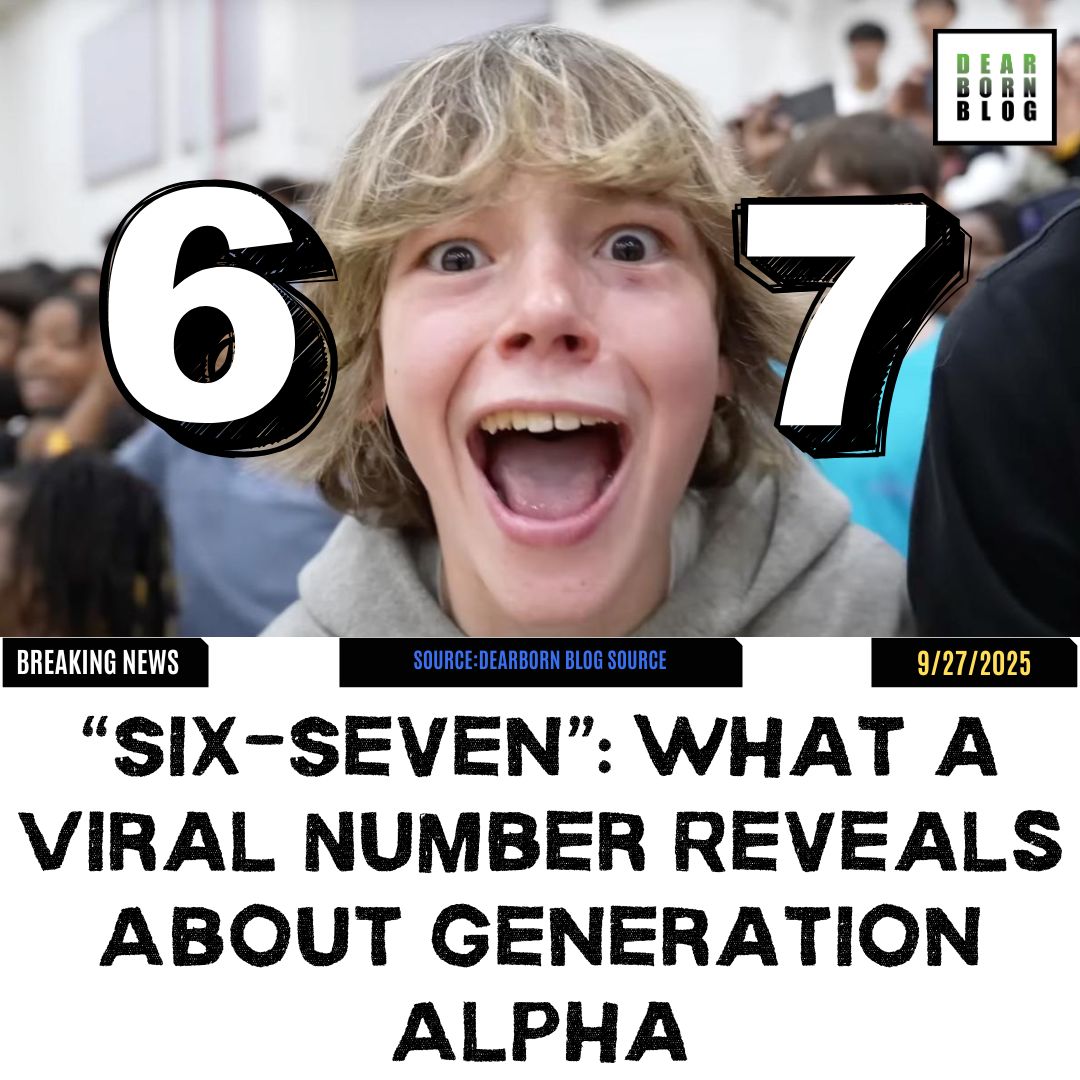
A nonsense number—6-7—has jumped from TikTok edits to school hallways and youth sports, baffling parents and teachers while delighting kids. Where did it come from, why did it spread, and what does it say about Generation Alpha’s humor, media diet, attention, and power to remix culture? We traced the origins, talked to experts, crunched the latest data, and sat down for a lightning interview with Dearborn Blog publisher Wissam Charafeddine to ground it all in our community’s values.
“Six-seven” is part chant, part shrug, part inside joke. It’s also a window into how the youngest generation plays with meaning, attention, and power online—and how communities like Dearborn can teach resilience and media literacy without shaming kids for being…kids.
The improbable rise of a number
If you’ve heard students muttering “six seven,” waving their hands in a looping gesture, you’ve encountered Gen Alpha’s latest meme-language. The phrase surged in early 2025 from a mashup of Skrilla’s track “Doot Doot (6 7)” and basketball highlight edits, especially around NBA star LaMelo Ball, who happens to be 6′7″ tall. From there, it spread as an all-purpose, meaning-lite catchphrase for “so-so,” “tall,” or just plain silly—its ambiguity is the point. [1][2][3][4][5][6][7][8][9]
Mainstream outlets from People to local TV have tried to decode it; Australian teachers have reported classroom disruptions; sports sites have mapped the basketball crossovers; and yes, there’s already a “6-7 Kid” lore thread—a child spotted on video chanting the phrase at an AAU game, remixed endlessly across TikTok. [1][2][3][4][8]
“There is no real meaning to it. It’s a number that is fun to say… and it just doesn’t mean anything.” — explainer quoted in E! News coverage of the trend. [5]
Quick origin timeline (for the grown-ups trying to keep up)
-
Dec 2024: Skrilla releases Doot Doot (6 7). [3]
-
Early 2025: The hook gets paired with LaMelo Ball highlights; “6-7” becomes a basketball-adjacent meme. [3]
-
Spring–Summer 2025: Kids adopt it as free-floating slang; the “6-7 Kid” clip turbocharges the spread. [4]
-
Aug–Sept 2025: The meme explodes across classrooms in the U.S., U.K., and Australia; educators alternately ban or co-opt it. [1][2]
By the numbers
• 57% of U.S. teens say they use TikTok daily, with 15% “almost constantly” on YouTube—TikTok is the second-most daily platform among teens. [10]
• 1 in 5 Americans now regularly get news on TikTok—quadruple since 2020. [14]
• Among kids 0–8, 40% have a tablet by age 2; nearly 1 in 4 have a cellphone by age 8. [11][12]
What “6-7” says about Gen Alpha
1) Meaning as play, not proclamation
Gen Alpha grew up amid hyper-memetic feeds where sound bites and gestures matter as much as dictionary definitions. Linguist and internet-culture writers have long noted that online youth humor is a “chaotic, meaningless-seeming mishmash of references”—impenetrable to outsiders, delightful to insiders. [16] In that sense, “6-7” is not a confession of emptiness; it’s a game that rewards participation over precision.
“Teens aren’t addicted to technology; they’re addicted to each other.” — scholar danah boyd (summarizing her research on networked youth). [17][18]
The “6-7” loop creates micro-belonging: you hear it, repeat it, lock eyes with your peer group, laugh. The point is connection.
2) Remix power is real—even when the content is nonsense
Memes are cultural power tools. A hand gesture and a two-syllable chant can hijack attention in a class, a locker room, or a basketball game. That’s not trivial; it’s a training ground for collective signaling. Business Insider framed the numbers trend (“6-7,” “41”) as intentionally “stupider and more meaningless than ever,” precisely to sidestep adult decoding. [15] Kids control the channel by picking content that resists adult surveillance.
3) Adults see distraction; youth see stagecraft
Teachers report disruption and “brain-rot” in classrooms. [1][2] But from the youth vantage point, “6-7” is stagecraft—a low-stakes performance that tests boundaries. The APA and U.S. Surgeon General caution that social media can be risky but not inherently harmful; the key is context, developmental readiness, and guardrails. [13][19][20] Blanket bans often miss the point; constructive co-creation and norms work better.
4) Memes live where the attention lives
Pew finds teens overwhelmingly on YouTube and TikTok; 57% are on TikTok daily. [10] And news consumption on TikTok is rising quickly, including among adults. [14] In other words, the attention market rewards short-loop sounds + gestures—exactly what “6-7” optimizes for.
Voices from the field: what experts say
-
danah boyd, author of It’s Complicated: Social media amplifies youth sociality; most teens “aren’t addicted to social media; …they’re addicted to each other.” [17]
-
Kate Eichhorn, author of The End of Forgetting: The digital trace complicates adolescence; “history…is never dead.” Youth create culture, but they also carry it. [21][22][23][24][25]
-
American Psychological Association (APA): Social media is neither inherently harmful nor beneficial; vulnerability varies, and scaffolded skills matter. [13][20]
-
Common Sense Media: Devices are arriving earlier; families are integrating screens into routines, for better and worse. [11][12]
-
Pew Research Center: Teen social media use is near-universal; platform choices differ by demographics, and “almost constant” use is common. [10][19]
“Technology makes the struggles youth face visible… it mirrors and magnifies everyday life, good and bad.” — It’s Complicated (boyd). [26]
A Dearborn conversation: rapid Q&A with Wissam Charafeddine
Interview conducted September 26, 2025; condensed and edited for clarity.
Q: When you see “6-7” echoing in Dearborn schools, what do you hear?
Wissam Charafeddine: I hear kids testing rhythm and belonging. It’s a drumbeat. Adults get stuck asking “What does it mean?” while the kids are really asking “Do you hear me?” Meaning is the side effect of connection.
Q: What’s the opportunity for educators and parents?
Wissam: Media literacy. Not as scolding, but as craft. If a number can go viral, let students produce their own counter-memes about kindness, civic action, climate, or Gaza ceasefire—whatever matters. Teach them to edit the world, not just consume it.
Q: Any Green Party–aligned takeaways?
Wissam: Decentralization and community power. Youth culture is already decentralized; it routes around gatekeepers. Let’s channel that toward mutual aid, climate justice, and anti-war solidarity. Dearborn’s kids have creativity and conscience—give them tools and trust.
Q: The Palestine context is heavy. Does “6-7” trivialize it?
Wissam: Not if we create space for both play and purpose. Play is how young people metabolize a hard world. Our job is to connect their creativity to truth-seeking and human rights—the Dearborn way.
How schools and families can respond (without snuffing the spark)
-
Name the game. Explain to kids that “6-7” is a participation loop designed for viral attention. Ask them to deconstruct how the beat, the gesture, and the repetition work. (This is basic media-production literacy.) [10][14]
-
Channel, don’t just cancel. If the chant is derailing class, reframe it as a warm-up call-and-response with time-boxed rules—or earnable moments linked to learning goals. Teachers in Australia and the U.S. have experimented with this approach. [1][2]
-
Co-create “house norms.” Borrow from the APA’s developmental guidance: scaffolding, age-appropriate boundaries, and explicit conversations about context collapse (jokes that land in one room may not land on the open internet). [13][19][20]
-
Build civic bridges. Dearborn can turn meme-savvy into community-savvy—student video labs, local history remixes, oral histories of Arab American resilience, climate storytelling. (Green values thrive when youth are creators, not just consumers.)
In Dearborn, we don’t panic about youth culture; we partner with it. We take the best of Gen Alpha’s inventiveness and align it with our commitments to truth, human dignity, climate sanity, and peace.
Why this matters for Dearborn—and Palestine
Meme culture can feel frivolous in a time of mass suffering. Yet meme factories also power the attention economy, where narratives about war, rights, and belonging are won and lost. If we want a future where ceasefire, human rights, and pluralism win the feed, we need our children’s creative engines humming. Teaching them how a “6-7” spreads is the first step to teaching them how justice spreads.
The Green Party’s platform prizes grassroots democracy, ecological wisdom, peace, and social justice—values that translate naturally into youth spaces: peer-to-peer governance in clubs, sustainable tech choices at school, anti-bullying norms that mirror anti-war ethics, and journalistic literacy that resists disinformation.
Dearborn’s role is simple and profound: model a city of resistance and care, where youth humor is welcomed, youth power is cultivated, and youth conscience is sharpened.
Sources
-
News.com.au, “’6-7’ trend: New ‘brain rot’ phrase sweeps Aussie classrooms,” Sept. 26, 2025. [Link] [1]
-
Adelaide Now, “What does 6-7 mean? The brain rot trend that kids are obsessed with,” Sept. 24, 2025. [Link] [2]
-
SB Nation, “Understanding the ‘6-7’ meme, and how LaMelo Ball is involved,” Sept. 24, 2025. [Link] [3]
-
AZCentral, “What does ‘6-7’ mean? What we know about the viral meme,” Aug. 13, 2025. [Link] [4]
-
E! News, “What Is 67? Unpacking the Latest Viral Slang,” Sept. 10, 2025. [Link] [5]
-
People, “Why Are Teens Saying 6-7?” Apr. 29, 2025. [Link] [6]
-
Parade, “What Does ‘6-7’ Mean on TikTok?” Sept. 19, 2025. [Link] [7]
-
FOX5 New York, “Gen Alpha slang: What ‘clanker,’ ‘67,’ ‘crashout’ mean,” Sept. 2025. [Link] [8]
-
Wikipedia, “6-7 (meme),” accessed Sept. 26, 2025 (overview and references). [Link] [9]
-
Pew Research Center, “Teens and Social Media Fact Sheet,” July 10, 2025. [Link] [10]
-
Common Sense Media, The 2025 Common Sense Census: Media Use by Kids Zero to Eight, Feb. 25–26, 2025. [Report page] [11]
-
Common Sense Media, 2025 Census PDF (detailed findings). [PDF] [12]
-
American Psychological Association, “Health advisory on social media use in adolescence,” 2023. [Link] [13]
-
Pew Research Center, “1 in 5 Americans regularly get news on TikTok,” Sept. 25, 2025. [Link] [14]
-
Business Insider, “Gen Alpha’s ‘6-7’ and ‘41’ slang has no meaning,” Sept. 11, 2025. [Link] [15]
-
Gretchen McCulloch (blog), on “Gen Z/TikTok humor” as chaotic multi-reference in-jokes, accessed Sept. 26, 2025. [Link] [16]
-
danah boyd, It’s Complicated quotes (Goodreads compilation), accessed Sept. 26, 2025. [Link] [17]
-
danah boyd, It’s Complicated (open PDF excerpts); related talks on youth social media, accessed Sept. 26, 2025. [Link] [18]
-
Pew Research Center, “Teens, Social Media and Technology 2024,” Dec. 12, 2024. [Link] [19]
-
PAR (Psychological Assessment Resources) blog summarizing APA guidance; quote from APA President Thema Bryant, May 17, 2024. [Link] [20]
-
Wired, “Social Media Could Make It Impossible to Grow Up” (Eichhorn excerpt), July 8, 2019. [Link] [21]
-
Vox, “The end of forgetting,” May 25, 2019 (Eichhorn interview/analysis). [Link] [22]
-
PopMatters, “Does Social Media Mark the End of Childhood?” July 8, 2019 (on Eichhorn). [Link] [23]
-
Inside Higher Ed, review of The End of Forgetting, July 4, 2019. [Link] [24]
-
PMC (NIH), “The End of Forgetting: Growing Up With Social Media,” 2021 (review article). [Link] [25]
-
Julie Kallio, PhD, notes on It’s Complicated, Mar. 19, 2014 (boyd excerpt). [Link] [26]
Citations in text
Mentions of facts and quotes in this article are followed by bracketed numbers that correspond to the Sources list above. For example: the classroom spread in Australia [1][2]; LaMelo Ball connection and sports edits [3][6][8]; Pew teen-usage rates and “almost constant” usage [10][19]; TikTok news consumption [14]; APA/Surgeon General guidance [13][20]; and expert perspectives (boyd/Eichhorn/McCulloch) [16][17][21][22][26].
The Dearborn takeaway
Dearborn’s strength is community literacy—religious literacy, media literacy, civic literacy—cultivated across families, mosques, churches, gurdwaras, schools, and neighborhood centers. We don’t sneer at youth culture; we scaffold it. A meaningless meme can be a meaningful doorway to talk about attention, ethics, Palestine, climate, and the dignity of all people.
Generation Alpha is telling us, in numbers and gestures, that they’re ready to co-author the story. Our job is to hand them the tools—and hold them to the truth.
Dearborn Blog stands for people-powered democracy, peace, and planet. We see our kids not as a problem to solve but as partners in building a just city that refuses war-washing and embraces pluralism.
Disclaimer
This article synthesizes publicly available reporting and research as cited above and includes an interview with Dearborn Blog publisher Wissam Charafeddine recorded on September 26, 2025. While we strive for accuracy and balance, the piece is intended for informational and educational purposes and should not be taken as clinical, legal, or educational policy advice. Views attributed to interviewees are their own. Dearborn Blog disclaims liability for decisions made based on this article. Corrections are welcome and will be appended transparently.

 Dearborn Blog
[…] “Six-Seven”: What a Viral Number Reveals About Generation Alpha: https://dearbornblog.com/2025/09/27/six-seven-what-a-viral-number-reveals-about-generation-alpha/ […]
LikeLike