

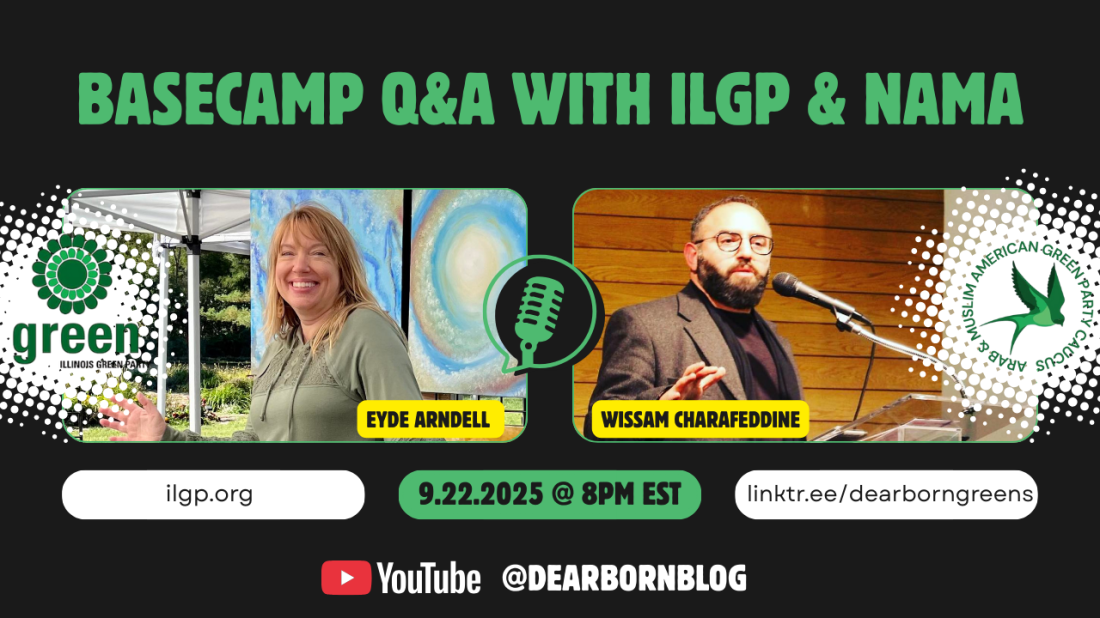
On September 22, 2025, organizers from the Illinois Green Party (ILGP) and the Arab & Muslim American Green Party Caucus (NAMA) went live on YouTube to demo a simple idea with big consequences: if Greens want to scale campaigns and committees without burning out, get off the hamster wheel of scattered chats and run the work in Basecamp. In a one-hour Q&A hosted by Dearborn Blog, Eyde Arndell (ILGP) and Wissam Charafeddine (NAMA) showed, click-by-click, how message boards, task lists, check-ins, and “Hill Charts” make transparency normal and chaos optional. Watch the full session on @DearbornBlog and grab the starter links at ilgp.org and linktr.ee/dearborngreens. YouTube+2ilgp.org+2
“Stop organizing inside an avalanche of DMs. Put the work where everyone can see it.”
The livestream title said it plainly: “BASECAMP Q&A with ILGP & NAMA — ditch the chaos, build the movement.” Under a crisp agenda, Arndell and Charafeddine walked through how Greens coordinate campaigns, caucuses, and committees in a single, shared space—no mystery inboxes, no “who has the file?” moments, no meetings that should’ve been a post. The tone was practical, almost minimalist: fewer tools, better habits, stronger results. The goal: make the infrastructure of accountability boring and reliable so the work of democracy can be bold. YouTube
Why Basecamp—and why now
Basecamp is a long-running project and teamwork platform built by 37signals, the Chicago company co-founded by Jason Fried and David Heinemeier Hansson (the developer of Ruby on Rails). Their philosophy is stubbornly simple: small teams, fewer features, clearer work. They’ve written books like Getting Real, Rework, and Shape Up to argue that most teams need less noise and more clarity—a thesis the Q&A made tangible in an organizing context. Basecamp+4Wikipedia+4WIRED+4
In 2022 the company publicly embraced its original name, 37signals, signaling a continued focus on a short roster of tools (Basecamp, later joined by the privacy-minded email service HEY). That focus shows in Basecamp’s newest versions: Lineup, Mission Control, and Hill Charts—visuals that let coordinators spot drift, bottlenecks, and workload at a glance. For volunteer organizations that live and die by clarity, those dashboards are oxygen. Hey World+2Basecamp+2
“Visualizations are for seeing, not squinting.” —Basecamp product page. Basecamp
What the demo covered
- Message Boards instead of DM piles. Organizers post proposals, deadlines, and decisions in threads that don’t disappear into chat ether.
- To-dos with owners and dates. No heroic memory required; the system nudges the work forward.
- Automatic summaries. Weekly digests and project notifications keep newcomers in the loop.
- Hill Charts. A plain-English map of “figuring it out” (uphill) vs. “making it happen” (downhill) so leads can aim help where it’s needed.
- Invite-only spaces. Keep sensitive work private while letting cross-committee read-only access reduce duplicative effort. Basecamp+23.basecamp-help.com+2
The presenters contrasted this with “tool sprawl”: a Slack here, a Google Drive there, a Telegram chain with 200 ghosts, a spreadsheet nobody can find. Yes, chat is great for quick pings, but the record of decisions needs a stable home. Basecamp is the home. Third-party reviewers broadly agree: Slack excels at rapid chat; Basecamp wins at organized, asynchronous coordination. For a volunteer movement spanning time zones and day jobs, that difference is decisive. Everhour+1
Movement metrics that matter
• One project per campaign or committee → clear scope
• One thread per decision → audit trail by default
• One task owner per to-do → no “someone should” ambiguity
• One check-in cadence (weekly) → momentum without meetings
Adapted from Basecamp’s learn pages and field guides. [1]
Who’s who: ILGP, NAMA, and a youth-first push
The Illinois Green Party has been steadily training local organizers to build slates and petition drives despite some of the harshest ballot-access barriers in the country. Their site distills the case for political choice and channels support to volunteers and candidates statewide—exactly the kind of network that benefits from a shared Basecamp foundation. ilgp.org+1
**NAMA—the Arab & Muslim American Green Party Caucus—**formed in early 2025 to organize a community that’s been both hyper-visible and under-represented in national politics. The caucus announcement framed its mission around core Green values—grassroots democracy, social justice, nonviolence, and ecological wisdom—and named the fight against militarism, surveillance, and the genocide in Gaza as central to its work. NAMA’s leaders emphasize movement discipline: build capacity, build alliances, and build tools that lift new organizers quickly. www.gp.org+1
Alongside them sits the Green Party’s YES (Young EcoSocialists) Caucus, the official youth wing (36 and under) dedicated to political education, campaign skills, and a pipeline into leadership. YES’s mandate dovetails with the night’s theme: make organizing learnable and repeatable. A platform where young volunteers can see work, claim tasks, and learn by doing beats a maze of private chats every time. Young EcoSocialists+1
“The most radical thing we can do is make participation easy.” —Young EcoSocialists mission language (paraphrase). Young EcoSocialists
A Dearborn driver of youth-centered Greens
The Q&A spotlighted Wissam Charafeddine—educator, technologist, and a public face of Dearborn’s Green movement—who has spent the last year pushing for a youth-centered Green Party culture: shorter feedback loops, clearer onboarding, and tools that don’t assume 24/7 availability. His role in helping launch NAMA and in coordinating Dearborn-area Green work has been documented across GPUS and independent political outlets; the Basecamp event is part of that same arc: replace burnout with structure. www.gp.org+1
Basecamp’s DNA: small is a feature
To understand why Basecamp fits grassroots work, it helps to know the company’s posture. 37signals has long argued that productivity is mostly about saying no—to feature bloat, to real-time panic, to “always on.” They’re also famous for an early outside investment from Jeff Bezos’s fund (a historical footnote that underlines how unusual their independence has been since). Their books—Getting Real, Rework, and Shape Up—argue for shipping smaller, calmer, and clearer. That stance is visible in Basecamp’s interface: a few core tools arranged around a project, not a waterfall of tabs. WIRED+2WIRED+2
The Shape Up playbook even recounts how the first Basecamp was built: Jason Fried designed, David Heinemeier Hansson programmed—and Ruby on Rails emerged from that work. In other words, Basecamp wasn’t invented to chase a market; it was built because the team needed a shared source of truth. Movements need the same thing. Basecamp
What Greens showed on the livestream
- Projects for committees: Ballot Access, Communications, Fundraising, Field, and Caucuses each get their own Project with clear scopes and calendars.
- Message boards for decisions: One thread = one decision = one link to share with newcomers.
- Templates: A “New Campaign” starter pack preloads to-dos (compliance, media, field) and check-ins (“What’s your top blocker this week?”).
- Hill Charts for reality checks: Leaders see where work is “figuring it out” vs. “making it happen” and offer help accordingly.
- Office-hours via posts: Instead of chasing DMs, staffers hold weekly Q&A posts. The answers live with the work.
Features referenced from Basecamp product and learn pages. [2][3]
From the Broadcast
The views expressed in the video advocating for the Green Party’s use of Basecamp can be categorized into five main areas: alignment with party values, organizational efficiency, accessibility, security and privacy, and cost-effectiveness.
Here is a categorized report of the views expressed:
1. Alignment with Green Party Values & Philosophy
The speakers view Basecamp’s company structure and software design as mirroring the Green Party’s core principles:
- Grassroots and Decentralization: The spirit of Basecamp is seen as aligned with the Green Party’s spirit of decentralization and grassroots organizing [13:54].
- Distributed Structure: The company operates as a distributed teams software without a central headquarters (HQ), which aligns with the party’s non-hierarchical approach [14:04].
- Equal Platform: All projects lay on an equal platform, which is said to lower barriers to participation and strengthen autonomy [14:13].
- Visionary Infrastructure: Using the software is an essential part of creating the infrastructure to make a grassroots movement workable and to grow the party for the future [01:04:33].
2. Organizational and Functional Efficiency
The application is praised as a powerful tool for streamlining internal processes, collaboration, and record-keeping:
- To-Do and Project Management: It allows for efficient volunteer work and activism in a more efficient way [01:44]. The to-do feature allows users to assign tasks, tag people, set due dates, put notes, and attach documents [22:07].
- Asynchronous Collaboration: Users can post an idea at 3:00 in the morning and not bother anyone, supporting remote and asynchronous work [33:57].
- Streamlined Communication: The message board automatically cleans up threads from email signatures and threaded quotes, making conversations finally readable and clean [42:09].
- Record-Keeping and History: The history log is useful for checking and verifying details, such as when a bylaw change was made or passed [48:38]. Additionally, users are advised to archive without deleting anything for future reference [47:15].
- Search and Organization: The dashboard organization, including placing multiple projects or teams into “stacks,” allows for creative organizing [20:19]. A dedicated “find” feature allows users to easily search using keywords or names [25:00].
- Automation: The software supports automations using Zapier to streamline tasks, such as automatically creating a new project hub from a template when a form is filled out [56:52].
3. Accessibility and Usability
The platform is considered easy to use for a wide range of Green Party members:
- Intuitive and Simple: The interface makes intuitive sense and is easy to learn [16:48]. It is particularly simple for younger users who will be able to catch on quickly [16:51].
- Cross-Device Functionality: It offers ease of access with a seamless experience on both the desktop app and the phone app [19:15], allowing members to “do everything from my phone” [25:52].
- Email Integration: Basecamp allows those who prefer email to still respond to any threads or messages through email, ensuring access for the “older crowd” [19:35].
- Customization: Users have control of a lot of the organization [17:21] and can rename features (e.g., changing “Campfire” to “Chat”) for clarity [17:27].
4. Security and Privacy
The company’s policies and software features are highlighted for protecting member data and communication:
- Proactive Privacy: The founders are known to be “big on privacy and individual dignity” [14:48].
- Anti-Surveillance: The affiliated email software, Hey, blocks spy pixels by default and shields the user’s IP, acting as a “practical defense against surveillance capitalism” [14:59].
- Encryption and Moderation: Communication is described as encrypted [27:36], and unlike email, Basecamp allows users to moderate and delete comments to get rid of hate speech or spam quickly [46:34].
5. Cost and Sustainability
The cost structure is seen as highly advantageous, especially through collaborative arrangements:
- Subsidized Access: Through the Yes Caucus, other Green Party groups can sublease the space and access the software at a discounted, legacy price of $250 a year, making it accessible for a grassroots organization [01:03:01], [01:03:40].
- Company Philosophy: The company’s philosophy to “stay small” is seen as a way to keep the costs sustainable [14:34].
- Free Option: There is a Basecamp Free option that allows a user to run one project at no cost [01:09:34].
Movement tech with movement ethics
Because volunteers rightly care about data, the conversation touched on privacy and retention. Basecamp isn’t a surveillance-economy product. While every platform has legal policies, 37signals emphasizes limited collection and retention practices and has a long public record of arguing for calmer, saner work over extractive metrics. Whether you’re organizing a campus canvass or tracking donations and press hits, using a platform with clear data boundaries builds trust. Basecamp Legal, LLC
This also matters politically. Greens oppose militarism and mass surveillance; it’s consistent to choose tools that don’t convert every click into ads. For the many young organizers radicalized by U.S. foreign policy failures—from Iraq and Afghanistan to Gaza—the tool choice is part of the ethic. The party’s youth wing has said as much: give people effective, principled tools and they’ll stay. Young EcoSocialists
“Organizing is logistics plus memory. Basecamp gives you both.”
From Dearborn to statewide to national
Dearborn Blog hosted the stream for a reason. Our city is an organizing classroom—multi-lingual, youth-heavy, and allergic to cynicism. The ILGP–NAMA collaboration reflects a broader alignment: grassroots democracy needs infrastructure. Not just slogans, but calendars. Not just vibes, but task owners. Not just viral clips, but message-board decisions with dates.
And because this was open, any Green formation can copy it. County chapters, working groups, campus Greens, and partner organizations can stand up a Basecamp, import the templates, and go. We’re not the movement that guards “secret playbooks.” We’re the movement that shares them.
The Green through-line
The Green Party’s Ten Key Values—Grassroots Democracy, Social Justice, Ecological Wisdom, Non-Violence, Decentralization, Community-Based Economics, Feminism, Respect for Diversity, Personal/Global Responsibility, Future Focus—are not just a list; they’re an operational challenge. Basecamp helps square that circle: decentralized work with a centralized record; personal responsibility with shared visibility; future focus with a calm cadence that avoids burnout. YES Caucus leaders have been clear: if we want youth-centered Greens, we have to lower the barrier to entry. This is what lowering looks like. Young EcoSocialists
How to get started (what the presenters recommended)
- Create one Project per entity (e.g., “ILGP Ballot Access 2026,” “NAMA Communications,” “YES Training Team”).
- Post a welcome message pinning expectations: where to post updates, how to ask for help, the weekly check-in day.
- Load a template to-do set for the next eight weeks only; future tasks live in a “Someday” list so the current board stays sane.
- Schedule weekly check-ins: “What did you ship? What’s your blocker? What’s next?”
- Use Hill Charts to visualize uncertainty; move items to “downhill” only when the unknowns are gone.
- Archive ruthlessly. Finished initiatives become the institutional memory new volunteers can search. Basecamp+1
This isn’t theory. It’s working practice from teams that elected Greens to local office, qualified candidates for ballots, and anchored ceasefire and solidarity work when national parties hedged. Organizing is an iterative science; Basecamp gives you the lab notebook.
Fast facts
• **Livestream:** Sept 22, 2025 — 8 PM ET — @DearbornBlog on YouTube. [4]
• **Hosts:** Eyde Arndell (ILGP) & Wissam Charafeddine (NAMA). [4][5]
• **Links:** ilgp.org • linktr.ee/dearborngreens. [6]
• **Tech:** Basecamp by 37signals; features shown included Lineup, Mission Control, Hill Charts, and check-ins. [7][8]
Watch, adopt, share
If you missed it live, watch the replay on YouTube. Then spin up a trial Project for your chapter and try the pattern for two weeks. You’ll know quickly whether the Basecamp rhythm—post, assign, check-in, ship—fits your crew. If your DMs suddenly feel lighter and your volunteers suddenly feel looped-in, you’ll have your answer. And if you make improvements, publish them. Movement tech evolves when we teach each other.
Dearborn Blog will keep spotlighting practical, pro-transparency tools—because a movement that documents its work is a movement that grows, hands off leadership, and wins.
Sources
[1] Basecamp Learn hub: projects, invites, and getting started. Basecamp
[2] Basecamp: Why Basecamp (Lineup, Mission Control, Hill Charts). Basecamp
[3] Basecamp: New in Basecamp—better events, one-click video, natural-language dates. Basecamp
[4] YouTube, “Basecamp Q & A with Illinois Green Party and NAMA Caucus” (Dearborn Blog livestream page). YouTube
[5] Instagram event posts referencing the Q&A with ILGP & NAMA (Eyde Arndell/Wissam Charafeddine billing). Instagram+1
[6] Illinois Green Party and GPUS Illinois page (contact/ballot access/resources). ilgp.org+1
[7] Basecamp product overview (features and visualizations). Basecamp
[8] Third-party comparisons of Slack vs. Basecamp (async vs. real-time strengths). Everhour+1
[9] 37signals company history and founders (including DHH / Ruby on Rails; reversion to 37signals name). Wikipedia
[10] 37signals founder post: “Hello again” (return to 37signals, company focus). Hey World
[11] Shape Up (Basecamp book) on Basecamp’s origins and Rails. Basecamp
[12] Wired coverage of 37signals’ small-teams philosophy; early profile. WIRED+1
[13] Wired report on Jeff Bezos’s minority investment in 37signals. WIRED
[14] YES (Young EcoSocialists), official youth caucus page and mission. Young EcoSocialists
[15] GPUS news release: formation of the Arab & Muslim American Green Party Caucus (NAMA). www.gp.org
[16] Independent Political Report coverage of NAMA formation and leadership. Independent Political Report
Disclaimer
This article is a news and commentary piece for educational purposes. It summarizes a public livestream and publicly available documentation from Basecamp/37signals and the Green Party. Tools evolve; features and pricing can change. Dearborn Blog does not receive compensation from Basecamp/37signals, ILGP, NAMA, or YES for this coverage. Readers should verify technical and legal details (including privacy practices) directly with vendors and organizations. Nothing herein constitutes legal or IT advice. Contact the editor with corrections; include source documentation for requested updates.
Hashtags: #GreenParty #ILGP #NAMA #Basecamp #Organizing #DearbornBlog #MovementTech #GrassrootsDemocracy

 Dearborn Blog