


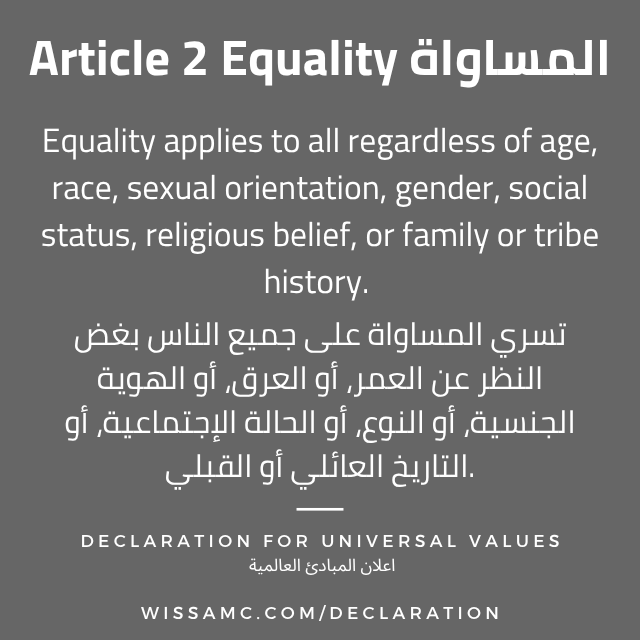
| From the Universal Declaration of Human Values by Wissam Charafeddine Throughout history, humanity’s understanding of equality has been shaped by both struggle and revelation. While ancient societies often accepted hierarchy as natural, the idea that all human beings are equal began to take root during the Axial Age, around 800–200 BCE, when spiritual and philosophical traditions in Greece, India, China, and the Middle East began advocating for universal moral values. It later gained momentum during the Enlightenment, when thinkers like Rousseau, Locke, and Kant championed natural rights. These ideals blossomed in documents such as the American Declaration of Independence (1776), the French Declaration of the Rights of Man (1789), and ultimately the Universal Declaration of Human Rights (1948), each building on the growing belief that no person is born superior to another. As Langston Hughes once wrote: “O, let America be America again— The land that never has been yet— And yet must be—the land where every man is free.” In our diverse Livonia community and beyond, the principle of equality remains a cornerstone of justice and human dignity. Article 2 of the Universal Declaration of Human Values reminds us that all individuals deserve equal treatment, regardless of age, race, gender, sexual orientation, social status, religious belief, or family background. This isn’t just a moral idea—it’s a call to action to create a society where opportunity, protection, and respect are shared by all. This principle is deeply rooted in historical struggles and global progress—from the civil rights and feminist movements to modern LGBTQ+ advocacy. Legal protections like anti-discrimination laws and international human rights declarations were hard-won through generations of effort, and they continue to shape our communities today. Livonia thrives when we uphold these values—fostering inclusion, fairness, and mutual respect in our schools, workplaces, and neighborhoods. By embracing equality as a guiding principle, we honor the legacy of those who fought for justice and build a stronger, more compassionate future for all. Article 2 is more than policy—it’s a reflection of who we are and the kind of community we aspire to be. |

 Dearborn Blog