

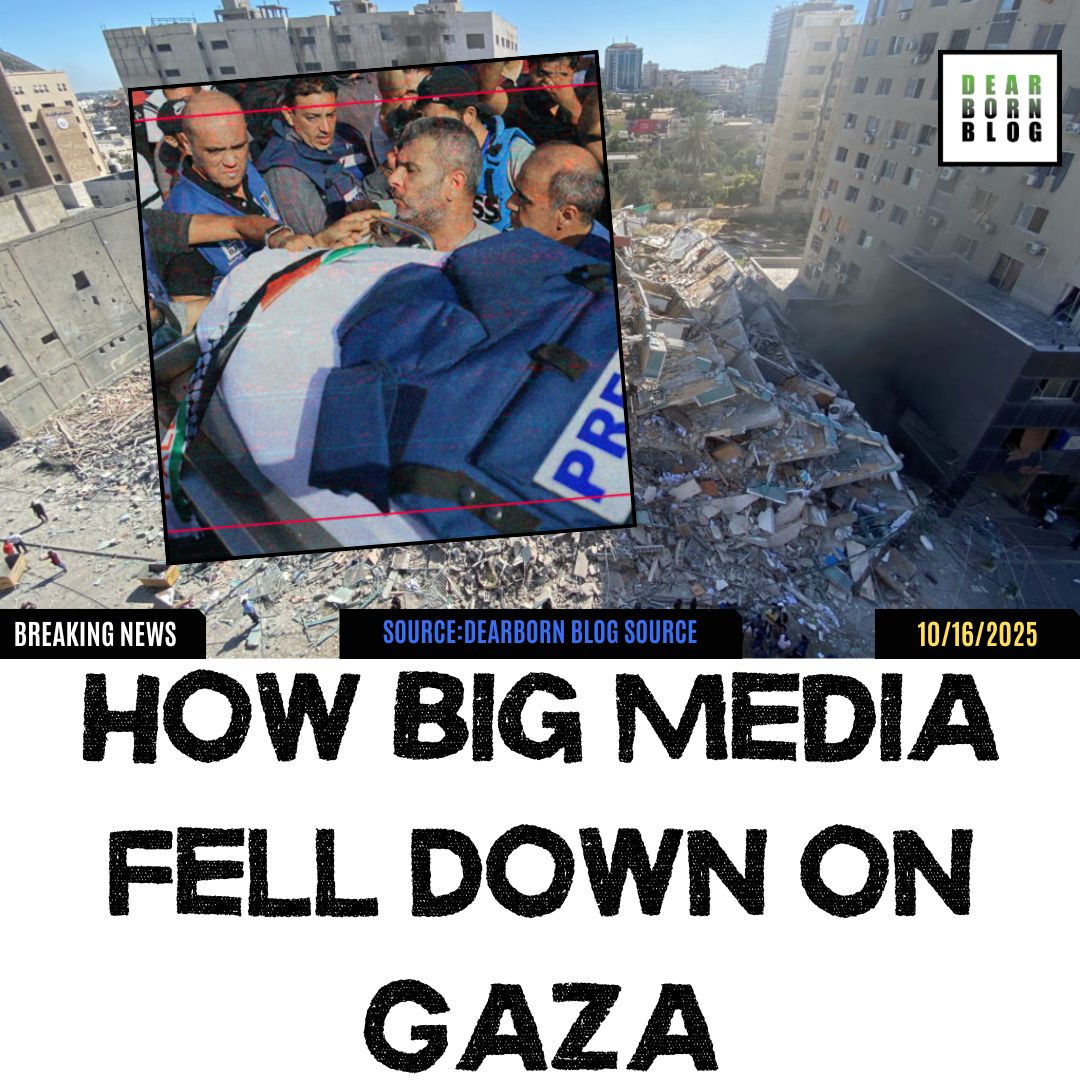
As Gaza’s civilian death toll mounted, America’s flagship newsrooms tripped over their own rules—soft-pedaling language, delaying recognition of mass casualties, and narrowing Palestinian voices—while independent outlets and “third wave” platforms filled the gap. The latest press-freedom clash with the Pentagon shows where this road leads—and why Dearborn’s readers, anchored in community and conscience, must insist on journalism worthy of the moment.
When journalism flinches, power smiles. Over the past two years of the Gaza war, mainstream U.S. media too often swapped rigor for euphemism, investigation for stenography, and proportion for a lopsided moral arithmetic. That failure is measurable—in language bans and internal memos, in delayed acknowledgement of mass civilian death, in editorial double standards, and in newsroom purges or demotions of dissenting voices. Meanwhile, independent and “third wave” outlets—many running on reader revenue rather than corporate advertising—have delivered some of the clearest, bravest coverage of Gaza and the global backlash. The stakes are not academic: this information ecosystem shapes policy, frames public empathy, and can either restrain or enable atrocity.
Key fact: Peer-reviewed and high-method studies estimate Gaza’s violent death toll far exceeds early official counts; The Lancet analysis suggests undercounting of roughly 41% for the first nine months alone.[1]
Language games at the paper of record
The New York Times did not merely wrestle with Gaza coverage—it tried to police the vocabulary. In April 2024, internal guidance leaked instructing Times journalists to restrict or “avoid” terms such as “genocide,” “ethnic cleansing,” “occupied territory,” and even “refugee camps,” while warning against using “Palestine” except in “very rare cases.”[2][3][4] These edicts didn’t live in a vacuum; they set the tone for story framing and headlines across the most influential U.S. newsroom. Later, the Times launched a leak investigation over internal dissent about Gaza coverage, a rare move that further chilled debate inside the building.[5][6]
Parallel to the language policing was the controversy over the Times’ December 2023 investigation, “Screams Without Words,” alleging that Hamas “weaponized sexual violence” on Oct. 7. Investigative journalists at The Intercept and others raised serious questions about sourcing, corroboration, and the role of a contributor with limited reporting background; more than 50 journalism professors publicly urged the Times to commission an independent review. The Times stood by its story, but critics argued that core claims were overstated or unproven—warning that atrocity narratives without robust evidence can migrate from empathy to propaganda.[7][8][9] A newsroom that gags certain words while hedging on mass death, and then doubles down on a contested atrocity framing, trains audiences to see Palestinians chiefly as context for Israel’s pain.
“If the vocabulary of a conflict is negotiated behind closed doors, the public inherits a narrative with the edges sanded off—and the reality sandblasted away.”
The numbers problem: when counting the dead becomes optional
From late 2023 through 2025, the most basic duty—counting the dead—was hedged, delayed, or minimized in many outlets. This is not a mere stylistic debate. A 2025 Lancet analysis estimated 64,260 violent deaths by the end of June 2024, about 41% higher than official tallies available at the time; subsequent scientific and statistical work suggests still higher totals and large numbers of “uncounted” deaths.[1][10][11][12] Even The Washington Post produced a major interactive acknowledging that Gaza’s actual toll was likely far higher than official figures, and that IDF claims about combatant numbers lacked transparent methodology.[13] Yet for months, many headlines leaned harder on “according to Gaza’s health ministry” caveats than on the converging independent evidence about mass civilian death. Deference to skepticism became a form of selective credulity.
Some commentators tried to flip the script by attacking the counts as inflated, citing ideologically driven think-tank reports and opinion pages. But peer-reviewed and high-method work—capture–recapture analyses, population surveys, and triangulation studies—repeatedly cut the other way. Journalism’s responsibility isn’t to launder uncertainty; it’s to weigh evidence and show readers where the weight lands.[1][10][12]
CNN’s crisis of confidence—and the internal revolt
CNN, the cable bellwether, faced a newsroom rebellion. In early 2024, staff told reporters that management edicts were producing “journalistic malpractice”—skewing coverage toward Israeli government lines, censoring Palestinian perspectives, and routing sensitive stories through Jerusalem for approval. Internal memos and emails reinforced that impression, and even some marquee talent publicly pushed back on double standards.[14][15][16] The effect on audiences is measurable: if your gatekeepers pre-filter grief and flatten context, you don’t just underinform—you unbalance the moral frame through which citizens view policy.
“When an outlet’s own journalists call the editorial line ‘malpractice,’ the audience should treat every euphemism like a red flag.”
MSNBC, NPR, and the narrowing of acceptable speech
Mehdi Hasan’s show was canceled in November 2023; he left MSNBC in January 2024 after declining a diminished role. He later described the environment as increasingly hostile to frank discussion of Palestinian suffering and U.S. complicity. Whatever one’s take on network strategy, the timing spoke loudly to advocates who saw the removal of one of cable’s sharpest interviewers on Israel-Palestine as a message to the rest of the industry: color inside the lines.[17][18]
NPR shows the contradictions clearly. On one hand, NPR’s Gaza producer Anas Baba—reporting while living under bombardment—has delivered extraordinary, humane coverage that any newsroom would be proud to publish.[19][20] On the other, NPR (like many outlets) faced public criticism over language, framing, and a tendency to preface Palestinian casualty figures with doubt while repeating early Israeli numbers without similar caveats. The lesson is structural, not personal: even brave field reporting can be reframed or diluted by editorial conventions that minimize Palestinian grievability.[21]
Third wave media grows up: Democracy Now!, Zeteo, The Intercept & Co.
While legacy outlets tied themselves in knots, independent platforms leaned into public-service journalism. Democracy Now! has consistently platformed Palestinian journalists, rights investigators, and scholars—highlighting rescinded awards and smear campaigns that sought to silence Gaza reporters like Maha Hussaini, and interviewing figures who documented collective punishment and famine risk long before it became “safe” to say so in primetime.[22][23][24]
The Intercept played a distinct role: exposing the Times’ internal Gaza memo; interrogating contested atrocity narratives; and surfacing how newsroom process, not just politics, can tilt the truth. That work precipitated not one but multiple meta-stories—about leak hunts, HR probes, and the limits of dissent in prestige media.[2][5][8]
After leaving MSNBC, Mehdi Hasan launched Zeteo—an independent, subscription-supported media startup that grew rapidly through 2024–2025. Zeteo has published unflinching analysis of Gaza and the democratic backsliding at home, while experimenting with reader-funded sustainability instead of corporate ad models. Whether one loves Hasan’s style or not, “third wave” projects like Zeteo widen the aperture on stories legacy outlets muffle.[25][26][27][28]
The road to authoritarianism runs through the press pass office
Fast-forward to this week. The Pentagon, under Defense Secretary Pete Hegseth, demanded that reporters sign a pledge not to obtain “unauthorized” information—including unclassified material—if they want to keep credentials. News organizations from across the spectrum (from The Washington Post to Fox News) refused, calling the policy plainly unconstitutional and a frontal attack on press freedom. Press associations are preparing legal challenges; even outlets generally friendly to the administration balked at the attempt to criminalize routine reporting.[29][30][31][32][33]
One editor’s response captured the moment’s stakes: “No way in hell.” That wasn’t hyperbole. A government that defines reporting as theft and truth as contraband is not flirting with authoritarianism—it is issuing engraved invitations. As Gaza coverage demonstrated, when elites feel the heat, their first instinct isn’t transparency; it’s to dim the lights. The press-pass pledge is the logical endpoint of a culture that treats uncomfortable facts as security breaches.
“Freedom of the press means the freedom to offend power. Consent-only journalism is just PR with better fonts.”
Dearborn’s angle: our neighbors, our diaspora, our duty
Dearborn is not a spectator in this story. Our city is home to families with loved ones in Gaza and the wider region, to journalists reporting in Arabic and English, to students who learned about free speech in civics class and watched it shrink on their screens. The Green tradition here—anti-war, pro-human rights, pro-planet—asks for journalism that resists war euphemisms as fiercely as it resists fossil-fuel spin. We need coverage that centers civilian lives, interrogates state violence (whoever commits it), and treats international law as more than a rhetorical flourish. That’s not “pro-Palestine” as a brand; it’s pro-humanity, pro-truth, and pro-accountability.
So here’s a proposition worthy of Dearborn: support the newsrooms that report without fear or favor; challenge the ones that don’t; and reject any government demand that turns reporters into hall monitors for the powerful. Because if Gaza taught us anything, it’s that the words you aren’t allowed to say are often the ones you most need to hear.
Sources
- The Lancet, “Traumatic injury mortality in the Gaza Strip from Oct 7, 2023…,” capture–recapture estimate (Jan. 2025).[1] :contentReference[oaicite:0]{index=0}
- Nieman Lab summary of The Intercept leak: NYT memo advising against terms like “genocide,” “ethnic cleansing,” “occupied territory,” and limiting use of “Palestine” (Apr. 16, 2024).[2] :contentReference[oaicite:1]{index=1}
- Truthout overview of the NYT language memo and its implications (Apr. 16, 2024).[3] :contentReference[oaicite:2]{index=2}
- TRT World report on the leaked NYT guidance memo (Apr. 16, 2024).[4] :contentReference[oaicite:3]{index=3}
- Wall Street Journal, NYT ends leak probe over Gaza coverage without conclusive finding (Apr. 15, 2024).[5] :contentReference[oaicite:4]{index=4}
- Margaret Sullivan’s analysis of the NYT leak investigation and newsroom climate (2024).[6] :contentReference[oaicite:5]{index=5}
- The Intercept criticism of “Screams Without Words” sourcing; Democracy Now! interviews with the reporters (Feb.–Mar. 2024).[7] :contentReference[oaicite:6]{index=6}
- Washington Post, journalism professors call on NYT to review the Oct. 7 sexual-violence report (Apr. 29, 2024).[8] :contentReference[oaicite:7]{index=7}
- The Nation analysis of the Times’ handling and “leak-hunting” posture (Mar. 1, 2024).[9] :contentReference[oaicite:8]{index=8}
- Nature coverage of independent survey estimating Gaza deaths substantially higher than official numbers (June 27, 2025).[10] :contentReference[oaicite:9]{index=9}
- FAIR (Fairness & Accuracy In Reporting), on U.S. media’s failure to prioritize victim counting (Feb. 5, 2025).[11] :contentReference[oaicite:10]{index=10}
- The Guardian recap of the Lancet analysis (Jan. 10, 2025).[12] :contentReference[oaicite:11]{index=11}
- Washington Post interactive, “Gaza’s uncounted dead” (Oct. 9, 2024).[13] :contentReference[oaicite:12]{index=12}
- The Guardian, CNN staff say the network’s pro-Israel slant amounts to “journalistic malpractice” (Feb. 4, 2024).[14] :contentReference[oaicite:13]{index=13}
- Anadolu Agency summary of the Guardian’s findings on CNN bias (Feb. 6, 2024).[15] :contentReference[oaicite:14]{index=14}
- Jerusalem Post on leaked recordings and internal CNN dissent (Feb. 2024).[16] :contentReference[oaicite:15]{index=15}
- AP News, Mehdi Hasan quits rather than accept demotion at MSNBC (Jan. 2024).[17] :contentReference[oaicite:16]{index=16}
- Al Jazeera, advocates decry MSNBC’s cancellation of Hasan’s program (Nov. 30, 2023).[18] :contentReference[oaicite:17]{index=17}
- Washington Post profile of NPR’s Gaza producer Anas Baba (Mar. 11, 2025).[19] :contentReference[oaicite:18]{index=18}
- Wikipedia entry on Anas Baba (with WaPo citation), background and role at NPR (accessed Oct. 2025).[20] :contentReference[oaicite:19]{index=19}
- Open letter critiquing NPR framing on Gaza (Dec. 30, 2024).[21] :contentReference[oaicite:20]{index=20}
- Democracy Now! headlines on the rescinded award to Gaza journalist Maha Hussaini (June 21, 2024).[22] :contentReference[oaicite:21]{index=21}
- Democracy Now! interview with Maha Hussaini (June 24, 2024).[23] :contentReference[oaicite:22]{index=22}
- Democracy Now! coverage of Palestinian voices and prizes like the Right Livelihood Award (Oct. 9, 2024).[24] :contentReference[oaicite:23]{index=23}
- Washington Post, “Mehdi Hasan saw a market for a new kind of media company”—launch and growth of Zeteo (Sept. 4, 2024).[25] :contentReference[oaicite:24]{index=24}
- Deadline, Hasan launches Zeteo (Feb. 28, 2024).[26] :contentReference[oaicite:25]{index=25}
- Zeteo homepage and anniversary note (2024–2025).[27] :contentReference[oaicite:26]{index=26}
- Common Dreams, on Zeteo’s launch and funding model (Apr. 15, 2024).[28] :contentReference[oaicite:27]{index=27}
- Washington Post, “Pentagon demands journalists pledge to not obtain unauthorized material” (Sept. 19, 2025).[29] :contentReference[oaicite:28]{index=28}
- Associated Press, U.S. outlets reject new Pentagon rules (Oct. 14, 2025).[30] :contentReference[oaicite:29]{index=29}
- The Guardian, U.S. news outlets refuse to sign new Pentagon restrictions (Oct. 13, 2025).[31] :contentReference[oaicite:30]{index=30}
- Al Jazeera, U.S. outlets won’t agree to Pentagon reporting restrictions (Oct. 14, 2025).[32] :contentReference[oaicite:31]{index=31}
- Axios, press-freedom groups decry Pentagon pledge (Oct. 14, 2025).[33] :contentReference[oaicite:32]{index=32}
Selected quotations (WordPress blockquotes ready)
“The guidance cautions against the use of terms such as ‘genocide,’ ‘ethnic cleansing,’ ‘occupied territory,’ and ‘refugee camps’…”[4]
“CNN’s coverage of the Israel-Gaza war amounts to journalistic malpractice.”[14]
“We refuse to sign a document that prohibits us from obtaining information the government hasn’t pre-approved.”[30][31]
Editor’s note for Dearborn readers
Dearborn’s story is entwined with Gaza’s. Our community knows the costs of euphemism—and the power of clarity. A Green-inspired media ethic demands both compassion and courage: name things accurately, test claims rigorously, and put civilians first. We’ll continue to elevate evidence-based reporting and the independent voices who refuse to ask power for permission to tell the truth.
Legal & Editorial Disclaimer
This article synthesizes publicly available reporting and peer-reviewed research. It is offered for informational purposes and commentary, not as legal advice or a definitive accounting of casualty figures or criminal liability. Where allegations are contested (e.g., sexual-violence claims on Oct. 7), we cite both criticism and responses. Dearborn Blog is not responsible for external websites. All trademarks and service marks are the property of their respective owners. Readers should consult primary documents and independent experts before drawing firm conclusions. We welcome corrections with verifiable sources.
Why this matters here: Dearborn’s civic voice is strongest when rooted in evidence and empathy. Keep supporting local reporters, subscribing to independent outlets that earn your trust, and holding mainstream media to the Green principle: people and planet over power and profit. That’s how truth gets its oxygen.

 Dearborn Blog