

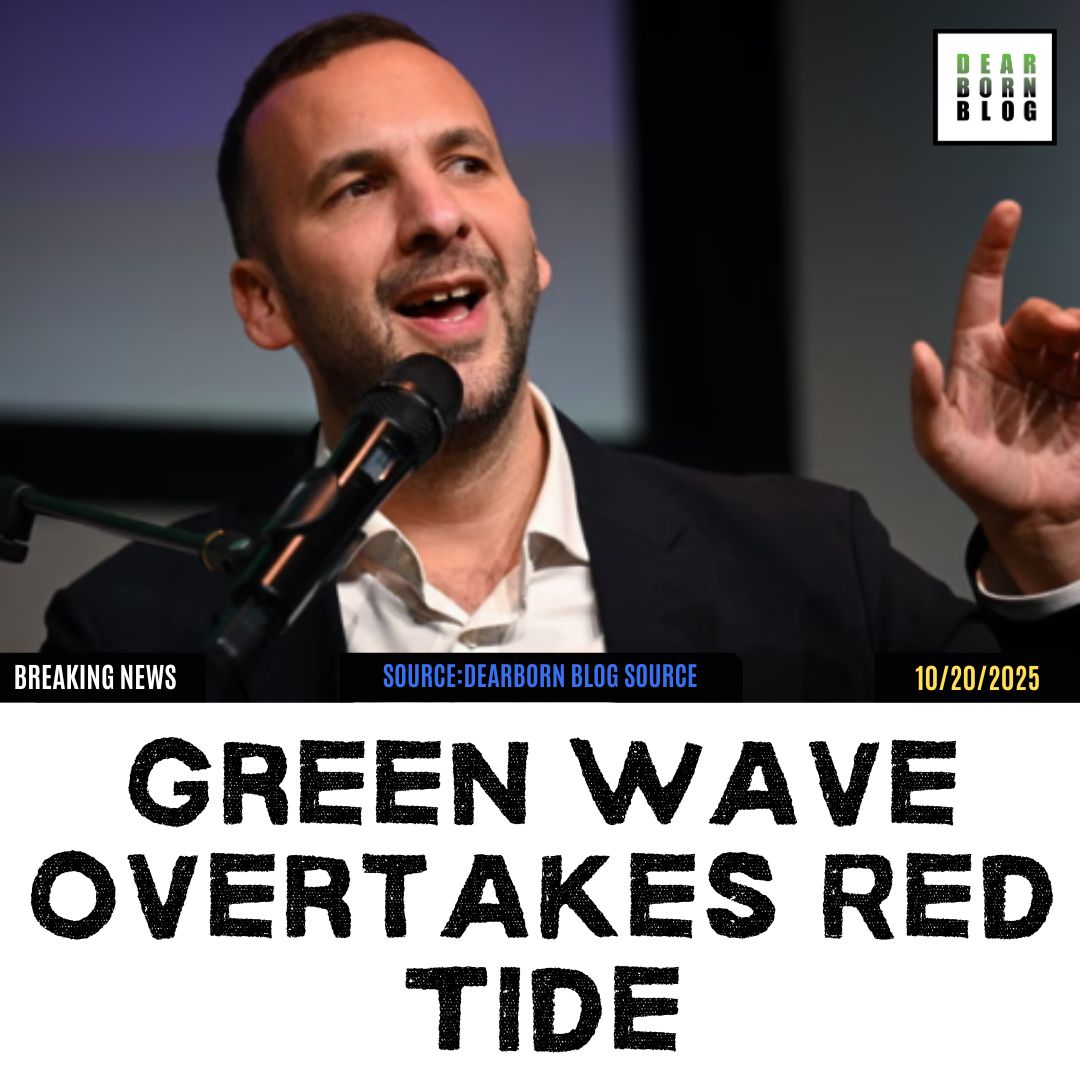
In a stunning turn for British politics, the Green Party under new leader Zack Polanski has surged to record levels—matching, and in one reputable tracker fractionally edging, Labour’s vote share—while membership rockets past 100,000 (and reportedly toward 115,000). It’s not just a poll blip; it’s a structural story about values, climate, fairness, and foreign policy that resonates far beyond the UK—Dearborn included. [1][2][3][4]
By the numbers
Polling & Membership
- 15% voting intention in a 16 Oct tracker (Labour at ~15%). [1]
- 100,000+ members (a first). [2]
- Surpassed Lib Dems in members; rapidly climbing toward UK Tory levels. [3][2]
- 115,000 claimed by Polanski in media appearances. [4]
Britain’s party system just did something weird and wonderful. The Greens—long pigeonholed as earnest environmentalists who could win council seats, the odd parliamentary constituency, and moral arguments—are suddenly the gravitational center of a nationwide conversation. Polls are snapshots, not verdicts, and margins of error are real. Yet when multiple reputable indicators point the same direction, you pay attention. On 16 October 2025, Find Out Now’s national tracker put the Greens at 15%, with Labour around the same level; down to two decimal places, Greens were 15.31% to Labour’s 15.23%—statistically neck-and-neck, but symbolically seismic. [1][5]
Membership figures tell an even louder story. The Greens have raced past 100,000 members for the first time in their history, after Polanski’s early tenure sharpened message discipline and media presence. [2] Earlier this month, Sky reported the Greens had overtaken the Liberal Democrats in membership; party statements and subsequent reporting suggest the figure is now well above six digits and climbing fast. [3][4][8]
“We’re not here to be disappointed in Labour. We’re here to replace them.” —Zack Polanski
Whether you agree with that ambition or not, you can’t deny the changed weather.
Why this surge—and why now?
Two winds are blowing in the Greens’ favor.
First, values friction. Labour under Keir Starmer won office promising competence after chaos. But competence without courage eventually looks like managerial caution. When senior Labour voices frame nature protections as red tape and elevate growth over biodiversity safeguards, they risk alienating younger voters who actually like snails and affordable homes, and who suspect we can build both if we reform the land and housing model instead of scapegoating habitats. [6] Editorials in mainstream outlets warn that eroding environmental safeguards betrays public sentiment and science. [6]
Second, the policy agenda. Polanski’s Greens aren’t hiding the ball: public ownership of core utilities, serious climate investment linked to good jobs, stronger workers’ rights, and a wealth-tax conversation focused at the very top. [7] The wealth-tax debate is live again—and contested. The Spectator blasted Polanski’s stance as “nonsense,” channeling familiar objections. [9] But the UK’s 2020 Wealth Tax Commission—a cross-disciplinary team anchored by LSE and Warwick scholars—concluded that if the state needs to raise revenue, a one-off wealth tax could work better than hikes on work or consumption. [12][13][14] Translation: reasonable people can disagree on mechanisms, but the Greens are operating within a serious evidence base—not fantasy economics.
Media dynamics: when the frame becomes the story
The UK press isn’t a neutral park bench; it’s a rugby scrum. Coverage of the Greens has swung between marginalization and hostility: polemics about “wokeness,” dire warnings about wealth taxes and migration, and tut-tutting about political naivety. [10][11][9] Yet adversarial coverage can backfire in an era of social platforms and decentralized media. Polanski is comfortable on combative programs—BBC Question Time clips of him arguing for humane migration policy and public services have circulated widely. [15][16][17] The Greens have leveraged that attention into membership sign-ups and local organizing, converting energy into structure.
There’s also a glaring asymmetry. Nigel Farage—often without MPs—long received disproportionate airtime on the BBC’s flagship panels, reshaping national discourse. [5] Green leaders have historically been granted fewer marquee slots, despite electing multiple MPs and governing in local councils across the country. The recent polling helps to puncture that bubble: ignore a growing movement only at the risk of misinforming the public.
“The Greens are enjoying their best polling in their history… Just 13 months after winning the election, Labour is on its worst post-war polling.” [5]
The electoral map underneath the headline
It’s tempting to read a single tracker as pure momentum. Resist that. Britain’s first-past-the-post system punishes dispersed vote shares. But the Greens’ 2024 breakthrough—four MPs—sat atop dozens of second-place finishes in urban strongholds: London, Manchester, Bristol, Sheffield, Norwich. [7] Dense clusters of winnable seats can turn 15% nationally into real Parliament arithmetic, especially if Labour continues bleeding young, progressive voters to the left while tackling Reform UK on the right. [7]
If you care about results (not vibes), watch the local elections and by-elections, ward-level swings, and organizational depth. Membership surges aren’t magic, but they are capacity: door-knockers, leaflet runs, data teams, poll watchers. Sky’s reportage and the Greens’ own numbers suggest the party has overtaken the Lib Dems in membership and is eyeing Conservative figures. [3][2] That arms race matters when turning national attention into local victories.
Big fights, clear lines
Three debates define this moment:
- Climate vs. “cut the green crap.” The Greens link climate action to decent jobs and lower bills (insulation, heat pumps, rail, renewables). Labour risks looking extractive if it frames nature as a speed bump rather than a shared asset. [6][7] In Dearborn terms: think of it as choosing between short-term pothole patching and long-term complete streets.
- Wealth tax vs. status quo. The Spectator and business-friendly voices deride wealth taxes as “daft” or unworkable; ministers echo that skepticism. [18][9] Yet the Wealth Tax Commission’s rigorous work outlines how a time-limited levy on ultra-high wealth could raise substantial revenue with fewer distortions than higher payroll or consumption taxes. [12][13][14] The serious question is design, not dogma.
- Foreign policy rooted in human rights. Greens propose a peace-first approach—cutting arms exports to human-rights abusers and backing international law, including accountability for war crimes. [7] That includes an unflinching stance on Gaza: end arms sales used in atrocities, push for ceasefire, back humanitarian law. [7] For Dearborn—home to one of America’s largest Arab communities—this is not abstract. When British Greens speak for proportionality, accountability, and dignity, it resonates with families who have watched relatives suffer under bombardment and blockade.
Is the surge sustainable?
Short answer: it depends on three execution challenges.
Message discipline. The Greens’ advantage is moral clarity tethered to practicality. Voters smell utopianism when numbers don’t add up. Polanski’s team has leaned into credible costings and partnerships with economists, while a chorus of critics insists it’s fantasy. [9][12][18] The party must continue translating values into bills-lowering, street-level benefits.
Broad coalition-building. The left universe in Britain is fractal. There’s chatter of new parties and alliances (Corbyn/Sultana), but organizational duplication is a momentum killer. The most disciplined outfit will inherit the wind. [5][7]
Ground game. British politics is still won in church halls and WhatsApp groups. Membership is the input; turnout is the output. If the Greens convert sign-ups into canvassing shifts, they can flip more second places into wins—especially where local air quality, bus cuts, damp housing, and energy bills make “green” feel like “my kid’s asthma” rather than “someone else’s polar bear.”
What this means for Dearborn
We’re an ocean away, but not a value away. The Green Party’s rise maps onto the same civic instincts we see in Dearborn: public goods over private predation, clean air over corporate excuses, and foreign policy that honors human life—Palestinian, Israeli, Yemeni, Ukrainian, Lebanese—without exception. Communities like ours have long argued that climate justice and peace politics are pocketbook issues. If the UK Greens can keep this surge grounded in practical wins, it strengthens green movements globally, including the Green Party here in the U.S.—and inspires Dearborn’s own push for clean transport, affordable housing, and accountability in public spending.
Voices and pushback
It’s not all roses and rooftop solar. The Telegraph has aimed a steady stream of barbs at Polanski’s “woke” leadership, framing the party as unserious and extreme. [10][11] The Spectator’s critique of wealth taxes is part of a broader elite recoil at redistributive tools—sometimes reasoned, sometimes reflexive. [9] Government ministers have waved off wealth taxes as impractical, even as watchdogs scold HMRC for failing to track billionaires’ tax behaviors effectively. [18][19] That tension—“we can’t tax it” vs. “we won’t even count it”—is becoming untenable with public services visibly fraying.
Then there’s the polling caution. Professional bodies urge journalists (and all of us) to treat snapshots with care, understand margins, and focus on trend lines and methodology. [5][20][21] Find Out Now, for its part, is an MRS partner and a British Polling Council member; its own post-mortems on the 2024 election show a willingness to interrogate misses. [5][21] That’s healthy.
“Opinion polls are not oracles; they’re instruments.” What matters is consistent movement, convergent indicators, and what happens when the canvas hits the doorstep.
The take-home
Whether the Greens are “ahead” of Labour by 0.08 percentage points is not the point. The point is that Britain’s political appetite for fairness, climate realism, and human-rights-first foreign policy is bigger than the legacy parties have admitted. A competent state doesn’t have to be a timid one. A green transition doesn’t require austerity cosplay. And international law is not optional depending on which ally violates it.
Dearborn readers know this story. We’ve built coalitions across faiths and neighborhoods to demand breathable air, honest budgets, and an end to blank-check militarism. The Green surge in the UK is a mirror, not a spectacle. It reflects what communities like ours are already doing: organizing, insisting, and refusing the false choice between pragmatism and principle.
If this is a blip, it will fade. If it’s a beginning, it will deepen—with school-run air quality monitors, bus lanes that actually run, municipal retrofits that lower bills, and foreign policy that applies the same moral yardstick to everyone.
The next chapters won’t be decided on television panels. They’ll be written in ward meetings, on doorsteps, and in city halls. That lesson travels well—from Westminster to Dearborn City Hall.
Sources
[1] Find Out Now, “Voting intention: 15th October 2025.” (Oct 16, 2025). findoutnow
[2] The Guardian, “Green party reaches 100,000 members for first time after Polanski becomes leader.” (Oct 12, 2025). The Guardian
[3] Sky News, “Green Party membership overtakes Liberal Democrats under Polanski.” (Oct 4, 2025). Sky News
[4] The Independent, “Greens leader Zack Polanski says he is talking to Labour MPs about defections.” (Oct 16, 2025). The Independent+1
[5] Owen Jones, “Greens pull ahead of Labour.” (Oct 16, 2025). owenjones.news
[6] The Guardian (Editorial), “The problem isn’t snails, but a broken housing model.” (Oct 12, 2025). The Guardian
[7] New Statesman, George Eaton, “Labour has a Green problem.” (Oct 15, 2025). New Statesman
[8] Green Party (press office), “Membership surges past 100,000 as polls show record support.” (Oct 12, 2025). greenparty.org.uk
[9] The Spectator, Matthew Bowles, “Polanski is talking nonsense about wealth taxes.” (Oct 13, 2025). The Spectator
[10] The Telegraph, “The Green Party’s woke new leader is even more deluded than we thought.” (Sept 13, 2025). Telegraph
[11] The Telegraph, “The Green Party conference captured everything wrong with the modern hard-Left.” (Oct 6, 2025). Telegraph
[12] Wealth Tax Commission, A Wealth Tax for the UK (Final Report). (Dec 9, 2020). wealthandpolicy.com+1
[13] Deloitte Tax, “Wealth Tax Commission: Final report—summary.” (Dec 9, 2020). taxscape.deloitte.com
[14] Wealth Tax Commission, Evidence Papers (attitudes, design, administration). (2020). Wealth Tax Commission
[15] YouTube (BBC QT clip), “Zack Polanski and Reform UK’s Zia Yusuf trade blows on Question Time.” (Oct 2025). YouTube
[16] BBC Question Time (Facebook clip), “How do you expect people to integrate…?” (2025). Facebook
[17] YouTube stream, “LIVE: Zack Polanski on Question Time (watchalong).” (Oct 2025). YouTube
[18] Financial Times, “UK business secretary dismisses wealth tax as ‘daft’.” (Aug 2025). Financial Times
[19] The Guardian, “HMRC criticised by watchdog for failing to track billionaires’ tax.” (July 16, 2025). The Guardian
[20] Market Research Society, “Interpreting polls and election data—guidance for media and journalists.” (2024–25). Market Research Society
[21] Find Out Now, “Find Out Now and the 2024 General Election: polling error review.” (Nov 15, 2024). findoutnow
Credits & Notes
- Headline, editorial framing, and analysis by Dearborn Blog.
- Fact-check emphasis: polling dates (Oct 16, 2025), membership milestones (Oct 4–12, 2025), and media reactions as cited above.
Disclaimer
This article is for news, analysis, and educational purposes. We cite publicly available sources and make good-faith efforts to present accurate information at time of publication (October 17, 2025). Polling data reflects snapshots with margins of error and methodological limits. Opinions expressed here are those of the Dearborn Blog editorial voice, which is supportive of the Green Party platform’s commitments to peace, climate action, social justice, and Palestinian human rights while striving for balanced, evidence-based reporting. Dearborn Blog does not accept liability for decisions made based on this coverage; readers should consult original sources and official documents for definitive guidance.

 Dearborn Blog