


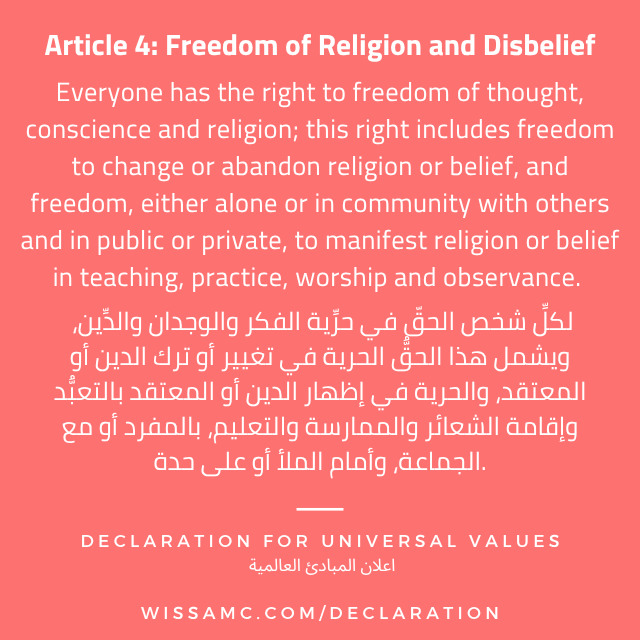
.FridayMusings is pleased to provide our readers with Article 4 – Freedom of Religion from the Universal Declaration of Human Values by Wissam Charafeddine, a Livonia author and lecturer. This article is particularly important with its discussion of defending the dignity of the believer–but the humanity of the doubter.Everyone has the right to freedom of thought, conscience and religion; this right includes freedom to change or disavow his religion or belief, and freedom, either alone or in community with others and in public or private, to manifest his religion or belief in teaching, practice, worship and observance.
With over 4300 religions in the world, over 32,000 Christian denominations, 10’s of thousands of Muslim and Jewish sects and schools of thought and over a trillion Hindu and Budhist Gods, the freedom to believe—or not to believe—is one of the most sacred rights a human being can possess. Article 4 of the Universal Declaration of Human Values affirms that and includes the right to change or disavow one’s religion, and to practice, teach, and express belief—either alone or with others, in private or in public. These freedoms protect not just religious devotion, but the autonomy of the soul and mind.This article is rooted in Article 18 of the Universal Declaration of Human Rights, drafted after the horrors of global religious persecution and war. It reflects centuries of philosophical struggle: from Locke’s Letter Concerning Toleration, which argued that faith must be free of state control, to the Enlightenment thinkers who demanded reason over dogma. It also draws from the painful lessons of the Reformation, the Inquisition, and countless modern-day examples where individuals have been punished—or killed—for their beliefs, conversions, or criticisms of religious authorities.
Today, religious freedom is still under siege around the world. Apostates and freethinkers are imprisoned or executed in several countries. In others, entire religious communities face systematic discrimination—whether it’s Uyghur Muslims in China placed in camps, Christians attacked in India, or Baha’is denied citizenship rights in Iran. Even in so-called democracies, laws exist that blur the line between blasphemy and dissent, making it dangerous to question mainstream religious narratives. As someone who has exercised this right by publishing my Arabic-language book Dialogue: Universe from Void—a respectful but direct critique of classical proofs of God’s existence—I recognize that this freedom is not guaranteed everywhere. My ability to speak, write, and reflect on these matters without fear is a privilege many still do not have.
True freedom of religion includes the freedom to search, to question, to leave, or to reform. It includes the right to be silent, and the right to speak. Without that, belief becomes coercion, and conscience becomes property of the state or the mob. In defending this right, we defend not only the dignity of the believer—but the humanity of the doubter.

 Dearborn Blog