

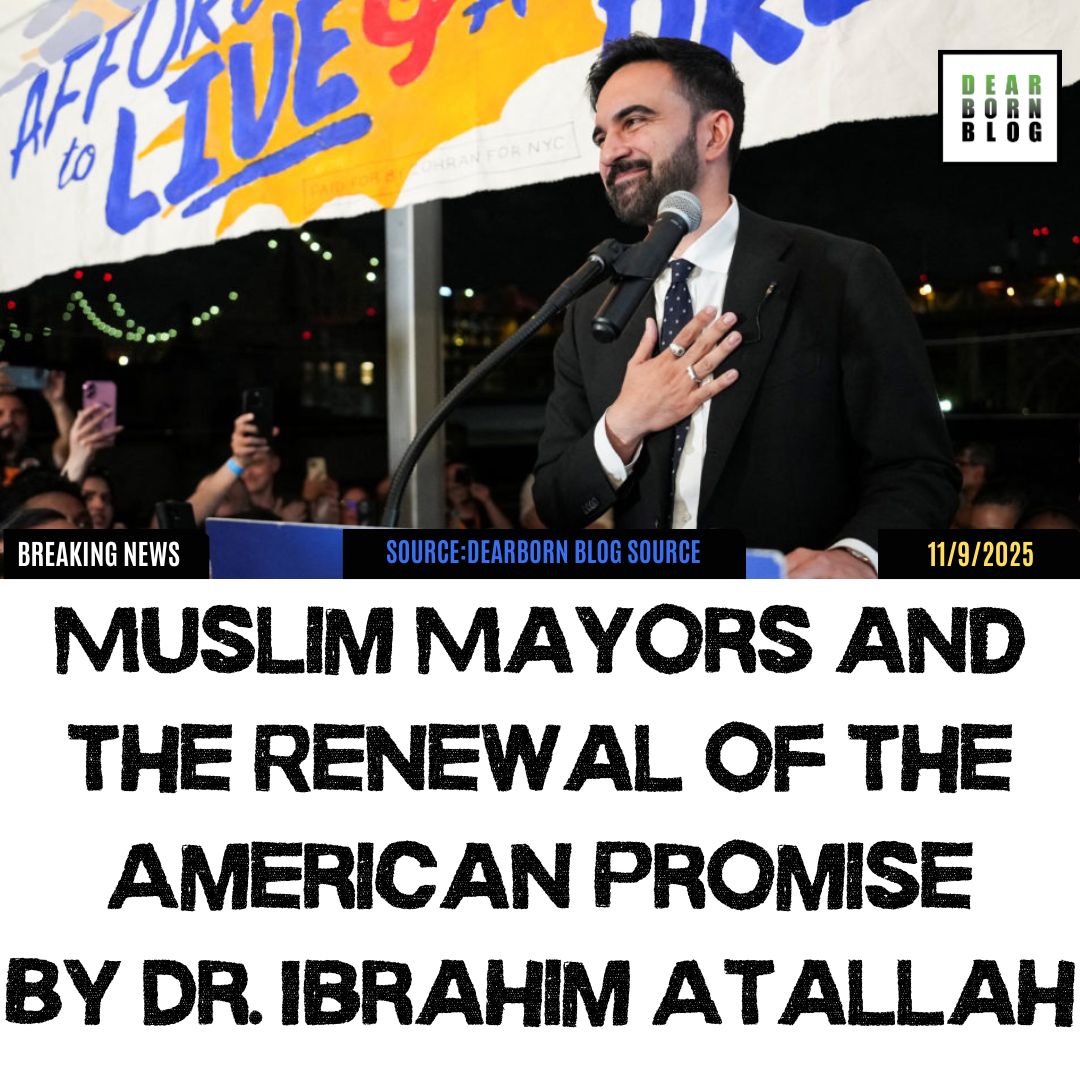
By Dr.Ibrahim Atallah
The recent elections in Dearborn, Dearborn Heights, Hamtramck, and New York have drawn unusual attention, largely because the mayors elected in these communities are all Muslim. For some, this development has stirred unease, as if it signals that one group is “taking over.” Yet such reactions overlook the deeper and more inspiring truth these elections reveal: the enduring greatness of America itself.
It is unfortunate that much of the media coverage has placed so much emphasis on the candidates’ faith background, subtly framing them as Muslim mayors rather than simply American mayors. In doing so, they risk portraying these leaders as something other than fully part of the American story, as though being Muslim somehow qualifies one’s citizenship, as though their achievements belong to a separate narrative. But these men and women are not foreigners governing American towns; they are Americans, chosen by their fellow Americans to serve their communities.
Some religious ideologists on either side may read these events through the lens of conquest or fear, one side whispering, “We are taking over America, city by city,” and the other warning, “America is being taken over by foreigners and Muslims.” Both interpretations miss the truth entirely. The story here is not one of invasion or conversion, but of participation, the fulfillment of a promise that every citizen, regardless of creed, can stand under the same flag and serve the same people.
America’s greatness has never rested in sameness but in openness, in the radical idea that an individual’s background need not define their destiny. Immigrants can arrive from any corner of the earth, carry accents, customs, or faiths unfamiliar to the majority, and still rise to positions of influence and leadership. That is not a threat to America; it is a testament to it.
From Barack Obama’s election as the first Black president to Muslim mayors now serving in some of the country’s most diverse cities, we see the same principle at work, a belief that public trust is not inherited through race or religion but earned through service, competence, and care for one’s community. This is not the story of “Muslims taking over.” It is the story of Americans, in all their variety, practicing the promise of democracy.
Those who claim that America is irredeemably racist must also reckon with this fact: in these elections, the voters themselves were not uniformly Muslim. They were first Americans with diverse backgrounds, Christian, Jewish, secular, Arab, Whites, African, Asian, and European, people who looked beyond difference to character. These victories were possible not because America is perfect, but because it is free.
There is, however, a particular glory in what took place in New York. While the elections in Dearborn, Dearborn Heights, and Hamtramck are meaningful, the diversity in those cities is not as wide as that of New York. In such communities, electing an Arab or Muslim mayor may, to some extent, follow naturally from demographic makeup. But in a city as vast and varied as New York, where no single group defines the majority, to elect an Arab or Muslim official reflects something deeper: the triumph of shared values over inherited boundaries, and the willingness of a truly diverse people to see beyond the lines that once divided them.
And yet, beyond that, there is the election of a Sikh, as mayor of Norwich, Connecticut, a citywhere the Sikh community is a minority. His rise to leadership is not a mere political event; it isa profound reminder of the American promise that leadership is not reserved for the familiar orthe expected, but is open to all who embody integrity, vision, and the will to serve. His storymagnifies what is most noble in the American ideal: that the measure of a person’s belonging isnot where they came from, but what they contribute to the common good.
In a world still divided by tribe, sect, and suspicion, America’s experiment in pluralism remains one of history’s boldest moral endeavors. The ideal that anyone, regardless of origin, can participate in self-governance is what keeps the nation alive and worth defending. When immigrant, Arab, or Muslim mayors take their oaths of office, they do not represent the triumph of Islam over America, but the triumph of American principles over prejudice.
Public officials should not run on any ticket other than their commitment to America itself, on the strength of their qualifications, their integrity, and their willingness to serve. Their faith may inform their conscience, but it must never eclipse their duty to the whole.
The moment calls for celebration, not as the triumph of any group “taking over” an office, but as the renewal of the American promise, that public service remains open to all who are willing to bear its weight. This is not the victory of religion over secularism, nor of one community over another, but of democracy over division, and of citizenship over fear.
The story, then, is not one of takeover but of trust, trust that citizens of differing faiths can share the same public square, uphold the same constitution, and trust that their elected officials are Americans first, before anything else. It is a story still unfolding, sometimes haltingly, but always toward greater inclusion. That, in the end, is what makes America not only exceptional, but profoundly hopeful.

 Dearborn Blog