

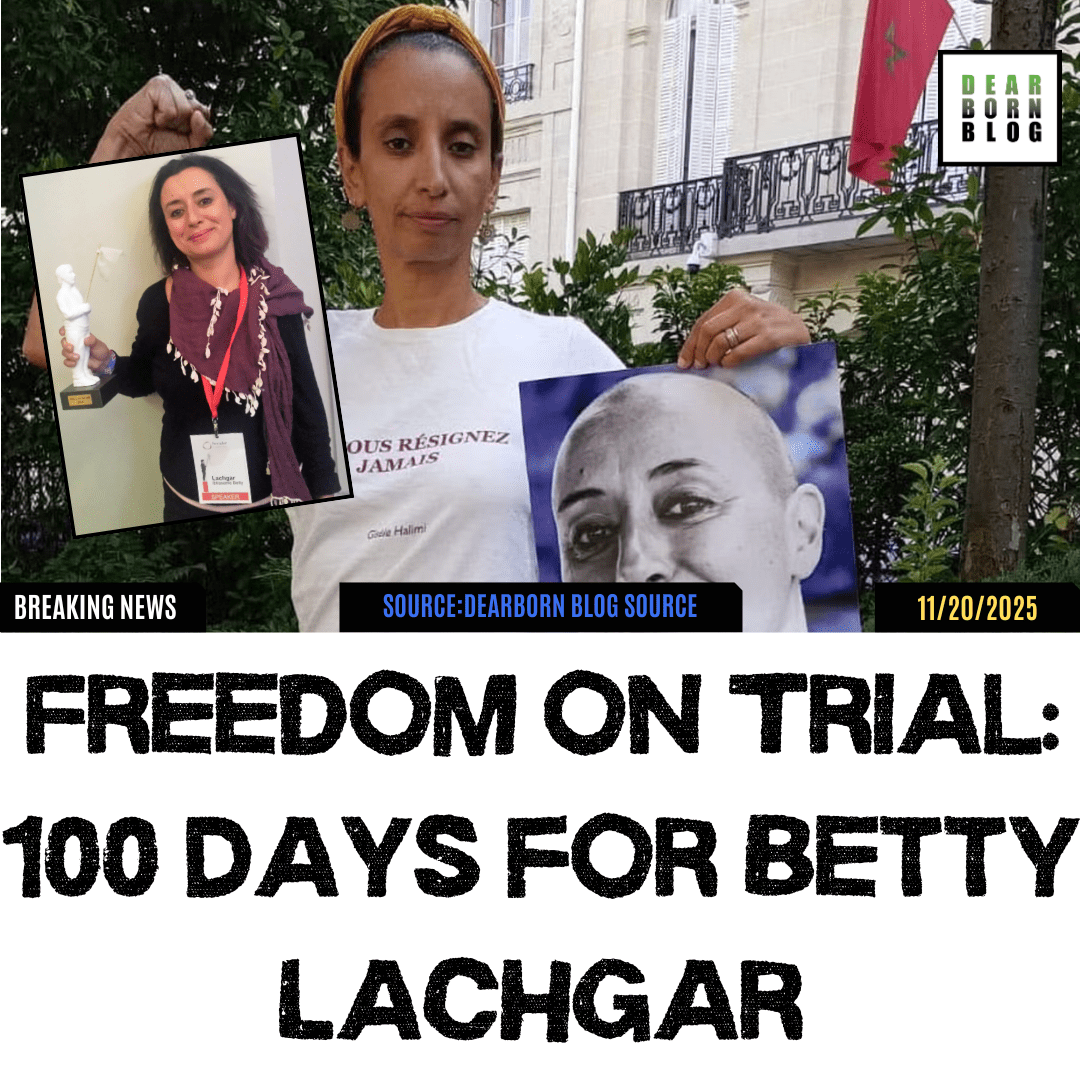
It’s been 100 days since Moroccan feminist and LGBT+ advocate Ibtissame Betty Lachgar (also known as Betty) has been behind bars—detained for what her sister describes as a t-shirt, a prosthetic arm on the brink of collapse, and a broader battle for freedom of conscience, expression and bodily autonomy. This blog unpacks the case, the stakes for women and minorities in Morocco, and why we in Dearborn stand with her.
2025 marks a grim milestone. For 100 days, Betty Lachgar has been in detention in Morocco under blasphemy charges. Her sister, Siham Lachgar, issued a plea:
“100 days for thinking freely, speaking freely, living freely for a fairer world for all of us.”
The letter arrives amid mounting concern: Betty is a cancer-survivor, reliant on a prosthesis in her elbow—from treatment in Paris—and now faces imminent amputation absent proper care. Her incarceration isn’t just a legal case: it’s a human rights bellwether.
Who is Betty Lachgar?
Betty is a Moroccan developmental psychologist, feminist and human rights activist. She co-founded the progressive, secular group Mouvement alternatif pour les libertés individuelles (MALI) in 2009, advocating for individual freedoms, secularism, LGBT+ rights and women’s bodily autonomy. Wikipedia+2Wikipedia+2
Her activism has repeatedly challenged taboos: public “kiss-ins” in support of youth arrested for posting a photo of a kiss; campaigns for legalising abortion in a country where sex outside marriage and homosexuality remain criminalised. Wikipedia+1
In short, Betty is a lightning rod for change. Her case now casts long shadows.
The Arrest and Charges
On 10 August 2025, Betty was arrested in Rabat after posting a photo of herself wearing a t-shirt bearing the slogan “Allah is lesbian” (in English), a provocative re-working of a feminist slogan (“I met God, she is Black, communist, and lesbian”) which she had previously worn abroad. The Independent+1
The Moroccan prosecutor charged her under Article 267-5 of the Penal Code (insulting the Islamic religion) and related provisions that criminalise “offending God” or Islam via public means. Human Rights Watch+1
In early September the Rabat First Instance Court sentenced her to 30 months’ imprisonment (2½ years) and a fine of 50,000 dirhams (about US$5,000) after finding her guilty of blasphemy and image-dissemination. Morocco World News+1
Her defense has appealed the verdict. Human Rights Watch
Conditions of Detention & Health Crisis
While legal documents operate in the language of charges and penalties, Betty’s lived reality is stark:
- Before arrest, she was receiving treatment in Paris for cancer and had scheduled surgery to return to Morocco in September. The Independent
- In detention: her prosthetic elbow has reportedly detached. Her cell is cold, the window broken, she sleeps on a hard surface without a mattress, and she reportedly did not receive proper specialised medical care until her 100-day mark.
“For 100 days, my sister … has been sleeping on a hard surface without a mattress in a cold cell (broken window).” — Siham Lachgar
- Her phone communications are severely restricted: three 10-minute calls per week to one authorised number, visits only by immediate close family once a week. Isolation intensifies vulnerability.
All of this amplifies the injustice: a serious health condition + detention + legal uncertainties = a humanitarian emergency.
Why This Case Matters
There are multiple layers:
Freedom of Expression
Betty’s case exemplifies the tension between state-protected religious sanctities and individual liberty. Human rights observers say her conviction undermines press freedom, academic freedom and the freedom to dissent. Metro Weekly+1
Gender & Minority Rights
As a feminist and LGBT+ advocate operating in a context where both women’s rights and queer rights are heavily constrained, Betty’s detention signals a chilling message: activism, especially independent from state allowances, may trigger severe reprisals.
Stat call-out:
2½ years in prison + 50,000 dirhams fine for wearing a t-shirt and posting a photo.
Health Rights
Detaining someone with serious medical needs and refusing provisional release or adequate care raises fundamental questions of justice, medical ethics, and human dignity. It also shifts the case into the realm of political imprisonment—or at least politically-charged detention.
Global Solidarity & Palestine Connection
Though this is a Moroccan case, there are parallels to other struggles for self-determination, freedom of conscience, and emancipation globally. The blog is pro-Green, pro-Liberation, and pro-Palestine: the thread is the same. When one person’s freedom of thought is suppressed, the freedom of many is threatened.
What the Moroccan Context Reveals
Morocco is often cast as a moderate or reforming state in the Maghreb. Yet, legal mechanisms remain. Article 267-5 of the Penal Code punishes “anyone who, through words, gestures or written expressions, offends the Islamic religion.” The penalty can reach up to 5 years in prison and large fines. Wikipedia+1
Observers note that while the law has existed, its application here seems sharper—with international human-rights organisations decrying the verdict as “harsh” and disproportionate. Morocco World News+1
What’s also relevant: The social media post was made July 31, 2025, but she had worn the shirt abroad earlier without prosecution. Some analysts suggest the sheaf of reporting accounts, online mobilisation and timing reflect a broader conservative shift or political opportunism. Le Monde.fr
A Sister’s Voice, A Collective Call
Siham’s letter is powerful. It is not just about Betty—it is about every woman, sister, daughter in Morocco and beyond. The sentence touches them all. The isolation, the health neglect, the penal system—it’s all part of a broader story of suppressed dissent.
“It’s not my sister they’re judging: it’s all women, mothers, sisters, daughters! It’s not my sister they’re judging: it’s freedom itself they’re trying to silence.” — Siham Lachgar
For 100 days, the world has watched—but observation isn’t enough. Calls to sign petitions, to share the #FreeBetty and #100Days hashtags, to demand her immediate release are more than symbolic—they are solidarity in action.
What Can You Do?
- Sign the petition at FreeBetty.org (or follow the link from trusted organisations).
- Share the story via social media: use hashtags #FreeBetty #100Days, amplify the voices.
- Support legal-aid / human-rights orgs that operate in Morocco and North Africa, including local feminist and LGBT+ groups.
- Push your elected officials (in US, EU, Canada, etc.) to raise the case in diplomacy: detention of activists for freedom of expression must not become normal.
- Stay informed: Monitor updates to the case, medical rights of detainees, and linkages with broader Arab-Maghreb civil-liberty issues.
Why Dearborn Blog Cares
Here at Dearborn Blog we align with the Green Party’s emphasis on human rights, social justice, anti-colonial solidarity, and radical inclusion. The same values that drive our support for Palestine also compel us to stand with feminist, queer and secular voices under threat. Betty’s struggle is one strand in the global tapestry of resistance to authoritarianism—religious or secular.
It is neither patriotic nor progressive to ignore cases like this because they are “over there.” Because they implicate the same systems of power that marginalise Palestinians, women, queer people—even those of us working for social entrepreneurship in Detroit-area communities. We are connected by justice-flows, not bound by geography.
When freedom of expression, conscience, bodily integrity, dignity become conditional on state toleration, none of us are truly free.
Disclaimer:
The content of this article is for informational and advocacy purposes only. While every effort has been made to check the facts, the authors and publishers of Dearborn Blog are not legal experts in Moroccan law, and this article should not be taken as legal advice. Neither Dearborn Blog nor its authors accept legal liability for actions taken based on the content herein.

 Dearborn Blog