

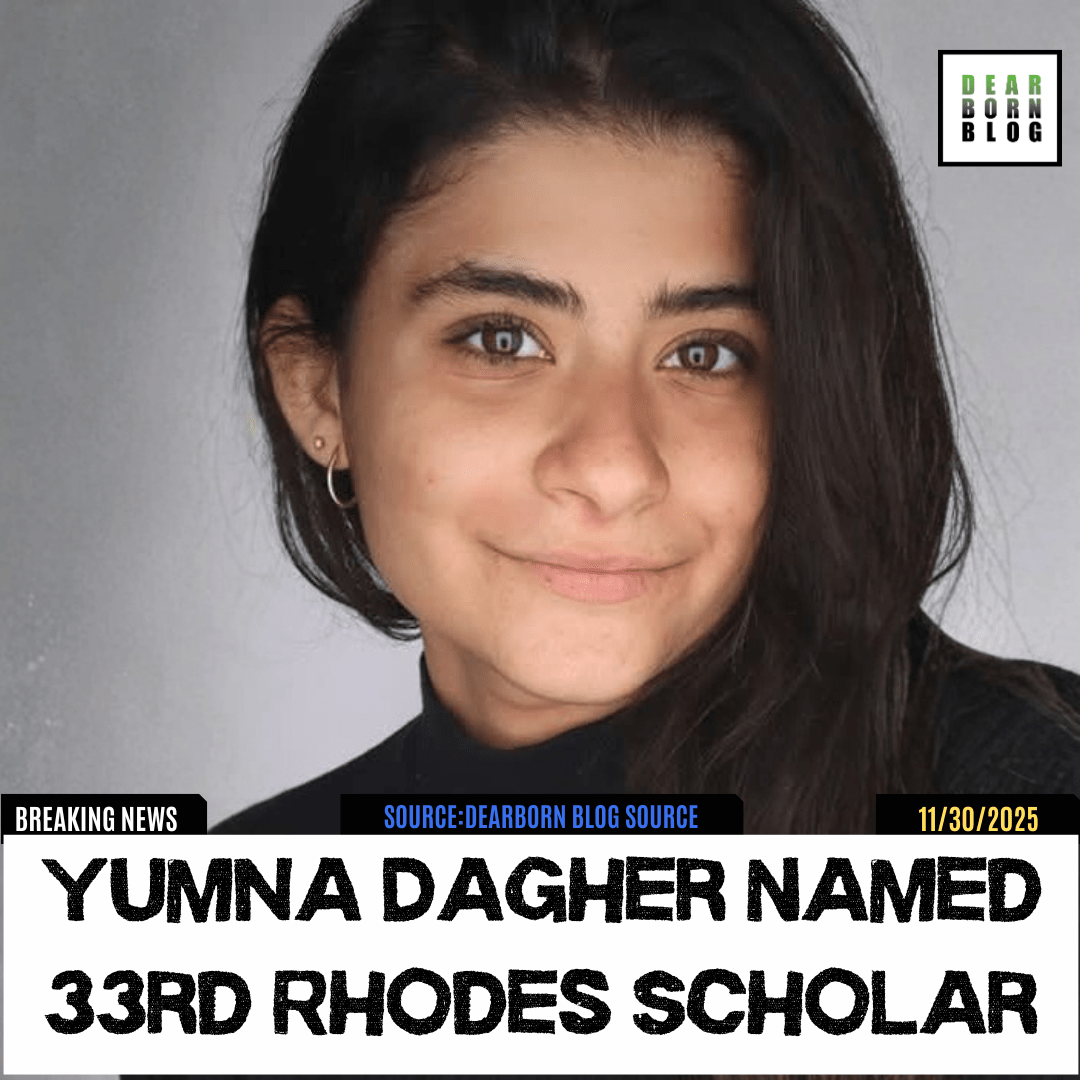
Yumna Dagher, a recent graduate of University of Michigan (U-M), has been named a 2025 Rhodes Scholarship recipient — becoming the 33rd Rhodes Scholar from U-M. Her journey from campus-gardens and Detroit urban farms to Oxford speaks to a vision that blends environmental justice, community food sovereignty, and cultural expression — a vision that resonates deeply with Dearborn Blog’s commitment to sustainable communities, collective liberation, and global solidarity
A New Chapter at Oxford
Last week, the University of Michigan announced that Yumna Dagher had been selected as a 2025 Rhodes Scholar — one of just 32 Americans awarded the scholarship this year. detroit.umich.edu+2Rhodes House+2 As a recent graduate with double majors in English and Environment (through U-M’s Program in the Environment), Dagher becomes the 33rd Rhodes Scholar from U-M since the awards began in 1902. The University Record+2Wikipedia+2
At Oxford, she plans to pursue graduate degrees in Nature, Society and Environmental Governance as well as Visual, Material and Museum Anthropology. Rhodes House+2UMich School for Environment+2
“I have always wanted to pursue graduate studies, but found myself at a juncture — the possibility of a fully funded graduate education seemed far away,” Dagher reflected. “Now, heading to Oxford, I hope to gain the theoretical grounding and interdisciplinary training necessary to build projects that honor the kinds of relational practices I witnessed on campus and within Detroit environmental spaces, where stewardship becomes a vessel for building collective climate futures.” detroit.umich.edu+1
In her own words, she envisions her path “at the intersection of culture, cooperative economics and sustainable food systems,” along with continuing her art and writing practice as a printmaker, cartoonist, and poet. Rhodes House+1
From Campus Farm to Community Resilience
Dagher’s journey is deeply rooted in land, community, and sustainable food — not just theory. As an undergraduate, she worked at U-M’s Campus Farm starting in 2024, collaborating with student-farmers, engaging in fieldwork, and teaching in the program’s refugee garden. That garden — co-administered with a resettlement agency — provided newly resettled gardeners the chance to grow culturally familiar crops and sustain food traditions after displacement. UMich School for Environment+2The University Record+2
During the 2024 growing season, Dagher and fellow interns helped grow thousands of pounds of organically produced food — destined for U-M dining halls and community members. She also supported the Mobile Farm Stand, a student-led pop-up market bringing locally grown produce directly to campus. UMich School for Environment+1
Her involvement deepened after visiting a Detroit-based, Black-led collective (Oakland Avenue Urban Farm). There, she learned firsthand that agriculture is more than food — it’s a foundation for community building, social justice, resilience. She internalized a vision of environmental stewardship as integral to collective survival and dignity. The University Record+1
Returning to campus, Dagher assumed leadership of U-M’s Sustainable Food Program (UMSFP). Under her guidance, the program repurposed an unused campus café into a climate-resilience hub, hosting workshops and community meals as part of a “Rooting for Change Cafe” series. Underlying all this, Dagher emphasizes — it’s the relationships that matter: “At the center of UMSFP was our people… we understood the work as the relationships we built.” UMich School for Environment+1
Her vision extends beyond local farms or campus gardens. She aims to weave together land-based organizing, cooperative economics, sustainable food systems, art, writing — and global solidarity.
“Together, we can braid these perspectives … to create cross-border models of resilience.” michiganagconnection.com+1
Why This Matters (Especially for Communities Like Dearborn)
Dagher’s story isn’t just about individual academic prestige. It represents a model — of scholarship that doesn’t privilege abstraction over community, or market value over care. It represents an approach where environmental justice, food sovereignty, culture, and collective memory converge.
- Sustainable food as social infrastructure — Her work with the Campus Farm and UMSFP shows how food systems, especially community-oriented ones, can be engines of equity, dignity, and resilience. For places like Dearborn — where immigration, refugees, and diverse cultural communities intersect — this model offers a way to reclaim food traditions, nourish bodies and spirits, and build local networks of care.
- Land and ecology as community heritage — The Detroit urban-farm experience reminds us that land isn’t just a resource for profit. It’s a site of memory, and resistance, and belonging. Dagher’s work foregrounds land as a basis for community-building, intergenerational knowledge, and ecological stewardship.
- Culture, art, and identity tied to ecology — By combining environmental governance studies with anthropology, creative writing, printmaking, and community arts — Dagher’s path rejects narrow academic silos. She affirms that culture and ecology are inseparable, and that art can articulate ecological futures rooted in justice. This resonates with Dearborn’s ethos of multicultural solidarity and political consciousness.
- Global outlook with grassroots grounding — Heading to Oxford on full scholarship gives Dagher access to global networks, resources, and intellectual tools — but her vision remains rooted in Detroit and Michigan. She wants to “braid perspectives” across geographies. That’s the kind of translocal solidarity we need: global structures, local care, collaborative resistance.
What the 2025 Rhodes Class Shows — And Why It Matters
The 2025 American Rhodes Scholars — 32 in total — were chosen from nearly 2,800 applicants, with 965 officially endorsed by colleges and universities across the country, 238 finalists, and final selection after rigorous interviews. Women In Academia Report+1 This year’s cohort includes roughly 14 women among the 32 selected. Women In Academia Report
Given that there have been 3,706 American Rhodes Scholars since 1902 (across 329 institutions) Women In Academia Report+1 — Dagher’s success reminds us that prestigious academic awards are not the exclusive preserve of privilege. When institutions, communities, and movements center social purpose, environmental justice, and cultural roots, extraordinary opportunities can emerge.
For the University of Michigan, Dagher’s recognition continues a legacy — now 33 Rhodes Scholars deep. The University Record+1
What Lies Ahead — For Yumna, For Michigan, For Us
Dagher’s next chapter begins in October 2026 at the University of Oxford. There, she will pursue an M.Sc. in Nature, Society and Environmental Governance, followed by another M.Sc. in Visual, Material and Museum Anthropology. Rhodes House+1
If she stays true to her vision — blending cultural creativity, community-based food systems, ecological governance, and cooperative economics — she could help shape models for sustainable, just, and culturally rooted futures. For Detroit, Michigan, Dearborn and beyond — that matters.
Her journey also highlights what happens when institutions support intersectional thinking — when activism, art, ecology, and solidarity meet opportunity.
In the Spirit of Dearborn Blog
Dagher’s achievement and ambitions embody core values of Dearborn Blog: ecological care, cultural solidarity, community resilience, and global justice. As activism must go hand in hand with real, structural transformation — from land and food to governance and art — her path offers a hopeful blueprint.
We celebrate Yumna Dagher — not as a celebrity, but as a steward: of land, of community, of justice. We hope her journey inspires others — especially from communities like ours — to imagine, build, and sustain.
Her Rhodes Scholarship is not the end. It’s a new beginning — for her, for Detroit-area communities, for anyone who believes that sustainability must be rooted in solidarity, art, and collective dignity.
Sources
- “Inspired by Detroit’s resilience, U-M student earns prestigious Rhodes Scholarship.” University of Michigan News, November 21, 2025. detroit.umich.edu+2The University Record+2
- “Blending art, agriculture and governance at Oxford.” Michigan News / U-M, November 20, 2025. Michigan News+1
- “U-M’s 33rd Rhodes Scholar, a PitE alum, inspired by Detroit’s resilience.” The University Record, November 2025. The University Record+1
- “Rhodes Scholar Blends Art Agriculture and Governance to Shape Climate Futures.” Michigan Ag Connection, November 25, 2025. michiganagconnection.com+1
- “Fourteen Women Among the Latest Cohort of 32 Rhodes Scholars From the United States.” Women in Academia Report, November 21, 2025. Women In Academia Report
- “Yumna Dagher.” Rhodes House – The Rhodes Trust, 2025 Scholar Bios. Rhodes House+1
- “List of University of Michigan alumni.” Wikipedia. Wikipedia+1
Disclaimer: This article is produced for informational purposes only. Dearborn Blog makes no guarantee regarding future events, individual outcomes, or the accuracy of third-party sources. Interpretations, analysis, and opinions herein reflect only the voice of Dearborn Blog and do not constitute legal, financial, or professional advice.

 Dearborn Blog