

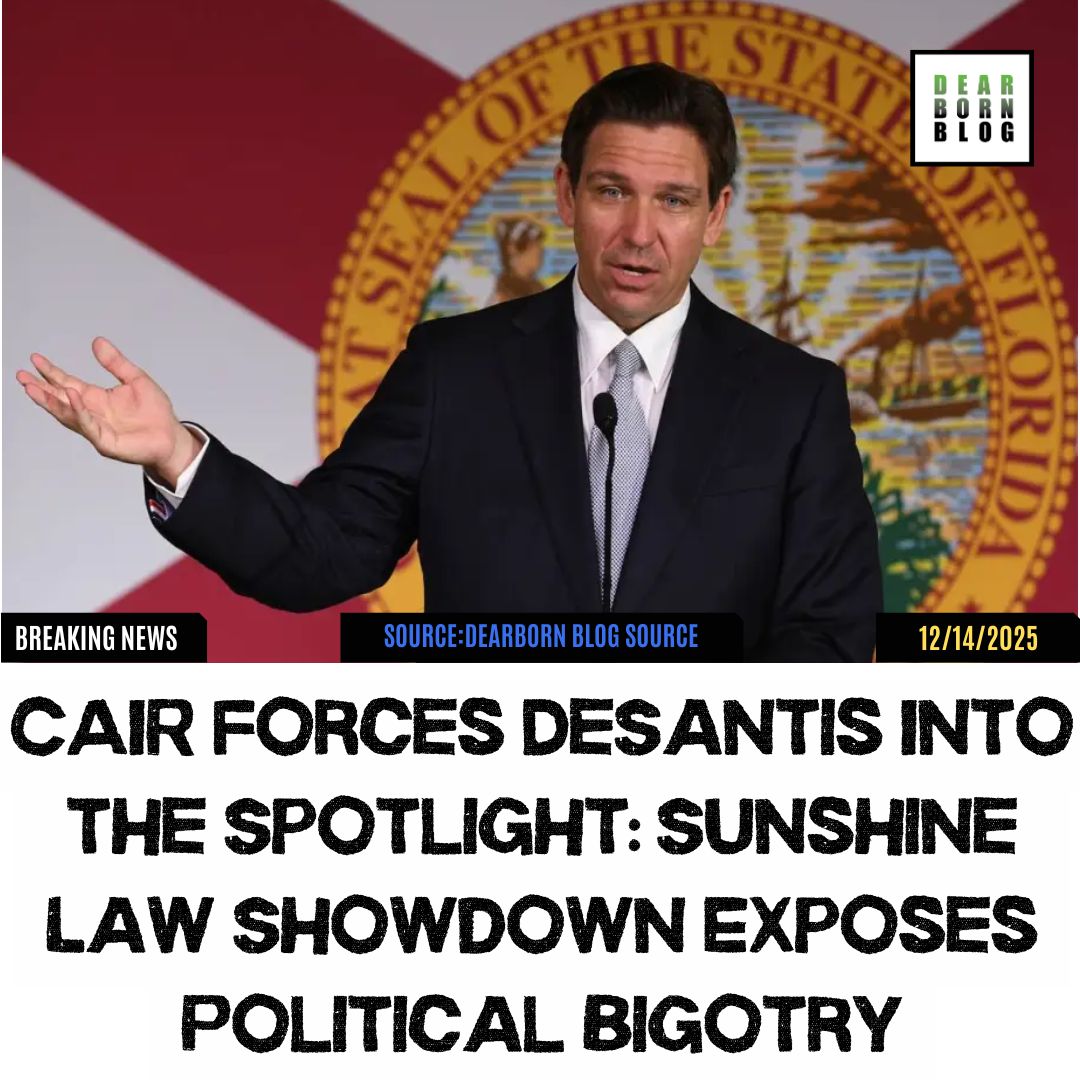
Florida Governor Ron DeSantis’ attempt to smear CAIR as a “terror organization” has backfired spectacularly. CAIR-Florida, backed by the nation’s largest Muslim civil rights group, has now dragged DeSantis and his network of political operators into a legal arena where discovery rules—not talking points—will define the truth. The fight is not just about one organization; it’s about whether the machinery of state power can be weaponized to silence advocacy for Palestinian human rights. And as Dearborn knows well, sunlight is disinfectant
When Bigotry Meets the Sunshine Law
Florida’s public records laws—the famous Sunshine Laws—have a long tradition of exposing corruption, collusion, and political misuse of public office. Governor Ron DeSantis may soon wish he had not invited the storm.
After DeSantis unilaterally designated CAIR as a “foreign terror organization,” a move immediately condemned by civil rights leaders, legal scholars, and constitutional advocates, the Council on American-Islamic Relations (CAIR) responded with a strategic counterstrike: an open records demand targeting communications between DeSantis, Israeli officials, and anti-Muslim hate groups.[1]
The request is sweeping and intentional. CAIR wants all emails, texts, memos, and communications connected to DeSantis’ claims—demands that could reveal the political architecture behind one of the most aggressive state-level attacks on Muslim civil rights seen in a generation.
CAIR’s Director of Government Affairs Robert McCaw stated bluntly:
“DeSantis has a long history of close collaboration with anti-Muslim hate groups and Israeli government officials who have spent years trying to silence Americans advocating for Palestinian human rights.”[1]
The legal message is unmistakable: If DeSantis wants a courtroom fight, CAIR will bring the receipts.
A Manufactured Crisis Built on Political Theater
DeSantis’ designation of CAIR as a “terror organization” has no basis in federal law, international terrorism lists, or any recognized criminal designation. In fact, Texas and Florida are the only two states attempting this political labeling, and neither can point to a single act of violence or criminal conduct committed by CAIR.
CAIR, founded in 1994, remains the largest Muslim civil rights organization in the United States. It provides legal support, anti-discrimination advocacy, and community protection—roles that have become increasingly essential in an era of rising Islamophobia and anti-Palestinian racism.[1]
CAIR-Florida immediately vowed to challenge DeSantis’ order in court, calling it:
“Unlawful, defamatory, and an escalation of state-sanctioned discrimination against Muslim communities.”[1]
DeSantis, ever eager for a culture-war headline, welcomed the lawsuit. Yet this bravado may fade as legal discovery begins to unspool his political connections.
A Moment of Unexpected Accountability
DeSantis has built a national brand on attacking marginalized communities—immigrants, LGBTQ+ students, Black activists, and Muslims. But CAIR’s open records demand pierces through the theater and enters the one realm where political swagger becomes legal liability.
Here is where the Sunshine Laws bite.
Here is where discovery pulls truth out of inboxes.
Here is where bigotry is cross-examined.
A WordPress-formatted highlight box:
Florida’s Sunshine Laws require that communications between public officials and outside groups—including foreign governments—be released upon request.
If those records show coordination to target a minority group, DeSantis’ political stunt becomes a constitutional crisis.
This is no longer a rhetorical dispute.
This is evidence-based litigation.
Why the Discovery Process Terrifies the Pro-Israel Political Machine
CAIR’s request specifically names communications between DeSantis’ office and:
- Israeli government officials, and
- anti-Muslim hate groups, including well-documented Islamophobic organizations that have spent decades manufacturing smears against Muslim civil rights advocates.
If such communications exist—and history strongly suggests they do—they could expose:
- Coordination between a U.S. state government and a foreign government to target American citizens.
- Influence campaigns aimed at suppressing U.S.-based Palestinian advocacy.
- Misuse of state authority to label political opponents as “terrorists.”
- Evidence that DeSantis’ policy decisions are shaped not by Florida voters but by outside ideological networks.
This is the kind of material that not only sinks lawsuits—it sinks political careers.
And unlike campaign press conferences, emails do not lie.
An Attack on Civil Liberties Backfires
The attempt to restrict CAIR fits into a broader pattern of state-level repression against Muslim and pro-Palestine communities. Michigan, Texas, and Florida have all seen political forces attempt to criminalize dissent or label civil rights groups as extremists.
DeSantis’ maneuver mirrors historical abuses of government power:
the Red Scare, COINTELPRO, and the post-9/11 surveillance dragnet.
Each time, fearmongering was used to attack communities whose only “crime” was seeking justice.
But this time, the targeted community is organized, legally prepared, and unwilling to be intimidated.
CAIR’s response is not just defensive—it is offensive.
The lawsuit turns DeSantis’ aggression into a liability.
It transforms a political stunt into a courtroom reckoning.
This is the moment where the narrative shifts.
Florida’s Muslim Community Deserves Transparency, Not Smears
CAIR’s request insists that Floridians deserve to know whether their governor used public office to serve the political interests of:
- foreign governments,
- ideological hate networks, and
- anti-Muslim propaganda organizations.
This is more than legal correctness—it is democratic necessity.
Robert McCaw captured it simply:
“The people of Florida have a right to know whether Governor DeSantis collaborated with a foreign government or hate groups.”[1]
If evidence reveals that DeSantis coordinated with outside actors to persecute Muslim Americans, the implications are enormous:
- Constitutional violations
- Abuse of office
- Civil rights infringements
- Undisclosed foreign influence
And every one of those revelations will strengthen CAIR-Florida’s lawsuit.
DeSantis welcomed a fight.
He may soon regret the invitation.
Why Dearborn in Particular Should Pay Attention
Dearborn has lived at the frontline of surveillance, wrongful targeting, and political misrepresentation for decades. Communities here know what it means when state power is weaponized against minority groups demanding equality and justice.
This Florida case is not isolated—it is a warning.
When one governor successfully labels a civil rights group a “terrorist organization,” others will follow.
When one state collaborates with foreign governments to silence Palestinian advocacy, others will expand the tactic.
And when politically motivated bigotry goes unchallenged, the consequences ripple nationwide.
CAIR’s lawsuit is therefore not just a Florida story.
It is a national civil rights test case.
Its outcome will shape how communities like Dearborn organize, speak out, and defend themselves from state-level repression.
And as always, Dearborn stands firmly on the side of justice, transparency, and the communities fighting for their rights.
Conclusion: Let the Sunshine In
The governor wanted a fight; now he has one governed by rules of evidence, not cable news.
CAIR’s move is a reminder that minority communities have power—legal, organizational, and moral power—and that no politician is above accountability.
As discovery begins, Floridians may soon see exactly who their governor has been working for.
And sunlight, as always, tells the truth.
Sources
- Middle East Monitor. US Muslim group demands records on Florida governor’s communications with Israeli officials. (Dec. 11, 2025).
https://www.middleeastmonitor.com/20251211-us-muslim-group-demands-records-on-florida-governors-communications-with-israeli-officials/
Disclaimer
This article is provided for informational and commentary purposes only. All claims are based on publicly available reporting and legal filings at the time of writing. Dearborn Blog does not assume responsibility for errors, omissions, or changes in ongoing legal cases. For corrections or comments you would like included in this article, please email info@dearbornblog.com.

 Dearborn Blog