

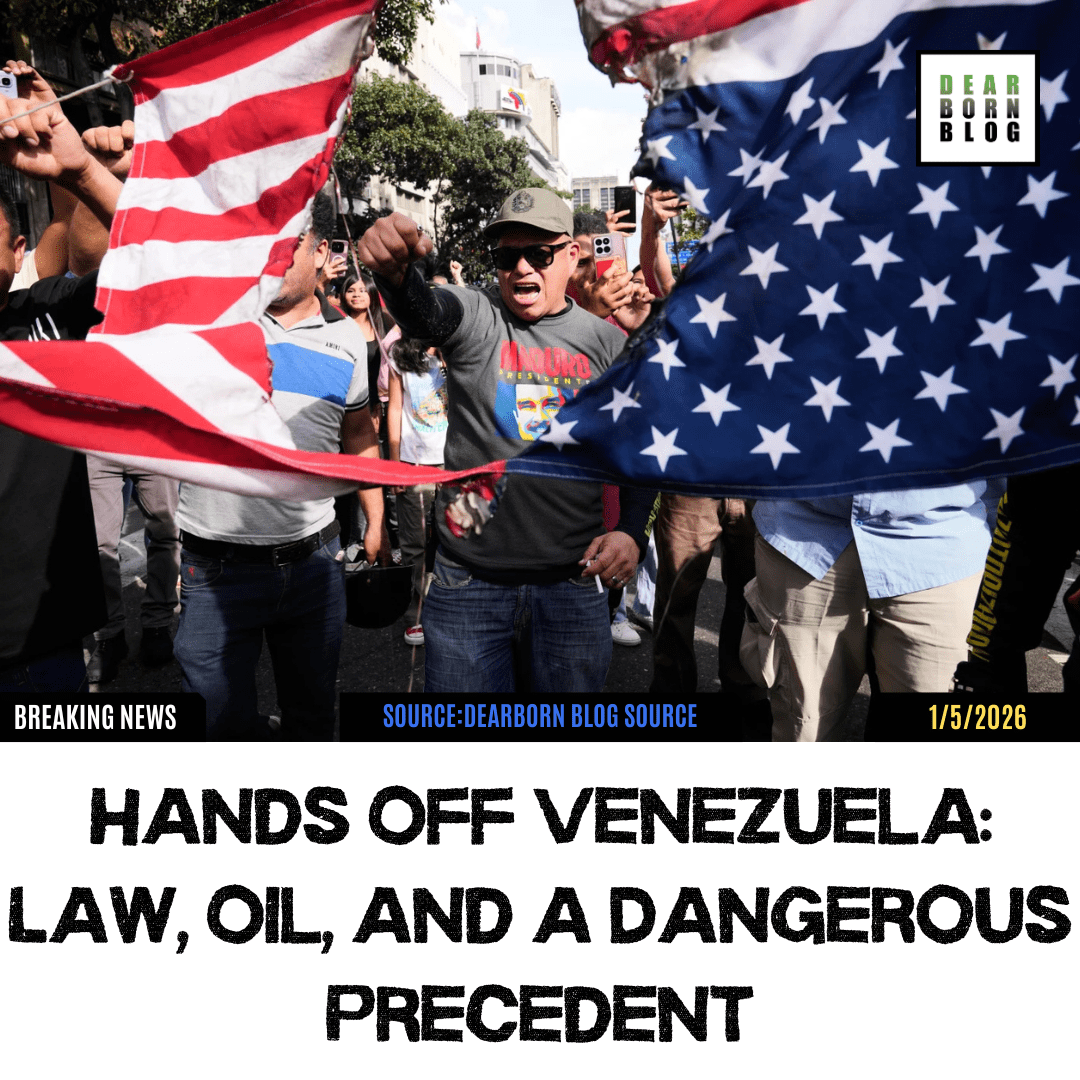
In the early hours of January 3, the U.S. launched strikes in and around Caracas and said Venezuela’s President Nicolás Maduro and First Lady Cilia Flores were captured and flown out of the country. President Trump then claimed the U.S. would “run” Venezuela “for now,” igniting worldwide condemnation, a constitutional firestorm in Washington, and urgent calls—led by Greens and anti-war advocates—to halt an illegal intervention before it metastasizes into another forever conflict.[1][2][3]
A raid that rewrote the headlines—and the rules
Caracas woke up to explosions, low-flying aircraft, and a level of shock that doesn’t stay neatly inside national borders.[1][2] U.S. officials—and President Trump himself—have framed the operation as a decisive strike against alleged “narco-terrorism,” with Maduro and Flores reportedly moved into U.S. custody to face long-standing criminal allegations.[2][1]
Then came the line that turned a military operation into an attempted geopolitical repossession:
“We’re going to run the country.”[2]
That claim—paired with talk of Venezuela’s oil and “temporary” U.S. control—has set off alarm bells across the globe and across the U.S. political spectrum, because it suggests something bigger than a raid: an asserted right to topple a government and administer a country by force.[2][4]
- Multiple outlets report U.S. strikes in and around Caracas, followed by the capture of Maduro and Flores.[1][2]
- The Trump administration says the operation was tied to drug trafficking and security claims; critics say it lacked constitutional authorization.[2][3]
- Congress is moving toward War Powers votes to block or limit further hostilities.[3][8][9]
- International reaction is sharply divided, with many governments and the UN system warning the action violates international law.[4][10]
The Green Party response: “illegal act of war”
The Green Party’s framing is blunt: this is an illegal act of war, a kidnapping, and a constitutional crisis rolled into one.[4] Greens have urged immediate congressional action—up to and including impeachment proceedings—arguing the executive branch cannot unilaterally wage war or seize leaders of sovereign states without lawful authority.[4][5]
A related Green Party post circulating on the party’s national infrastructure called the escalation “U.S. imperialism and endless war,” condemning the abduction of Maduro and Flores and warning that attacks at sea—reported as boat strikes and seizures—are expanding the conflict footprint beyond land targets.[5][4]
This isn’t just a “Greens don’t like Trump” moment. It’s a “rules still exist even when a president feels dramatic” moment.
The core question: by what authority?
1) U.S. constitutional authority
The Constitution assigns Congress—not the president—the power to declare war.[6] That doesn’t mean presidents never use force without a formal declaration, but it does mean unilateral war-making is contested terrain, not a blank check.
The War Powers framework exists precisely because U.S. presidents of both parties have a long history of “oops, we invaded something” energy. Congress has tools to force debate and votes, and lawmakers are now signaling they intend to use them.[3][7]
2) A War Powers resolution is already on the table
This part matters: Congress has already seen the movie trailer for this crisis.
There is a Senate joint resolution explicitly aimed at directing the removal of U.S. Armed Forces from hostilities “within or against Venezuela” absent authorization.[8] There’s also a parallel House measure with the same basic purpose.[9] Reporting indicates votes are imminent and lawmakers say they were misled about the administration’s intentions—fueling bipartisan anger and urgency.[3]
Congress “has the sole power to declare war…” the Senate resolution states in its findings.[8]
3) International law is not a vibe; it’s a charter
Under the UN Charter, member states must refrain from the threat or use of force against the territorial integrity or political independence of any state—except under narrow conditions, most notably self-defense after an armed attack or action authorized by the UN Security Council.[11][12]
The U.S. justification—“drugs,” “cartels,” “security”—runs into the same wall: international law doesn’t recognize “we really wanted to” as a doctrine. That’s why much of the international reaction has been framed around illegality and precedent-setting danger.[10][2]
The oil subtext that became… text
When a president talks about “running” another country and then points at its oil, subtlety is no longer available.[2]
The Green Party argument is straightforward: Venezuela’s resources—especially oil—are the real gravitational center of this operation, with “drug protection” used as a public-facing pretext.[4][2] That interpretation gained extra oxygen because Trump’s administration has also embraced a Western Hemisphere-first security posture in its National Security Strategy, emphasizing regional “preeminence,” strategic resources, and a revived Monroe Doctrine logic.[13]
That strategy document explicitly frames the hemisphere as a priority zone for U.S. power projection and resource security—language critics say reads like a blueprint for coercion dressed up as “stability.”[13]
The “drug war” pretext—and a credibility problem named Juan Orlando Hernández
The press-release line that stings (and sticks) is hypocrisy: claiming a moral crusade against narcotics while handing favors to convicted narco-politicians.
In late 2025, Trump pardoned Honduras’ former president Juan Orlando Hernández after a U.S. conviction tied to major drug trafficking—an extraordinary reversal that drew sharp criticism and fact-check scrutiny.[14][15] The U.S. Justice Department’s own earlier statements on the case described the underlying allegations and conviction in stark terms.[16]
So the critique lands like a gavel: if “drugs” is the reason you can abduct a head of state, why pardon another political figure convicted on drug trafficking charges?
That contradiction doesn’t prove the Venezuela operation is “about oil,” but it does weaken the claim that it’s primarily about principle.
What Venezuelans are saying—and what the world is doing
Coverage of Venezuelan public reaction has been mixed, with reports of fear and anger inside the country, celebrations among some opposition communities and diaspora groups, and deep uncertainty about what comes next.[2][1]
International response is similarly fractured. Many governments, along with UN voices, have warned this sets a dangerous precedent and violates international norms; a smaller set of leaders has framed the removal of Maduro as the fall of an authoritarian regime and an opening for transition.[10]
The worst-case scenario isn’t hard to sketch: splintered security forces, contested succession, external powers choosing sides, and civilians trapped in the churn. And the “best-case scenario” still has a problem: even a future democratic transition becomes morally and legally contaminated if it arrives on the back of illegal force.
Why this matters in Dearborn (yes, even if you’ve never been to Caracas)
Dearborn is a city built from global stories—migration, work, war, refuge, organizing, and the constant question of whether human dignity is real or just a slogan on a podium.
When Washington normalizes the idea that the U.S. can kidnap leaders, seize assets, and “run” countries, it doesn’t stay foreign-policy trivia. It becomes a template—one that tends to boomerang back as expanded surveillance, militarized policing, cracked civil liberties, and budgets that mysteriously have billions for force and pennies for people.[3][7]
And let’s be honest: communities like ours don’t need imagination to understand what “intervention” does. Many Dearborn families have lived the downstream consequences of U.S. militarism in the Middle East—consequences that include displacement, instability, and the brutal logic that treats civilian life as a rounding error. That same logic is visible today as the world watches the Gaza Genocide unfold, enabled by the normalization of impunity and the steady erosion of international law.
The Green Party’s core worldview connects these dots: a livable planet and a livable society are incompatible with empire-by-default. If U.S. policy is addicted to oil, militarism will always find a “reason.” The antidote is not better propaganda—it’s energy transition, demilitarization, and actual rule of law.
What accountability could look like—right now
The immediate demands being advanced by Greens, constitutional advocates, and anti-war organizers are not exotic. They’re basic governance:
- No further hostilities without congressional authorization—vote on the War Powers resolutions and enforce them.[3][8][9]
- Full public accounting: legal rationale, chain of command, civilian casualty assessment, detention authority, and end goals. (If the plan is “we’ll figure it out,” that is not a plan.)[2][3]
- International de-escalation: emergency diplomacy through the UN and regional bodies to prevent spirals and protect civilians.[10][11]
- Stop the resource-grab framing—because “we’ll run your country and take the oil” is not democracy; it’s a confession.[2]
The bottom line
The Green Party is right about the central risk: if the U.S. can claim the right to seize leaders and “run” nations under a vague banner of security, then international law becomes optional—and every country with a powerful military learns the same lesson.[4][10]
Dearborn doesn’t need to agree with Maduro, endorse his record, or romanticize any government to reject illegal war. You can hold two thoughts at once: authoritarianism is real and invasion is not liberation.
If we want a world where smaller nations aren’t treated like extraction zones, we have to defend the idea that law applies to everyone—including the countries that are used to getting away with everything.
Sources (for footnotes)
[1] Reuters — reporting on strikes, sounds/explosions, and capture claims (Jan. 3, 2026). Reuters
[2] Associated Press — coverage of U.S. operation, “run Venezuela” claim, and oil assertions (Jan. 3, 2026). AP News
[3] Reuters — coverage of lawmakers saying they were misled; War Powers push and planned votes (Jan. 3, 2026). Reuters
[4] Green Party of the United States — draft/statement language condemning the attack and urging congressional action (Jan. 3, 2026).
[5] Green Party (gp.org) — “Urgent: U.S. Military Attack on Venezuela” (state/local post hosted on gp.org) (Jan. 3, 2026). www.gp.org
[6] U.S. Constitution Annotated (Congress.gov) — Declare War Clause overview (Article I, Section 8). Congress.gov
[7] Cornell Law (LII) — War Powers Resolution overview and key requirements. Legal Information Institute
[8] Congress.gov — S.J.Res. 90 text: directing removal of U.S. forces from hostilities “within or against Venezuela” absent authorization. Congress.gov
[9] Congress.gov — H.Con.Res. 64 text: House War Powers measure on Venezuela hostilities. Congress.gov
[10] Reuters — compilation of world reactions condemning/endorsing the strikes (Jan. 3, 2026). Reuters
[11] United Nations — UN Charter, Article 51 (self-defense). United Nations
[12] United Nations (Legal Office Repertory) — UN Charter Article 2(4) (non-use of force). United Nations Legal Affairs
[13] White House — National Security Strategy (Nov. 2025), Western Hemisphere “Trump Corollary to the Monroe Doctrine.” The White House
[14] FactCheck.org — analysis of Trump’s pardon of Juan Orlando Hernández (Dec. 2025). FactCheck.org
[15] Reuters — Honduras AG seeking arrest warrant after U.S. pardon of Hernández (Dec. 8, 2025). Reuters
[16] U.S. Department of Justice — Hernández sentencing release (June 26, 2024). Department of Justice
Disclaimer
This article is for informational purposes and reflects publicly available reporting and statements cited above. Details may change rapidly as more verified information emerges. Dearborn Blog does not assert guilt or innocence for any individual and encourages readers to consult primary documents and multiple credible sources. For corrections, updates, or comments you’d like added, please email info@dearbornblog.com.

 Dearborn Blog