

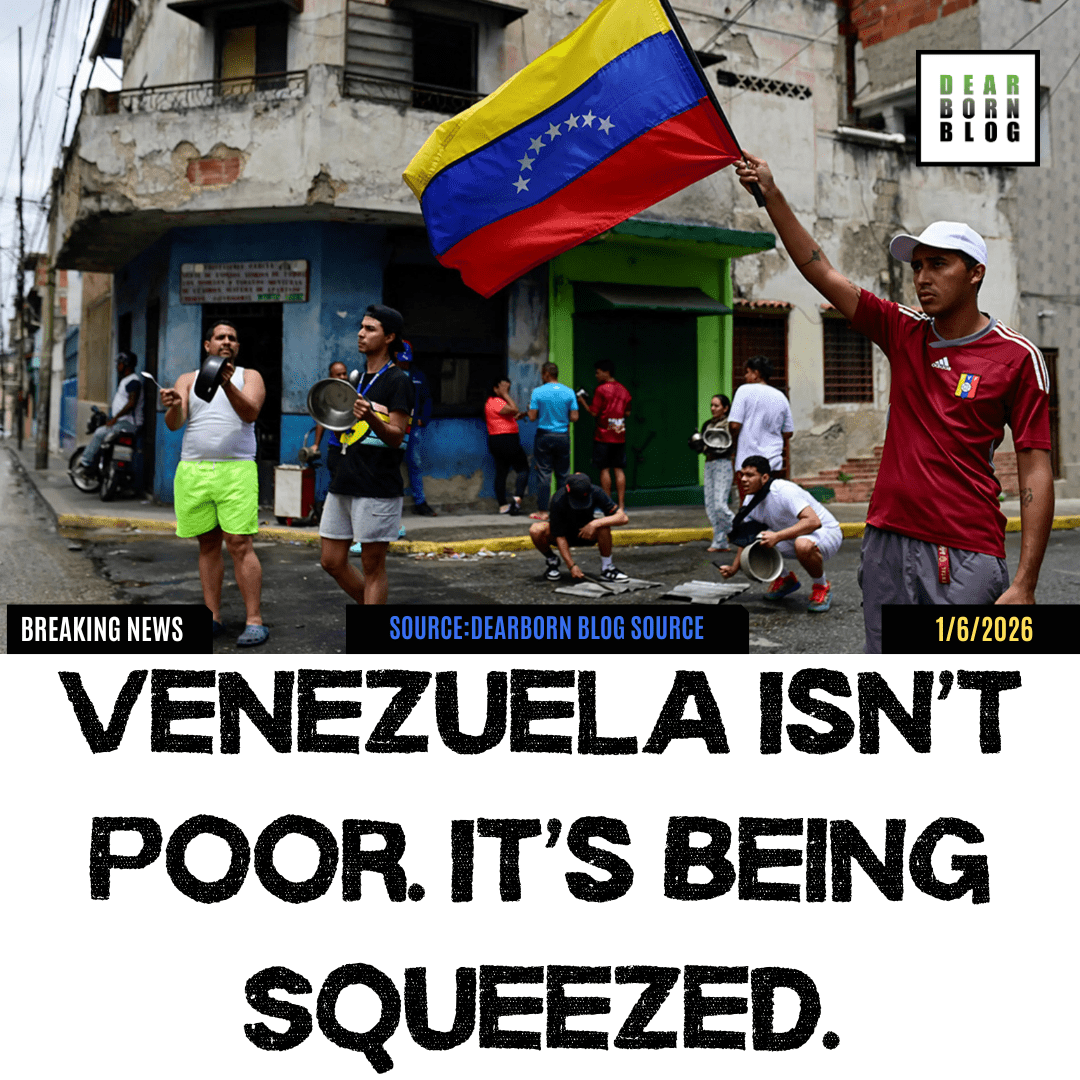
Based on a firsthand Arabic essay by Lebanese journalist Lorca Sbeity, who lived in Venezuela and whose son was born there, this piece argues that Venezuela’s collapse can’t be pinned on one man—or excused by blaming only foreign powers. It’s a story of vast oil wealth, internal political failure, and external pressure that too often punishes ordinary people before it touches the powerful.
This article is adapted from an Arabic-language post by Lorca Sbeity (لوركا سبيتي), a Lebanese media professional who spent a meaningful period living in Venezuela. Her connection isn’t abstract: her son was born there and holds Venezuelan citizenship. That personal anchor matters, because Venezuela is one of those places where political arguments stop being theoretical the moment you step outside and meet people trying to survive a broken economy in a country sitting on extraordinary wealth.[1]
Sbeity frames her approach with a line that cuts through propaganda like a hot knife through a smug PowerPoint: “To recognize the path of truth, follow the arrow of falsehood.” In other words: watch who benefits from the story being told—and who gets flattened under it.
A Rich Country Living Like a Poor One
Venezuela is not resource-poor. It holds the world’s largest proven oil reserves—often cited around 303 billion barrels—yet decades of mismanagement, corruption, underinvestment, and geopolitical warfare have turned that advantage into a trap.[2][3]
Oil wealth can be a blessing. It can also become a curse when a nation’s entire economic nervous system depends on one commodity—and when political actors, domestic and foreign, treat that commodity like a lever to control the whole country.
Sbeity describes the “cruel contradiction” she witnessed firsthand: a nation that should be able to thrive, but instead remains stuck between an embattled ruling system and an external pressure campaign that rarely distinguishes between government elites and the families just trying to eat.[1]
“A country capable of being prosperous, but constantly trapped between a distressed authority and an external pressure that shows no mercy.”[1]
Maduro: Not the Old Elite—But Still a Ruling Machine
Sbeity points out something many analyses skip: Nicolás Maduro didn’t rise from Venezuela’s traditional elite. His political ascent was tied to unions, street-level organizing, and the Chavez-era project that promised social justice, redistribution, and national control over oil wealth.[4][5]
That political origin story matters because it explains why Maduro’s “sovereignty” rhetoric resonates far beyond Venezuela. Many countries—especially across the Global South—carry historic scars from foreign intervention dressed up as “democracy promotion.”
But Sbeity refuses to romanticize the result.
Under Maduro, Venezuela experienced a catastrophic economic and social unraveling: hyperinflation, currency collapse, decaying public services, and a mass exodus of Venezuelans seeking survival elsewhere.[6][7] Democratic space also narrowed over time, with escalating repression and shrinking room for political competition.[8]
So no, Sbeity isn’t selling a “Maduro is a misunderstood hero” narrative. She’s calling out something more intellectually honest—and more uncomfortable:
Maduro is a factor. He is not the whole equation.
<div style=”border:1px solid #ddd; padding:16px; margin:20px 0; background:#f9f9f9;”> <strong>Reality check:</strong> UNHCR reports that the number of Venezuelan refugees and migrants has reached <strong>nearly 7.9 million</strong> globally—one of the largest displacement crises in the world today.[6] </div>
Why “It’s All Maduro” Is a Convenient Lie
Sbeity’s central warning is simple: reducing Venezuela’s tragedy to Maduro alone is a misleading shortcut.
The United States has played a major role through a widening system of sanctions and financial restrictions that have tightened Venezuela’s economy over years.[9][10][11] And while sanctions are sold as “targeted” tools meant to pressure leadership, the lived outcome is frequently broader: restricted access to financing, disrupted trade, and a country forced to function with fewer economic arteries open.
Congressional Research Service overviews document how U.S. sanctions policy evolved and expanded, including measures affecting Venezuela’s government and economy.[9] U.S. government pages outline legal frameworks and actions targeting entities linked to Venezuela’s oil sector.[10][11]
Sbeity’s point isn’t that internal governance failures don’t matter—they do. Her argument is that sanctions can behave like collective punishment, where the first people to feel the squeeze aren’t ministers or generals, but families trying to find medicine, stable food supply, or a wage that survives the week.
“The sanctions were not only pressure on the authorities—they became a collective punishment that struck people before rulers.”[1]
“Judge of the World”: Selective Law, Selective Outrage
Sbeity then widens the lens: Venezuela is a case study in a global order where one superpower often acts as prosecutor, judge, and enforcer.
Her critique is about double standards—especially how “freedom” and “human rights” can become rhetorical weapons used against opponents, while allies are shielded from accountability.
She points to the glaring contradiction of unwavering U.S. political support for Israel’s government even amid global outrage over the Gaza Genocide and widespread documentation of mass civilian harm and devastation. Sbeity’s message here isn’t a detour—it’s the same pattern: accountability becomes conditional. International law becomes optional. The moral vocabulary gets deployed strategically.
That’s not “whataboutism.” It’s an argument that values can’t be credible when they’re enforced like a VIP club.
January 2026: The Crisis Turns Into a Shockwave
As of January 3–4, 2026, Venezuela’s story has taken a dramatic new turn. Major outlets report that U.S. forces captured Nicolás Maduro in a military operation and transported him to the United States, with immediate controversy over legality under U.S. constitutional requirements and international law.[12][13]
Reuters reports significant debate among legal experts over whether criminal आरोप/indictments can justify cross-border military action, and notes questions about congressional authorization and international legal standards.[12] AP describes the operation as unprecedented and destabilizing, with ripple effects across the region, including travel disruption and rising uncertainty over what comes next inside Venezuela.[13][14]
At the same time, oil is back at the center of gravity. Reuters reporting emphasizes both Venezuela’s massive reserves and the decayed state of its infrastructure, noting that any “recovery” or “revival” is neither quick nor simple.[3] Other coverage highlights that talk of “running” Venezuela or reorganizing its oil sector would face major logistical, financial, and legal hurdles—beyond the obvious moral ones.[15]
Here’s the important part for our readers: even if you hate Maduro, turning regime change into a military hobby is not “democracy.” It’s roulette with human lives.
The Question Sbeity Forces Us to Answer
Sbeity asks the kind of question that makes polished talking points melt:
What kind of democracy can be born in a country under siege? What kind of freedom is built on hunger and collapse?
That question doesn’t absolve leaders who abuse power. It doesn’t excuse corruption or repression. It doesn’t deny governance failures.
It simply refuses to let foreign policy masquerade as morality while civilians absorb the blast.
Why This Matters in Dearborn
Dearborn is a city of diasporas—people whose families know what “pressure” feels like when it lands on the wrong bodies. We know how quickly political language gets weaponized. We also know how easy it is for powerful actors to demand “freedom” abroad while shrinking accountability at home.
Sbeity’s essay is a reminder that real solidarity is not a bumper sticker. It’s a disciplined refusal to accept simple villains and simple saviors.
A Green-aligned ethical approach doesn’t require us to pick an emperor. It requires us to defend principles consistently:
- No collective punishment through sanctions that crush civilians first.[9][10]
- No military “solutions” that treat sovereignty like a removable sticker.[12][13]
- Yes to diplomacy, humanitarian access, and international law that applies to allies and adversaries.
Venezuela isn’t a one-man tragedy. It’s what happens when a petrostate’s internal failures collide with an international order that still lets one power play referee while holding the ball.
And if that sounds familiar… it’s because the pattern keeps repeating. The names change. The playbook doesn’t.
Sources
- Lorca Sbeity (لوركا سبيتي) — Original Arabic post on Facebook beginning “Venezuela isn’t a poor country…” (accessed Jan 4, 2026).[1] Facebook
- Reuters — Background on Venezuela’s oil reserves (303B barrels) and industrial decline (Jan 3, 2026).[2] Reuters
- Reuters — Additional reporting on Venezuela’s oil industry deterioration and sanctions context (Jan 3, 2026).[3] Reuters
- The Guardian — Biographical/trajectory context on Nicolás Maduro (Jan 2026 coverage).[4]
- Council on Foreign Relations (CFR) — Background on Venezuela’s political/economic crisis and petrostate dynamics.[5] Council on Foreign Relations
- UNHCR — “Venezuela situation” displacement figure: nearly 7.9 million.[6] UNHCR
- IOM — Regional/global overview of Venezuelans living abroad (nearly 7.9 million).[7] International Organization for Migration
- CFR — Ongoing political crisis overview and governance concerns.[8] Council on Foreign Relations
- Congress.gov / CRS — “Venezuela: Overview of U.S. Sanctions Policy” (updated Dec 5, 2025).[9] Congress
- U.S. State Department — Venezuela-related sanctions overview.[10] U.S. Department of State
- U.S. Treasury (OFAC) — Venezuela-related sanctions legal framework and program details.[11] OFAC
- Reuters — Legal debate on U.S. capture of Venezuela’s president (Jan 3, 2026).[12] Reuters
- Associated Press — Reporting on Maduro’s capture and transfer to the U.S. (Jan 4, 2026).[13] AP News
- Associated Press — Background explainer/live updates on the operation and uncertainty (Jan 2026).[14] AP News+1
- AP / ABC7 Chicago (AP syndication) — Hurdles to U.S. plans around Venezuela’s oil sector (Jan 4, 2026).[15] ABC7 Chicago
Disclaimer
This article is for informational and analysis purposes only and does not constitute legal advice or a definitive account of ongoing events. Fast-moving situations can change as new evidence emerges or official statements are updated. For corrections, clarifications, or comments you would like added to this article, please email info@dearbornblog.com.

 Dearborn Blog