

By Dr. Wajih Qanso (English adaptation for Dearborn Blog)
As the world debates how artificial intelligence may reshape life itself, many of our societies still greet the new year like it’s a foggy tunnel—hoping a fortune-teller can name the turns. The difference isn’t “progress vs delay.” It’s two completely different ways of existing.
A month before last year ended, I followed long, serious discussions about artificial intelligence—and what it may mean for humanity’s future. People disagreed on how dangerous this new reality could become, but they shared one unsettling intuition: AI won’t remain just a tool organizing human life. It may become the launchpad for new forms of life that go beyond the human.
If the human being is the result of biological evolution across billions of years, then AI—within a few decades—could produce patterns of “life” freed from the slow, heavy chains of biology. It would be able to invent its own pathway of development, where a single second of improvement could equal what natural evolution accomplishes across millions of years—not because nature is “stupid,” but because biology advances through costly trial, error, and extinction. (This idea is debated, but the fear is real: that the speed of iterative software improvement could outpace society’s ability to understand and govern it.)[4]
“AI is no longer designed to learn from mistakes—but to learn not to make them.”
AI systems increasingly aim not only to adapt to change, but to predict it—and, more dangerously, to shape it. Their “mission” is no longer limited to navigating a shifting environment. They are being built to create and modify the environment itself, continuously.
From science fiction to scientific reality
Half a century ago, this kind of talk would have been filed under science fiction—fun, frightening, and safely unreal. Today, it’s treated by many as a plausible scientific trajectory, with disagreement focused less on whether and more on when. Some estimates are short (a decade), others long (a century).
What became clear is that these debates are not merely about technology and its risks. They are debates about manufacturing humanity’s future itself—designing the shape of the coming world with intention, reducing surprises, and converting past and present experience into forward momentum.
In other words: the future is no longer “guessed.” It is increasingly engineered.
If the present is the result of what we once thought and chose, the future will be the result of what we think, invent, and practice today.
That is one way to say goodbye to a year—and welcome a new one.
The other shore: anxiety instead of planning
On the other side of this world, many of us greet the new year with fear, uncertainty, and a tight chest. Threats of war arrive nonstop. We can’t deter them, can’t manage them, and can’t even predict them with confidence.
An enormous backlog of unresolved files makes recovery crawl like a wounded turtle. Political deadlocks multiply. Decision-making freezes. Even decisions that were made stumble in execution.
The past feels catastrophic. The present feels disabled. The future appears like a mysterious fate—like dice thrown in the dark. A tunnel that spits us out into another tunnel, with unknown bends and terrors, unknown openings and relief, unknown good and evil.
And so the future begins to look like a magician’s box: secretive, theatrical, and not entirely real—yet somehow controlling us.
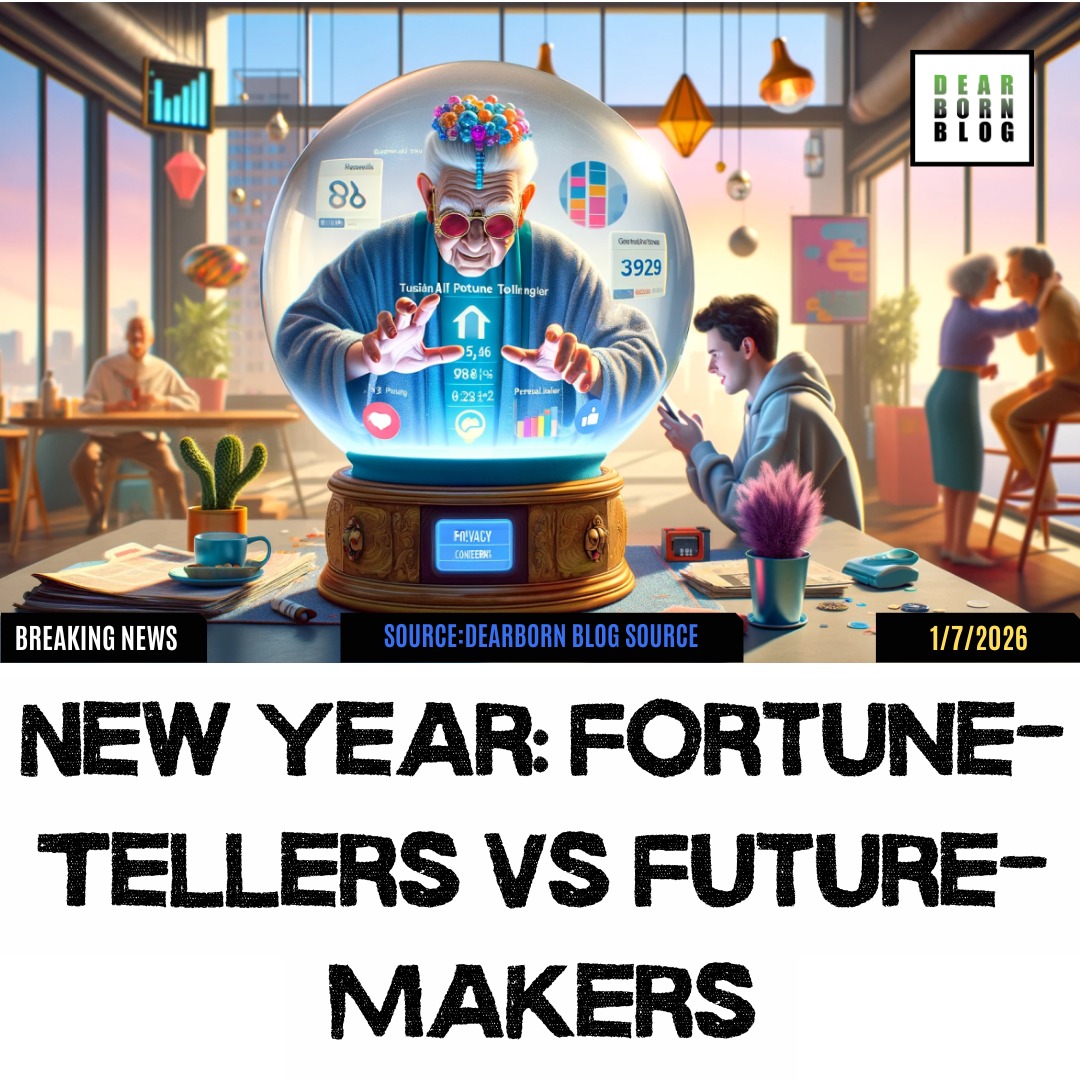
Fortune-tellers replacing builders of destiny
Some people sit frozen before fortune-tellers. Others search for prophetic warnings, saintly predictions, a seer’s timeline, a magician’s story. We flock to them hoping they’ll clear the fog of what’s coming—hoping their words contain even a thin flame of certainty.
We seek a future that is already “prepared,” already written—an invisible force that steers outcomes for us, a sealed destiny, a higher “care” (real or imagined—it hardly matters) that we hand our agency over to with comfort.
We often know, deep down, that much of it is performance. Yet their narratives seduce us because they do something emotionally convenient:
- They relieve our conscience from the guilt of neglect.
- They tempt our minds into resigning from serious thinking.
- They give our willpower an excuse to be lazy.
“We cling to them… so their prophecies might carry a spark of light about where we are headed.”
When history stops flowing
This is how we receive our days and years—not because “nations have ganged up on us” (the familiar excuse), but because, as Ibn Khaldun said, “decline called out, and people rushed to answer.”[2]
In today’s language: it happens when history stops moving in us. When time becomes nothing but old tales, miracle-stories, and fantasies. Not because time betrayed us, but because we removed time from our calculations—so its direction shatters, events detach from causes, and logic dissolves.
Then anything becomes possible: outcomes without natural مقدمات (premises), ideas “true” without their conditions, the present turning into the past, and the past masquerading as the future.
Between a future shaped by a creative mind and determined will—and a future delivered by priests and astrologers—this is not a simple difference in “how advanced” we are.
It’s a fork in the road between two modes of existence.
— — —
A quick reality-check (not a sermon):
Even many AI researchers and institutions now talk openly about managing systemic risk—not just building cooler tools.[3] And debates about AI systems training and improving themselves faster than oversight can keep up have moved from fringe speculation into mainstream discussion.[4]
— — —
What this means in Dearborn
Dearborn knows something about the difference between waiting for fate and building outcomes. Communities like ours don’t have the luxury of magical thinking—because rent, schools, safety, water, air quality, and civil rights don’t improve via horoscope.
A “future-makers” mindset in Dearborn can look very practical: teaching AI literacy without hype, demanding transparency and accountability in public-sector tech, defending civil liberties when new surveillance tools appear, and insisting that innovation serves people—not the other way around. That’s not sci-fi. That’s local democracy with better tools and sharper ethics.
Sources (for context & attribution)
[1] Dr. Wajih Qanso, “السنة الجديدة: بين عرافي المستقبل وصانعيه” (Janoubia, January 4, 2026). جنوبية
[2] Ibn Khaldun, Al-Muqaddimah (commonly cited formulation about decline and societal response; referenced here as a conceptual frame used by the author).
[3] National Institute of Standards and Technology (NIST), AI Risk Management Framework (AI RMF 1.0) (2023). NIST+1
[4] The Guardian, interview on the stakes of AI systems training/improving themselves and the timeline pressures (Dec 2, 2025). The Guardian
Disclaimer
This article is an English adaptation of Dr. Wajih Qanso’s original Arabic text for commentary and public discussion. It reflects the author’s analysis and rhetorical framing, including speculative projections about AI’s trajectory, which remain debated among experts. Dearborn Blog provides this for informational purposes and community conversation, not as technical, legal, or investment advice. For corrections, clarifications, or requests to update the article, please email info@dearbornblog.com.

 Dearborn Blog