

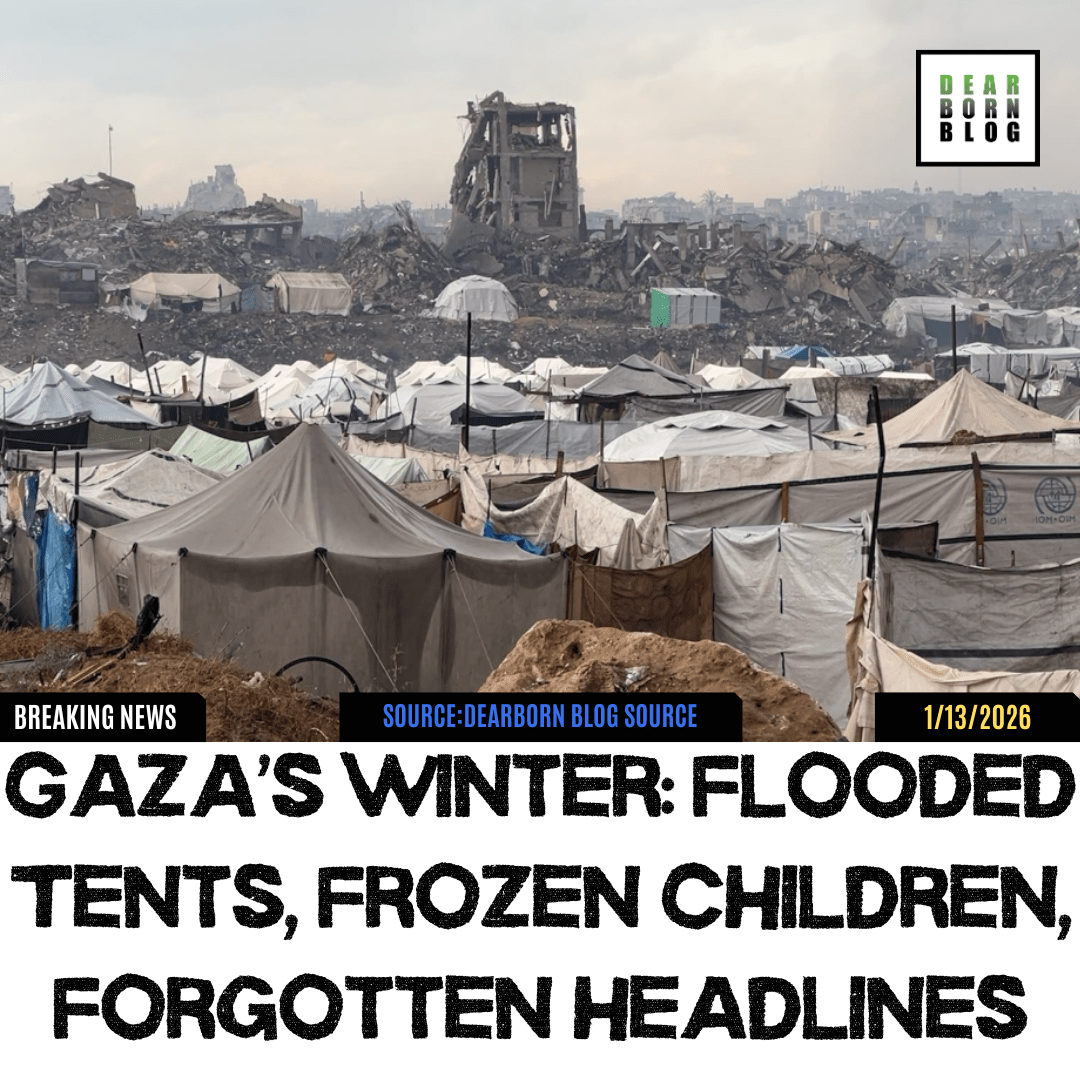
Gaza is “flooded, freezing, and forgotten.” That isn’t poetry—it’s a field report. As storms tear through makeshift camps, the humanitarian crisis deepens under blocked or delayed shelter supplies, shattered infrastructure, and constrained access.
An Instagram post making the rounds says: “This is Gaza RIGHT NOW. Flooded, Freezing and Forgotten. And in DIRE need of attention and aid.”
It’s the kind of caption that feels “too online”… until you realize it’s describing the physical world: rainwater inside tents, walls collapsing onto sleeping families, infants dying from exposure, and a population squeezed into unsafe shelters with nowhere left to go.
In just the last few days, major outlets and humanitarian agencies have described a grim pattern: severe weather hitting a population already living on the thinnest possible margin—thin plastic sheeting, worn-out tents, damaged buildings, no reliable heating, and limited materials to reinforce anything.
And the “forgotten” part? That’s the most dangerous ingredient, because attention is not just vibes—it’s leverage. It’s what forces supplies through gates, pressures officials to allow in the unglamorous lifesavers (tarps, timber, pumps), and keeps Gaza from being treated like an acceptable permanent emergency.
What’s happening on the ground: weather as a weapon of misery
A powerful storm sweeping Gaza has flooded hundreds of tents and collapsed already-weakened structures, killing people sheltering near the coast and in tented areas.
Reuters reported that a one-year-old died of extreme cold in a tent, and that thousands of tents were damaged in a 48-hour period, while officials struggled to respond amid fuel shortages and destroyed equipment (including vehicles like bulldozers and water pumps).
The details matter because they show the mechanism of suffering. This isn’t “bad weather.” It’s bad weather hitting people who have been pushed into conditions where weather becomes deadly.
“Flooding, cold temperatures, and damaged shelters are exposing displaced people to new risks, while humanitarian access remains severely constrained.”
That line—“severely constrained”—is a polite bureaucratic phrase for a very physical reality: fewer materials arrive, fewer repairs happen, fewer options remain.
The tent problem isn’t a metaphor. It’s math.
Humanitarian reporting has been unusually specific about the scale of need, which is another way of saying: this is not a mystery. <div style=”border:1px solid #ccc; padding:14px; background:#f7f7f7;”> <strong>Numbers that should stop you mid-scroll</strong><br><br> • About <strong>850,000</strong> people across <strong>761</strong> displacement sites were assessed as at high risk of flooding.<br> • Officials and UN partners cited an urgent need for roughly <strong>300,000 new tents</strong> for displaced people.<br> • Thousands of tents have been reported damaged in a matter of days during recent storms.<br> </div> :contentReference[oaicite:6]{index=6}
Even when some aid is entering, the gap between “some” and “enough” is where children get hypothermia, respiratory infections spike, and families lose the last dry blanket they own.
UNICEF’s winterization planning has been explicit about what “enough” looks like: winter clothing kits, high-thermal blankets, tarpaulins to reinforce shelters, tents for the most vulnerable, and cash support to help families buy essentials when markets function at all.
“Blocked supplies” — the unsexy scandal that kills people
When most people imagine a humanitarian blockade, they picture food and medicine. But winter exposes a quieter category of life-saving inputs: shelter reinforcement and flood mitigation.
The International Organization for Migration (IOM) warned that around 795,000 displaced people were at flood risk in low-lying rubble-strewn areas, while critical shelter and flood-response materials (like timber, plywood, sandbags, and water pumps) faced access restrictions and delays.
Doctors Without Borders (MSF) has made the same point in plain language: Gaza faces another winter of torrential rain and wind, while “vital supplies like tents, tarpaulins and temporary housing” are blocked or delayed.
This is the part where “winter” stops being seasonal and starts being political.
And yes, Israeli officials have said that hundreds of trucks enter daily carrying food, medical supplies, and shelter equipment—but humanitarian organizations continue to state that supplies remain insufficient relative to needs.
A situation can be true in two directions: some flow exists, and the flow is still not enough to stop deaths from exposure.
OCHA’s field language: sewage contamination, protection risks, and the slow collapse of “normal”
OCHA situation reports don’t do melodrama. They do logistics, constraints, and consequences. That’s exactly why their winter entries read like an alarm bell.
OCHA notes that winter storms and flooding have exposed families to cold temperatures and contaminated floodwaters.
Other updates describe tents and makeshift shelters damaged by heavy rains, destruction of belongings, sewage contamination, and rising health and protection risks—especially for older people, people with disabilities, and others who can’t simply “move somewhere else.”
That last phrase—move somewhere else—is the cruel joke at the heart of displacement in Gaza right now. Displacement assumes there is an “else.” But as Reuters reported, people have been compressed into a narrow strip near the coast where many live in tents or damaged buildings.
“Don’t stop talking about Gaza” — why this isn’t just hashtag therapy
The Instagram post is right to insist on attention.
Attention is not charity; it’s pressure. Pressure changes administrative decisions: what’s allowed in, what’s expedited, what’s funded, what’s politically costly to ignore.
Social posts can’t capture everything—especially the operational details—but they can do one essential job: interrupt the global attention economy that keeps turning away. In that sense, “don’t stop talking” is not a slogan. It’s a strategy.
A quick note on your request: I wasn’t able to reliably fetch the full Instagram comment thread from that specific link due to repeated access throttling on Meta-hosted pages in this environment. So I’m not going to hallucinate quotes or pretend I read comments I couldn’t access. If you paste the comments (even as screenshots or a text dump), I can accurately weave them into this article in the same format and voice.
Dearborn’s stake in this: diaspora politics, labor politics, and moral clarity
Dearborn isn’t watching Gaza from outer space. It’s a city with deep family ties across the region, a strong tradition of civic organizing, and a built-in “foreign policy realism” that comes from knowing people on the receiving end of policy.
This is where Green Party values land with force: human rights, international law, demilitarization, and prioritizing human needs over weapons pipelines. Winter deaths from exposure are not “natural.” They’re the downstream effect of decisions—about displacement, infrastructure destruction, and whether shelter materials are treated as essential or suspicious.
If your local politics feels disconnected from Gaza, remember: local officials influence state and federal representatives through resolutions, constituent pressure, and public hearings. Communities also shape where local institutions (unions, faith groups, mutual aid networks) send resources and attention. “Local” is how “global” becomes real.
What solidarity looks like when the weather turns lethal
Solidarity doesn’t have to mean grand gestures. It can mean coordinated, boring, effective pressure and support:
- Amplify credible field reporting (OCHA updates, UNICEF winterization needs, MSF statements) so the public conversation isn’t stuck in rumor.
- Pressure elected officials to support unrestricted humanitarian access and the entry of shelter materials and repair equipment—especially flood mitigation tools and temporary housing components.
- Support reputable humanitarian responders that publish transparent needs and distributions (UNICEF winterization programming is one example with unusually clear targets).
- Keep Gaza Genocide in the frame: winter doesn’t pause mass suffering; it compounds it. The cold is not a “new crisis.” It’s an accelerant poured on an existing one.
The bottom line
“Flooded, freezing, forgotten” is not an exaggeration. It’s a compressed summary of what happens when displacement meets winter without adequate shelter, infrastructure, and access.
In saner circumstances, rain is inconvenience. In Gaza right now, rain is collapse—of tents, of walls, of already-frayed health, and sometimes of small bodies that can’t regulate temperature in the cold.
So yes: keep talking. But talk in a way that sharpens reality rather than blurring it—names, numbers, constraints, and the very specific items that keep people alive: tarps, tents, pumps, fuel, access.
Because “forgotten” is a policy choice. And it’s one we can refuse.
Sources
- Reuters — “Six dead as Gaza’s displaced struggle to hold ground in torrential rain” (Jan 13, 2026).
- Associated Press — “Howling winds send walls crashing down on Gaza tent camps, killing 4” (Jan 13, 2026).
- Reuters — “UN agency warns displaced Gazans face floods, as emergency supplies blocked” (Dec 12, 2025).
- IOM — “Nearly 795,000 Displaced Palestinians at Flood Risk…” (Dec 11, 2025).
- MSF — “MSF: Winter in Gaza” (Jan 7, 2026).
- OCHA / UNISPAL — “Gaza Humanitarian Response — OCHA Situation Report No. 60” (recent).
- OCHA oPt — “Report: Humanitarian response… (Oct 2025 ceasefire)” (Jan 5, 2026).
- UNICEF USA — “Help UNICEF Deliver Warmth and Safety This Winter” (Nov 2025).
- UNICEF — “Children in Gaza need life-saving support” (Winterization section).
- Reuters — “Rainstorms flood tents of Gaza’s displaced…” (Nov 26, 2024).
- Instagram snippet of the referenced post caption (accessed via search preview).
Disclaimer
This article is for informational purposes only and reflects publicly available reporting and humanitarian agency updates at the time of writing. Conditions in Gaza can change rapidly, and figures may be updated or revised as new assessments emerge. Dearborn Blog does not provide legal, medical, or financial advice, and readers should verify details directly with primary sources and aid organizations. For corrections, clarifications, or comments you’d like inserted into this article, email info@dearbornblog.com.

 Dearborn Blog