

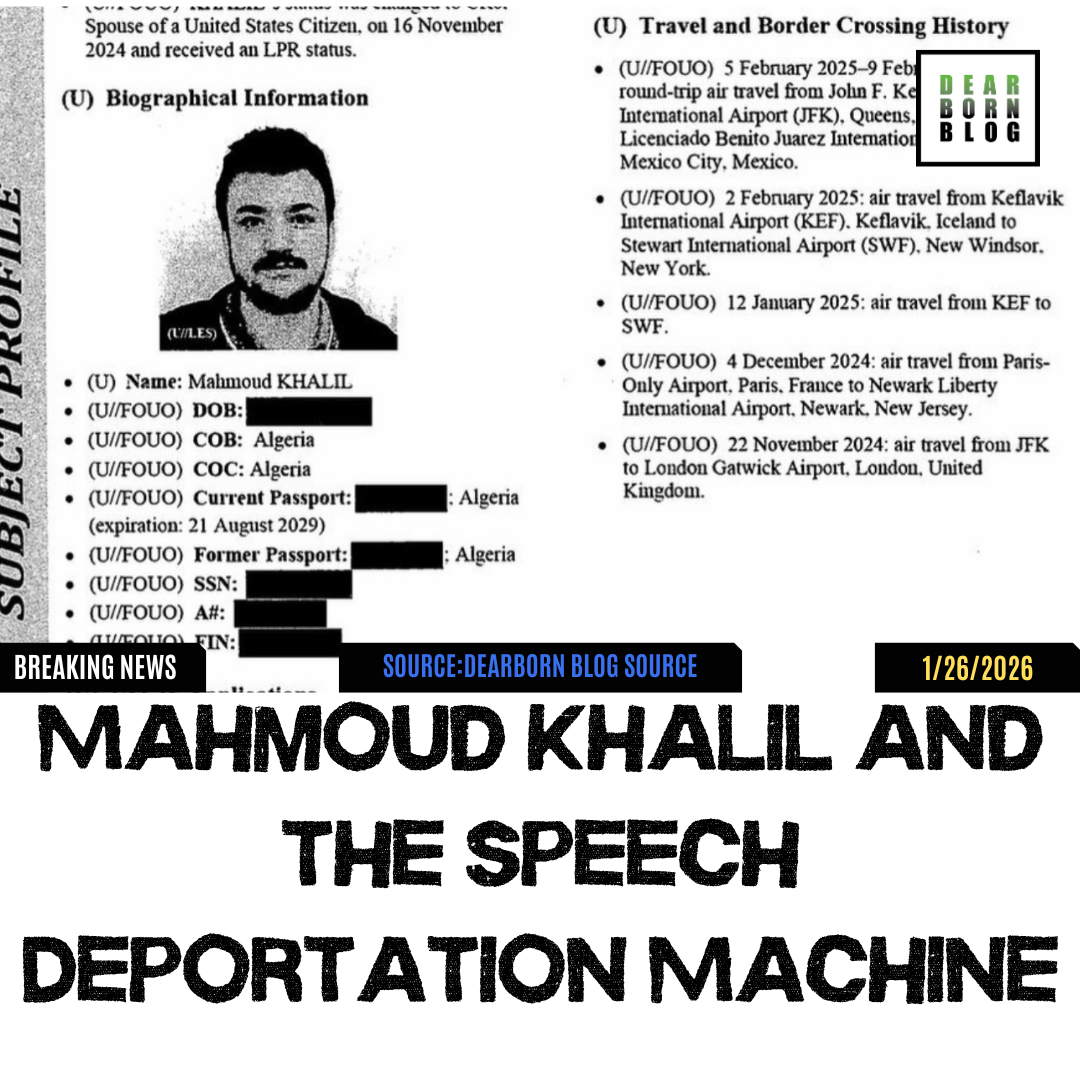
Newly unsealed government records tied to AAUP v. Rubio spotlight how immigration enforcement can be weaponized against constitutionally protected pro-Palestinian speech. Mahmoud Khalil’s case shows what happens when “foreign policy” becomes a loophole big enough to drive a black van through.
A paper trail that reads like a warning label
A batch of newly unsealed documents in the federal case AAUP v. Rubio has reignited a question the U.S. keeps trying to dodge: Do noncitizens lawfully in the country actually get meaningful First Amendment protection—or only until the government dislikes what they say?
According to reporting on the unsealed records, the answer looks grim. The documents describe senior officials—up to and including Secretary of State Marco Rubio—signing off on deportation actions against students and scholars based on involvement in campus protest, op-eds, and public advocacy around فلسطين and the ongoing Gaza Genocide.12
One of the names repeatedly referenced: Mahmoud Khalil, described in the records and news coverage as a Columbia University-affiliated organizer/negotiator in the 2024 protest encampment wave and subsequent demonstrations.34
The deeper issue isn’t just “one activist targeted.” It’s the emerging architecture of ideological deportation—where the government treats protest speech as a national-security contaminant.
What the revealed records describe (and what they don’t)
The unsealed materials referenced in public coverage include internal memos and “reports of analysis” that summarize a person’s biographical background, communications identifiers, travel history, and protest-related allegations—often stitched together from open-source material.15
In screenshots circulating online (and provided to Dearborn Blog), one federal document frames Khalil’s protest involvement as creating a “hostile environment,” tying it to alleged distribution of “Hamas-authored flyers,” and suggesting this could support deportation action under a “foreign policy” theory. Another document shown is a Notice to Appear, initiating removal proceedings and explicitly invoking that foreign policy rationale (with personal identifiers heavily redacted in the copy shared publicly).6
Important: these are allegations and characterizations, not criminal convictions. Even the reporting on the unsealed materials emphasizes that the government’s case leaned on protest participation and expressed viewpoints—not proven criminal conduct.12
That distinction matters because it’s the bright line the First Amendment is supposed to protect: speech isn’t a deportable offense.
The legal hook: “foreign policy consequences” as a speech trapdoor
The key statutory lever in play is a rarely used provision of immigration law: 8 U.S.C. § 1227(a)(4)(C)—the “foreign policy” deportability ground. In plain English, it says an immigrant can be deemed deportable if the Secretary of State has reasonable grounds to believe their presence or activities could cause “potentially serious adverse foreign policy consequences.”7
On paper, that sounds like it’s meant for extreme cases (think: covert operatives, high-level diplomatic crises). But the filings and case analysis around AAUP v. Rubio describe it being applied to domestic political speech—the very thing the First Amendment exists to protect.58
A Knight First Amendment Institute amicus brief (in related litigation) notes that under the foreign policy ground, a person may not be deported based on beliefs/statements/associations that would be lawful in the U.S. unless the Secretary of State personally determines the person’s presence would compromise a “compelling” U.S. foreign policy interest.8 In other words: the law itself anticipates the danger of punishing speech—and tries (imperfectly) to fence it off.
The problem is obvious: if “foreign policy” becomes a magic word, the fence becomes decorative.
The pipeline: protest → blacklist → “Tiger Team” → deportation memo
The case analysis published by Columbia’s Global Freedom of Expression project describes federal authorities relying on internal reports that drew from third-party online sources and “open source allegations,” and using enforcement tactics that intensified fear—masking agents, sudden arrests, rapid transfers—creating a broad chilling effect on speech.5
The Knight Institute amicus brief goes further: it describes testimony that DHS/HSI reviewed lists reportedly sourced heavily from Canary Mission—a blacklisting operation that targets pro-Palestinian campus activism—and used those leads to generate fast-turnaround reports for referral to the State Department.8 The same brief describes how the allegations of “antisemitism” or “pro-Hamas” content were often not independently corroborated by the intelligence office compiling them.8
That’s the real scandal here. Even if you believe some protest spaces have had serious problems (and some have), outsourcing enforcement triggers to ideological websites and social-media rummaging is not “national security.” It’s algorithmic rumor with a badge.
Here’s the logic chain the documents and related coverage suggest:
Protected speech → political labeling (“pro-Hamas,” “antisemitic”) → administrative referrals → visa/green card jeopardy → removal proceedings.158
And if that pipeline stands, it won’t stop at Ivy League campuses.
Columbia as a pressure cooker—and Khalil as a test case
Well before the immigration escalation, AP reported that Columbia opened investigations and disciplinary actions against students critical of Israel, including scrutiny linked to op-eds and social media activity.3 In that reporting, Khalil described facing numerous allegations he said were largely unrelated to his actual actions, and he characterized the disciplinary structure as designed to “chill pro-Palestine speech.”3
Then came the next step: detention and deportation threats. The Guardian reported Khalil’s arrest by ICE at a university-owned apartment, with his attorney stating agents claimed to be acting on a State Department order affecting his status; the article also notes widespread Trump-administration threats to deport foreign students involved in protests.4
Whether every procedural detail in each report holds up in court is precisely what litigation is for. But the pattern is difficult to miss: institutional pressure + federal threats + immigration leverage = political speech deterrence.
And a federal judge’s words—quoted in coverage of the unsealed memos—cut through the fog: the “big problem,” he wrote, was that top officials “are not honoring the First Amendment.”9
That’s not a slogan. That’s a judge describing a constitutional failure.
Dearborn should pay attention (because we’re in the blast radius)
Dearborn isn’t a spectator city. It’s one of the most visible Arab and Muslim-majority communities in the country—now documented as majority Middle Eastern or North African ancestry in Census-based reporting (54.5%).10 It’s also a place with deep institutional ties to scholarship, migration, and political organizing: the University of Michigan–Dearborn hosts the Center for Arab American Studies, explicitly rooted in this community’s lived experience.11 ACCESS—founded in Dearborn in 1971—was built to help Arab immigrants navigate life in America, including the legal and social systems that too often treat “Arab” as a suspicion category.12
So when the federal government tests a model of “speech-based immigration punishment” on high-profile campus activists, communities like ours will feel it faster and harder than most. Add in the broader reality that Dearborn has been repeatedly targeted by far-right provocateurs chasing viral “anti-Muslim” content, and you get the full picture: the politics of spectacle + the machinery of enforcement.13
This isn’t abstract. International students, permanent residents, and mixed-status families in Metro Detroit have every reason to read these developments as a warning: your speech can be reinterpreted as a “foreign policy risk.”
That is the kind of precedent that doesn’t just chill protests. It chills daily life.
A necessary line: protecting Jewish students without criminalizing Palestinian advocacy
Let’s be blunt and clear: Jewish students deserve safety and equal protection on campus. Antisemitism is real, violent, and historically persistent—and institutions have a duty to confront it.
But the documents and related case analysis describe something else entirely: conflation—treating pro-Palestinian advocacy as inherently antisemitic, or treating criticism of Israel as support for terrorism.58 That’s not safety. That’s political filtering.
If the government (or a university) can label the word “genocide” as harassment, or “divestment” as extremism, you don’t get harmony—you get coerced silence, and silence is where prejudice grows best.
The constitutional approach is boring—and correct: punish threats and harassment; protect political speech. Don’t swap that order just because cable news got nervous.
What accountability looks like (and what it doesn’t)
Accountability isn’t canceling a student visa because someone held a megaphone. It’s demanding that:
- Courts rigorously scrutinize any use of the foreign-policy deportation provision when the underlying conduct is speech.87
- Universities publish transparent due process rules and stop running discipline through secrecy and gag-style processes.3
- Elected officials in Michigan—especially those who claim to defend civil liberties—speak clearly: the First Amendment is not a citizen-only subscription service.
- Community institutions in Dearborn expand “know your rights” infrastructure for students and residents who may be targeted, directly or indirectly.
Because if this can be done to a Columbia activist in the national spotlight, imagine how quietly it can be done to someone with no cameras around.
And that’s the point of building a machine: it runs whether or not anyone is watching.
“These documents prove that it was the students’ opinions alone, and not any criminal activity, that led to handcuffs and deportation proceedings.” — Conor Fitzpatrick, FIRE2
Sources
Disclaimer
This article is for informational and journalistic purposes only and does not constitute legal advice. Descriptions of allegations are presented as allegations, based on the cited reporting and referenced documents. If you notice an error or have a correction you’d like included, please email info@dearbornblog.com.
- Common Dreams — “’Confirming Everything We Knew Already’: Docs Show Trump Admin Targeted Gaza Activists for Their Opinions” (Jan. 24, 2026). ↩ ↩2 ↩3 ↩4
- Foundation for Individual Rights and Expression (FIRE) — “Unsealed documents prove the government crusade to deport Ozturk, Khalil, and others is based solely on protected expression” (Jan. 23, 2026). ↩ ↩2 ↩3
- Associated Press — “Facing Trump’s threats, Columbia investigates students critical of Israel” (Mar. 2025). ↩ ↩2 ↩3 ↩4
- The Guardian — “Ice arrests Palestinian activist who helped lead Columbia protests, lawyer says” (Mar. 9, 2025). ↩ ↩2
- Columbia Global Freedom of Expression — Case analysis: AAUP v. Rubio (includes factual summary, legal posture, and findings overview). ↩ ↩2 ↩3 ↩4 ↩5
- Unsealed court documents and DHS materials (screenshots shared publicly and reviewed for this article): HSI “subject profile,” referral letter, and Notice to Appear (redacted copies). ↩
- Cornell Law School (LII) — 8 U.S.C. § 1227 (Deportable aliens), including foreign policy subsection. ↩ ↩2
- Knight First Amendment Institute — Amicus brief (PDF) discussing foreign-policy removal, Canary Mission leads, and lack of corroboration standards (Sept. 17, 2025). ↩ ↩2 ↩3 ↩4 ↩5 ↩6 ↩7
- ScheerPost / Truthout reprint — summary of unsealed memos and judge’s characterization of First Amendment violations (Jan. 24, 2026). ↩
- ClickOnDetroit — Census-based reporting on Dearborn’s MENA-majority population (Sept. 26, 2023). ↩
- University of Michigan–Dearborn — Center for Arab American Studies overview. ↩
- ACCESS — organizational history (“Our Roots”). ↩
- The Guardian — reporting on far-right provocations targeting Dearborn’s Muslim community (Nov. 26, 2025). ↩

 Dearborn Blog
Alnizamdmh.com
عÙس٠اØ٠د سÙÙ Ùاس٠Ùط٠اÙ٠جÙدÙ
739814500
alnizamdmh.com
DMHhttp://www.alnizamdmh.com
تعز اÙÙÙ Ù
[signatureImage]
LikeLike