

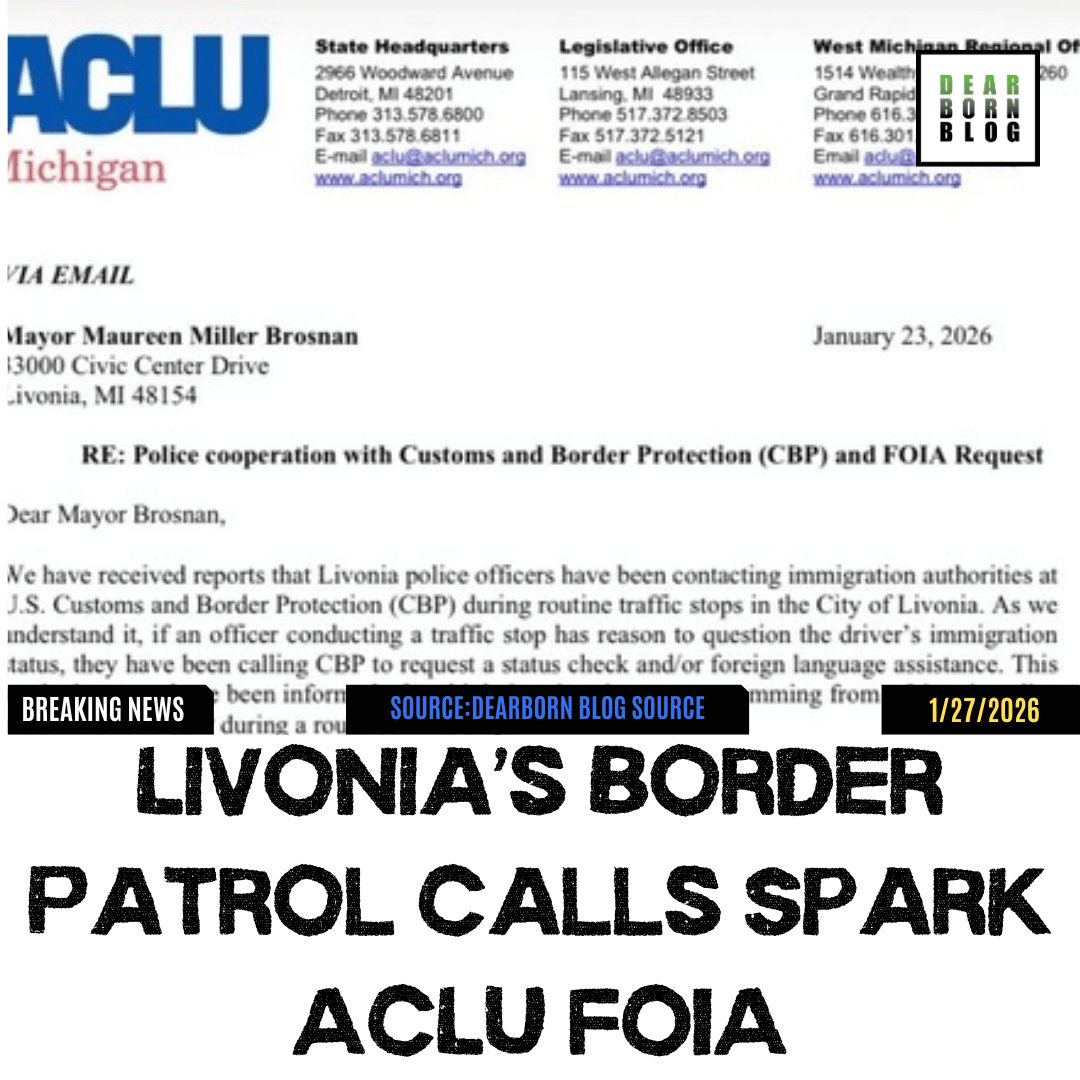
A Michigan ACLU letter alleges Livonia police are contacting Border Patrol during routine traffic stops—turning everyday encounters into immigration pipelines. As national tensions rise over federal agents operating in U.S. cities, Livonia is now facing a local demand: explain the policy, or end it.
<h2>When Washington’s Agenda Reaches Livonia’s Streets</h2>
“This issue of Musings arrives two days early because, after witnessing the shooting in Minneapolis on Saturday, remaining silent felt impossible. Moments like this demand more than quiet concern; they demand collective courage.”[9]
That’s how local writer Bill Joyner framed the moment in a note shared with Dearborn Blog—connecting a national shock to a local worry: the creeping normalization of heavily armed federal enforcement as routine civic life.
Across the country, many people are expressing alarm about what they see as the growing acceptance of armed political rhetoric and what Joyner described as a “White House militia”—a frame shaped by recent events in Minneapolis, where reporting describes the killing of ICU nurse Alex Pretti by federal agents amid escalating conflict over federal crackdowns and local authority.[8][7]
Joyner’s warning lands uncomfortably close to home because—according to a newly surfaced civil-rights letter—Livonia may be inviting federal immigration enforcement into ordinary traffic stops.
And if that’s true, it’s not “community policing.” It’s something else entirely.
<h2>This Isn’t Community Policing. This Is Something Else Entirely.</h2> <h2>What the Michigan ACLU Is Alleging</h2>
On January 23, 2026, the ACLU of Michigan sent a letter (via email) to Livonia Mayor Maureen Miller Brosnan titled: “Police cooperation with Customs and Border Protection (CBP) and FOIA Request.”[1]
The ACLU says it has received reports that Livonia police officers have been contacting CBP during routine traffic stops in the City of Livonia, describing two reported reasons:
- To request “status checks” on drivers and
- To request foreign-language assistance.[1]
The ACLU adds that it was informed of multiple immigration arrests “stemming from” an officer’s call to CBP during a routine traffic stop—in just that same week.[1]
Here’s the heart of the concern, in the ACLU’s own framing: <blockquote> <p>“This is a concerning practice, and we urge the Livonia Police Department to stop prolonging otherwise routine and innocent traffic stops by contacting CBP…”[1]</p> </blockquote>
To be clear: the ACLU letter does not claim Livonia officers are required to do this. It argues the opposite—strongly.
<h2>“You Don’t Have To Do This”—And Doing It Can Create Liability</h2>
One of the most consequential parts of the ACLU letter is its legal thesis: Livonia has no legal obligation to help federal immigration enforcement during routine stops—and choosing to do so can increase legal exposure.[1]
That position lines up with public guidance the ACLU of Michigan and the Michigan Immigrant Rights Center (MIRC) circulated to law enforcement agencies statewide in 2025. In that guidance, they emphasize that local departments are not required to participate in federal immigration enforcement—and warn that entanglement can undermine public safety, increase civil-rights violations, and create liability.[2]
The ACLU/MIRC guidance also calls out two details that are strikingly relevant to the allegations in Livonia:
- Local law enforcement should not prolong traffic stops to contact immigration enforcement, and
- Local law enforcement should not rely on federal immigration officers for interpretation.[2]
Those aren’t minor technicalities. They go to the core of what traffic stops are supposed to be: limited, specific, and tethered to the reason for the stop—not expanded into a fishing expedition with federal consequences.
Zooming out, longstanding debates over immigration enforcement authority reinforce the complexity and risk of local “voluntary” participation. Federal immigration enforcement powers and interior arrest practices are governed by federal law and policy, and the line between local policing and federal immigration enforcement is a recurring flashpoint in constitutional and civil-rights litigation.[10][11]
<div style=”border:1px solid #e5e5e5; padding:14px; border-radius:10px; background:#fafafa; margin:18px 0;”> <strong>What’s being asked right now (in plain language):</strong><br><br> • The ACLU wants records—policies, communications, and practice details—about Livonia’s reported CBP contacts during routine stops.[1]<br> • The ACLU argues Livonia can police effectively without turning traffic stops into immigration screening—and that doing so may increase legal risk.[1][2]<br> • State leaders are now publicly demanding the practice end.[4][9] </div>
<h2>Rep. Laurie Pohutsky: “A Standing Policy”</h2>
State Rep. Laurie Pohutsky responded publicly after what she says was confirmation from Mayor Brosnan that the practice exists. <blockquote> <p>“After several reports from concerned constituents about the presence of ICE and Border Patrol in our community, I received confirmation from Mayor Maureen Brosnan today that the Livonia Police Department has a standing policy of calling Border Patrol during traffic stops.”[4]</p> </blockquote>
Pohutsky called the practice “unacceptable,” argued local police have no obligation to assist federal law enforcement in this way, and warned the city could expose itself to legal action by doing so.[4]
She also stated that the mayor was unwilling to commit to changing the policy at that time, and added that she and other elected officials—including Congresswoman Rashida Tlaib—were demanding federal agents be kept out of the community.[4]
<h2>Rashida Tlaib Responds: Concern, Profiling Fears, and Rights</h2>
Joyner also shared comments attributed to U.S. Rep. Rashida Tlaib, emphasizing concerns about racial profiling and civil-rights abuse in the use of “traffic stops” as a gateway to immigration enforcement.[9] <blockquote> <p>“This is incredibly concerning and dangerous… We need to ensure that our rights aren’t abused.”[9]</p> </blockquote>
Note: Dearborn Blog received this wording through Joyner’s message.[9] We are continuing to look for the original post or direct statement from Rep. Tlaib’s office to independently verify the precise text.
Separately, Rep. Tlaib has publicly emphasized “Know Your Rights” guidance for residents who may encounter ICE, underscoring that constitutional rights apply regardless of immigration status and encouraging community preparedness and legal awareness.[5]
<h2>Why This Matters Beyond Immigration Politics</h2>
Even if a person supports strict federal immigration enforcement in the abstract, the Livonia allegations raise a more basic civic question:
Should local police turn ordinary traffic enforcement into a pipeline to federal immigration detention?
Civil-rights advocates say that choice damages public safety because it changes how people experience police—especially immigrants, mixed-status families, and communities of color. When residents believe any contact with police could trigger immigration enforcement, they may avoid reporting crimes, serving as witnesses, or seeking help.[2]
We have already seen how “off-policy” immigration contacts can become public scandals in nearby communities. In Detroit, Outlier Media reported on a case where a resident who reported a crime was later reported to immigration authorities by an officer—an action the department said violated policy.[6] That kind of incident doesn’t just harm the person affected; it corrodes the credibility of public safety institutions citywide.
<h2>Livonia, Dearborn, and the Metro Reality</h2>
This story isn’t “only Livonia.”
Dearborn residents commute, shop, study, and drive through Livonia constantly. Metro Detroit’s municipal borders are invisible at 35 miles per hour—but the consequences of a stop aren’t.
If Livonia is indeed contacting CBP to “check status” or provide language help during traffic stops, the practical effect is that a routine interaction can become a high-stakes federal event for someone who thought they were dealing with a broken taillight or rolling stop.
And at a time when communities across Michigan are already anxious about aggressive immigration enforcement—fueled by national rhetoric and high-profile federal actions—policies like this pour gasoline on distrust.[2][8]
<h2>What Livonia Should Do Next</h2>
If Livonia leaders want to defuse this with seriousness (not spin), the next steps are pretty clear:
- Publish the policy: If there is a “standing policy,” residents deserve to see it—unfiltered.
- Commit to a non-escalation standard for traffic stops: stops should not be extended to pursue civil immigration questions unrelated to the stop’s purpose.[2]
- Use proper interpretation resources: language access should not be outsourced to federal immigration enforcement.[2]
- Provide data transparency: how often are CBP/ICE contacted, under what circumstances, and what outcomes follow?
- Hold a public forum: let residents ask questions; let city leaders answer them on the record.
The ACLU letter explicitly invites the city to talk and to provide additional guidance—while urging the city to cease the reported practice.[1]
<h2>A Dearborn Bottom Line</h2>
Joyner wrote that the trend he’s seeing is “dangerous, divisive, and corrosive to democratic life,” and that it demands people “insist on a future grounded in accountability, restraint, and respect for one another—nationwide and here in our hometown of Livonia.”[9]
Dearborn Blog agrees with the core principle: rights are not seasonal—not in Minneapolis, not in Livonia, not anywhere.
And for a region that has watched state violence reverberate globally—from our own streets to the Gaza Genocide—consistency matters. A community that demands human dignity abroad should demand it at home, too. The method changes; the principle doesn’t.
<h2>Sources</h2>
- ACLU of Michigan letter to Livonia Mayor Maureen Miller Brosnan (Jan. 23, 2026), “Police cooperation with Customs and Border Protection (CBP) and FOIA Request.” (Copy provided to Dearborn Blog.)
- ACLU of Michigan & Michigan Immigrant Rights Center press release (Sept. 24, 2025), “Civil Rights Groups Urge Michigan Law Enforcement Agencies…”
- ACLU press release (Mar. 25, 2021), “New ACLU of Michigan Report: Border Patrol Operates Far from the Border…”
- Rep. Laurie Pohutsky public statement (Facebook post), regarding confirmation of Livonia policy calling Border Patrol during traffic stops.
- Rep. Rashida Tlaib resource post (Jan. 29, 2025), “Detroit Metro Times: What to do if you are confronted by ICE in Michigan.”
- Outlier Media (Mar. 20, 2025), “A woman reported a crime. Detroit Police reported her to immigration.”
- CBS News Detroit report on Minneapolis political fallout and federal escalation framing (Jan. 2026).
- ABC News (Jan. 24–25, 2026), reporting on the killing of Alex Pretti by federal agents in Minneapolis and ensuing disputes over facts and accountability.
- Bill Joyner message to Dearborn Blog (Jan. 2026), “Musings” excerpt and collected local commentary (text provided to Dearborn Blog).
- Congressional Research Service report: “Enforcement of Immigration Laws: Interior Arrests” (overview of federal immigration enforcement authority and practice).
- Arizona v. United States (2012) (U.S. Supreme Court), key decision on state involvement in immigration enforcement.
<h2>Disclaimer</h2>
This article is for informational purposes only and does not constitute legal advice. Dearborn Blog is reporting on allegations and public statements referenced above; some claims (including the precise wording of one quoted response attributed to Rep. Rashida Tlaib) were provided to us secondhand and are noted as such. We welcome documented corrections, clarifications, or official statements for inclusion. For any corrections or comments you would like inserted in the article, please email info@dearbornblog.com.

 Dearborn Blog