

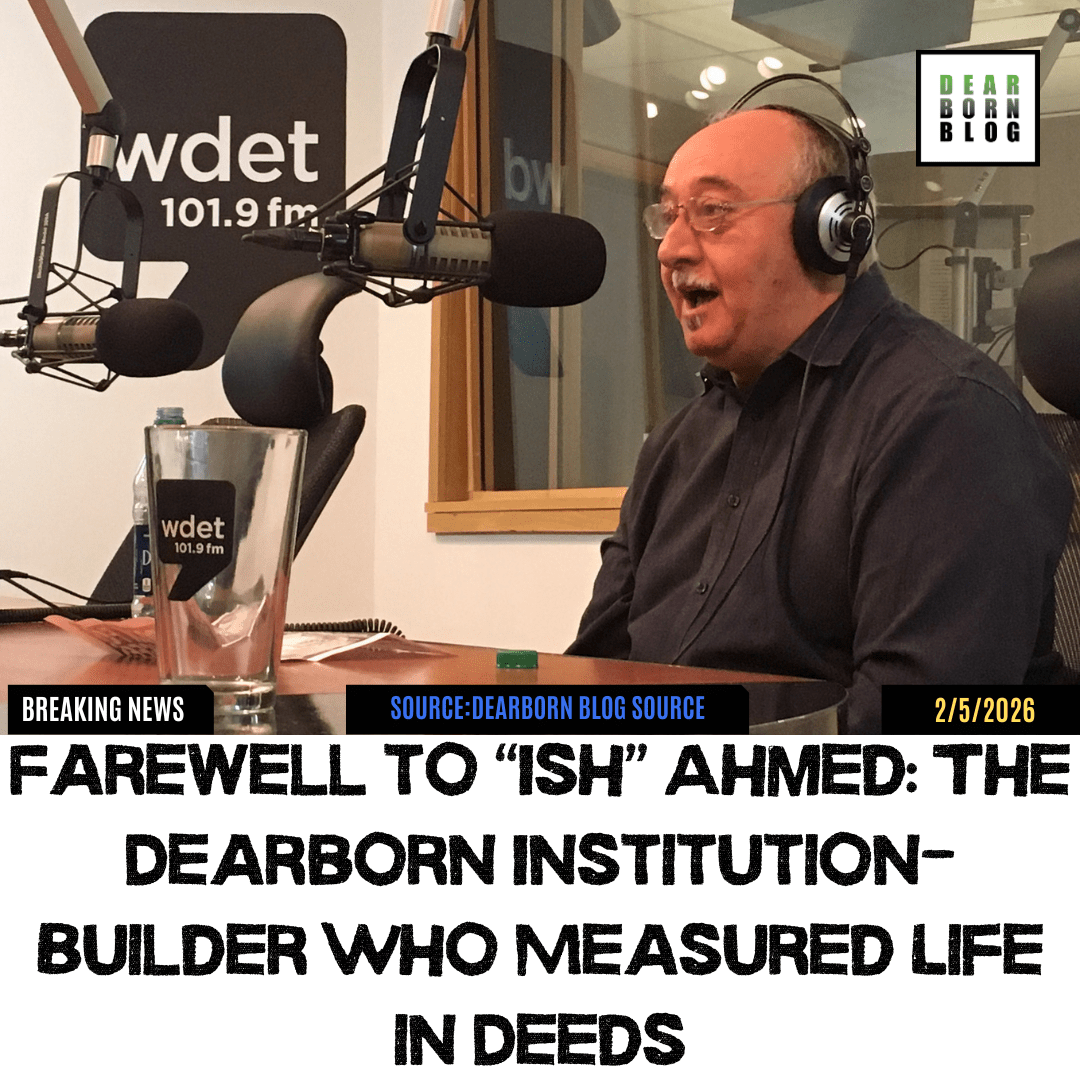
Ismael “Ish” Ahmed—a name that sounds short enough to fit on a bumper sticker—carried the long weight of a lifetime of organizing, public service, and cultural bridge-building in Dearborn and Detroit. He died on January 31, 2026, leaving behind institutions that still breathe, serve, and grow.
Metro Detroit is mourning the passing of Ismael “Ish” Ahmed, remembered across community, civic, and cultural circles as a builder: someone who helped turn immigrant struggle into organized power, and organized power into durable institutions. Multiple local outlets reported his death on Saturday, January 31, 2026, with funeral and memorial arrangements to be announced. [1][4] A memorial listing also records January 31, 2026 as his date of death. [12]
Some reports list his age as 79, while at least one syndicated item has reported 78—an inconsistency that sometimes appears in early coverage of a death before full family statements are widely published. [1][11]
What doesn’t vary is the shape of the legacy: it’s not abstract. It has addresses.
“We are not what we say, but what we do”
Professor Aoun Jaber—in a moving Arabic tribute shared with Dearborn Blog—summed up Ish’s whole operating system in one line:“We are not what we say, but what we do.”
If that sounds like a moral proverb, Ish treated it like a job description.
Jaber traces Ish’s early life from Brooklyn to southeast Dearborn (“Dix”), near the Ford River Rouge Complex—a tightly packed, hyper-diverse working-class ecosystem where people learned quickly that “community” is not a slogan. It’s how you survive. In that neighborhood, Jaber writes, Ish grew up among dozens of nationalities, absorbing diversity not as a marketing campaign, but as daily reality.
That kind of upbringing tends to produce two kinds of adults: the cynical, and the organized. Ish chose organized.
From the assembly line to community power
In Jaber’s account, Ish shared the daily pressures of industrial working families and took part in labor struggles against discrimination and police repression—experiences that sharpened his instincts for coalition-building and solidarity across communities, especially with Black and Latino neighbors.
That arc—worker, organizer, institution-builder—matches the public record of his life as described by civil-rights and community histories, including profiles that highlight his longtime commitment to immigrant rights and social justice in Michigan. [2]
ACCESS: a humble room that grew into a regional pillar
One of the clearest expressions of “do, don’t just say” is Arab Community Center for Economic and Social Services (ACCESS).
Jaber describes the early days with the kind of detail you only get from people who were there: a modest setup—chair, desk, even a ping-pong table—built by a small group of progressive Arab American organizers in 1973, with Ish among the founders. Over time, that seed became one of the most significant Arab American human services institutions in the United States. [1]
That story is echoed in broader Michigan civic coverage of Ish as a founding figure of ACCESS and a leader associated with building Arab American service infrastructure in metro Detroit. [1][4]
Taking the “service” mindset into state government
In 2007, then-Gov. Jennifer Granholm appointed Ish to lead the Michigan Department of Human Services. [5] A University of Michigan profile later described the role plainly: Michigan’s second-largest agency, serving people on the front lines of poverty—work that’s never glamorous and always consequential. [6]
This move mattered because it’s one thing to build community institutions outside government; it’s another to walk into a massive bureaucracy and try to make it behave like a human being. Ish tried anyway. [5][6]
And for those who believe politics should be more than careerism—yes, that includes a lot of Green-leaning folks in Dearborn—this is the point: governing should look like care, accountability, and measurable outcomes, not just speeches.
Culture as civic infrastructure: Concert of Colors and the sound of belonging
Ish didn’t treat art as decoration. He treated it as public infrastructure.
WDET 101.9 FM notes that he was the longtime host of This Island Earth and a cherished voice on the station. [7] The station also documents that he helped establish the Concert of Colors in 1993, and that it grew from a one-day event into a major multi-day cultural gathering. [8]
In other words: he built bridges people could actually walk across—sometimes with a bassline underneath them.
A life in coalition—local and global
Professor Jaber’s tribute also highlights Ish’s worldview: internationalist, anti-war, supportive of liberation movements, and openly supportive of the Palestinian people.
Here’s the honest version: Dearborn is a city where global politics aren’t “far away.” They show up at kitchen tables, in family histories, in the faces of neighbors. Ish understood that reality and worked in a way that connected human rights abroad to dignity and equity at home—without demanding that everyone share the same identity to share the same future.
At Dearborn Blog, we’re pro-human rights, pro-civil liberties, and unapologetically supportive of Palestinian human rights and self-determination—while insisting that community safety and democratic life require rejecting dehumanization wherever it appears.
A Dearborn-sized summary of an outsized legacy
• Helped found ACCESS and helped grow it into a durable community institution. [1][2]
• Led Michigan’s human services agency after appointment by Gov. Granholm. [5][6]
• Built cultural bridges through WDET and Concert of Colors. [7][8]
• Remembered across metro Detroit as a lifelong activist for immigrant rights and social justice. [1][4]
Closing: the best memorial is continuation
The easiest thing after a death is nostalgia. The harder thing is continuity.
Ish Ahmed’s life suggests a challenge to Dearborn and metro Detroit: if you miss him, don’t only praise him—practice the method. Organize. Serve. Build coalitions. Create institutions that outlive any one personality. And keep the doors open for the next wave of newcomers who will need the same kind of structured welcome that earlier generations fought to create.
May he rest in peace—and may the work stay loud.
Sources
- The Arab American News — “Veteran political and community activist Ismael (Ish) Ahmed dies at 79” (Jan 31, 2026).
- ACLU of Michigan — “Spotlight on Arab American History Month: Ismael Ahmed.”
- Ismael Ahmed (Wikipedia biography) — Biographical summary and career timeline.
- Deadline Detroit — “Ismael (Ish) Ahmed… Dies at 79” (Feb 1, 2026).
- State of Michigan (Granholm archive) — “Granholm Taps ACCESS Founder to Lead Department of Human Services” (Aug 13, 2007).
- University of Michigan HR — “On the Front Line Against Poverty” (profile referencing his DHS leadership).
- WDET 101.9 FM Facebook post — statement mourning his passing and noting This Island Earth.
- WDET event page — “Concert of Colors was established by Ismael Ahmed… in 1993” (event background).
- Instagram post (photographer tribute) — community remembrance connected to Concert of Colors.
- Yemeni American news aggregation referencing his death (community coverage).
- Syndicated coverage noting date of death and age (shows early-report variance).
- Memoritree memorial page — “Ismael N. Ahmed (1947–Jan 31, 2026), Dearborn, MI.”
- Professor Aoun Jaber — Arabic tribute text provided to Dearborn Blog (quoted and paraphrased in this article).
Disclaimer
This article is published for informational and community memorial purposes, based on publicly available reporting and the tribute text provided by Professor Aoun Jaber. Early reporting around funerals, memorial details, and biographical specifics may change as official family statements and arrangements are finalized. Dearborn Blog is not responsible for inadvertent errors or omissions. For corrections or comments you would like inserted in the article, please email info@dearbornblog.com.

 Dearborn Blog