

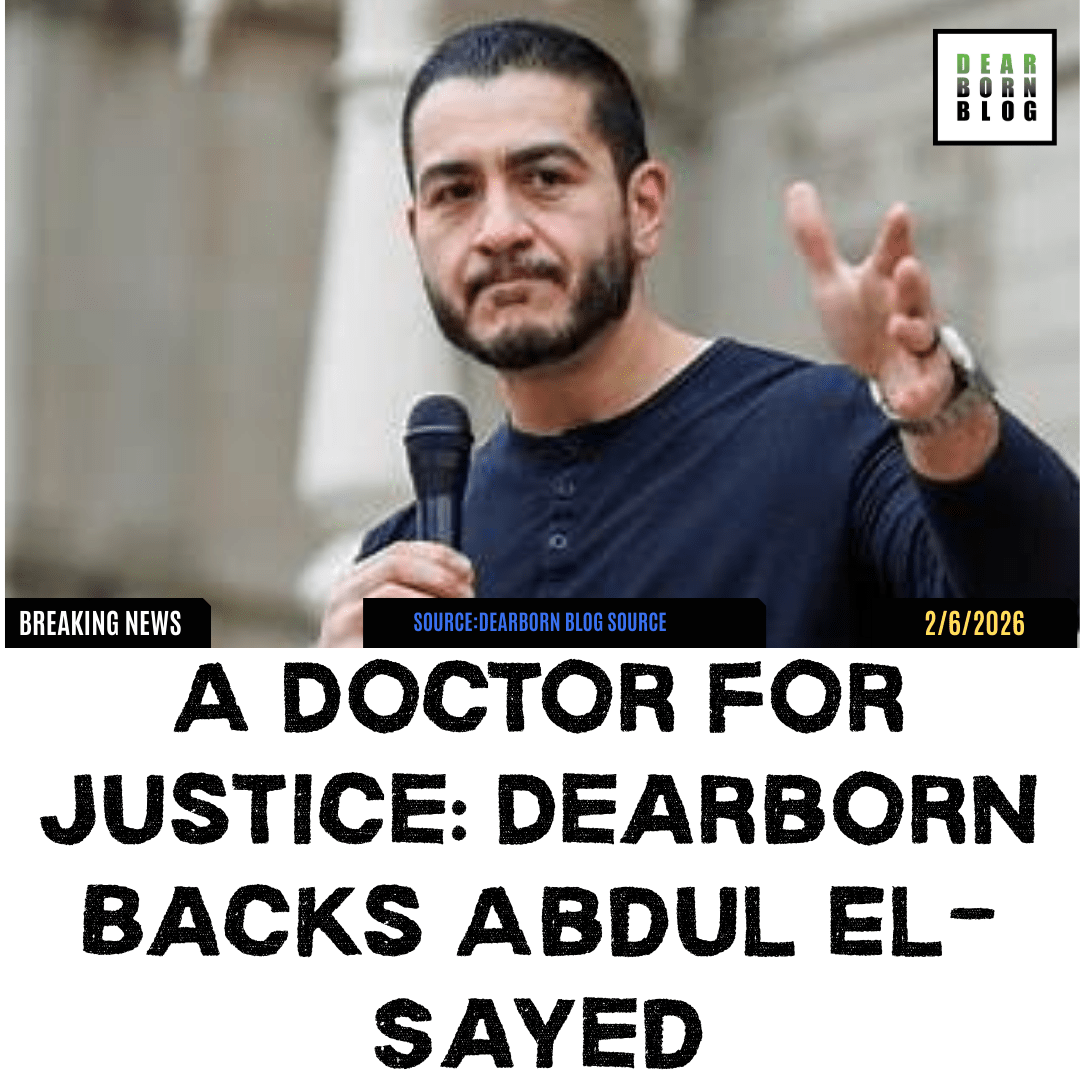
Dearborn Blog is endorsing Dr. Abdul El-Sayed for U.S. Senate because his record and platform match what our community keeps asking for: dignity at home, justice abroad, and a government that stops treating people like a budget line item—especially when it comes to healthcare, clean air, and Palestine.
Dearborn Blog is formally endorsing Dr. Abdul El-Sayed for the U.S. Senate.
That’s not a casual “we like his vibes” endorsement. It’s a values endorsement—rooted in Dearborn’s lived reality: a working-class city built by immigrants and labor, shaped by industrial pollution and public health inequities, and politically awakened (again and again) by the moral emergency of Palestine.
El-Sayed is running in Michigan’s 2026 U.S. Senate race for an open seat.[5] He’s a physician and public health leader who has run major public agencies, including county health leadership in the very region Dearborn calls home.[7] He’s also running an explicitly populist campaign—arguing that life shouldn’t be this hard, and that government should work for people instead of billionaires.[1] In a state where politics often feels like a corporate focus group with yard signs, that kind of clarity is rare.
And on one issue that has reshaped politics in Dearborn more than any other in the last two years—Gaza—El-Sayed has been unusually direct: he opposes “blank check” support for foreign militaries and has publicly connected U.S. funding to the catastrophe in Gaza.[9]
That alignment matters here.
What Dearborn Blog stands for—and why this endorsement fits
Dearborn Blog tries (imperfectly, but sincerely) to follow a simple compass: people over profit, peace over militarism, and truth over PR.
That puts us in the same neighborhood as many Green Party of the United States priorities—Medicare for All, climate action that’s real, demilitarizing foreign policy, civil liberties, and getting big money out of politics. El-Sayed isn’t running as a Green Party candidate. He’s running as a Democrat. But the question for Dearborn isn’t “what letter is next to your name?” It’s: do your choices protect human beings—or protect power?
On that core question, El-Sayed keeps landing where Dearborn has been landing: build a pro-worker economy, treat healthcare as a right, and stop exporting violence with our tax dollars.[1][2][3]
Dearborn’s political “why”: Gaza Genocide and the demand for moral consistency
Dearborn didn’t become a political headline by accident. It happened because our community watched Gaza burn, watched U.S. leaders make excuses, and then watched too many politicians treat Arab and Muslim voters like a problem to manage instead of constituents to respect.
El-Sayed has leaned into a foreign policy argument that’s straightforward and very “Dearborn-coded”:
- Spend taxpayer money rebuilding schools, healthcare, and infrastructure at home—not subsidizing militarism abroad.[3]
- Stop directly funding foreign militaries.[3]
- Make human rights—not lobby pressure—the baseline.[9]
In a 2025 endorsement announcement, Peace Action praised El-Sayed for pushing back against “endless militarism” and highlighted his public criticism of U.S. funding connected to “genocide and mass starvation in Gaza.”[9]
That’s the language many in Dearborn have been using in the streets, at school board meetings, at mosques and churches, and in living rooms where people feel helpless watching livestreamed devastation.
“No more blank checks for foreign militaries. No more silence while children starve.”[9]
That’s not a line every candidate is willing to say out loud. In Michigan politics, some still treat “Palestinian rights” like a career-ending hazard symbol. El-Sayed treats it like a basic moral test.[11]
A Dearborn connection that’s real, not performative
El-Sayed isn’t parachuting into Dearborn every four years for hummus and a photo op. A 2025 fundraiser in Dearborn drew local elected officials and community leaders and was framed—by Arab American media—as part of a broader moment of Arab and Muslim political power moving from the margins toward the center.[8]
That same report described a crowd that included Abdullah Hammoud and other local leaders, and it explicitly connected El-Sayed’s run to the kind of unapologetic values politics that many Arab/Muslim voters have demanded since Gaza.[8]
Also worth noting: on El-Sayed’s campaign endorsement list are multiple elected officials from Dearborn-area districts—evidence that this isn’t just an internet coalition, it’s also a local governing coalition.[4]
Competence is a value too
A lot of politicians can talk. Fewer have run anything complicated without breaking it.
El-Sayed’s case isn’t only moral; it’s operational. He ran public health systems in Detroit and Wayne County, and those jobs are not gentle.
When he stepped down from his county post in 2025 while considering a Senate run, Michigan Public noted that during his tenure he oversaw the installation of air quality monitors and helped clear medical debt for around 300,000 county residents.[7] CBS Detroit similarly reported that his work included an air quality monitoring program and partnerships aimed at improving kids’ health outcomes, alongside broader county initiatives.[12]
Dearborn understands public health the hard way: asthma near industrial corridors, access gaps, and healthcare costs that punish working families. A Senate candidate whose career is literally “health, systems, and how policy makes people sick” is not random—it’s relevant.• Michigan Public reported that El-Sayed helped clear medical debt for around 300,000 Wayne County residents during his county tenure.[7]
• Federal filings show El-Sayed’s campaign reported more than $5.35 million in total receipts in 2025 (coverage dates listed on the FEC page).[10]
The platform overlap: People, planet, peace
El-Sayed’s campaign priorities are broad, but the throughline is consistent: affordability, health, and rights.[2]
Healthcare as a right
He’s long been identified with Medicare for All politics and universal healthcare messaging, and his campaign is centered on making life less financially brutal for regular people.[5][6] Dearborn families don’t need another “market-based solution.” We need care without financial ruin.
Clean air and water
His campaign explicitly frames clean air and water as rights and emphasizes holding polluters accountable.[2] That theme hits home in southeast Michigan, where the line between “environmental policy” and “my kid can breathe” is not theoretical.
Housing and cost of living
His campaign calls for large-scale investment to address housing affordability and supply.[2] Dearborn renters and first-time buyers are living the national crisis locally—higher rents, higher rates, and fewer stable options.
Civil rights and liberties
Dearborn—home to immigrants, Muslims, Arabs, and people who get “randomly selected” at airports way more than randomness should allow—knows civil liberties are not a luxury. El-Sayed’s campaign lists civil rights and liberties as a core priority area.[2]
Foreign policy rooted in diplomacy and human rights
His foreign policy framing argues for diplomacy, cooperation, and human rights—and includes explicit opposition to directly funding foreign militaries.[3] In the context of Gaza, that approach is not “radical.” It’s the bare minimum of moral coherence.
The coalition: endorsements that signal what kind of campaign this is
El-Sayed entered the Senate race with major progressive attention, including an endorsement from Bernie Sanders.[5][6] His campaign also lists endorsements from Rashida Tlaib, along with other national and local leaders.[4]
These endorsements don’t guarantee correctness—but they do signal ideology and alignment: anti-oligarchy economics, expanded healthcare access, and a more restrained U.S. foreign policy.
The controversy question, answered honestly
Any candidate who challenges pro-Israel orthodoxy in U.S. politics will be attacked—sometimes fairly, often cynically, and sometimes with outright bigotry. El-Sayed has drawn especially intense scrutiny from pro-Israel outlets and groups over his framing of Gaza and U.S. policy.[11] Some critics argue his language is too harsh; supporters argue harsh reality deserves harsh language.
Dearborn Blog’s position is simple:
Calling out mass civilian suffering is not “extremism.”
Treating human rights as optional is.
We can hold two truths at once:
- Civilians—Israeli and Palestinian—deserve safety and dignity.
- The scale of devastation in Gaza and the role of U.S. funding demand public accountability, not silence.
El-Sayed’s willingness to confront that second truth is a major reason for this endorsement.
Why this matters for Dearborn specifically
A U.S. senator can’t fix everything—but senators vote on the big levers that keep landing on Dearborn’s back:
- healthcare policy and federal funding
- environmental regulation and enforcement
- labor rights and economic rules
- war funding, military aid, and foreign policy “blank checks”
Dearborn doesn’t need symbolic representation. It needs representation that understands:
- working-class life is already expensive enough
- public health is political
- climate and pollution are justice issues
- and Palestine is not a side issue—it’s a moral line in the sand for a lot of our community
In this race, El-Sayed is the candidate whose public record and stated priorities most closely match that reality.[1][2][3][7][9]
The endorsement
Dearborn Blog endorses Dr. Abdul El-Sayed for U.S. Senate because:
- He centers healthcare, cost of living, and public health as core governing priorities—not slogans.[1][2][7]
- He’s been willing to confront U.S. complicity in the Gaza Genocide and oppose “blank check” military policy—while many politicians dodge the issue.[9][11]
- He’s built real relationships with Dearborn and southeast Michigan communities that are too often treated as disposable during election season.[8]
- His campaign is demonstrably grassroots-funded in its public filings, reinforcing a people-powered approach.[10]
- His values align with the peace-and-justice direction many Dearborn residents (and Green-aligned voters) have been demanding for years.
This endorsement isn’t the end of your homework—it’s the start of it. Read platforms. Ask hard questions. Watch who takes corporate money and who doesn’t. Watch who speaks clearly about Gaza when it costs them something. Then act like your future depends on it—because it does.
Sources
- Abdul for U.S. Senate — “Official Campaign Website / Meet Abdul.”[1]
- Abdul for U.S. Senate — “Priorities.”[2]
- Abdul for U.S. Senate — “Sensible Foreign Policy.”[3]
- Abdul for U.S. Senate — “Endorsements.”[4]
- Associated Press — “Former Michigan health officer Abdul El-Sayed enters Democratic US Senate race.”[5]
- The Washington Post — “Health official jumps into Michigan Senate race with Sanders’s support.”[6]
- Michigan Public — “El-Sayed steps down from Wayne County to consider US Senate bid.”[7]
- The Arab American News — “Abdul El-Sayed raises funds and hopes in Dearborn for 2026 U.S. Senate run.”[8]
- Abdul for U.S. Senate — Press release: “Peace Action Backs Abdul El-Sayed for Michigan’s Open U.S. Senate Seat.”[9]
- Federal Election Commission — Candidate overview/financial summary for EL-SAYED, ABDUL (S6MI00418).[10]
- The Guardian — “The populist playbook: Democratic US Senate candidate seeks to replicate Mamdani’s success.”[11]
- CBS News Detroit — “Wayne County health director Abdul El-Sayed resigns; considering ‘future opportunity’.”[12]
Disclaimer
This article reflects the editorial opinion of Dearborn Blog and is provided for informational purposes only. It does not constitute legal, financial, or professional advice. We strive for accuracy, but political platforms, public statements, and campaign details can change quickly. If you notice an error, have updated information, or would like a correction or comment added, please email info@dearbornblog.com.

 Dearborn Blog