

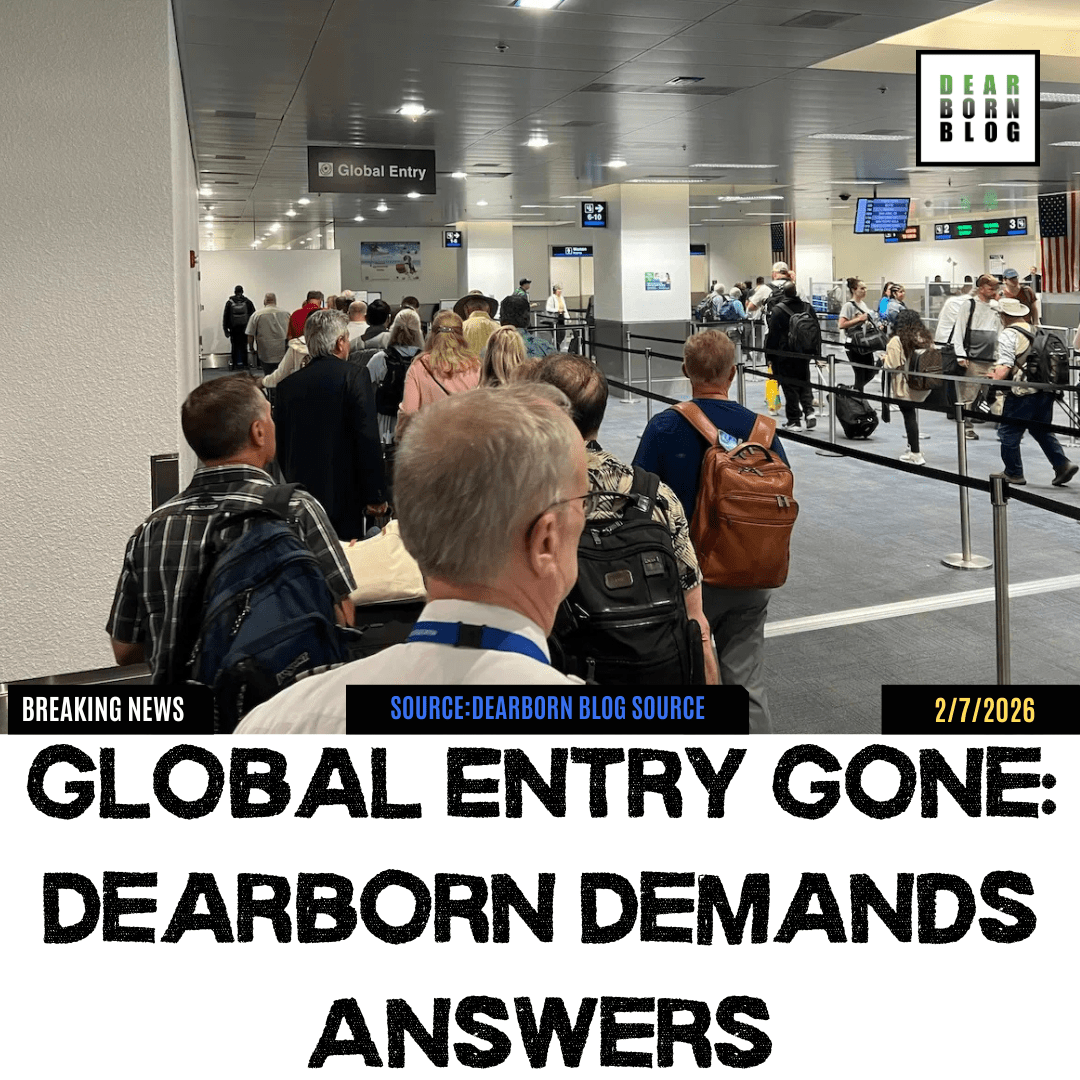
Arab American travelers are reporting sudden losses of TSA PreCheck and Global Entry—sometimes with little more than a vague notice and no clear path to an explanation. In Dearborn, the impact isn’t abstract: it hits jobs, families, reputations, and trust in government. Here’s what we know, what DHS says, and what people can do next.
There are a few uniquely modern forms of whiplash. One of them is opening an email from the Department of Homeland Security (DHS) and learning that the thing you paid for—and relied on—has disappeared.
That’s what multiple Arab American travelers say has been happening lately: TSA PreCheck and Global Entry privileges revoked without a specific explanation, sometimes after years of uneventful use.1 In Dearborn—where “travel” often means visiting family abroad, attending conferences, caring for relatives, and moving between two worlds as a normal part of life—this lands less like a bureaucratic update and more like an accusation without a charge.
Dearborn Blog has been made aware of two local examples: community members Wissam Charafeddine and Dr. Ali Hassan say they recently had TSA PreCheck and/or Global Entry revoked, with no detailed reason provided beyond general eligibility language. (We are not publishing private correspondence, personal identifiers, or travel histories; the point here is the pattern, not anyone’s paperwork.)
We can hold two thoughts at once, because reality is a multitasker:
- Trusted traveler programs exist for legitimate security and risk-management reasons.3
- If the government can quietly take away expedited travel privileges using vague, opaque logic—and the appeals process is confusing—then the door is open for errors, bias, and political misuse.
So let’s map the territory: what these programs are, how revocations happen, why explanations can be thin, what the data says, and what accountability could look like—especially for Arab American communities that have long dealt with disproportionate suspicion.
Quick reality check:
Global Entry and TSA PreCheck are “trusted traveler” programs. The benefits are real—shorter lines, less hassle—but they’re administered as privileges, not constitutional rights, and they can be denied or revoked based on a “low-risk” determination.3
What TSA PreCheck and Global Entry actually are
TSA PreCheck is an expedited screening option at U.S. airports. Members generally keep shoes and light jackets on, leave laptops and liquids in bags, and use dedicated lanes (where available).3
Global Entry is run by U.S. Customs and Border Protection (CBP) and speeds up re-entry into the United States at many airports and some other entry points. Many Global Entry members also receive TSA PreCheck eligibility as part of their membership, which is why people often experience these as a bundled “fast-pass” for modern life.
Both programs rely on background checks and ongoing vetting (the “trusted” part). Applicants provide information that is checked against criminal, immigration, customs, and other databases. The premise is classic risk management: move “known low-risk” travelers faster, so officers can focus on unknown or higher-risk cases.3
Revoked “without explanation” is not just a feeling—opacity is a documented issue
In theory, when someone is denied or revoked, the government provides written notice. CBP publicly states that denied or revoked applicants will be given information in writing “detailing the reason.”10
In practice, many travelers report getting notices that feel like they were written by a nervous robot trying not to say anything legally meaningful: “You do not meet eligibility requirements,” “Your status has changed,” or “DHS cannot always disclose…”—language that doesn’t tell you what to fix, what to appeal, or whether it was a clerical error or something more serious.67
This isn’t just anecdotal. A major Government Accountability Office (GAO) report on trusted traveler programs documented gaps in how CBP communicated reconsideration options and next steps, noting that CBP had removed key guidance from denial letters for years and later took steps to restore additional information after GAO raised the issue.1
FOIA “provides the public the right to request access to records from any federal agency”… unless the information falls under exemptions like national security, law enforcement, or privacy.— FOIA.gov (U.S. Department of Justice), overview of the Freedom of Information Act11
That quote matters here because when agencies won’t explain, people often turn to FOIA as the last flashlight in a dark hallway.
What the numbers say: denials are rare, revocations are rising
Most applicants are approved. GAO found that from fiscal year 2020 through the second quarter of fiscal year 2023, TSA enrolled or renewed over 99% of TSA PreCheck applications, and CBP enrolled or renewed over 97% across its programs.1
But “rare” doesn’t mean “not serious”—especially when revocations hit specific communities harder or appear to accelerate in a way the public can’t easily audit.
Recent reporting suggests Global Entry revocations have increased sharply. One analysis citing CBP data obtained via a public records request reported that CBP revoked more than 17,000 Global Entry memberships in 2024—up 47% from the prior year—and that the trend continued into 2025.4 Another travel-industry analysis similarly described a steep rise since 2020 and emphasized the lack of transparency many travelers experience when their status is terminated.5
Data point worth bookmarking:
GAO reports that CBP’s Ombudsman reviewed 76,183 reconsideration requests (FY2020–Q2 FY2023). About 39% were approved in some form (enrollment allowed, membership reinstated, or interview permitted), while about 61% were sustained.1
Translation: appeals are not hopeless—but the process can be exhausting, and many people don’t even know where to start.
Why Arab Americans are sounding the alarm
This story hits differently in Arab American communities for a reason: there’s a long record of profiling and collective suspicion, especially in the post-9/11 security era. Even when policies are written in neutral language, implementation can drift into “you fit a pattern we don’t like.”
And the concern isn’t new. In 2017, U.S. Senator Cory Booker and other senators publicly raised alarms after receiving reports that Global Entry memberships were being revoked from “Arab and Muslim sounding names,” suggesting a pattern that appeared linked to religion or ethnicity rather than individualized misconduct.8 Around that same period, the American-Arab Anti-Discrimination Committee (ADC) said it was receiving reports of Global Entry revocations affecting Arab and Muslim Americans and supported efforts to obtain records and explanations through public accountability channels.9
Those earlier warnings matter today because they establish a baseline: the fear of discriminatory revocations is not conspiracy-fuel—it’s a documented civil rights concern raised in mainstream policy channels.89
What DHS and CBP would likely argue
To be fair (and yes, we’re capable of fairness in Dearborn): DHS agencies will say trusted traveler programs are designed to identify risk, and that risk is not limited to convictions. A person can be “high risk” in a database sense because of unresolved investigations, inconsistent records, customs violations, or associations that trigger security flags.
They will also argue that detailed explanations can reveal investigative methods, compromise ongoing cases, or enable bad actors to reverse-engineer screening criteria. This “don’t show your cards” logic is baked into many security systems.
But here’s the tension: a system that punishes people without telling them what rule they broke is a system that can quietly punish the innocent—especially when bias, data errors, or political retaliation enter the bloodstream.
The civil liberties flashpoint: when “security vetting” touches lawful speech
In 2026, the anxiety isn’t only about ethnicity. It’s also about how surveillance and enforcement tools can spill into everyday rights.
A recent federal lawsuit described in travel reporting connects ICE facial recognition activity to the subsequent loss of Global Entry and TSA PreCheck—without an arrest or criminal charge—raising fears that lawful civic activity can indirectly trigger “risk” consequences in unrelated systems.7
That should worry everyone, regardless of politics. But it especially worries communities that are already over-policed and over-suspected.
And let’s name the elephant without dressing it up: Arab Americans advocating for Palestinian human rights—especially amid the ongoing Gaza Genocide—have watched pressure campaigns, smear tactics, and institutional crackdowns spread across the country. When people then lose travel privileges “without explanation,” it is rational (not paranoid) to ask whether political viewpoints are being laundered into “security” labels.
We cannot claim that is what happened to Wissam Charafeddine or Dr. Ali Hassan. We can say the lack of transparency creates the perfect environment for that suspicion to thrive—and for government credibility to corrode.
What to do if your Global Entry or TSA PreCheck is revoked
Here’s the practical playbook—because righteous anger is valid, but paperwork wins (annoyingly often) in the real world.
1) Get the denial/revocation letter and screenshot everything
Log into whatever portal or account you used (Trusted Traveler Programs for Global Entry; enrollment communications for TSA PreCheck). Save the letter, save the dates, and document any status changes.
2) Use the reconsideration process—don’t just “reapply” blind
GAO describes that TSA and CBP both have reconsideration paths for people denied or revoked.1 Follow the steps listed in the letter or portal. If you have supporting documents (court dispositions, proof of identity correction, evidence of resolved issues), submit them.
3) File a FOIA request for your records (especially if the letter is vague)
FOIA exists so ordinary people can request records from federal agencies, with exemptions for certain protected categories (national security, law enforcement, etc.).11 Even if you receive partial redactions, FOIA can reveal whether the issue was a database error, misidentification, or something else.
4) Consider contacting your congressional representatives
Members of Congress have constituent services offices for federal-agency problems, and historically, congressional scrutiny has forced agencies to explain patterns that would otherwise remain invisible.8
5) Connect with civil rights organizations if you suspect bias
If you believe you were targeted due to ethnicity, religion, national origin, or political viewpoint, talk to an attorney or a civil rights group experienced in DHS-related cases. This is especially important if multiple people in a community report similar outcomes in a short time.
Don’t accidentally hand CBP an easy reason:
Many revocations appear tied to customs/agriculture issues, failure to declare items, or other border-rule violations cited in reporting about Global Entry terminations.46
Declare what you’re carrying. When unsure, over-declare. “I didn’t know” is not a magic spell.
What accountability could look like (Dearborn edition)
Green Party values—civil liberties, equal justice, transparency, and opposition to discriminatory state power—aren’t just campaign poetry. They’re measurable standards we can demand from institutions that wield enormous discretion over people’s lives.
Here are reforms that don’t weaken security, but do strengthen legitimacy:
- Meaningful notice: provide specific, reviewable reasons whenever possible, not just generic eligibility statements.110
- Error correction fast lanes: if the issue is a record mismatch or identity confusion, fix it in weeks, not months.
- Bias auditing: publish anonymized data on denials/revocations by geography and other non-sensitive indicators, and allow independent civil rights review when disparities emerge.
- Firewall lawful speech: ensure political expression and lawful protest are not used as “risk” proxies.7
And in Dearborn specifically: local officials, community institutions, and legal advocates should track reports, look for patterns, and help residents navigate appeals. If a policy harms a community, the first step is making the harm visible—because invisibility is how bureaucracy gets away with things.
Dearborn’s bottom line
We can support real security and still demand due process. We can acknowledge that trusted traveler programs are discretionary and still insist that discretion must be accountable. And we can say, plainly, that Arab American communities have earned the right not to be treated as “permanent suspects,” whether the pretext is “national security,” “data vetting,” or a silent checkbox in a database.
If DHS wants public trust, it can’t run a system that feels like secret court for airport lines.
Sources
- U.S. Government Accountability Office (GAO). GAO-24-106314: DHS Trusted Traveler Programs—DHS Has Enrollment Processes, but CBP Should Provide Additional Information on Reconsiderations. February 28, 2024. :contentReference[oaicite:0]{index=0}
- U.S. Government Accountability Office (GAO). GAO-24-106314 Highlights. 2024. :contentReference[oaicite:1]{index=1}
- Congressional Research Service (CRS). Trusted Traveler Programs (R46783). May 5, 2021. :contentReference[oaicite:2]{index=2}
- Quartz. You might lose Global Entry. Here’s how to keep it. (Cites FOIA-obtained CBP revocation data; notes rise continuing into 2025.) 2025. :contentReference[oaicite:3]{index=3}
- One Mile at a Time. People Are Mysteriously Losing Global Entry At An Increasing Rate. November 15, 2025. :contentReference[oaicite:4]{index=4}
- The Points Guy. Know your rights and protect your privacy: What citizens need to know about reentering the US. November 19, 2025. :contentReference[oaicite:5]{index=5}
- Thrifty Traveler. Lost Global Entry? A New Federal Lawsuit Points to ICE Facial Recognition. January 31, 2026. :contentReference[oaicite:6]{index=6}
- Senator Cory Booker (U.S. Senate). Booker, Carper Lead Colleagues to DHS Over Reports of Global Entry Revocations Appearing to Target Arab and Muslim Americans. 2017. :contentReference[oaicite:7]{index=7}
- American-Arab Anti-Discrimination Committee (ADC). ADC Responds to Reports of Global Entry Revocations; Calls for Transparency/Accountability. 2017.
- U.S. Customs and Border Protection (CBP). Trusted Traveler Program Denials (public statement that denied/revoked travelers will be given written information detailing the reason). March 6, 2024. :contentReference[oaicite:9]{index=9}
- FOIA.gov (U.S. Department of Justice). What is FOIA? (overview of the Freedom of Information Act and exemptions). :contentReference[oaicite:10]{index=10}
- The White House. Restricting the Entry of Foreign Nationals to Protect the United States from Foreign Terrorists and Other National Security and Public Safety Threats (proclamation illustrating the broader federal posture of heightened vetting). June 4, 2025. :contentReference[oaicite:11]{index=11}
Disclaimer
This article is published for general informational purposes only and does not constitute legal advice. Policies, procedures, and agency practices can change, and individual cases can vary widely based on facts not publicly available. Dearborn Blog makes no claim about the specific cause of any individual revocation discussed here, including the experiences attributed to Wissam Charafeddine and Dr. Ali Hassan, beyond what has been reported to us. If you need legal advice, consult a licensed attorney.
Dearborn Blog is committed to accuracy and welcomes corrections. For any corrections or comments that you would like inserted in the article, please email info@dearbornblog.com.

 Dearborn Blog