

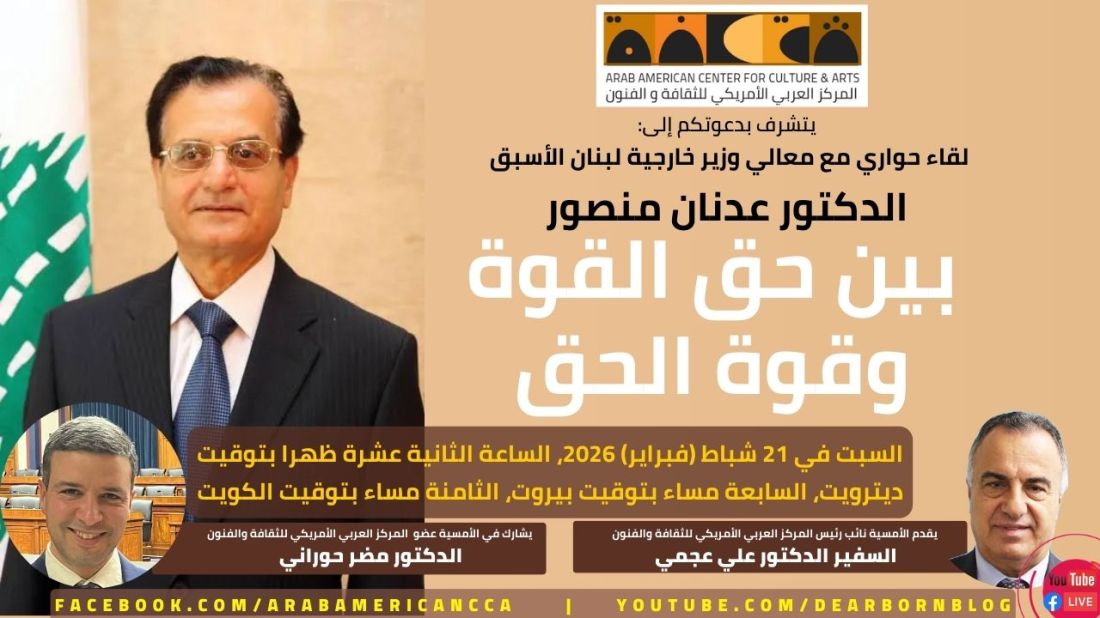
Between the Right of Power and the Power of Right: Insights from Former Lebanese Foreign Minister Dr. Adnan Mansour
Welcome back to the Dearborn Blog! In our latest episode, hosted in the cultural oasis of the Arab American Center for Culture and Arts, we had the distinct honor of welcoming a heavyweight in Middle Eastern diplomacy: Dr. Adnan Mansour, the former Minister of Foreign Affairs and Emigrants of Lebanon.
Guided by our hosts, Dr. Modar Hourani and Ambassador Dr. Ajami, this profound episode dove deep into the shifting sands of the global order. If you’ve been feeling like the moral compass of the world has been spinning out of control lately, you won’t want to miss this conversation.
Here are the key takeaways and profound moments from this crucial dialogue. You can watch the full episode here.
The Central Question: Does Might Make Right?
The episode opened with a philosophical yet highly urgent question [04:19]: Where is the right that transcends everything, and where is the peace based on justice? Dr. Mansour took us on a historical journey, tracing the evolution of the global order from the Cold War’s bipolar balance to today’s unipolar reality. He highlighted a troubling trend: the dismantling of international law in favor of unilateral decisions by global superpowers. When discussing the ongoing devastation in Gaza, Dr. Mansour pointed out the glaring hypocrisy in how international law is applied [16:50]. He argued that when the “Right of Power” (brute force) replaces the “Power of Right” (justice and international consensus), the world is driven toward a dangerous and unethical collision course.
As he powerfully noted, “Justice without power becomes subservient to the powers of evil” [35:20]. A right that cannot be defended is easily trampled.
The Illusion of a Multipolar World (For Now)
Are we moving towards a multipolar world with the rise of China and Russia? Dr. Mansour provided a grounded reality check. While China is making massive economic strides and Russia maintains immense military and geographical weight, Dr. Mansour argues that the United States remains the sole undisputed global hegemon [51:50]. From its unparalleled military reach to the dominance of the US dollar, true global balance has not yet been achieved. However, he remains optimistic that the future holds a shift, noting that a world with multiple competing powers is inherently more balanced and less prone to unilateral bullying.
A Hard Look at the Arab World
One of the most sobering segments of the interview was Dr. Mansour’s candid critique of the Arab world. He did not mince words about the region’s internal fragmentation. Since the establishment of the Arab League in 1945, Arab nations have failed to unite on a single diplomatic or military front [57:00].
This lack of unity, he explained, has turned the Middle East into a testing ground for foreign powers. Instead of protecting their collective sovereignty, Arab nations are often bogged down by internal divisions and foreign dependencies.
This environment has directly contributed to a massive “Brain Drain” [01:06:50]. Speaking to a reality that many of us in the Dearborn diaspora understand all too well, Dr. Mansour lamented that Arab nations routinely export their brightest minds to the West because they fail to provide the freedom, stability, and opportunities needed to thrive at home.
Lebanon’s Sectarian Paralysis
Turning his focus to his homeland, the former Foreign Minister diagnosed the root cause of Lebanon’s endless cycles of crisis: its sectarian political system [01:11:10].
Dr. Mansour eloquently explained a tragic inverse relationship in Lebanese politics: “When the state advances, the sects retreat, and when the sects advance, the state retreats.” Unfortunately, in Lebanon, the sects have advanced at the total expense of a unified central state. He argued that true sovereignty and neutrality can never be achieved as long as internal factions pledge allegiance to external foreign powers instead of a shared national identity.
Final Thoughts: Witnesses or Partners?
The episode wrapped up with a lingering challenge to all of us—especially to the Arab diaspora and the younger generations tuning in. Are we content with merely being witnesses to the reshaping of the world order, or do we have the courage to become active partners in its creation?
If you are passionate about geopolitics, human rights, and the future of the Middle East, this is a must-watch.
Watch the full discussion on the Dearborn Blog YouTube Channel: https://www.youtube.com/watch?v=nBSwa3RLNEQ
Don’t forget to like, share, and leave your thoughts in the comments! Let us know what you think about Dr. Mansour’s vision for the future of the Arab world.

 Dearborn Blog