

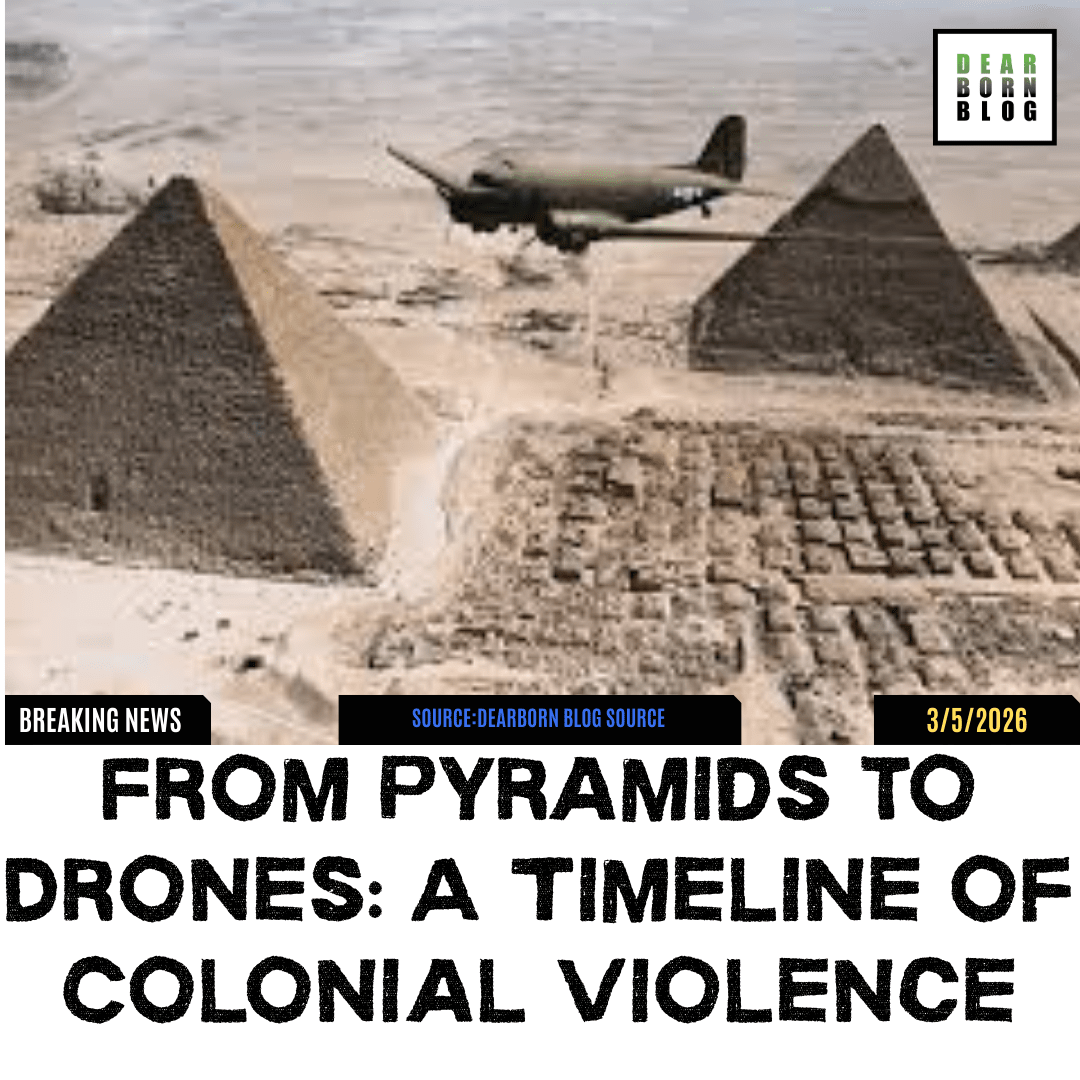
From Napoleon’s march on Cairo to modern “operations” named like video games, the Arab & Muslim world has repeatedly been treated as a testing ground for empire—first by European colonial powers, later by superpowers and regional militaries. This timeline is a starting map of that long pattern, with corrections, context, and sources.
Empires don’t always announce themselves with a top hat and a flag planting ceremony. Sometimes they arrive as “expeditions,” sometimes as “mandates,” sometimes as “coalitions,” and sometimes as “precision strikes” named by a PR department that thinks biblical references are a substitute for international law.
What you shared is more than a list of battles. It’s a rough historical X-ray: two centuries of outside force repeatedly landing on Arab and Muslim soil—Egypt, Palestine, Iraq, Syria, Libya, Yemen, Iran, Afghanistan, and Lebanon—then explaining it afterward in the language of “security,” “stability,” “civilization,” or “counterterrorism.”
This article does two things:
- It keeps your core timeline, with a few needed corrections (some entries have off-by-a-few-years issues).
- It adds context and sourcing, because history deserves better than vibes.
And yes: calling all of this “colonialism” is a lens, not a magic spell. Some entries are classic colonial conquest; others are modern interstate wars, interventions, or proxy escalations. But the pattern—power projecting into the region, repeatedly, with catastrophic human cost—is real.
A quick correction before we start
A few items in the list are commonly dated differently:
- Siege of Kut runs Dec 1915–Apr 1916, not just 1915.
- Suez Crisis is 1956 (not 1952).
- The Radfan/Aden conflict is typically tied to the Aden Emergency (1963–67), with the Radfan campaign concentrated in 1963–64.
- Operation Rough Rider (Yemen strikes) is widely reported as March–May 2025, not 2024.
Those details matter because dates are how propaganda gets caught lying.
The timeline (corrected + sourced)
| Year | Event | Where | Outside power(s) | Notes |
|---|---|---|---|---|
| 1798 | Battle of the Pyramids | Egypt | France | Napoleon’s victory opened the way to Cairo. [1] |
| 1799 | Siege of Acre | Palestine/Levant | France | Napoleon’s major setback in the campaign. [2] |
| 1915–1916 | Ctesiphon; Siege of Kut | Iraq | Britain | Mesopotamian campaign: advance, reversal, and the humiliating surrender at Kut. [3] |
| 1916 | Romani (Sinai) | Egypt | Britain | Part of the Sinai–Palestine front leading toward Palestine. [4] |
| 1917 | Capture/Fall of Baghdad | Iraq | Britain | Ottoman withdrawal; British entry March 1917. [5] |
| 1917–1918 | Gaza; Beersheba; Jerusalem; Megiddo | Palestine | Britain | Campaign that ends with Ottoman collapse across the front. [6] |
| 1920 | Maysalun | Syria | France | French force consolidation under the mandate era. [7] |
| 1925 | Bombing of Damascus | Syria | France | Brutal suppression during the Great Syrian Revolt. [8] |
| 1941 | Habbaniya / Anglo-Iraqi conflict | Iraq | Britain | British intervention to retain strategic control during WWII. [9] |
| 1941–1942 | Tobruk; Gazala; El Alamein | Libya/Egypt | Britain (and allies) | WWII fought on Arab land; empires treat the region as a chessboard. [10] |
| 1956 | Suez Crisis + Sinai invasion | Egypt | Britain/France/Israel | Canal nationalization triggers invasion and global crisis. [11] |
| 1958 | Operation Blue Bat | Lebanon | USA | U.S. intervention in Lebanon amid Cold War politics. [12] |
| 1963–1964 | Radfan / Aden Emergency phase | Yemen (South) | Britain | Counterinsurgency tied to the end of British rule. [13] |
| 1967 | Six-Day War | Egypt/Jordan/Syria | Israel | Territorial transformations that still define the conflict map. [14] |
| 1978 | Invasion of South Lebanon (Litani) | Lebanon | Israel | Start of repeated invasions and occupations. [15] |
| 1981 | Osirak bombing (Operation Opera) | Iraq | Israel | Airstrike on Iraqi nuclear reactor near Baghdad. [16] |
| 1982 | Lebanon invasion | Lebanon | Israel (U.S. later involved) | Israel invades; U.S. becomes entangled via regional deployment. [17] |
| 1988 | Operation Praying Mantis | Iran | USA | Major U.S. naval action against Iran in the Gulf. [18] |
| 1990–1991 | Gulf War | Iraq/Kuwait region | USA/UK/France (and coalition) | War triggered by Iraq’s invasion of Kuwait. [19] |
| 1996 | Operation Grapes of Wrath | Lebanon | Israel | Large-scale bombardment and civilian harm documented by rights groups. [20] |
| 1998 | Operation Desert Fox | Iraq | USA/UK | Bombing campaign framed around weapons inspections and WMD claims. [21] |
| 2001 | Afghanistan invasion | Afghanistan | USA/UK | U.S.-led invasion after 9/11 (Operation Enduring Freedom). [22] |
| 2003 | Iraq War (invasion) | Iraq | USA/UK | Rapid invasion followed by long occupation and insurgency. [23] |
| 2006 | Lebanon War | Lebanon | Israel | 34-day war with Hezbollah; massive displacement. [24] |
| 2007 | Operation Orchard / “Outside the Box” | Syria | Israel | Strike on suspected nuclear-related site; discussed by IAEA and Reuters. [25] |
| 2008–2009 | Operation Cast Lead | Palestine | Israel | UN human rights reporting documents large-scale destruction. [26] |
| 2012 | Operation Pillar of Defense | Palestine | Israel | Recurring cycle of escalation in Gaza. [27] |
| 2014 | Operation Protective Edge | Palestine | Israel | Major Gaza war in the repeating pattern. [27] |
| 2014–present | Operation Inherent Resolve | Iraq/Syria | USA (and coalition) | Anti-ISIS campaign with lasting footprint. [28] |
| 2017 | Shayrat strike | Syria | USA | U.S. missile strike on Syrian airbase (widely reported). [29] |
| 2021 | Guardian of the Walls | Palestine | Israel | IDF describes aims as “restore security”; Gaza again as battlefield. [30] |
| 2022 | Breaking Dawn | Palestine | Israel | Another Gaza escalation cycle. [27] |
| 2023–present | Genocide in Gaza (as alleged internationally) | Palestine | Israel (with external support debated) | ICJ case filed; provisional measures ordered; UN inquiry alleges genocidal elements; Israel rejects. [31] |
| Mar–May 2025 | Operation Rough Rider | Yemen | USA (UK later joins strikes) | U.S. campaign against Houthi targets; UK participation reported later in 2025. [32] |
| Dec 2024 | Operation Arrow of Bashan | Syria | Israel | After Assad government collapse (as reported), Reuters documents strikes; other reporting names the operation. [33] |
| June 2025 | “Twelve-Day War” (Israel–Iran) | Iran/Israel region | Israel/USA (France defensive interceptions) | Reuters reports U.S. role; France says it intercepted Iranian drones; UK’s role described variably in public record. [34] |
| Feb–Mar 2026 | Operation Epic Fury | Iran | USA/Israel | CENTCOM announces operation; Reuters describes massive strikes and escalation. [35] |
What this timeline says (and why it hits Dearborn differently)
A person in Paris can treat “Syria 1925” as a page in a textbook. A family in Dearborn might treat it as a story their grandparents told with a quiet, exhausted look.
This is one of the core truths of diaspora life: your homeland is not “foreign policy.” It’s family.
From Napoleon’s campaign to the British remapping of the region after WWI, the classic colonial move was simple: control the trade routes, control the resources, control the politics.
Then modernity shows up and the costumes change. Colonialism puts on a suit and calls itself “security partnership.”
The “operations” era: when war became a branding exercise
By the late 20th century, notice how the language shifts:
- “Battle of…” becomes “Operation…”
- Occupation becomes “stabilization”
- Bombing becomes “surgical” (because nothing says “minimal harm” like a 2,000-pound bomb)
This isn’t just semantics. Naming is power. If you control the vocabulary, you can control the moral framing—at least long enough to get the next weapons package approved.
A reality check box (because war is also a supply chain)
Reuters reported in June 2024 that the U.S. had sent Israel “more than 10,000” 2,000-pound bombs since October 7, 2023. That’s not a metaphor. That’s an inventory list.
The UK later suspended some export licenses for Israel over IHL concerns (while leaving notable carve-outs debated publicly).
This is why many people argue that outside powers aren’t “neutral observers” in genocide in Gaza—they’re part of the enabling environment, even if they’re not the ones pulling the trigger.
“Genocide” is a legal word, not just a shout
Because the term matters, here’s the sober version:
- South Africa brought a case against Israel at the International Court of Justice (ICJ) under the Genocide Convention.
- The ICJ ordered provisional measures in January 2024 and further addressed modifications in March 2024—this is not the final verdict on genocide, but it is the court saying “the risk is serious enough to order measures now.”
- A UN Commission of Inquiry report (as summarized in major reporting) has described findings framed as evidence of genocidal intent; Israel rejects the allegation.
That’s the key: there is an active international legal and investigatory process, not just internet yelling.
The 2025–2026 escalation problem: Gaza, Yemen, Syria, Iran—one fuse, many barrels
Your last entries (Rough Rider, Arrow of Bashan, Twelve-Day War, Epic Fury) point to something the region has been screaming for decades:
You don’t get “contained” wars anymore. You get cascading wars.
- U.S. strikes in Yemen under Operation Rough Rider are documented as a major campaign in 2025.
- Reuters documented massive Israeli strikes in Syria after Assad’s collapse (as reported), while other reporting explicitly names Operation Arrow of Bashan.
- Reuters described the June 2025 12-day Israel–Iran war and also reported France intercepted Iranian drones aimed at Israel before the ceasefire.
- CENTCOM publicly announced Operation Epic Fury starting Feb 28, 2026, and Reuters described a dramatic escalation.
Whatever anyone thinks about any one of those operations, the trend is ugly: the region is increasingly treated as an integrated battlespace, and civilians—again—eat the consequences.
Dearborn’s takeaway (and it’s not “learn history”)
Dearborn doesn’t need a lecture about the Middle East. Dearborn is a living archive of the Middle East.
The question is what we do with that reality:
- Do we accept that our tax dollars bankroll endless warfare as “normal”?
- Do we demand transparency and legal accountability (including for allies)?
- Do we push for diplomacy, ceasefires, and international law as real constraints—not decorative words?
The Green Party’s anti-war instinct isn’t abstract here. It’s local. It’s family. It’s the phone call from overseas. It’s the funeral fundraiser. It’s the kid at school who’s half-awake because they were up all night doomscrolling news from “back home.”
Empires love distance. Dearborn collapses distance.
Sources (with footnote numbers used above)
- Encyclopaedia Britannica, “Battle of the Pyramids.”
- Encyclopaedia Britannica, “Siege of Acre (1799).”
- Encyclopaedia Britannica, WWI “Other fronts 1915–16” (Ctesiphon/Kut context) + 1914–1918 Online overview of Kut.
- Background on Sinai–Palestine campaign context (including Romani era framing).
- 1914–1918 Online, “Fall of Baghdad.”
- Encyclopaedia Britannica entries on Gaza (WWI), Megiddo, and Jerusalem 1917 capture.
- Encyclopaedia Britannica, “Syria: The French mandate.”
- Humanitarian History Atlas, “Damascus, 1925: The Bombing of the City.”
- Encyclopaedia Britannica, “Iraq: World War II and British intervention.”
- Encyclopaedia Britannica on Tobruk and El Alamein context.
- Encyclopaedia Britannica, “Suez Crisis (1956).”
- U.S. Marine Corps historical monograph (PDF), “Marines in Lebanon 1958.”
- UK National Army Museum, “Aden Emergency,” plus Radfan campaign dating.
- Encyclopaedia Britannica, “Six-Day War.”
- Historical overview of Israel’s Lebanon incursions (contextual reporting).
- Encyclopaedia Britannica, “Osirak,” plus Operation Opera context.
- Encyclopaedia Britannica, “Lebanese Civil War” (1982 invasion context).
- U.S. Naval History and Heritage Command, “Operation Praying Mantis.”
- Encyclopaedia Britannica, “Persian Gulf War (1990–91).”
- Human Rights Watch, “Operation Grapes of Wrath” summary/report.
- U.S. Air Force historical fact sheet, “Operation Desert Fox.”
- Encyclopaedia Britannica, “Afghanistan War” (2001 invasion context).
- Encyclopaedia Britannica, “Iraq War” (2003 invasion).
- Encyclopaedia Britannica, “2006 Lebanon War.”
- Reuters (2007 strike acknowledgement context) + IAEA reporting on Syria’s Dair Alzour/Deir ez-Zor case.
- OHCHR press release on UN findings regarding “Operation Cast Lead.”
- (General Gaza operation sequence context; multiple well-documented cycles.)
- Official CJTF-OIR “Inherent Resolve” site.
- Widely documented U.S. strike on Shayrat (included here as standard reference point).
- IDF page describing “Operation Guardian of the Walls.”
- ICJ case docket + provisional measures orders; UN/major reporting on genocide allegation; Israel rejects.
- U.S. Naval Institute reporting on Operation Rough Rider.
- Reuters on Syria strikes after Assad collapse; Breaking Defense naming “Arrow of Bashan.”
- Reuters on the 12-day war; Reuters on France intercepting drones; UK Parliament briefing on impacts.
- CENTCOM press release on Operation Epic Fury + Reuters explainer.
Disclaimer
This article is a historical overview based on publicly available reporting and reference works. It is not legal advice, and it does not claim to be a complete list of all military actions affecting the Arab & Muslim world. Details in ongoing conflicts can change as new evidence emerges. For corrections, clarifications, or requests to add context, please email info@dearbornblog.com.

 Dearborn Blog