

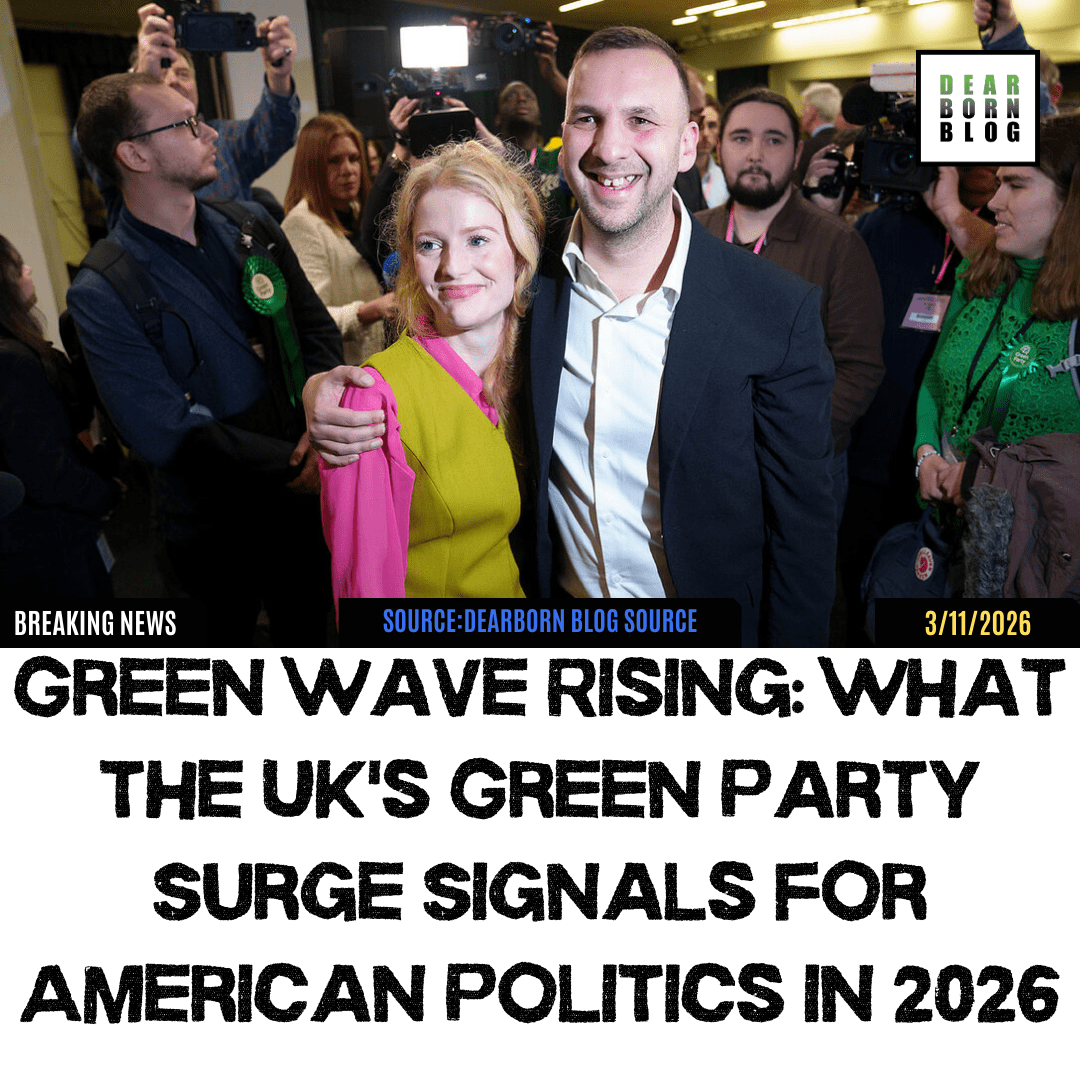
As Britain’s Greens shatter expectations in Labour heartlands, a growing coalition of U.S. Green congressional candidates is watching — and organizing — for a watershed 2026 midterm moment.
By Dearborn Blog Staff | March 10, 2026
When Hannah Spencer — a plumber-turned-politician who never attended university — swept to a stunning victory in Britain’s Gorton and Denton by-election last month, the political world took notice. Her Green Party claimed 40.7% of the vote in a district that had been a Labour stronghold for generations. Labour, the traditional home of Britain’s working class, limped in third at just 25.4%. It was a result that rewrote the political map of England.
Across the Atlantic, American Greens are paying close attention. As the United States enters a turbulent 2026 midterm election cycle — one defined by widespread disillusionment with both the Democratic and Republican parties — the lessons from Britain are not lost on the roughly 20 Green congressional candidates who are declaring their campaigns for seats in the U.S. House and Senate.
The question is whether what happened in Gorton and Denton can happen in Dearborn, Detroit, Milwaukee, or Los Angeles. The structural differences between British and American politics are real and formidable. But the underlying political frustration? That, experts say, is very much the same.
“Working hard used to get you something. It got you a house, a nice life, holidays. But now? Working hard? What does that get you?”
— Hannah Spencer, Green MP for Gorton and Denton, UK
Britain’s Green Moment — and Its Parallels to America
The Green Party of England and Wales has spent most of its life on the political margins since its founding in the 1970s. It was not until 2010 that the party won its first seat in the House of Commons. Today, it holds a record five seats — a number that, while modest, represents an unmistakable trajectory.
The driver of that growth, analysts say, is the hollowing out of the Labour Party’s left-wing base. Under Prime Minister Keir Starmer, Labour has drifted toward the political center in an effort to neutralize the threat posed by the right-wing Reform UK party. That drift — on issues ranging from immigration and asylum law to social spending — has left many traditional Labour voters feeling politically homeless.
“All the trends point to voters wanting something different,” said Louise Thompson, a senior lecturer in politics at the University of Manchester. “There is a real sense of frustration and disillusionment with the two main political parties.”
That story will sound familiar to anyone watching American politics. Democrats have hemorrhaged voters in recent years — over 2 million left the Democratic Party between 2020 and 2024 according to analysis of voter rolls across 30 states, cutting the party’s registration advantage from around 11 points to just above 6. Meanwhile, a Pew Research Center survey published in October 2025 found that majorities of Americans view both major parties as too extreme and neither as governing honestly or ethically.
“I think people are just disappointed in politics and disappointed in party politics,” said Mary Ann Marsh, a political analyst in Massachusetts, speaking to NBC News last year. The share of registered voters unaffiliated with either major party has grown nearly 9 percentage points since 2000.
About 20 Green Congressional Candidates Eye 2026
With most state filing deadlines still months away, the full picture of Green congressional candidacies for November 2026 is still forming. But the Green Party of the United States reports that candidates are actively organizing across multiple states for both House and Senate races — a surge of interest the party attributes directly to voter anger at both establishment parties.
Among those who have publicly declared or are actively campaigning:
| Candidate | State / Office | Key Platform Focus |
| Brian McGinnis | North Carolina – U.S. Senate | Veterans’ rights, ending corporate capture of democracy |
| Greg Stoker | Texas – U.S. House | Anti-duopoly reform, working-class economic relief |
| Candidate (NC-13) | North Carolina – House District 13 | Military service-based candidacy, people over power |
| Pete Karas | Wisconsin – Secretary of State | Climate action, rejection of two-party inaction |
| Butch Ware | California – Governor (Green, ex-VP nominee) | Gaza, racial justice, labor rights |
| Anthony Aguilar | North Carolina – U.S. Senate challenger | Progressive reform, anti-corporate politics |
| Unnamed (TX-Dist. 1) | Texas – U.S. House (Rural) | Farm economy, anti-monopoly agriculture |
| Unnamed (IL-Chicago area) | Illinois – U.S. House | Illinois ballot access drive; urban climate & labor |
| Unnamed (WI-Milwaukee) | Wisconsin – U.S. House | Green New Deal, healthcare access |
| Unnamed (PA-Philadelphia area) | Pennsylvania – U.S. House | Housing affordability, student debt relief |
| Unnamed (CA-Bay Area) | California – U.S. House | Tech accountability, universal healthcare |
| Unnamed (MI-Detroit area) | Michigan – U.S. House | Environmental justice, water rights |
| Unnamed (NY-Brooklyn) | New York – U.S. House | Gaza ceasefire, public housing |
| Unnamed (AZ-Tucson area) | Arizona – U.S. House | Immigration reform, border communities |
| Unnamed (OR-Portland) | Oregon – U.S. House | Homelessness, progressive tax reform |
| Unnamed (MN-Minneapolis) | Minnesota – U.S. House | Labor rights, police accountability |
| Unnamed (CO-Denver) | Colorado – U.S. House | Climate, public lands protection |
| Unnamed (MA-Boston area) | Massachusetts – U.S. House | Medicare for All, wealth tax |
| Unnamed (FL-South FL) | Florida – U.S. House | Voting rights, housing crisis |
| Unnamed (NJ-Southern) | New Jersey – U.S. House | Coastal environment, working class economy |
Note: Several 2026 candidacies are still in early announcement or organizing phases as state filing deadlines have not yet passed. This list reflects confirmed and reported campaigns as of March 2026. Blank-named entries represent active Green Party organizing efforts in those districts.
The Structural Challenge: Why the U.S. is Not the UK
To understand both the promise and the limits of what the UK result might signal for American Greens, it is essential to understand one fundamental difference: the electoral systems themselves.
Britain uses a first-past-the-post system in single-member constituencies. So does the United States — but in the UK, there are more viable parties competing for those votes. In Gorton and Denton, the Green candidate won with just 40.7% because the vote was split four ways. In a U.S. congressional district where two parties dominate the ballot, fundraising, and media coverage, winning with 40% would require a very different kind of political infrastructure than the Greens currently possess.
No Green Party candidate has ever been elected to the U.S. House or Senate. The party’s best congressional showing came in 2016, when Arizona’s Mark Salazar received 31.43% of the vote running in a district with no Democratic opponent. Ballot access laws, the campaign finance system, and the structural advantages enjoyed by the two major parties create formidable barriers that have no direct equivalent in British politics.
In September 2024, Democratic Congresswoman Alexandria Ocasio-Cortez publicly criticized the Green Party’s political strategy as “predatory,” arguing that Greens fail to build political power at the local level while only appearing “every four years” for presidential campaigns. The criticism stung — and Green Party leaders say the 2026 cycle is their answer to it.
“We feel the time is now, that it’s really time for a leftist party,” said Pete Karas, who organizes the Wisconsin Green Party’s candidate recruitment effort and is himself running for Secretary of State. “We feel like it’s going to be more attractive to voters and to candidates.”
The Dearborn Factor: Gaza, Identity, and the Left-Flank Revolt
For Dearborn readers, the parallels run even deeper than abstract electoral theory. This city — home to one of the largest Arab American and Muslim American communities in the United States — was ground zero in 2024 for the Democratic coalition’s fracturing over U.S. foreign policy in Gaza.
The Green Party, which advocates cutting all U.S. military aid to Israel, calling for a permanent ceasefire in Gaza, and supporting Palestinian rights, found a receptive audience here that it had rarely commanded nationally. Jill Stein’s 2024 presidential campaign — which received over 860,000 votes, its best showing in decades — drew heavily on Arab American, Muslim American, and progressive voters who felt that the Democratic Party had abandoned them.
The same dynamic played out in Britain’s Gorton and Denton. Community organizer Ally Fogg, who campaigned for the Greens there, noted that support for the party’s stance on Gaza and Palestine was a major motivating factor for voters alongside bread-and-butter economic issues like rent control and the cost of living.
The challenge for American Greens, just as for their British counterparts, is whether that foreign policy outrage translates into durable local political infrastructure — or whether it remains a protest vote that dissolves the moment the immediate crisis fades.
“The Green Party has an opening — but growth depends on building infrastructure, deepening messaging, and sustaining presence beyond symbolic presidential runs.”
— Dearborn Blog analysis, August 2025
What the Greens Are Running On in 2026
The U.S. Green Party’s platform for 2026 mirrors, in many ways, the policies that powered Spencer’s victory in Gorton and Denton: Medicare for All (universal healthcare), a Green New Deal to combat climate change and create jobs, a wealth tax on billionaires, student debt cancellation, free public higher education, rent control and affordable housing, and a $25 minimum wage. The party is also prominently running on ending U.S. military aid to Israel and the repeal of Citizens United — the Supreme Court ruling that opened the floodgates to unlimited corporate political spending.
When you poll Americans individually on these policies — a wealth tax, Medicare for All, public ownership of utilities — the results are often surprising to those who assume the country is uniformly moderate. According to multiple surveys, majorities or strong pluralities of Americans support these positions. The question has always been whether those policy preferences can be channeled into Green Party votes.
Brian McGinnis, a veteran and firefighter running as the Green Party candidate for U.S. Senate in North Carolina, frames his campaign in terms that echo Spencer’s victory speech: service over corporate interest, people over political donors. In Texas, Greg Stoker has declared his congressional candidacy explicitly as a rejection of the two-party duopoly. In Wisconsin, the state Green Party is mounting what its leaders call its most aggressive candidate recruitment drive in decades.
Can Lightning Strike Twice? The Sustainability Question
Political analysts are cautious about projecting too much from the UK result onto the American scene. Brandon Burden, a political scientist at the University of Wisconsin, noted that dissatisfaction with one party’s national leadership doesn’t automatically lift third-party candidates in state and local races, where voters often apply different criteria.
The history of the American Green Party is also a history of promising moments that did not compound into lasting power. Ralph Nader’s 2.7% in 2000 — which likely altered the outcome of the presidential election and drew intense Democratic backlash — ultimately triggered legal and organizational crackdowns on Green ballot access that the party spent years recovering from. Jill Stein’s 2016 and 2024 campaigns generated activist energy but did not translate into down-ballot gains.
Still, something feels different about 2026. The combination of factors — a deeply unpopular Republican administration, a Democratic Party struggling to articulate a coherent opposition message, a growing bloc of young voters with no party loyalty, and a foreign policy issue that has activated communities like Dearborn’s in ways rarely seen — creates conditions that the Greens have not enjoyed simultaneously before.
As one Gorton and Denton voter who switched from Labour to Green put it: “I’m not a radical. I just want a decent life for people.” It is a sentiment that crosses oceans.
What to Watch in the Coming Months
For readers in Dearborn and across Metro Detroit, several developments will indicate whether the Green wave has the momentum its supporters believe:
1. Ballot access battles in Michigan. The party must gather signatures to qualify candidates. Democrats have aggressively challenged Green ballot access in recent cycles.
2. Candidate quality and local rootedness. Spencer won partly because she was genuinely embedded in Gorton and Denton. Green candidates who are locally known and locally invested stand the best chance.
3. The Democratic Party’s direction. If Democrats continue drifting rightward on immigration, military spending, and corporate taxation, they continue creating political space on their left flank.
4. Whether the Gaza issue sustains. The foreign policy outrage that energized Arab and Muslim American voters in 2024 must translate into sustained political organizing, not just protest votes.
5. Down-ballot infrastructure. The Greens’ long-term viability depends less on any single congressional race and more on whether the party can build a bench of city council members, school board members, and state legislators.
Hannah Spencer’s victory in Gorton and Denton will not automatically be replicated in an American congressional district. The barriers are real. But what it proves — unmistakably — is that working-class voters who feel abandoned by mainstream left-wing parties will look elsewhere when given a credible alternative. In an America where both parties have record-low trust ratings, that is not a small thing.
The question for 2026 is not whether American Greens can replicate the UK result. The question is whether they can use this moment of political upheaval to build something that lasts.

 Dearborn Blog
As a Brit who’s now joined the Greens, the US is less favourable to a green party, partly because of the sheer cost of election campaigns, but also because they use open primaries to nominate candidates, whereas British parties use inside processes. It’s easier for outsiders like Sanders, AOC and Mamdani to gain office by winning Democratic primaries, rather than running for third parties.
If the US Greens are serious, they should do the opposite of what Ralph Nader did in 2000. They should focus on building support at a local level first. Use presidential candidates for publicity and nothing more. And focus on winning heavily Democratic seats where voters can defect with splitting the vote. Maybe some heavily Republican ones two; you’d be surprised, but 2 of our 4 seats in the British Parliament are former Conservative bastions.
LikeLike