

Subtitle: Freedom of Belief, Neutrality of Government
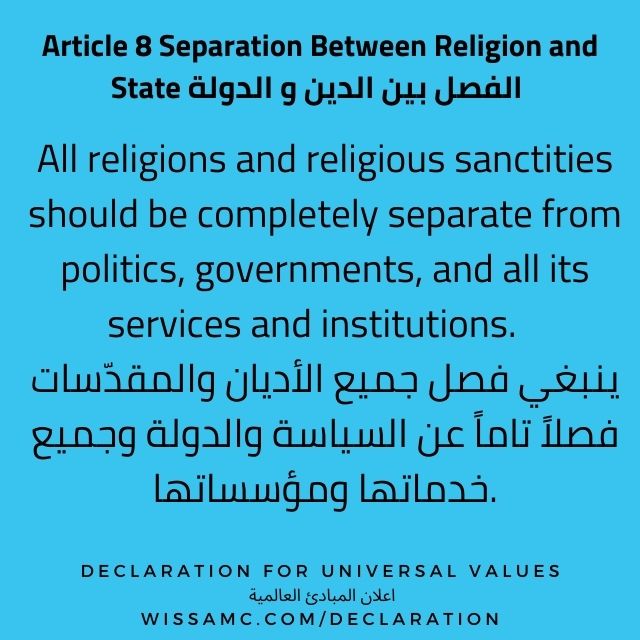
All religions and religious sanctities should be completely separate from politics, governments, and all its services and institutions. Governments can organize and manage religious institutions if need be and consent awarded by members of the said institutions.
A just society requires a clear boundary between religion and state. Article 8 affirms that all religions and religious sanctities should remain separate from politics, government, and public institutions. This principle is not hostile to religion; it is protective of both religion and freedom. When the state adopts, favors, or enforces religious doctrine, faith becomes a tool of power, and citizens of differing beliefs are pushed into inequality. A government worthy of all its people must remain neutral in matters of belief, allowing religion to flourish freely in civil society while ensuring that laws, public services, and political authority are grounded in equal citizenship rather than sectarian preference. The article’s core idea in the book is exactly this separation of religious and political spheres, so that government is not controlled by religious doctrine and religion is not corrupted by state power.
This separation protects the believer and the nonbeliever alike. It creates a civic space where Muslims, Christians, Jews, Hindus, Buddhists, atheists, agnostics, and everyone else stand equal before the law, without one creed enjoying official privilege over others. The state’s role is not to save souls, certify orthodoxy, or referee divine truth. Its role is to secure liberty, justice, safety, and the common good. History has repeatedly shown that when religion and government fuse too tightly, the result is often coercion, hypocrisy, persecution, and the misuse of sacred language for political domination. The book itself frames this article in that historical tradition: church-state entanglement has too often produced abuses of power, while secular neutrality better protects freedom of belief and equal treatment.
At the same time, Article 8 leaves room for a limited and carefully bounded administrative role for governments in relation to religious institutions when necessary and when consent is granted by the members of those institutions. That is an important nuance. It does not mean the state should control theology, doctrine, or worship. It means that in certain circumstances—such as questions of legal status, property, public accountability, pligrimage, religious tourism, or institutional administration—the government may help organize or regulate aspects of religious institutions, but only voluntarily and with the consent of the communities involved. In this model, the state remains neutral, religious communities remain autonomous, and both coexist without swallowing each other whole. That is the mature goal of Article 8: a society where freedom of conscience is fully protected, public institutions belong equally to all, and neither priest nor politician gets to masquerade as the other.

 Dearborn Blog