

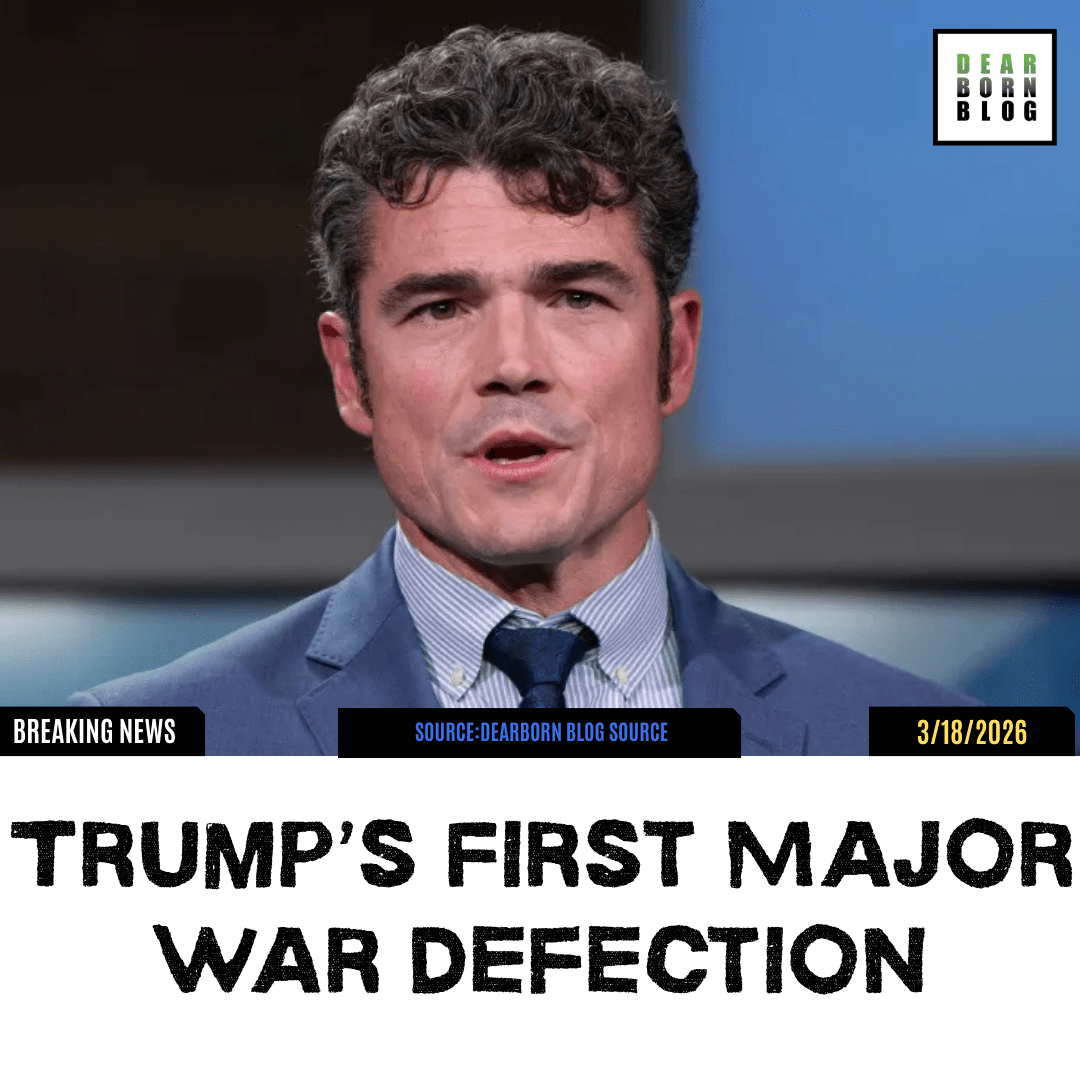
In what appears to be the first high-level public break inside the Trump administration over the war on Iran, National Counterterrorism Center Director Joseph Kent resigned and accused the administration of waging a war Iran did not imminently threaten to start. In his resignation letter, he said he could not “in good conscience” support the conflict and argued that the war was driven by pressure from Israel and its powerful American lobby. That is not a throwaway complaint from a sidelined staffer. That is a rupture from inside the machinery of U.S. national security itself. [1][2]
The attached resignation letter, now widely circulating, says Kent stepped down as Director of the National Counterterrorism Center effective immediately. In the letter, he wrote that Iran “posed no imminent threat to our nation” and that “it is clear that we started this war due to pressure from Israel and its powerful American lobby.” Reuters and the Associated Press both independently reported those same core claims from Kent’s public resignation statement, which matters because the internet is a carnival of nonsense and forgery on a good day. In this case, the central substance of the letter has been corroborated by major news organizations. [1][2]
“After much reflection, I have decided to resign from my position as Director of the National Counterterrorism Center, effective today.”
“I cannot in good conscience support the ongoing war in Iran.”
“Iran posed no imminent threat to our nation, and it is clear that we started this war due to pressure from Israel and its powerful American lobby.”
This is not just a personal act of dissent. Reuters reported that Kent’s resignation is the highest-ranking known departure from Trump’s administration over the Iran war so far, while the Associated Press described it as a major sign of internal unease over the conflict’s rationale. The White House and the Office of the Director of National Intelligence did not immediately respond to Reuters’ requests for comment. That silence carries its own strange little thunder. [1][2]
Why this resignation matters
Kent was not a ceremonial placeholder sitting under patriotic letterhead. The Office of the Director of National Intelligence says the NCTC director leads the U.S. counterterrorism and counternarcotics enterprise and serves as the president’s principal counterterrorism adviser. His Senate nomination materials describe the job as one that must unify intelligence and policy stakeholders across the national security apparatus. In plainer English: this is a top-tier intelligence role with access to highly sensitive information and direct relevance to how threats are defined, assessed, and sold to the public. [3][4]
Kent’s background also gives the resignation unusual weight. The ODNI biography says he served 20 years in the Army, completed 11 combat deployments, and served in elite units including the 75th Ranger Regiment and Special Forces, earning six Bronze Stars. This was not the resignation of a dovish outsider who wandered into the wrong building by accident. This was a deeply embedded national security figure, shaped by war, stepping away from power to say the war itself was unjustified. That hits differently, as the children say while the empire hums ominously in the background. [3]
The Associated Press also noted that Kent was confirmed in July 2025 despite controversy around his far-right political history, and that his resignation reflects broader tension inside Trump’s own political orbit about the war. That matters because it undercuts the lazy talking point that opposition to escalation comes only from the usual anti-war corners. Here, the break came from inside the administration, from a man who was very much not imported from a peace studies seminar. [2]
What Kent actually alleged
Kent’s letter did not merely object to timing, messaging, or tactical execution. He challenged the basic premise of the war. He wrote that Iran posed no imminent threat, and he argued that Trump had been pushed off his earlier “America First” instincts by a misinformation campaign from Israeli officials and influential voices in American media. Reuters reported that Kent compared the current moment to the run-up to the Iraq war, saying Trump had been deceived into believing there was a near-term threat and a quick path to victory. That is an extraordinary allegation from a sitting intelligence chief on his way out the door. [1]
Reuters also noted that legal experts have said an imminent threat can be central to justifying military action under existing U.S. law. Kent’s resignation therefore does not raise only a political disagreement. It raises a legal and constitutional question too: on what exact basis was this war launched, and what intelligence did the administration rely on when it sold the case to the country? That is not a small clerical footnote. That is the whole beast. [1]
The moral force behind the letter
One of the most striking parts of Kent’s statement is personal. He described himself as a veteran who deployed 11 times and a Gold Star husband whose wife Shannon was killed in war. Reuters reported in 2019 that Shannon Kent, a Navy cryptologic technician, was among the Americans killed in the ISIS-claimed bombing in Manbij, Syria. So when Kent writes that he cannot support sending another generation to “fight and die in a war that serves no benefit to the American people,” he is not speaking in borrowed language. He is speaking from the kind of grief that cannot be faked and should not be trivialized. [5]
That personal history also scrambles the usual propaganda wiring. Pro-war rhetoric often tries to monopolize the language of patriotism, sacrifice, and support for troops. Kent’s resignation blows a hole in that script. It shows that someone can be deeply military, deeply patriotic, deeply scarred by war, and still conclude that this war is morally wrong, strategically foolish, and unworthy of American lives. [1][5]
What this says about the Trump administration
At minimum, it shows that the administration’s public case for war is not internally settled. The Associated Press reported that Trump and his allies have offered shifting explanations for the strikes, and Kent’s resignation now throws even more scrutiny on those justifications. When a senior intelligence official publicly says there was no imminent threat, the administration no longer gets to pretend all disagreement is fringe theater. The disagreement is now inside the vault. [2]
Reuters also reported that Kent was close to Director of National Intelligence Tulsi Gabbard, who has kept a low public profile during the war. That makes the resignation more politically sensitive inside the intelligence community. Whether or not it triggers more departures, it suggests that the official public posture of unity may be far thinner than it looks on television. Washington is very good at pretending the wallpaper is load-bearing. Then one panel falls off and everyone acts shocked that there was wiring and smoke behind it. [1]
The war’s cost is already climbing
This resignation is not happening in a vacuum. Reuters reported on March 16 that roughly 200 U.S. troops had been wounded in the Iran war, with 13 Americans killed since the conflict began on February 28. Reuters also reported that U.S. forces have struck more than 7,000 targets in Iran. Whatever euphemism officials choose this week, this is not a neat little operation with crisp edges and no consequences. Wars are always sold as controlled burns. They keep becoming wildfires because reality refuses to read the memo. [6]
The humanitarian consequences could spread far beyond the battlefield. Reuters reported that the World Food Programme warned the war could push another 45 million people into acute hunger by June, raising the global total to more than 319 million. Rising food, oil, shipping, and aid-delivery costs are already compounding crises elsewhere. The European Union’s foreign policy chief, Kaja Kallas, also called on the United States and Israel to end the war, saying it is in everyone’s interest to stop the escalation and pursue diplomacy instead. [7][8]
By the numbers:
About 200 U.S. troops wounded, 13 U.S. troops killed, more than 7,000 targets struck in Iran, and a WFP warning that 45 million additional people could be pushed into acute hunger if the war continues. [6][7]
Why this matters in Dearborn
Dearborn does not experience the Middle East as an abstract foreign policy board game played by men in suits and maps. Families here are tied by blood, memory, migration, language, and grief to Iran, Iraq, Lebanon, Palestine, Yemen, and beyond. A war launched in Washington does not stay in Washington. It enters living rooms here through phone calls, funeral notices, visa fears, shattered nerves, and the old ache of knowing that American decisions are too often made over the heads of the people who pay for them. That is why Kent’s resignation matters locally. It is a sign that even inside the national security state, the official story is cracking. [1][2][6]
For Dearborn, the deeper question remains the same one communities like ours have asked for generations: Who pays for wars they did not choose? Usually not the lobbyists. Not the television hawks. Not the officials who produce elegant phrases like “limited action” and “degrading capabilities.” The bill lands on soldiers, civilians, immigrants, refugees, and families already carrying too much history. Kent’s resignation does not settle every argument about Iran, the United States, or the region. But it does puncture a crucial myth: that this war is unanimously understood inside government as necessary, urgent, or honest. [1][2][6][7]
In the end, this is bigger than one resignation letter. It is a warning flare from inside the state itself. A senior intelligence official with combat experience, top-level access, and personal sacrifice behind him has now publicly said that Iran posed no imminent threat and that the war was launched under pressure from Israel and its lobby. The administration may deny, attack, deflect, and spin until the gears smoke. But the resignation happened. The letter exists. The fracture is visible. In an age of polished lies, even one visible crack matters. [1][2]
Sources
[1] Reuters, US National Counterterrorism Center director resigns over war in Iran, March 17, 2026.
[2] Associated Press, Top counterterrorism official Kent resigns over Trump’s Iran war, says Iran posed no imminent threat, March 17, 2026.
[3] Office of the Director of National Intelligence, Director NCTC / Joe Kent biography.
[4] U.S. Senate Select Committee on Intelligence, Questionnaire for Joseph Kent nomination materials, 2025.
[5] Reuters, U.S. names three killed in Syria blast claimed by Islamic State, January 18, 2019.
[6] Reuters, Number of US troops wounded in war against Iran rises to about 200, March 16, 2026.
[7] Reuters, Iran war may push 45 million people into acute hunger by June, WFP says, March 17, 2026.
[8] Reuters, EU foreign policy chief Kallas calls on US, Israel to end Iran war, March 17, 2026.
Disclaimer
This article is based on the attached resignation letter and on publicly available reporting and official biographical material available at the time of writing. Events tied to war, intelligence, and national security can change quickly, and additional facts, clarifications, denials, or corrections may emerge. This piece is provided for informational and analytical purposes only and should not be treated as legal advice or as a final factual determination of every disputed claim. For corrections, comments, or requests to update this article, please email info@dearbornblog.com.

 Dearborn Blog