

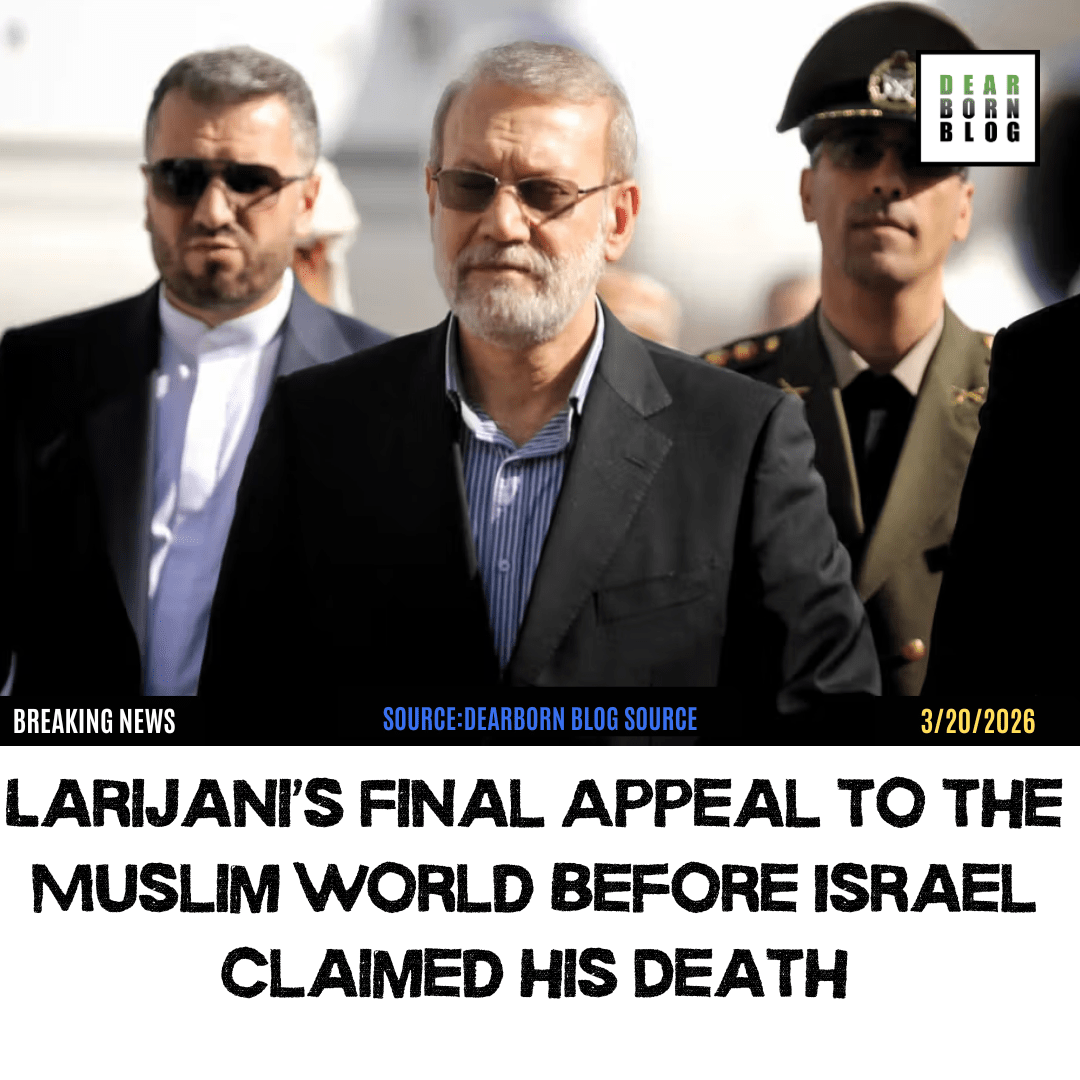
In what may stand as Ali Larijani’s final major public message, Iran’s top security official issued a blunt appeal to Muslims and Islamic governments, accusing them of silence, cowardice, and political betrayal as Iran faced war with the United States and Israel. Hours later, Israel said it had killed him in a strike near Tehran — a claim that, at the time of publication, had still not been publicly confirmed by Iran.[1][2]
By Dearborn Blog Staff
Editor’s Note:
As of publication on March 17, 2026, Israel has claimed it killed Ali Larijani, but Iran had not publicly confirmed his death in the reporting reviewed for this article. This piece is written to reflect that reality, not fantasy dressed up as certainty.[1][2]
Ali Larijani’s message was not written like a diplomatic memo. It read like a warning, a rebuke, and, if Israel’s claim is later confirmed, a final political testament. Addressed to “Muslims around the world and to the governments of Islamic countries,” the statement argued that Iran had been attacked during negotiations by what he called “American-Zionist aggression,” and that the wider Muslim world had, with only rare exceptions, failed to stand with the Iranian people.[4][5]
That timing is what gives the statement its force. On Tuesday, March 17, 2026, Israel’s defense minister said Larijani, the secretary of Iran’s Supreme National Security Council, had been killed in an Israeli strike. Reuters had earlier reported that Israeli officials said he had been targeted but that his fate was unclear. Later reports from Reuters and AP repeated the same central point: Israel said he was dead, but Iran had not yet confirmed it.[1][2][3]
A message aimed at Muslim governments, not just enemies
Larijani’s statement was remarkable not simply because it attacked the United States and Israel. Iranian officials do that all the time. What made this message different was that it was aimed just as sharply at Muslim-majority governments that, in his view, had failed a basic moral and political test.[4][5]
He argued that while Iran remained “steadfast on the path of resistance,” many Islamic governments had offered little more than political gestures. Then came the line that will likely be quoted most often from the statement:
“Whoever hears a man calling out ‘O Muslims!’ and does not respond to him is not a Muslim.”
Larijani followed that invocation with a cutting challenge:
“So what kind of Islam is this?”
In the text circulated publicly, Larijani also condemned governments that had objected when Iran struck American bases and American or Israeli interests on their territory. His answer was simple: if bases in your country are used to attack Iran, then Iran is not expected to sit quietly and absorb the blows. He called those objections “flimsy pretexts” and framed the confrontation as one between “America and Israel on one side and Muslim Iran and the forces of resistance on the other.”[4][5]
That is not the language of de-escalation. It is the language of political sorting. Pick a side. Stop pretending neutrality is morally clean. Stop using diplomatic euphemisms to hide strategic cooperation. Whether one agrees with Larijani or not, the message was designed to strip the mask off governments trying to balance public outrage with quiet military alignment.[4][5]
Why Larijani mattered
Larijani was not a symbolic figure. He was one of the most powerful officials in Iran’s security establishment, a longtime regime insider, a former parliamentary speaker, a former nuclear negotiator, and a man deeply involved in state decision-making during one of the most dangerous moments in the country’s recent history.[1][3]
AP described him as a top strategist who had become central to Iran’s leadership structure after earlier wartime losses. Reuters reported that he had been publicly visible at Quds Day rallies shortly before the strike and that his possible killing would make him the most senior Iranian official killed since the death of Ayatollah Ali Khamenei earlier in the war.[1][3]
He was also, it must be said plainly, a deeply controversial figure. AP reported that Larijani had been sanctioned by the United States and European Union for his role in the suppression of anti-government protests and internal repression. So this was not a peace activist writing poetry in exile. This was a senior architect of the Iranian state speaking from inside the machinery of power.[3]
That dual reality matters. For some, Larijani was a resistance figure confronting American and Israeli power. For others, he was an enforcer of an authoritarian system. History is often rude like that: one man can be read as both a target of imperial violence and an agent of domestic repression. Pretending only one side exists is how people end up worshipping cardboard cutouts instead of understanding the world as it is.[3][6]
The uncertainty still matters
Even after Israel’s claim, the fog did not clear immediately. Reuters reported first that Israeli officials said Larijani had been targeted and that his fate was uncertain. Al Jazeera reported that Iranian state media later published a handwritten note attributed to Larijani, though it said it was not clear whether that was intended as proof of life. In other words: even in the middle of a very public assassination claim, the evidentiary ground was still moving.[1][5]
That is why serious reporting has to use disciplined language. Not “he was definitely killed” if the state allegedly targeted has not confirmed it. Not “fake news” just because there is uncertainty. The truthful version, at least for now, is this: Larijani issued a major message on Monday, March 16; Israel claimed on Tuesday, March 17 that it had killed him; Iran had not publicly confirmed that claim at the time this article was prepared.[1][2][4]
What made the message politically explosive
The core political point of Larijani’s statement was not merely that Iran was under attack. It was that the wider Islamic world was being tested and, in his view, failing. He urged Muslim governments to think not only about Iran, but about “the future of the Islamic world,” arguing that America “has no loyalty” and that Israel is the enemy of the region, not a partner that can deliver security or stability.[4][5]
He also insisted that Iran “does not seek to dominate” other countries and instead called for the unity of the Islamic nation as a path toward “security, progress, and independence.” That language was doing several jobs at once: defending Iran’s regional posture, accusing Arab and Muslim governments of complicity, and appealing over the heads of rulers directly to Muslim publics.[4]
This is why the message resonated beyond Tehran. It was not just about military retaliation. It was about legitimacy. Who speaks for the region? Who defines resistance? Who profits from silence? And who is asked, once again, to die while governments issue polished statements that mean less than a shrug?[4][6]
The regional backdrop
The broader context makes the statement even more combustible. Reuters reported that the war had entered its third week, had caused more than 2,000 deaths, and had triggered enormous regional and global consequences, including missile and drone attacks across the Gulf and a near-total shutdown of the Strait of Hormuz.[6]
Against that backdrop, Larijani’s message can be read as an attempt to force a reckoning: if this is the regional order, if American bases remain embedded across the region, if Israel can strike senior officials while Muslim governments hedge their language, then what exactly is left of the idea of a united Islamic political community?[4][5][6]
Whether that argument persuades anyone is another matter. But it was undeniably the argument he chose to make at what may have been the last major public moment of his life.[1][2][4]
Why this matters in Dearborn
In Dearborn, a city with deep Arab, Muslim, immigrant, and anti-war traditions, this story will not be heard as just another distant geopolitical bulletin. People here know what it means when powerful states speak the language of security while bodies pile up. They know what it means when governments ask the public to suspend disbelief and morality at the same time. And they know the gap between what people feel in their bones and what states say at podiums can become a canyon overnight.
Larijani’s politics were his own, and many will reject parts of them outright. But the force of his final appeal — if final it was — came from a question much larger than one man: what obligations do people and governments have when a region is being torn apart in plain sight? That question is not just Iran’s question. It is Palestine’s question. It is Lebanon’s question. It is Iraq’s question. And for a city like Dearborn, which has spent years watching official narratives collapse under the weight of real human suffering, it is also a local question.
If Israel’s claim is ultimately confirmed, then Ali Larijani’s last public message was not soft, diplomatic, or cautious. It was confrontational to the end. It accused, demanded, and warned. It did not ask history for kindness. It tried to seize the microphone before the bomb smoke swallowed the room.[1][2][4][5]
A line that will linger:
“So on which side do you stand?”
That was Larijani’s challenge to Muslim governments. It may also become the line many ordinary people remember most from this moment.
Sources
[1] Reuters, “Israeli military strike targeted Iran’s security chief Larijani, fate unclear, officials say,” March 17, 2026. Reported that Israeli officials said Larijani was targeted, while his fate remained unclear and Iran had not yet issued a response.
[2] Reuters, “Israel says Iran’s security chief Larijani is killed,” March 17, 2026. Reported Israel’s direct claim that Larijani was killed and noted that Iran had not confirmed the death at the time.
[3] Associated Press, “A look at the top Iranian official and the head of internal security targeted by Israel,” March 17, 2026. Provided background on Larijani’s role, prior positions, and sanctions related to internal repression.
[4] Iran International, “Larijani rebukes UAE, other Islamic states for not backing Iran during war,” March 16, 2026. Summarized Larijani’s message criticizing Muslim governments for failing to back Iran and defending retaliation against U.S. and Israeli-linked targets.
[5] Al Jazeera, “Israel says it has killed Ali Larijani, Iran’s top security official,” March 17, 2026. Reported on Larijani’s Monday message and noted the later publication of a handwritten note attributed to him, while saying it was unclear whether it was proof of life.
[6] Reuters, “Iran rejects de-escalation offers; Israel says it kills Iranian security chief,” March 17, 2026. Provided broader context on the war’s third week, the death toll, regional escalation, and the Strait of Hormuz crisis.
Disclaimer
This article is a news analysis and commentary piece based on publicly available reporting and statements available as of March 17, 2026. Because this is a fast-moving war story, some claims — including the reported death of Ali Larijani — may be updated or clarified by later official confirmation or contradictory evidence. Dearborn Blog publishes this piece in good faith for public discussion and informational purposes and does not assert unverified claims as settled fact. For any corrections, clarifications, or comments you would like inserted in the article, please email info@dearbornblog.com.

 Dearborn Blog