

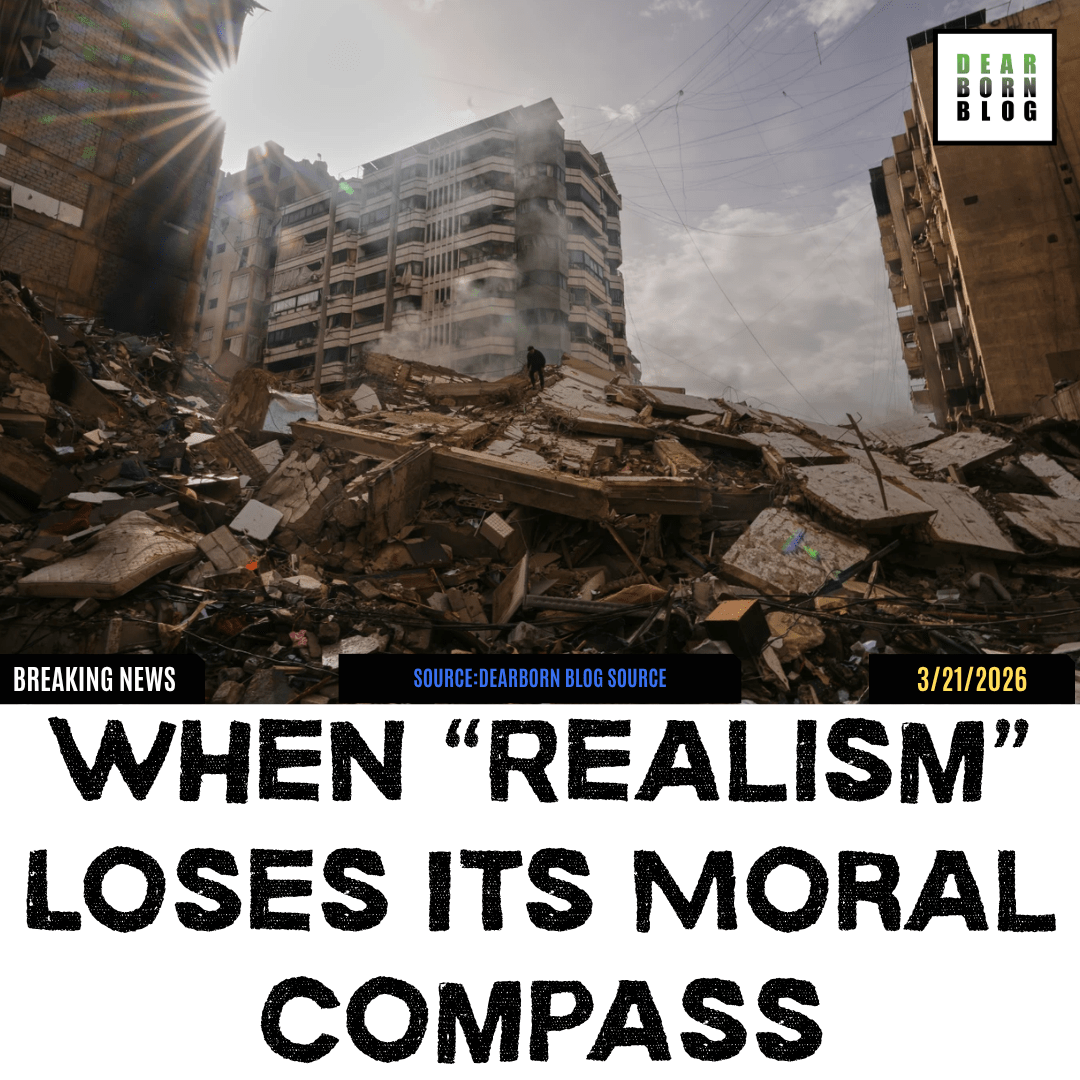
In times of war, some voices wrap themselves in the language of “realism” while blurring the most basic truth in politics: there is still a difference between the aggressor and the attacked. Criticizing Iran is fair game. Using that criticism to soften the clarity of U.S.-Israeli aggression is something else entirely.
By Wissam Charafeddine
There is a certain kind of political commentary that loves to call itself “realistic.” It begins with a familiar line: the world is not black and white. It warns us against emotion, against symbolism, against moral clarity. It insists that everything is interests, power, maneuvering, and survival. Then, almost without fail, it ends up flattening the most important distinction of all: the difference between the aggressor and the one under attack.
That is not realism. That is confusion with a necktie on.
As of March 20, 2026, the U.S.-Israeli war on Iran has entered its third week, with Washington deploying thousands of additional Marines and sailors to the region on top of the roughly 50,000 U.S. troops already stationed there. Reuters reported that the administration was weighing options tied to the Strait of Hormuz and other strategic sites, even as President Trump publicly downplayed the prospect of a broader ground war. AP likewise reported a widening regional crisis, rising deaths, displacement, and deepening energy disruptions. [1][2]
This matters because once bombs are falling, the first obligation of any serious political analysis is to identify the central fact of the moment: who is attacking whom? That question does not erase complexity. It simply prevents complexity from becoming an alibi.
There is a reason international law begins where it does. Article 2(4) of the United Nations Charter requires states to refrain from the threat or use of force against the territorial integrity or political independence of another state. That principle is not a poem, not a slogan, and not a sentimental fantasy. It is the legal floor beneath any claim to international order. [3]
“Realism” that cannot distinguish between the bomber and the bombed is not realism at all. It is moral disorientation dressed up as sophistication.
To say that U.S. and Israeli actions are aggression is not to invent a religious morality play. It is to describe a plain legal and political reality. And once that reality is clear, a second point follows just as plainly: criticizing Iran does not absolve Israel, and condemning aggression does not amount to canonizing any government.
This should not be difficult.
We already know this logic from Iraq. Opposing the 2003 invasion did not require anyone to bleach Saddam Hussein’s crimes. It required only a functioning moral compass. The same is true here. Refusing to excuse an assault on Iran does not mean pretending the Iranian state has a spotless record, whether internally or regionally. It means refusing to let every conversation begin by interrogating the target of attack before we name the attacker.
That maneuver has become almost automatic in our politics. Yes, there is aggression, but what about Iran? Yes, there is an illegal war, but what about the regime? Yes, Trump and Netanyahu are dragging the region toward catastrophe, but what about Tehran’s history? Each question may be valid in another context. But in the middle of a live assault, this pattern often functions less as analysis than as displacement.
It shifts the moral weight away from the crime in progress and onto the record of the victim, rival, or target.
That is how people train themselves to stop seeing clearly.
The same pattern has defined far too much Western and regional discourse on Palestine. The International Court of Justice, in its July 19, 2024 advisory opinion, concluded that Israel’s continued presence in the Occupied Palestinian Territory is unlawful. Earlier, in January 2024, the Court ordered provisional measures requiring Israel to take steps to prevent acts falling under the Genocide Convention. Separately, the UN Special Rapporteur Francesca Albanese concluded in March 2024 that there were reasonable grounds to believe the threshold indicating genocide had been met in Gaza. [4][5][6]
Add to that the International Criminal Court’s November 2024 decision issuing arrest warrants for Benjamin Netanyahu and Yoav Gallant, and the broader picture becomes even harder to hide behind clever phrasing. [7]
And yet people still say: there is no morality in politics.
That line sounds tough-minded, but it collapses under even the lightest pressure. If politics were truly nothing but a jungle, states would not spend so much time manufacturing legal justifications, invoking self-defense, laundering violence through humanitarian language, or presenting naked force as reluctant necessity. The lie itself proves that legitimacy still matters. Even empires know they need a mask.
So no, politics is not a choir rehearsal. States pursue interests, and they often do it brutally. But that does not mean values, law, principle, legitimacy, and historical memory disappear. It means they remain contested terrain. It means the struggle over meaning is part of the struggle over power.
And that is exactly why the current argument over Iran matters so much.
Some insist that Iran’s stance on Palestine is merely a vehicle for regional influence. Fine. Every state has strategic calculations. But let us at least ask the obvious question honestly: where, exactly, is the easy Iranian interest in maintaining decades of confrontation with Israel and the United States, paying enormous military, economic, and political costs along the way?
The low-cost path has always been visible. Reconcile with Washington. Normalize with Israel. Re-enter the American regional order. Trade Palestine for security guarantees, sanctions relief, and elite acceptance. That road has never been closed. Others have taken it. Iran did not.
This does not prove sainthood. It proves that reducing everything to “they just use Palestine for leverage” is lazy analysis.
A serious political mind can hold two thoughts at once: that Iran has acted harshly and opportunistically in parts of the region, and that the U.S.-Israeli axis remains the principal engine of destruction, occupation, and destabilization in the Middle East. These two claims do not cancel each other out. In fact, refusing to rank them is usually where analysis starts to rot.
Criticizing Iran is legitimate. Turning that criticism into a rhetorical shield for U.S.-Israeli violence is not.
The obsession with false balance has done enormous damage in our part of the world. Every time an existential threat becomes visible, some commentators rush to flatten the hierarchy of dangers. The occupier and the occupied. The invader and the invaded. The empire and the state under bombardment. Everyone gets blended into one gray puddle. Then we are told this is maturity.
It is not maturity. It is failure to prioritize.
There is a reason communities like Dearborn react so strongly to this kind of language. For many families here, these arguments are not abstract debates for television studios or faculty lounges. They are tied to memory, exile, war, sanctions, displacement, occupation, and the long afterlife of American intervention in Arab and Muslim lands. In Dearborn, people know what it means when powerful states speak in the language of order while leaving entire societies shattered behind them.
That is why moral clarity matters here.
Not because Dearborn is naïve. Not because our communities believe in fairy tales about perfect governments. But because too many of us have already seen what happens when elite “realism” asks ordinary people to lower their outrage, moderate their language, and wait patiently while history crushes them in the name of strategic complexity.
The question, then, is not whether Iran is above criticism. Of course it is not.
The real question is whether we still possess the political and moral discipline to identify the primary danger when it stands in front of us. Right now, that danger is not theoretical. It is armed, funded, internationally shielded, and regionally expansive. It is the same project that occupies Palestine, destroys Gaza, bombs Lebanon, threatens the wider region, and now escalates direct war on Iran with American backing. [1][2][4][5][7]
Even within the United States, the public appears wary of a deeper war. Reuters/Ipsos polling published March 19 found that most Americans believed Trump would escalate into a larger ground conflict with Iran, while only a small minority supported that outcome. [8]
That should tell us something. The appetite for endless war is weak. The machinery for it is not.
So let us be plain.
A political language that cannot name the main aggressor is not realism. A framework that treats law as irrelevant whenever power is involved is not depth. A commentary style that invokes complexity only when Israel or the United States are on the offensive is not sophistication. It is selective fog.
And a moral compass that stops working the moment Washington and Tel Aviv enter the frame is not a compass worth keeping.
Dearborn deserves better than that. Arab Americans deserve better than that. Anyone who claims to care about law, human dignity, anti-war politics, or Palestinian freedom should demand better than that.
Yes, the world is complicated. Yes, states are flawed. Yes, Iran can and should be criticized.
But no amount of criticism changes the central truth of this moment: the U.S.-Israeli war machine remains the clearest existential threat to justice, sovereignty, and human life in the region.
Once that truth is blurred, everything else becomes easier to sell: another war, another bombing campaign, another “exception,” another dead child explained away as strategy.
And that is not realism.
That is moral collapse.
Source List
[1] Reuters, “US to deploy thousands of additional troops to the Middle East, officials say,” March 20, 2026.
[2] Associated Press, “The Latest: US deploys thousands more troops to the war as Iran threatens world tourism sites,” March 20, 2026.
[3] United Nations, Charter of the United Nations, Article 2(4).
[4] International Court of Justice, “Summary of the Advisory Opinion of 19 July 2024,” on the legal consequences arising from Israel’s policies and practices in the Occupied Palestinian Territory.
[5] International Court of Justice, “Summary of the Order of 26 January 2024,” Application of the Convention on the Prevention and Punishment of the Crime of Genocide in the Gaza Strip (South Africa v. Israel).
[6] Office of the United Nations High Commissioner for Human Rights, A/HRC/55/73, “Anatomy of a Genocide,” March 25, 2024.
[7] International Criminal Court, “Situation in the State of Palestine: ICC Pre-Trial Chamber I rejects the State of Israel’s challenges to jurisdiction and issues warrants of arrest for Benjamin Netanyahu and Yoav Gallant,” November 21, 2024.
[8] Reuters, “Most Americans believe Trump will send ground troops into Iran, and don’t support it, Reuters/Ipsos poll finds,” March 19, 2026.
Disclaimer
This article is a commentary piece published in the public interest and reflects analysis and opinion based on the sources available at the time of publication. It is not legal advice, and it does not claim to offer a final or exclusive interpretation of rapidly developing events. Dearborn Blog welcomes corrections, clarifications, and substantive comments. For any corrections or comments you would like inserted into the article, please email info@dearbornblog.com.

 Dearborn Blog
Excellent article. “Article 2(4) of the United Nations Charter requires states to refrain from the threat or use of force against the territorial integrity or political independence of another state” YES it is an expression of the ethic of reciprocity that is found in the scriptures of nearly every religion.
LikeLike