

Readings on Sovereignty, Pluralism, and the Arab Dilemma
1. Hezbollah is a Lebanese Party
Hezbollah is a Lebanese Shiite Islamist political party, founded by Lebanese members in 1982. It adheres to the doctrine of Wilayat al-Faqih, an Islamic theory that holds that, during the occultation, the qualified jurist should exercise guardianship and leadership over the Ummah.
There is no evidence that its political or military decisions are dictated from outside its own will. From a religious standpoint, the authority of the Wali al-Faqih is regarded as binding and necessary for moral and legal accountability in religious action, and political, military, and social work are all considered part of religious duty. Even so, there is no evidence that the Wali al-Faqih intervenes in local decisions. Religiously, his concern is always the welfare of Muslims as a whole, all of whom are equal in his view. The fact that the Wali al-Faqih lives in Iran does not mean that his religious judgment favors the interests of the state in which he resides. The history of Shiite religious authority is clear in its transcendence of geographic borders. Ayatollah Khamenei is ethnically Turkic, and the Assembly of Experts—which appoints, dismisses, and oversees the Wali al-Faqih—is composed of 88 jurists from different ethnic backgrounds and countries.
Yes, the party has gone through stages in which its goals, vision, and national integration have evolved.
Hezbollah is not an Iranian party. But it is part of the Axis of Resistance, which is led and funded by Iran across the Islamic world.
Any view of the party as somehow non-Lebanese diminishes the choice and will of a large segment of the Lebanese people who brought it into being. It does not help national dialogue, because it amounts to denying the patriotism of one of the parties involved.
Yes, you may disagree with its performance or support it. But you do not have the right to strip it of its Lebanese identity, its patriotism, or its love for its homeland.
2. Iranian Support for Hezbollah Is Not an Occupation
The word *occupation* is not an emotional label or a ready-made media accusation. It has a precise legal meaning, and once that meaning is lost, the discussion shifts from law to propaganda. Under Article 42 of the 1907 Hague Regulations, occupation is defined as the forcible military control by one state over the territory of another state—or part of it—through the entry of its armed forces.
So the standard here is not the existence of funding, arms transfers, or ideological ties. The standard is the existence of actual authority—direct or indirect—over the land, its administration, and the territory itself.
Accordingly, Iranian support for Hezbollah—however people may differ in judging it politically, morally, or strategically—does not in itself amount to “occupation” unless it can be shown that Iran placed Lebanon, or part of it, under the authority of its own army, or that it came to exercise effective rule over Lebanese territory in place of the Lebanese state. Even more recent legal discussions about what is sometimes called “proxy occupation” or “occupation by proxy” do not remove the requirement of effective control over the territory. Mere support, coordination, or influence is not enough; what is required is a much higher level of actual control and domination.
Moreover, the relationship between Lebanon and Iran was not, in its essence, the relationship of a foreign army to a country stripped of its will. It was an official and declared relationship between two states linked by diplomatic channels and cooperation agreements. Lebanon’s Ministry of Economy lists among the bilateral agreements a framework agreement with Iran signed in October 1997 and ratified in November 1998. In recent years as well, official Lebanese and Iranian statements have repeatedly spoken of expanding economic and trade cooperation, holding joint economic committees, and working within a framework of sovereignty and mutual respect. In addition, the ministerial statements that endorsed the formula of *the army, the people, and the resistance* legitimized the role of the resistance and its place within the state’s map of authority. This was affirmed in the ministerial statements of 2005, 2008, and 2009, and remained in force until it was removed from the latest ministerial statement in 2025. Therefore, Iranian military supply and support for Hezbollah operated with state cover and legal-political legitimacy, not in defiance of the state, up until the current government of Nawaf Salam.
This does not mean that every aspect of the relationship has been the subject of Lebanese consensus. But it does mean that the situation is not one of occupation in the legal sense. It is, rather, a relationship between states, intertwined with alliances and overlapping domestic and regional forces.
The more accurate way to put it, then, is this: Iran supported Hezbollah, and that support formed part of a broader regional project. Lebanese people differ profoundly over its effects, its limits, and its legitimacy. But to turn all of this into “an Iranian occupation of Lebanon” is to leap over both the legal definitions and the facts on the ground. Occupation is one thing. Alliance is another. Support is another. Influence is something else again. Whoever confuses them is either deliberately or ignorantly blurring concepts in order to win the battle with words after failing to win it with precision—and in the end, the only beneficiary is Israel.
3. Lebanese Identity Cannot Be Separated from the Palestinian Cause, Nor Jabal Amel from the Upper Galilee
The carving of Lebanon out of historic Syria was not a simple or organic development. It was part of a broader colonial partition of the region after the First World War, shaped by the French and British arrangements that redrew the borders of Bilad al-Sham.
Just as “Greater Lebanon” itself was born in the laboratory of the Mandate, against the will of Jabal Aamil and most of the Shia & Sunni leadership and some of the Orthodox and Druz, and minority of Maronites, till it was forced upon them, the separation of southern Lebanon—especially Jabal Amel—from its natural extension into the Galilee, Palestine, and Syria was also neither natural nor self-evident. It took place within a process of administrative and political redrawing under French rule, driven in part by France’s interest at the time in securing political Maronite predominance. This incorporation was not free of hesitation, objection, or local anxiety. Jabal Amel entered the “new Lebanon” already burdened by marginalization and unease toward the new structure of power. Other studies have also shown that the new borders shrank the historic Ameli sphere and weakened its older organic cohesion.
More importantly, the Zionist movement itself had northern territorial ambitions from the very beginning. These extended through the Upper Galilee and up to the lower slopes of the Litani River, which figured in Zionist thinking as a desirable northern boundary for Palestine, especially for strategic and water-related reasons from the earliest days of Zionist immigration.
Then came the Franco-British border settlement in the early 1920s, making the matter even more artificial and more painful for the people living through it. Dozens of villages were shifted from Mandate Lebanon into Mandate Palestine. Among the best-known examples are the Seven Shiite Villages, which ended up on the Palestinian side of the border after the 1923 boundary revision, even though their inhabitants retained Lebanese ties and affiliations for years afterward. That fact alone shows that the line dividing Lebanon from Palestine was not a “natural” border so much as a colonial line negotiated by two foreign powers over the heads of the local population.
The truth is that Lebanon cannot protect itself from Israel by denying Palestine, nor can it invent for itself some magical neutrality in the face of an expansionist colonial project that has never respected either moral or geographic limits. A power that uprooted a people from its land, occupied southern Lebanon, and bombed Beirut does not suddenly become a normal neighbor just because some Lebanese have grown tired of the conflict or weary of its costs.
There are those who try to reduce Lebanese patriotism to a narrow, impoverished, and historically empty meaning: to care only about banks, electricity, jobs, and municipalities, as though a country were merely a service company rather than a political and moral entity living at the heart of a turbulent region. Yes, the Lebanese have every right to demand a state, bread, dignity, and just institutions. That is unquestionable. But the disaster begins when these legitimate demands are presented as a substitute for Palestine, or when Palestine is portrayed as the foreign burden Lebanon must discard in order to “recover.”
Lebanon does not dissolve into Palestine, no. But neither can it be detached from it. That is the proper equation. The point is not to erase Lebanon’s particularity within the wider Arab world, nor to reduce Lebanon to a mere appendix of a larger cause. The point is simply to understand Lebanon as it truly is: a polity that emerged from the same colonial setting, was formed within the same Levantine wound, stands on the same fault line, and cannot define itself honestly if it treats Palestine as though it were just another foreign news item on the evening broadcast.
For that reason, every Lebanese discourse that seeks to build national identity on the basis of disowning Palestine is, at its core, a discourse of amputated memory. It is a reconciliation with the colonial map, and a deeper alignment with the enemy’s terms than with the facts of history. Not because it loves Lebanon more, but because it understands Lebanon less. Anyone who wants to build a mature Lebanese patriotism should not begin by severing the artery that connects Lebanon to its historical context, but by understanding that context—and by recognizing that Palestine is not a burden on Lebanese identity, but part of the test of its sincerity.
Whoever wants a Lebanon without Palestine usually wants a Lebanon without depth, without memory, without clarity, and without any real understanding of what it means to be a small country on the border of an insatiable settler-colonial project.
A Lebanese person who denies Palestine does not protect Lebanon; he loses the ability to understand it. A patriotism built on forgetting is not patriotism at all, but a defect in memory and identity.
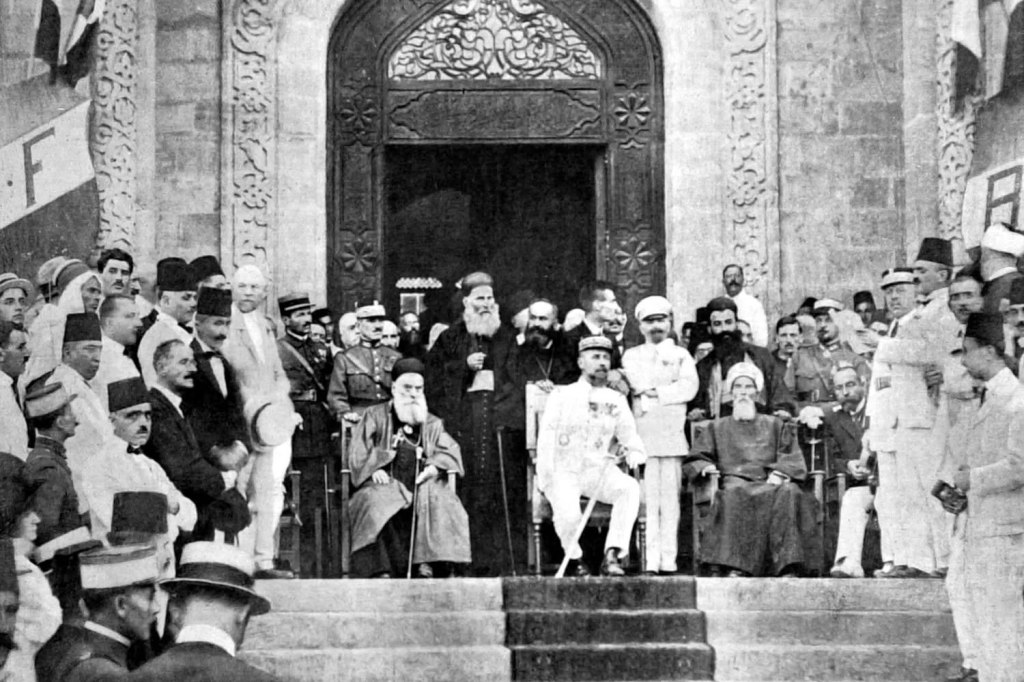
General Henri Gouraud at Beirut’s famed Pine Residence on September 1, 1920. The representative of the French Government in the Middle East is photographed seated next to Maronite Patriarch Elias Peter Hoayek to his right and Grand Mufti of Beirut Sheikh Mustafa Naja to his left.
4. Lebanese Have the Right to Reject Hezbollah Politically, Not the Resistance
Lebanese have every right to distinguish between resistance as a national right in the face of occupation and aggression, and Hezbollah as a Lebanese political party that entered power and became part of the ruling order. Not everyone who rejects the party’s political performance is rejecting the resistance, just as not everyone who respects the resistance is obliged to give the party a permanent blank check in governance, administration, alliances, and sectarian power-sharing. Confusing the two is a denial of the people’s right to hold power accountable.
Post-civil war Lebanon was not built as a modern and just state. It was built on a settlement among warlords that preserved the sectarian power-sharing system and granted most of those warlords political and practical amnesty, allowing them to reproduce themselves inside the state instead of closing their chapter. International reports have described this arrangement as one that entrenched clientelism, patronage, political paralysis, corruption, and weak accountability, while forcing reform and political renewal to pay the price every time.
Hezbollah did not remain outside this system forever. Since the 2000s, it became one of the most prominent political forces in Lebanon. It entered its first government in 2005 and then became increasingly integrated into the equations of rule, compromise, and alliance-building. Carnegie’s analyses clearly pointed out that its entry into the post-Syrian-withdrawal government in 2005 transformed it into a full partner in لبنان’s failed political class, after it had previously been able to present itself as standing outside the corruption of day-to-day power. Likewise, incorporating the language of “resistance” into the government’s ministerial statement gave the party political cover, but at the same time tied it directly to responsibility for the very system of which it had become a part.
For that reason, a Lebanese citizen has every right to say clearly: I do not reject resistance to Israeli occupation, but I do reject Hezbollah when it becomes part of the authority of corruption, sectarian division, obstruction, and the sharing of influence within the state. This is not a contradiction. It is a healthy distinction between a liberation function and an exercise of political power. A party that enters parliament and government, forms alliances, obstructs, bargains, and shields one faction or another is no longer above criticism simply because it once carried arms against the enemy. Whoever enters power enters, with it, the realm of accountability.
This in no way diminishes the sacrifices of the resistance fighters. On the contrary, the greatest insult to the very idea of resistance is to use it as a shield for corruption, as a pretext to silence people, or as cover for prolonging the life of a system that has suffocated Lebanon. Blood shed in the face of occupation must not be turned into an open-ended check for domestic politics, nor into a moral immunity from accountability. Resistance earns its honor by defending the homeland, not by exempting a political party from the consequences of its role in the ruin of the state.
From this perspective, rejecting Hezbollah politically does not mean treason, collaboration, or hostility to the resistance. In many cases, it may be an attempt to save the meaning of resistance itself from being swallowed by the swamp of the Lebanese system, which since the end of the civil war has been built on dividing up the state rather than building the state. Lebanese have the right—indeed the duty—to reject any party, no matter its history or slogans, if it becomes a partner in the quota-sharing system that has sat on Lebanon’s chest for decades. A nation is not built on party sacred cows. It is built on accountability.
At the same time, this criticism must not undermine the sanctity, patriotism, or necessity of supporting the resistance wing of the party in the face of Israeli colonialism, occupation, and terrorism.
Just as the party chose to move beyond the restrictive definition given by Sayyed Abbas al-Moussawi—namely, that its essence was resistance and resistance alone—into something broader and more complex, regionally and politically, it also chose to place its new political wing and its participation in one of the most corrupt states in modern history under the fire of criticism, and at the risk of becoming part of a system that oppresses the Lebanese people and destroys their state. That, in fact, is how many Lebanese came to see it, and they expressed this during the October 17 uprising under the slogan: #AllOfThemMeansAllOfThem.
5. Those Who Call for the State to Hold the Sole Monopoly on Arms Must Not Be Branded Traitors, Even If the Timing Is Poor
Lebanese have the right to disagree politically over weapons, the role of the resistance, and the limits of the state’s function, without that disagreement automatically being turned into an accusation of treason. Calling for the state alone to hold arms is not a thought crime, nor is it a departure from patriotism. It is a legitimate political position that lies at the heart of the public debate over the nature of the state and its future. Whoever argues that the final authority over force should rest with the state is not stepping outside national loyalty; they are expressing a particular vision of statehood, sovereignty, and constitutional responsibility.
This position does not come out of nowhere. It has roots in the logic of the state itself, in the Taif Agreement, and in the basic principle that, in any nation, the ultimate power and the final decision over war and peace should lie within the institutions of the state, not outside them. For that reason, those who hold this view must not be accused of treason, stripped of their patriotism, or portrayed as agents simply because they differ over the question of weapons, their role, and their ultimate fate. This is not a matter of faith and heresy, nor of honor and betrayal. It is a major political issue, one that allows for debate, disagreement, and judgment.
At the same time, however, one must distinguish between the right to raise the issue and the timing of raising it. To bring up disarmament in the middle of war, under fire, and in the face of an ongoing assault does not appear—in the minds of people or in the logic of battle—as a cool, sovereign debate. It looks like a stab in the back of the fighter on the front line. In wartime, internal disputes must not become a burden on those who are fighting in defense of the homeland, the land, and the honor of the people against one of the vilest occupations in history. In the moment of confrontation, every tongue and every hand should be directed toward pushing the resistance fighter forward, shielding him, and supporting him politically, morally, and popularly, because he is not fighting only for himself, but on behalf of the whole nation, all its land, and the dignity of all its people.
From that perspective, postponing the debate over disarmament until after the war is not the same as canceling the debate, nor is it a denial of the people’s right to ask the major questions. It is an act of national and moral discipline, an understanding of priorities. Every moment has its proper conversation. It is neither wise nor honorable to throw open the gates of internal conflict while the enemy is at the door, killing, bombing, and destroying. The debate over defense strategy, the state’s monopoly on arms, and the shape of the state after the battle belongs in another setting. Its natural time is after the immediate danger has passed, not while the enemy is pounding at the gates with fire and blood.
This does not mean that everyone who defends the continued existence of resistance arms is a traitor to the state, just as it does not mean that everyone who calls for the state to hold the sole monopoly on arms is a traitor to the resistance. That is the central point. In Lebanon, public debate has long been poisoned by turning every political disagreement into a trial of intentions: if you criticize the party, you are told you are against the resistance; if you defend the resistance, you are told you are against the state. The healthier national approach is to allow people to discuss openly: when is resistance necessary, and when should all instruments of force be integrated into the state? These are major political questions, not tests of loyalty or betrayal. Confusing the two serves only those who want to silence debate through emotion instead of confronting it with argument.
For that reason, those who call for the state to hold the sole monopoly on arms must not be branded traitors. Their position is not a declaration of war against the resistance, but an expression of a particular understanding of the state, sovereignty, and responsibility. That position may certainly be debated, opposed, or criticized, but it must not be morally or nationally criminalized simply because it departs from the narrative of another camp. Nations are not governed through mutual accusations of treason. They are governed through the ability to distinguish between the external enemy and legitimate internal disagreement. Whoever cannot tolerate a difference over means is not building a state; he is merely demanding forced unanimity in the name of the nation—and that is usually the beginning of a nation’s unraveling, not its sovereignty.
6. Those Who Consider the Resistance’s Weapons Necessary So Long as the Israeli Threat Persists Must Not Be Branded Traitors Either
Just as it is wrong to accuse those who call for the state to hold the exclusive monopoly on arms of treason, it is equally wrong to accuse of treason those who believe that the weapons of the resistance remain necessary as long as the Israeli threat endures, and as long as the Lebanese state is still incapable on its own of providing adequate deterrence and effective defense of the land, the sovereignty, and the people. Whether one agrees with this view or not, it is not necessarily a position outside the bounds of patriotism, nor is it inherently hostile to the state. In the eyes of those who hold it, it may well be a realistic reading of Lebanon’s history, geography, and the balance of forces surrounding it.
Lebanon has never lived in a normal, secure neighborhood beside an ordinary state that respects borders, law, and sovereignty. It has instead faced an enemy that, since its inception, has been built on aggression, expansion, occupation, assassination, invasions, destruction, organized terror, and contempt for international law, moral standards, and human rights. For that reason, the Lebanese citizen who believes that this enemy has not changed in its essence, that its ambitions have not ended, and that deterrence is not an intellectual luxury but an existential necessity, cannot simply be reduced to the image of someone conspiring against the state or against civil peace. More often than not, such a person is motivated by fear for Lebanon, not hatred of it.
Moreover, calling for the continued existence of the resistance’s weapons does not necessarily mean rejecting the state in principle, nor wishing to abolish it. For many, it simply reflects the view that the state, in its current form, has not yet reached the level of real capacity required to bear the burden of confrontation on its own. When a state is penetrated, weak, fragmented, hostage to internal balances, and incapable of taking decisive action or possessing sufficient means of deterrence, it becomes understandable that some Lebanese would see abandoning the available instruments of strength as a form of political naïveté, or as a dangerous gamble with the security and fate of the country.
Here too, we must distinguish between legitimate debate and easy accusations of treason. Any Lebanese has the right to say: I do not trust Israel, I do not trust international guarantees, and I do not believe the Lebanese state today is fully capable of replacing the resistance; therefore, I see the continued possession of resistance arms as a temporary—or even ongoing—necessity so long as the threat remains. This is a political position, open to debate and objection, but it is not treason. To denounce it as such is no less unjust than denouncing those who call for the state alone to control arms. In both cases, we are dealing with two political positions born of different visions of how to protect Lebanon, not a contrast between patriot and traitor.
That said, doing justice to this position does not mean granting it absolute immunity, nor exempting it from the major questions. Whoever sees the resistance’s weapons as necessary must also answer: how are those weapons to be regulated nationally? How can they remain an instrument of deterrence against the enemy without becoming a source of internal division? How can they remain in the service of defending Lebanon rather than serving the entanglements of power and regional axes? And how can they be prevented from being used to cover internal corruption, state paralysis, or the perpetuation of the sectarian quota system? To argue that the weapons are necessary is one thing; to remain silent about everything surrounding them is another.
Likewise, those who reject these weapons must understand that their opponent is not necessarily someone who loves chaos or hates the state. He may simply be someone who sees talk of disarmament under a constant Israeli threat as akin to removing the door while the thief is still circling the house. And this is precisely what colonial powers and the Zionist enemy have demonstrated, day and night, every time a resistance movement was disarmed or its fighters were forced into exile elsewhere.
The conclusion, then, is that a nation is not protected through mutual accusations of treason, but through building a national space that recognizes the real dilemma Lebanon faces: the necessity of the state on the one hand, and the necessity of deterrence on the other; the dream of a state that alone possesses arms, and the reality that makes many fear that disarmament may come before the building of a truly capable state, leaving the country exposed before a merciless enemy, as we can see with our own eyes. For that reason, those who consider the resistance’s weapons a necessity so long as the Israeli threat persists must not be branded traitors, just as those who hope that this exceptional situation will one day end within a just, strong, and capable state must not be branded traitors either. The issue is not who loves Lebanon and who hates it. The issue is how to protect it from external danger, and how to build it internally, without lying to ourselves and without sacrificing truth on the altar of slogans.
7. Lebanon’s Problem Is Bigger Than Its Size, and Its Solution Is Bigger Than Its Size as Well: The Awaited Arab State
Lebanon, in its geographic, demographic, and economic scale, is not a country that can afford to live in isolation from its surroundings, nor is it capable of securing on its own all the conditions necessary for its safety in a region where small states are shattered when left alone among predators. Lebanon’s modern history itself reveals a country exhausted by foreign interventions, proxy wars, and the fragmentation of the state, while its economy and institutions continue to suffer from deep fragility even in moments of proclaimed “recovery.” This is not an insult to Lebanon. It is a description of the predicament of a country burdened with more than it can bear, and repeatedly pushed into becoming an arena for the conflicts of others.
From this perspective, Lebanon’s problem is not merely one of internal corruption, nor merely a problem of Israel, nor merely a sectarian problem. It is also the problem of a small entity being asked to provide for itself, by itself, the guarantees of survival in a merciless environment. For that reason, Lebanon’s solution cannot be purely Lebanese in the narrow sense, as though this country were an island in a calm sea. The real solution is larger than its size and capacities, because it requires a strategic, civilizational, political, economic, and security depth that it does not possess on its own. What a small country cannot possess by itself, it may find in a large Arab entity, or in a cohesive Arab-Islamic one, capable of providing it with protection, deterrence, a market, depth, and guarantees. For the external colonial entity can never truly intend Lebanon’s good above the interests of colonialism itself, or above the interests of that permanent colonial warship called Israel, which colonialism planted in our region.
In this view, the Awaited Arab State, or a strong Arab-Islamic framework, is neither a romantic dream nor a rhetorical longing. It is an answer to a structural dilemma: how can Lebanon live securely when it is too weak to deter on its own, too small to suffice unto itself, and too exposed to be left alone? A large Arab entity, if founded on justice, institutions, freedom, and integration, would not swallow Lebanon; it would protect it. It would not erase its distinctiveness; it would lift from it the burden of permanent existential anxiety. It would not confiscate its pluralism; it would give that pluralism a strong back that shields it from external predation.
So when we say that Lebanon’s solution is the Awaited Arab State, we are not evading the task of building the Lebanese state, nor are we replacing internal reform with an external dream. We are saying that internal reform alone is not enough for a country that has long lived on the fault line of geopolitical earthquakes. Lebanon needs a just state at home, yes, but it also needs a nurturing nation beyond itself. It needs an honest judiciary and effective institutions, yes, but it also needs a strong Arab or Arab-Islamic depth that prevents it from remaining easy prey to the Israeli enemy, to international penetration, and to the blackmail of geography. This meaning is fully consistent with regional studies that suggest broader Arab integration can create a bloc more capable of protecting rights and interests, and of strengthening stability and cooperation in vital areas that exceed the capacities of any single state.
At its core, then, the issue is not that Lebanon failed because it is Lebanon. The issue is that it was asked to bear alone burdens that only large entities can carry: deterrence, economic survival, geopolitical balance, civilizational protection, and the management of diversity under constant threat. That is a burden beyond its capacity. Anyone who thinks seriously about saving Lebanon must not remain trapped within its narrow borders alone, but must think in terms of the larger circles that make its survival possible. For Lebanon to remain free, dignified, and plural, it may need something greater than Lebanon itself: an Awaited Arab State, or a strong Arab-Islamic entity, capable of providing the guarantees of safety that its size alone has failed to secure.
The conclusion is that Lebanon’s problem is not only that it is small, but that its enemies are large, its environment is ablaze, its state is weak, and today’s world has no mercy for isolated units left to fend for themselves. That is why the way out of the impasse lies not only in patching up the الداخل, but also in building a horizon larger than the الداخل itself. It is not enough to ask, How do we fix Lebanon? We must also ask: Within what larger space can Lebanon survive, flourish, and be protected? And that is precisely where the meaning of The Awaited Arab State the title of my 2022 book, begins.
And now we see initiatives for an “Islamic NATO” and a Gulf alliance beginning to take shape, after American military bases in the region proved that they are there only to protect Israel—and after it became clear, as one Qatari political figure put it, that in America’s eyes all the people of the Gulf are not worth a single barrel of oil. And after Lebanon’s relationship with France has proven itself to be sterile as well, yielding nothing but dreams of protection and the reality of harm.
8. The Awaited Arab State Does Not Erase Lebanon’s Distinctiveness; It May Well Be Its True Guarantee
Some Lebanese believe that any talk of the Awaited Arab State, or of a larger Arab or Arab-Islamic entity, automatically means swallowing Lebanon whole, erasing its uniqueness, and dissolving its cultural, religious, and political pluralism into something bigger than itself. That fear is understandable in a country long haunted by anxieties over numbers, sect, balance, and wounded memory. But this is not the only possible reading, nor is it an unavoidable one. The issue is not size in itself, but the nature of the larger entity: is it a project of domination and absorption, or a project of justice, integration, and guarantees?
Lebanon does not need someone to erase it. It needs someone to protect the conditions of its existence. Lebanon’s distinctiveness does not lie in remaining weak, nor in hanging forever on the mutual fears of its sects, nor in staying an open arena for every foreign intrusion. Its true uniqueness lies in its pluralism, its cultural vitality, its intellectual freedom, its civilizational role, and its ability to gather differences within a single space. And this uniqueness is not protected by weakness. It is protected by strength behind it. Small entities do not preserve their pluralism by being left exposed, but by being surrounded—or upheld—by a larger framework that secures them and prevents them from being crushed.
From this perspective, the Awaited Arab State, if founded on institutions, rights, decentralization, fair representation, and respect for local particularities, would not be the opposite of Lebanon but its support. It would not come to say to Lebanon, “Become a copy of others.” It would say instead: “Remain yourself, but within a larger space that protects you from being devoured while alone.” Just as an individual does not lose his identity by living in a just state, regions and communities do not lose their distinctiveness when they belong to a broader entity that guarantees their rights and preserves their diversity. What kills distinctiveness is not just union, but despotism; not belonging to something larger, but forced dissolution. And neither of those is an inevitable feature of any unifying project.
One could even say that Lebanon, precisely because of its own complex makeup, may be among the countries most in need of a larger framework to ease its existential burden. Many of its crises did not arise only from its diversity, but from the fear within that diversity, and from each group’s feeling that it needs an outside protector against the others. That is where the tragedy lies: when a greater and just umbrella is absent, sects begin searching for umbrellas of their own, and the nation enters a marketplace of foreign protections. But if there were a strong and just Arab or Arab-Islamic entity that guaranteed rights, freedoms, participation, and dignity for all, it would strip the sects of their excuse for dependence on the outside and turn diversity from a source of fear into a source of richness.
So the real question is not: Would the Awaited Arab State erase Lebanon’s uniqueness? The real question is: Can Lebanon truly preserve its uniqueness while weak, threatened, fragmented, and left at the mercy of outside balances? Experience says that distinctiveness without protection becomes fragility, pluralism without guarantees becomes anxiety, and freedom without strength to guard it becomes an open door to blackmail. Lebanon therefore needs more than pride in its uniqueness; it needs a larger structure capable of protecting that uniqueness from turning into a curse.
None of this diminishes the importance of building the Lebanese state itself. Quite the opposite: no larger Arab space has any meaning if Lebanon itself is not built on justice, citizenship, and the rule of law. But the point is that small just states sometimes need larger just spaces, just as beautiful homes need safe neighborhoods. It is not enough for the house to be tidy inside if the whole street is on fire, looted, and in chaos. Lebanon, no matter how much it reforms itself, will remain vulnerable unless it finds its place within a broader regional equation that provides it with support and guarantees.
The conclusion, then, is that the Awaited Arab State is not a negation of Lebanon, but may well be a condition for its protection. It is not a threat to Lebanon’s pluralism, but perhaps the only guarantee that this pluralism can endure without permanent fear and without humiliating dependence. It is not a project of erasure, but a project of rescue from the fate prepared for small entities that are meant to remain alone so they can be easily swallowed. And Lebanon, if it wishes to remain the Lebanon we love, may need something greater than itself—not in order to disappear, but in order to endure.
9. Why the Nation-State Alone Is Not Enough in the Arab East to Guarantee Security, Sovereignty, and Renewal
One of the deepest illusions lodged in the political mind of the Arab East is the belief that the nation-state, in its current form, can by itself provide security, sovereignty, and renewal. This illusion may be understandable, given people’s attachment to the existing state, their fear of chaos, and their need for at least a minimum degree of stability. But it remains an illusion when it turns into a final doctrine that excuses people from seeing the limits of reality. For most of the nation-states in the Mashriq did not emerge as the natural embodiment of a completed historical process. They were born instead out of colonial partitions, functional borders, and balances of power often designed less to enable renaissance than to prevent it.
As a result, many of these states were not built on the basis of civilizational, strategic, or economic self-sufficiency, but on the temporary management of permanent crises. Narrow borders, unevenly distributed resources, insufficient strategic depth, security dependence, economic subordination, fragile markets, weakness in scientific and technological production, and constant exposure to foreign penetration—these are the conditions under which they were formed. And yet each of them is expected to behave as though it were a fully self-sufficient state, capable on its own of protecting its borders, securing its economy, creating its balance, and producing its own renaissance. That is not realism. It is asking a small entity to bear burdens that only a larger, more integrated entity can carry.
In the Arab East, the nation-state alone is not enough for security, because security in this region is not purely local. Lebanon’s security is tied to Syria, Palestine, Jordan, and the Mediterranean. Syria’s security is tied to Iraq, Turkey, Lebanon, and Jordan. Iraq’s security is tied to the Gulf, Iran, the Levant, and Anatolia. Palestine’s security is not a Palestinian matter alone, but the knot of the entire region. When the threat crosses borders, when the enemy crosses borders, when the economy crosses borders, when sectarianism is stirred by forces that cross borders, and when energy, water, trade, and maritime routes are all supra-national questions, then relying on an isolated nation-state is like insisting on using a candle against a storm.
The nation-state alone is not enough for sovereignty either, because real sovereignty is not merely a flag, an anthem, and a seat at the United Nations. Sovereignty means having the power to make decisions without blackmail, to sustain an economy without dependency, to secure oneself without summoning foreigners, and to ensure food, energy, water, medicine, and knowledge without remaining captive to chains controlled by others. What value does formal sovereignty have if a state cannot protect its skies, patrol its seas, shield itself from sanctions, manage its currency, or build its defense and economic policies free from outside dictates? In today’s world, sovereignty is protected not only by law, but by weight. Whoever lacks strategic mass, depth, a broad market, and negotiating power will see his sovereignty steadily eroded, no matter how loudly his anthem is sung.
The nation-state alone is not enough for renaissance, because renaissance is not the project of a ministry, nor the program of a four-year government, nor a beautiful cultural speech. Renaissance requires a broad market, integrated resources, sufficient human scale, accumulated knowledge, productive infrastructure, transport networks, defensive capability, and cultural and civilizational depth. What one small state lacks in one field, another may possess in another. What a single state cannot build on its own may become possible once it enters a larger project of integration. To continue clinging to the nation-state as though it were the end of history is, in many cases, to defend a framework that has already proven incapable of generating power, and then to demand that this weakness produce miracles.
Here we must be clear: to say that the nation-state is insufficient is not to call for its erasure tomorrow, nor to leap recklessly over reality, nor to ignore the importance of building and reforming it. It means, rather, that the nation-state must indeed be built—but also understood within a horizon larger than itself. A just and strong nation-state is necessary, yes, but in the Mashriq it is not sufficient on its own unless it enters a broader Arab or Arab-Islamic space of integration that can turn fragmentation into strength, division into cooperation, and fragility into cohesion. The goal is not to demolish the house before building the neighborhood. It is to understand that no matter how orderly the house may be, it cannot survive if the whole neighborhood is exposed to fire.
The experience of the Mashriq itself has spoken plainly. What have these neighboring nation-states, each on its own, produced? Tense borders, competing or incapable armies, fragmented markets, dependency on outside axes, a race for foreign protection, and the repeated failure of the internal order to confront external pressure. Even when some states tried to rise on their own, they quickly collided with the ceiling of their size, the suffocation of geography, the conspiracy of foreign powers, or absorption into balances larger than themselves. The problem is not independence in itself. The problem is turning independence into isolation, and sanctifying fragmentation as though it were a final destiny beyond which no thought is permitted.
For this reason, the Arab East needs more than adjacent nation-states suspicious of one another. It needs a shared security vision, a broader economic market, integration of resources, connected infrastructure, defense cooperation, and a unifying civilizational horizon. It needs a formula that makes each state stronger by belonging to the whole, not weaker; and that preserves local particularities within a wider unity rather than threatening them. True unity is not the abolition of diversity, but its organization within a greater power. Small entities are not always preserved through isolation; sometimes they are preserved through intelligent integration into a project that shields them from predation.
For all these reasons, the nation-state alone is not enough in the Arab East to guarantee security, sovereignty, and renaissance. It is smaller than the threats, narrower than the needs, and too weak to bear alone the burdens of history, geography, colonialism, and the modern economy. It may serve as a foundation, but it is not enough to be the whole roof. It may be a temporary necessity, but it is not the final answer to the question of power, survival, and renewal.
The conclusion, then, is that what the Arab East lacks is not only the reform of this regime or that one. What it lacks is liberation from the prison of mental and political fragmentation. It is not enough to improve the management of the states that already exist. We must also ask: what larger framework can make these states viable, capable of endurance, and prepared for renaissance? That is where the shift begins—from the mindset of the nation-state as a final destiny, to the mindset of the UMMAH as the space of strength, integration, and survival. And that is also where the road begins from fragile survival to possible renaissance.
10. Why Arab or Arab-Islamic Unity Is Not the Opposite of Political Realism, but a Condition for It in Our Time
Talk of Arab unity or of a broader Arab-Islamic framework is often dismissed as nostalgia, or as the leftover of an emotional discourse that sounds beautiful but is no longer viable. In the name of “political realism,” people are told to settle for what already exists and to bury any thought of something larger than the nation-state, because this, we are told, is the age of hard national states, not of unifying projects. Yet in many cases this very argument is the opposite of realism. It asks us to confront a changing reality with tools that have already proven inadequate, to face giant blocs with fragmented entities, and to resist cross-border projects with minds trapped inside borders.
Political realism does not mean surrendering to what has been imposed upon you. It does not mean sanctifying maps drawn by colonialism, nor worshipping the status quo simply because it exists. True realism means seeing the balance of power as it is, not as one wishes it to be. Today’s world is not driven by small units content with sovereignty slogans. It is driven by great blocs, alliances, economic groupings, civilizational spaces, and networks of security and interests that cross borders. Whoever speaks of realism while rejecting all thought of integration and unity is like a man who asks an unarmed person to face a tank alone, then calls the one who urges him to join an army a dreamer.
Israel is not an ordinary nation-state project. It is an integrated Western functional project, supported politically, militarily, technologically, and economically by centers of global power. Foreign bases in our region are not merely “friendly relations”; they are part of a structure of domination that protects interests greater than the interests of our peoples. And the global economy itself leaves little room for small, weak states to exercise real sovereignty. So how can it be called “realism,” in the face of all this, for each Arab state to insist on remaining alone—negotiating alone, being blackmailed alone, drained alone, and threatened alone?
In fact, the more realistic conclusion is to understand that fragmentation itself is the illusion, not unity. The illusion is to imagine that Lebanon alone, or Jordan alone, or Iraq alone, or Syria alone—or any Arab state alone—can secure for itself security, food, medicine, energy, technology, deterrence, and full sovereignty in a world of blocs. The illusion is to cling to a framework that has already proven weak, then demand that this weakness somehow deliver salvation. Thinking in terms of broader Arab or Arab-Islamic integration is not an escape from reality. It is a response to it.
The unity intended here is not necessarily some cartoonish image of erasing borders tomorrow on the evening news, nor the forced melting of societies into a single center, nor the reproduction of a larger despotism in the name of the UMMAH. That is not a project of unity, but a project of political stupidity. Realistic unity in this age can begin gradually: through economic integration, a common market, defense coordination, interconnected energy and transport, the liberation of scientific research, the alignment of major strategic positions, and the building of supranational institutions that protect common interests without erasing local particularities. Realism does not mean skipping all the stages. It means knowing in which direction one ought to move.
For that reason, Arab or Arab-Islamic unity is not the opposite of political realism; it may well be its highest expression, if it is understood as a project of power, integration, and the protection of interests, rather than as mere emotional rhetoric. It is not an alternative to building the nation-state, but its completion. It is not the opposite of sovereignty, but its means in an age when sovereignty is protected only by major blocs. Nor is it a denial of local particularities; it may in fact be the framework that allows those particularities to remain viable without permanent fear and without dependence on foreign powers.
The same applies to the Arab-Islamic dimension. The region is not only politically fragmented; it is also torn apart across its civilizational circles, which could have been a source of strength but are now used as fuel for incitement and division. Yet reality tells us that interests, geography, energy, transit routes, culture, and shared threats all push toward broader frameworks than the narrow confinement of the nation-state. Any rational Arab or Arab-Islamic project, then, should not seek to erase anyone, but to gather scattered elements of strength into a single equation that prevents all from being swallowed one by one.
Those who mock the idea of unity in the name of realism forget that the most “realistic” powers in the world do not live in isolation. They build unions, markets, alliances, and spheres of strategic influence. Why, then, does unity or integration become rational when others do it, yet a naïve dream when we think of doing it? That is not wisdom. It is one of the deep effects of psychological defeat, which has led the Arab to trust the ability of others to unite while doubting only his own.
The conclusion is that political realism does not mean lowering our ambitions until they match our weakness. It means raising our instruments until they match the size of the challenges. From this perspective, Arab or Arab-Islamic unity is not an intellectual luxury, not a nationalist poem, and not an escape from the state. It is the project of higher realism—the realism that understands that security requires a bloc, sovereignty requires depth, renaissance requires a market, and dignity requires power. An Ummah that remains fragmented while fully aware of the price of fragmentation is not being realistic. It is participating in deceiving itself.
11. Why the Project of the Awaited Arab State Must Begin with Building the Arab Human Being, Not Merely Drawing Maps
One of the greatest mistakes made by grand projects is to imagine that the matter begins with the map before the human being, with form before substance, and with the declaration of unity before the making of the people who can sustain it. Some are led to believe that the Awaited Arab State can be born simply by joining territories, signing agreements, changing flags, or expanding borders. But the deeper truth is that any entity greater than the level of its human beings will collapse from within, even if it appears mighty from the outside. The problem in our Arab world has never been only the narrowness of geography, but also the inability of the human being to carry the project meant for him.
For the state is not merely land outlined by a pen, nor institutions standing on paper. In its essence, it is public ethics, political reason, an awareness of the common good, an ability to cooperate, discipline in work, a sense of responsibility, and a possible trust among people. If the Arab human being remains captive to fear, sectarianism, division, civilizational laziness, dependence on the leader, the sanctification of the sect, and the flight from criticism, then even the largest maps will not create for him a respectable state. They will only create for him a larger arena for failure. Maps do not build nations; people are the ones who build maps and then fill them with meaning.
From this perspective, the project of the Awaited Arab State does not begin with the question, How do we draw its borders? It begins with a deeper question: What kind of Arab human being do we want? Do we want a sectarian individual draped in the slogan of unity? Or a free human being capable of seeing himself as part of a horizon broader than his tribe, his sect, or his party? Do we want a person who seeks only his group’s share of the cake? Or a citizen who understands that justice is indivisible, and that the renaissance of the Ummah is not a bargain among sects, but a moral and intellectual transition from the logic of spoils to the logic of mission?
The Arab human being fit to carry a great project is not one merely stuffed with slogans, but one built from within: confident without arrogance, rooted in his identity without hatred, open to knowledge without dissolving into others, capable of reconciling authenticity and modernity, critical spirit and civilizational belonging, personal freedom and public responsibility. The problem is not that the Arab lacks feeling for the الأمة; that feeling often exists. But feeling alone does not build a state. What builds a state is the disciplined, educated, honorable, productive human being—one capable of working with others, respecting the law, and postponing his small personal interest when the greater good requires it.
That is why building the Arab human being means first rebuilding his mind: liberating it from mental colonization, from the defeat complex, from pathological fascination with the other, from chronic fear of difference, and from a culture of excuses instead of a culture of responsibility. It also means rebuilding his public ethics: teaching him that honesty is not a luxury, that excellence is not optional, that time is not something to be wasted without measure, that public money is not fair game, that a job is not a spoils-system reward, and that the law is not made only for the weak. For an Ummah that seeks a great project with a human being small in conscience, weak in discipline, and opportunistic in practice is building for itself a façade, not a state.
Building the Arab human being also means reordering his relationship to religion, identity, and freedom. No Awaited Arab State can be built by a human being who sees religion as a tool of internal hostility, who sees freedom as chaos, or who sees identity as a weapon for erasing others. A great project requires a human being who understands that religion is a moral force, not a sectarian club; that identity is civilizational belonging, not an intellectual prison; and that freedom is responsibility, not lawlessness. If this understanding becomes corrupted, then any possible unity turns into a larger prison, and any large entity into a wider despotism.
Education here is not a secondary detail; it is the true workshop of the Ummah. The Awaited Arab State does not begin with a unified foreign ministry, but with a new school, a new university, and a new culture—one that forms a human being who knows who he is, why he lives, how he works, and what he owes to his homeland, his Ummah, and humanity. It begins with an upbringing that teaches the child that the other Arab is not merely a rival over bread, but a partner in destiny. It begins with a culture that teaches the young that personal success is not enough if their Ummah remains broken. And it begins with a public discourse that restores value to duty, not merely to consumerism, complaint, and individual survival.
From here as well, building the Arab human being does not mean producing one identical copy of everyone, but rather creating a shared civilizational common ground among diverse people. The Awaited Arab State does not need to crush local particularities. It needs a human being capable of being the son of his city, his village, his sect, and his culture—and also the son of his Ummah—without a pathological contradiction between the two circles. For the historical failure did not lie in the existence of particularities, but in our inability to organize them within a horizon broader than narrow tribalism.
For all these reasons, whoever imagines that the project of the Awaited Arab State begins only with conferences, charters, and alliances misreads the beginning. All of these are important tools, yes, but they come only after there exists at least a minimum kind of human being capable of carrying them. If the Arab human being remains fragile within, broken in will, troubled in consciousness, available for political purchase, and quick to fall into trench warfare and hatred, then every unifying project will turn into a hollow superstructure without spirit, or into a new cover for old conflicts.
The conclusion, then, is that the Awaited Arab State does not begin merely by drawing maps, but by shaping the human being: by building an Arab who knows himself, trusts his mission, masters his work, respects his own mind, and carries public ethics worthy of a historical project. Maps may gather land, but the human being alone is the one who gathers meaning. If the human being is not built first, then the Awaited Arab State will remain nothing more than a beautiful fantasy. But if he is built, then what appears today to be a distant dream may tomorrow become simpler than anyone imagined.
Here is the English translation of the text you shared.
Part Twelve — The Civil, Secular State Is Not Against Religion, but One of the Guarantees of Religious Pluralism; and Islam, at its core, stands with the just state, not the religious state
One of the most deeply rooted misconceptions in the Arab East is the portrayal of the civil, secular state as though it were an enemy of religion, a project to uproot faith from society, or a war against Islamic identity. In most cases, this is not an accurate understanding, but rather a confusion between secularism as the state’s just neutrality among religions, and atheism as an intellectual stance toward religion. In its proper sense, the civil, secular state does not tell people: do not believe. It does not tell the believer: hide your faith. And it does not tell society: abandon your heritage. It says only this: the state must not belong to one sect, nor be a sectarian sword in the hands of one group, nor a guardian of one creed at the expense of the rest of the citizens. In that sense, it is not the destruction of religious pluralism, but one of its most important guarantees.
In a country like Lebanon, where pluralism is not a minor detail but the core of the entity itself, the civil, secular state becomes less an intellectual luxury than a moral and national necessity. For the alternative to it, in reality and not in fantasy, is not some ideal religious state, but a sectarian quota-sharing state divided among the representatives of communities in the name of God, sect, history, and rights—while the human being, the citizen, and justice are all lost. Lebanon did not suffer from an excess of secularism, but from an excess of sectarianism. It was not suffocated by the neutrality of the state, but by the absence of that neutrality. It was not destroyed because the state was not religious enough, but because the state became a marketplace of sects, each one wanting its share of the treasury, of power, and of fear.
The claim that Islamic identity contradicts the civil, secular state is one that requires deep reconsideration. Islam, in its essence, did not place the sanctity of the state above the sanctity of justice. It did not make the form of the political system one of the pillars of faith. Nor did it tie people’s salvation in the afterlife to the existence of a “religious state” in the theocratic sense that Europe knew in certain periods of its history. What Islam affirmed, in text, spirit, and objective, was justice, consultation, the lifting of oppression, the protection of rights, the prevention of despotism, and the preservation of human dignity. As for political, administrative, and institutional forms, they belong to the realm of human judgment, subject to time, place, public interest, and the experience of nations.
More plainly: Islam calls for a just state, not a clerical one. It calls for a government that does not oppress, not one that monopolizes speaking in the name of God. It calls for a system that safeguards blood, property, honor, freedoms, and covenants—not one that raises the banner of religion and then devours the people in religion’s name. For that reason, many Muslims are mistaken when they imagine that defending Islam requires defending the “religious state” as the only legitimate form. The real question is not the label, but the outcome: is the state just or unjust? Does it protect all people, or sort them into ranks? Does it treat the citizen as a full human being with full rights, or as a تابع of a sect, a doctrine, or a majority?
Islamic philosophy itself, for anyone who reads it with reason rather than fanaticism, does not bind us to a closed religious state. The great Islamic tradition—from jurisprudence to theology, from philosophy to the higher objectives of the law—is full of indications that the aim is the proper ordering of people’s interests and the removal of harms from them. If the civil, secular state, in a plural society, is more capable of protecting lives, consciences, rights, and equality among citizens, then from that perspective it is closer to the spirit of Islamic justice than a state that speaks in the name of religion and then subjugates people through it. What matters is not that the word “religious” be written on the wall, but that the word “justice” be written in the lives of people.
One might even say that the civil, secular state is, in some Arab and Islamic environments, a protection for religion itself against political exploitation. For the worst thing that can happen to religion is not that the state stands at equal distance from الجميع, but that religion be turned into an instrument in the struggle for power—that the name of God become part of the electoral machine, a cover for corruption, a weapon against opponents, and a means of shielding leaders from criticism. When that happens, it is not only politics that is degraded, but religion too, because it is pulled out of its moral, spiritual, and civilizational sphere and thrown into the mud of patronage, interests, and bargains.
From this perspective, defending the civil, secular state does not mean abandoning Islamic identity. In many cases, it may be the wisest and fairest way of protecting it. In a just state, the Muslim does not lose his religion; he practices it in freedom and dignity. The Christian does not feel like a guest. The Druze does not live under the anxiety of numbers. The nonbeliever is not treated as a standing suspicion. All meet under one law that does not ask them, before granting rights: what is your sect? Who is your sheikh? Under what historical fear do you move?
This is the heart of the matter: the civil, secular state is not against Islam, but against the monopolization of Islam. It is not against religiosity, but against turning religiosity into a political privilege. It is not against values, but against trading in values. And if Islam, as we believe, is a religion of justice, mercy, dignity, and responsibility, then the states closest to its spirit are not those that raise religious slogans the highest, but those that prevent injustice more, preserve dignity more, treat people equally more, and close the doors of strife and tyranny more firmly.
The conclusion is that Lebanon, if it wishes to survive and preserve its pluralism, does not need a state of sects that is outwardly devout and inwardly fractured. It needs a just civil state, neutral among religions, protecting the right of everyone to believe and to differ at the same time. This does not contradict Islamic identity; it is in harmony with what is deepest in it: that governance is a means to justice, not an idol for imposing belief; and that the state is measured by the fairness, freedom, and dignity it achieves for people, not by how many sacred banners it raises above the heads of the oppressed.
Thus the conclusion of the series becomes clear: there is no future for Lebanon without a resistance that protects it, without a just state that builds it, without a broader Arab horizon that supports it, and without a civil, secular state that safeguards its diversity and prevents religion from being transformed from a light of guidance into fuel for discord. Only there does the nation begin to emerge from its impasse—not by denying its identities, but by organizing them beneath the roof of justice.

 Dearborn Blog