

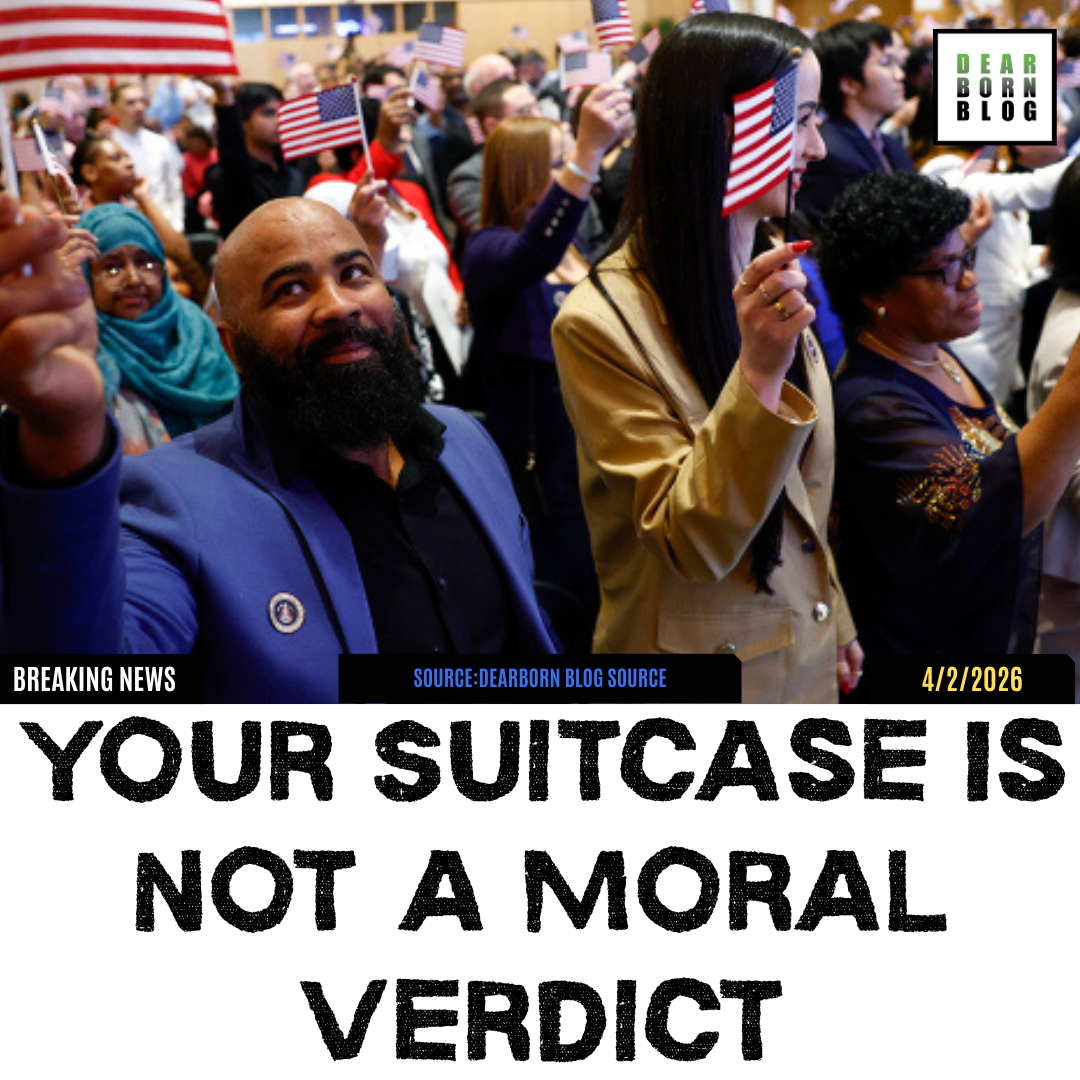
Migration is not a moral verdict. People leave for survival, opportunity, and dignity—not as a referendum on their identity, beliefs, or political convictions.
By Wissam Charafeddine
Introduction
Across political debates, a persistent argument emerges: if people leave a country, it must mean something is fundamentally wrong with its culture, politics, or identity. This logic reduces complex human movement into a simplistic moral judgment.
But migration is not a verdict. It is a condition shaped by history, economics, war, and global inequality. To treat it otherwise is to misunderstand both migration and morality itself.
Your suitcase does not carry your beliefs. It carries your circumstances.
Migration as Structure, Not Choice
Most migration is not driven by ideology—it is driven by necessity. Wars, sanctions, economic collapse, and environmental pressures shape movement far more than personal belief systems.
Research consistently shows that migration flows follow patterns of instability and opportunity, not moral alignment. People move because they must—or because they can—not because they are issuing political statements.¹
“Migration is less about who people are and more about the structures that constrain their choices.”
The Iraq Example
Following the 2003 invasion of Iraq, millions of Iraqis were displaced internally and externally. This mass movement was not a rejection of identity—it was a response to violence, instability, and institutional collapse.²
To interpret this displacement as a moral judgment would be to ignore the conditions that made staying impossible.
Key Stat:
At the peak of displacement, over 4 million Iraqis were forced from their homes—one of the largest displacement crises of the 21st century.
The Fallacy of Moral Interpretation
To claim that migration reflects moral failure creates a dangerous framework. By that logic, every empire that produced migration would be morally condemned by the very people it displaced.
This reductio ad absurdum reveals the flaw: movement reflects conditions, not virtue.
If leaving defines morality, then every refugee becomes a philosopher—and every border, a moral judge.
What Migration Data Actually Shows
What Data Shows vs What It Does NOT Show:
Economic disparities drive movement → ❌ Does NOT show moral superiority or inferiority
Conflict increases displacement → ❌ Does NOT show rejection of identity
Networks shape destinations → ❌ Does NOT show ideological alignment
Policy affects migration flows → ❌ Does NOT show personal virtue
Voices on Migration and Power
“Migration reflects power structures, not personal failure.”
— Narges Bajoghli
“Our communities are not defined by where we go, but by what we stand for.”
— Linda Sarsour
Dearborn and the Politics of Movement
In Dearborn, migration is not abstract—it is lived experience. Families trace their histories across borders shaped by war, labor demand, and political upheaval.
These stories challenge simplistic narratives. They show that movement is not a rejection of origin, but a continuation of survival and aspiration.
Conclusion
Your suitcase is not a moral verdict. It does not measure your beliefs, your values, or your identity. It reflects a moment—a decision shaped by forces often beyond your control.
To understand migration, we must move beyond judgment and toward context. Only then can we see it for what it is: not a statement of who people are, but a response to the world they navigate.
Sources
Migration Policy Institute Reports
UNHCR Iraq Displacement Data
Pew Research Center Migration Studies
U.S. Census Bureau Migration Data
Stanford University Press Publications
Open Global Rights Analysis
Refugees International Reports
Disclaimer

 Dearborn Blog