

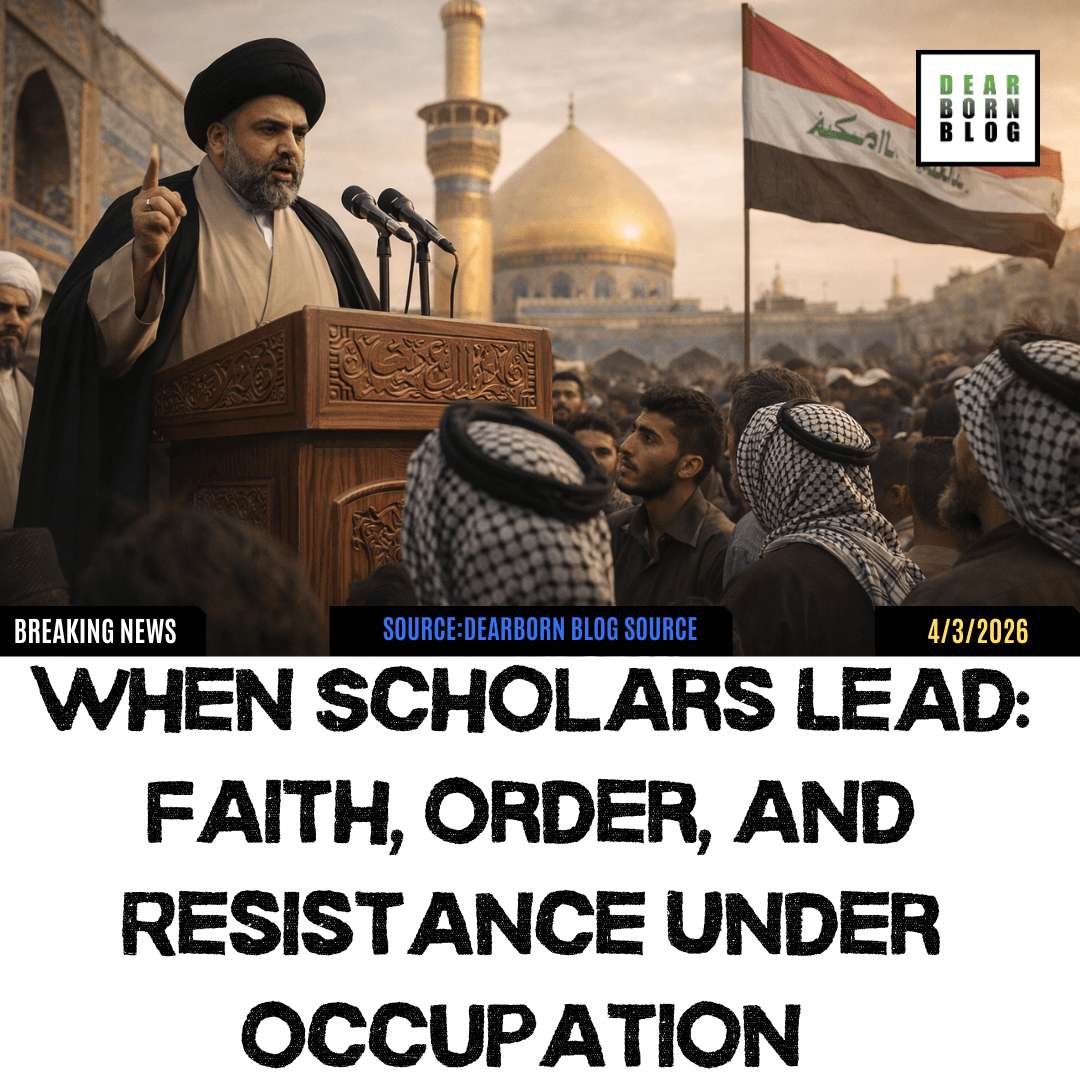
In moments of political collapse, when institutions disintegrate and foreign power asserts control, societies often turn to alternative sources of legitimacy. In Iraq, just days before the fall of Baghdad in April 2003, one such source emerged forcefully: the religious establishment. A letter attributed to Muqtada al-Sadr, circulated on April 4, 2003, offers a striking window into how religious authority framed resistance, governance, and moral order under occupation.
This document, issued five days before Baghdad fell, does more than call for calm—it outlines a theory of Islamic governance rooted in the Hawza tradition, one that prioritizes social order, religious legitimacy, and resistance to foreign domination.
The Letter: Translation and Context
In the name of God, the Most Merciful, the Most Compassionate.
From the office of Sayyid Muqtada al-Sadr…
To the noble Iraqi people: In these critical and dangerous circumstances, we call upon you to preserve order, protect public and private property, and refrain from chaos…
Do not allow the occupier to exploit division among you. Remain united under the guidance of religious authority…
Establish local committees to manage daily affairs in accordance with Islamic principles…
Peace be upon you, and the mercy of God.
This message reflects both urgency and structure: a call to avoid collapse while quietly asserting an alternative authority to the incoming occupation forces.
Five Days Before Baghdad Fell
Timeline Insight: This letter circulated on April 4, 2003 — just five days before the fall of Baghdad on April 9, 2003 — positioning it as one of the earliest organized responses to the anticipated collapse of state authority.
Religious Authority as Governance
The letter’s most striking feature is its implicit claim: when the state collapses, religious scholars must step in. This reflects a long-standing doctrine within Shi’a political thought, particularly in the Hawza tradition centered in Najaf.
Rather than advocating immediate armed resistance, the message emphasizes:
Social discipline
Protection of infrastructure
Grassroots organization through local committees
This is not chaos—it is parallel governance.
The Hawza Tradition and Social Order
The Hawza system has historically functioned as both a religious and social institution. In times of crisis, it has provided not just spiritual guidance but also material coordination.
By invoking this tradition, the letter positions religious scholars not merely as clerics, but as custodians of society itself.
Resistance Without Collapse
Unlike militant calls for immediate confrontation, the tone here is measured. Resistance is framed not as spontaneous violence, but as disciplined endurance.
This aligns with broader patterns in resistance movements where legitimacy is built not through force alone, but through the ability to govern.
A Broader Lens: Palestine and Global Resistance
The themes present in the letter—occupation, legitimacy, grassroots organization—resonate far beyond Iraq. In Palestine, similar dynamics have long shaped political life, where civil society structures often fill the vacuum left by constrained or fragmented state authority.
This comparison highlights a shared framework: resistance is not only about opposition, but about constructing alternative systems of order.
Diaspora Connections: Dearborn and Beyond
For communities in Dearborn, Michigan—home to one of the largest Arab-American populations in the United States—these historical moments are not distant.
They form part of a living political memory, shaping conversations about identity, justice, and global solidarity.
Political Frameworks and Contemporary Relevance
Elements of this model—community governance, resistance to occupation, and social justice—find echoes in modern political platforms, including aspects of the Green Party’s emphasis on grassroots democracy and decentralized power.
While contexts differ, the underlying principle remains: legitimacy flows from the people, especially in times of crisis.
Conclusion
The April 4, 2003 letter attributed to Muqtada al-Sadr stands as more than a historical artifact. It is a blueprint—however contested—for how societies might navigate the collapse of formal authority.
By centering religious legitimacy, social order, and disciplined resistance, it offers a model that continues to echo across regions and generations.
Sources
Muqtada al-Sadr, April 2003 Letter Archive
Juan Cole, Sacred Space and Holy War
Fanar Haddad, Sectarianism in Iraq
Charles Tripp, A History of Iraq
Patrick Cockburn, Muqtada al-Sadr and the Fall of Iraq
The New York Times Archives (April 2003)
Al Jazeera Historical Coverage
BBC News Iraq War Timeline
US Department of Defense Iraq Reports
International Crisis Group Reports on Iraq
Human Rights Watch Iraq Documentation
UN Reports on Iraq 2003
Green Party Platform Documents
Institute for the Study of War
Carnegie Middle East Center
Brookings Institution Iraq Analysis
Disclaimer

 Dearborn Blog