

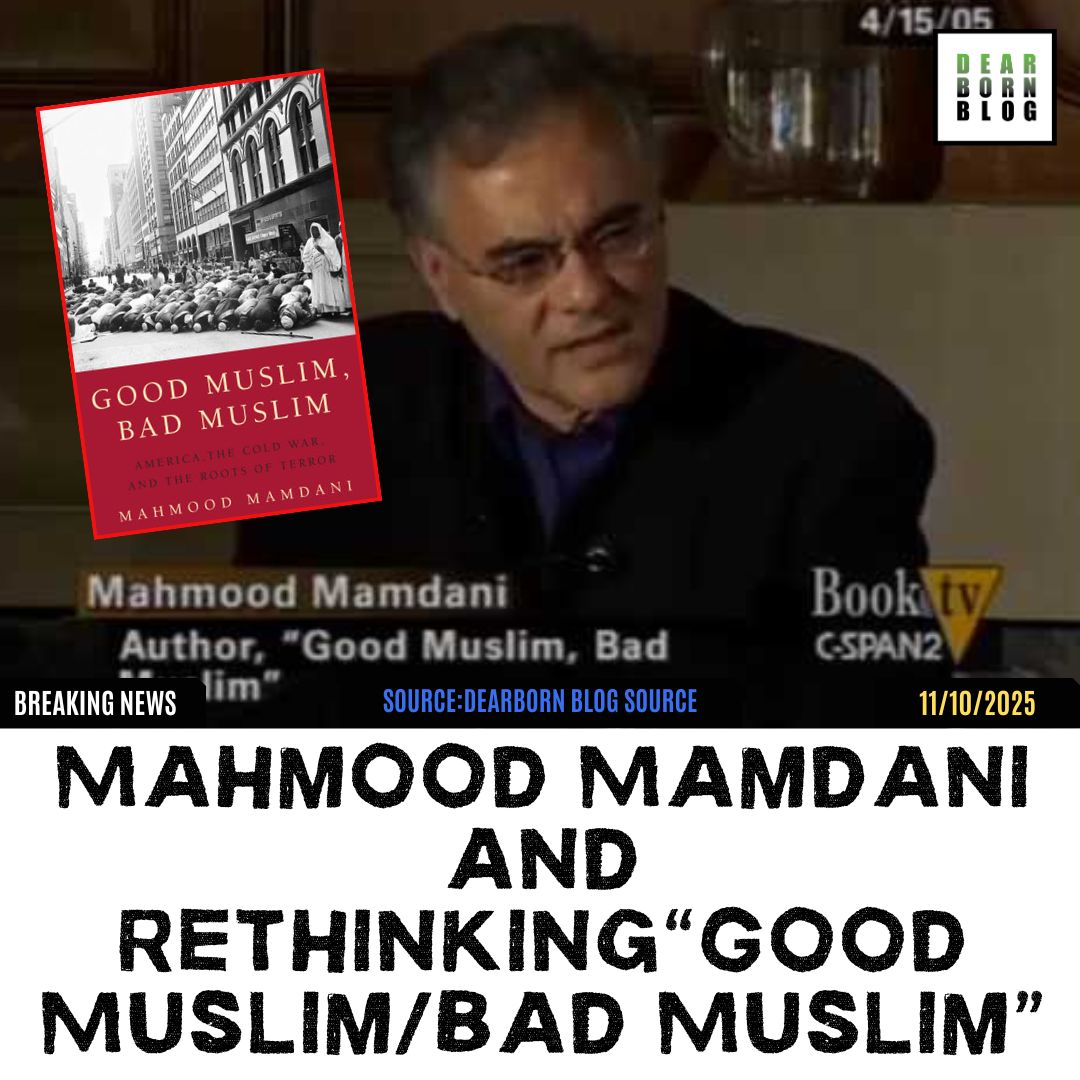
At the University of Michigan in Ann Arbor on October 21, 2018, Professor Mahmood Mamdani unpacked a myth baked into post–Cold War politics: the West’s habit of sorting Muslims into “good” and “bad.” His thesis is blunt and useful for Dearborn today—this binary isn’t about theology at all. It’s about power, geopolitics, and how states manufacture enemies. By tracing U.S. policy from Afghanistan in the 1980s through the War on Terror, Mamdani urges us to replace culture-war clichés with hard history, civil-liberties vigilance, and community-led solutions that align with Green values and our city’s pro-peace, pro-justice commitments. [1][2][3]
On a fall day in Ann Arbor in 2018, Ugandan scholar Mahmood Mamdani sat down to discuss the ideas that made his book Good Muslim, Bad Muslim: America, the Cold War, and the Roots of Terror a touchstone in debates about Islam, violence, and U.S. foreign policy. The conversation—recorded and widely shared—centers a deceptively simple question: How did the West come to divide Muslims into “good” and “bad,” and who benefits from that divide? [1]
Mamdani’s answer refuses lazy stereotypes. The “good/bad” split, he argues, grew from Cold War statecraft, not scripture. In the late 1970s and 1980s, Washington helped politicize religion to wound a geopolitical rival, then later criminalized the very networks and narratives it once abetted. The result was a durable myth: culture causes violence; policy is merely a response. In real life, the causality often runs the other way. [2][3][6][7][9][10]
This matters for Dearborn—a proudly Arab-majority city where many families carry memories of the very history Mamdani describes. It matters for Green politics, too, because the Green platform insists that security without justice is theater: we need civil liberties, human rights, peace diplomacy, and social investment—not fear machines.
What Mamdani actually argues
“Judgments of ‘good’ and ‘bad’ refer to political identities, not to cultural or religious essences.” [2][17]
Mamdani’s core claims, distilled:
- The binary was engineered. During the Soviet-Afghan war, the United States poured money and weapons into Islamist factions via Pakistan’s ISI in an operation later called Operation Cyclone. Allies matched funds; militant networks grew. Religion wasn’t the cause; it was the instrument of a state strategy. [3][6][12]
- From ally to enemy by policy, not by creed. Groups labeled “freedom fighters” in the 1980s were redeclared “terrorists” after 2001. The underlying ideology didn’t suddenly mutate; the geopolitical alignment did. The “good/bad Muslim” frame made that pivot easy to sell. [2][17]
- Culture talk hides political choices. When we treat “Islam” as the engine of violence, we ignore the record of coups, occupations, sanctions, proxy wars, black budgets, and surveillance states—things governments actually do. [2][17]
- The remedy is political. If policy helped construct the problem, policy can deconstruct it: de-escalation, accountable intelligence, rights-respecting policing, and diplomacy that treats communities as partners rather than suspects. This later thread is expanded in Mamdani’s 2020 work, Neither Settler nor Native, which argues that legalistic “security” fixes fail unless we tackle how modern states manufacture permanent minorities. [18][19][20]
The Cold War seedbed—and why it still matters
It’s not controversial that the U.S. covertly bankrolled the anti-Soviet jihad in Afghanistan. Declassified records show President Carter signed a finding on July 3, 1979 authorizing CIA support for insurgents; aid then ballooned under Reagan, with Saudi Arabia matching U.S. funds and Pakistan steering weapons to favored factions. Stinger missiles arrived in 1986; billions flowed; and a transnational jihadist milieu coalesced. [6][3][12]
None of that “proves” a simple pipeline from policy to every later atrocity—history isn’t a conveyor belt—but it demolishes fairy tales about timeless cultural hatred. When states pour gasoline on a conflict and light a match, you don’t blame the fire on metaphysics. You write better fire codes. [3][6][12]
After 9/11: the binary hardens at home
The “good/bad” story didn’t stay overseas. It soaked into domestic policy:
- The USA PATRIOT Act expanded government surveillance powers with weak oversight, blurring foreign-intelligence tools into ordinary criminal contexts. Civil-liberties groups and courts flagged the constitutional risks. [13][24][26]
- NSEERS (Special Registration) singled out men and boys from mostly Muslim-majority countries for fingerprinting, interrogations, and exit restrictions. DHS later dismantled the framework as “obsolete” and discriminatory, but not before it chilled whole communities. [14][15][16]
- Countering Violent Extremism (CVE) initiatives promised “soft” prevention, yet rested on shaky behavioral science and often devolved into ideology-profiling of Muslim youth. Even government-commissioned literature reviews struggled to show effectiveness; rights groups called it stigmatizing. [27][28][29]
These measures didn’t just police crime; they policed identity. And identity policing is how a society keeps the “good/bad” line fresh in everyone’s head.
“We do not need culture wars masquerading as security. We need rights that work in real life.”
What this means for Dearborn
By 2023 data, Dearborn became the first Arab-majority city in the United States—an achievement rooted in decades of migration, work, union organizing, and civic participation. Roughly 54–55% of residents reported Middle Eastern or North African ancestry in the 2020 Census analysis. That’s a statistical headline and a moral responsibility. [30][31][32][33]
For a city like ours, Mamdani’s analysis lands close to home:
- It explains why national narratives so often misread Arab and Muslim communities—as proxies for geopolitics, not neighbors.
- It clarifies why local coalitions demanding ceasefires, humanitarian law, and civil liberties are not fringe; they’re constitutional politics at street level.
- It aligns with Green principles: nonviolence, grassroots democracy, social justice, and respect for diversity. Policy should secure dignity, not suspicion.
A practical Dearborn agenda (grounded, not performative)
- Civil-liberties first. City and county partners can codify “non-cooperation” guardrails against dragnet registries, mosque mapping, or bulk data sharing that targets residents by religion or origin—lessons learned from the Patriot Act era. [24][26]
- Public safety without profiling. Expand community-led violence-prevention, youth mentorship, and credible-messenger programs that are evaluated for outcomes, not ideology, and audited for bias. Independent metrics beat vibes. [27][29]
- Evidence-based media literacy. Fund school and library programs on disinformation, especially related to West Asia/North Africa, so our kids can tell the difference between history and heat. Pair with Arabic-English civic vocab so debates don’t get lost in translation.
- Translocal diplomacy. Sister-city and university partnerships—UM-Dearborn, Henry Ford College, and Ann Arbor’s networks—can host scholar exchanges about post-conflict justice and de-escalation. Invite scholars across the spectrum, including critics of Mamdani, to model pluralism. [18][20]
- Data for dignity. Use the Census Bureau’s MENA coding advances to target health, housing, and small-business support without collapsing communities into stereotypes. Counting well is part of protecting rights. [33]
The scholar behind the thesis
Mahmood Mamdani is not a culture-war pundit. He’s a Columbia University scholar whose work spans the politics of Africa, colonialism, genocide, and the modern state. Citizen and Subject (1996) reframed colonial governance; When Victims Become Killers (2001) probed Rwanda; Good Muslim, Bad Muslim (2004) challenged the War on Terror narrative; Neither Settler nor Native (2020) interrogated how states manufacture permanent minorities. Whether you agree with every claim, the throughline is rigorous: look at structures, not scapegoats. [18][19][21][22]
Six takeaways, without the hand-wringing
- History beats headlines. The Afghan case shows how states instrumentalized religion for strategy, then disowned the blowback. [3][6][12]
- Binary thinking is policy-convenient, not truth-apt. “Good” and “bad” Muslims map to geopolitics, not theology. [2][17]
- Civil liberties are security. We learned the hard way that mass surveillance and registries corrode trust and deliver little. [24][26][14][16]
- Evaluation matters. CVE lacked reliable indicators and too often flagged identity, not risk. [27][29]
- Dearborn is a bellwether. America’s first Arab-majority city can model inclusive, rights-forward governance. [30][31][32]
- Green politics scales locally. Nonviolence, justice, democracy, ecology—these aren’t slogans. They’re budget lines and policy metrics.
From Ann Arbor to Dearborn: a community reflection
“Change the question from ‘Who is the good Muslim?’ to ‘Why was this category invented?’” [1][2]
That pivot is the whole game. In Dearborn, we don’t prove our Americanness by passing culture tests or cheering the latest war. We do it by practicing democracy: organizing unions, protecting speech, securing due process, and tending to the social goods—schools, clinics, parks—that make fear less profitable.
So the invitation, after Mamdani, is simple and stern: retire the binaries. Replace them with evidence, rights, and solidarity. That’s how a city with Ford’s grit and UM-Dearborn’s brains leads—locally first, but with eyes wide open to the world.
Notable quotes (for emphasis)
“This talk has turned religious experience into a political category, differentiating ‘good Muslims’ from ‘bad Muslims,’ rather than terrorists from civilians.” [17]
“The presumption that there are ‘good’ Muslims readily available to be split off from ‘bad’ Muslims masks a failure to make a political analysis of our times.” [2]
Watch the Conversation
- Video: Mahmood Mamdani on “Good Muslim, Bad Muslim” (recorded talk; widely circulated). [1]
Sources & Further Reading
[1] YouTube — Mahmood Mamdani: Good Muslim, Bad Muslim (book talk video). YouTube
[2] Penguin/Random House (book page) — Good Muslim, Bad Muslim: America, the Cold War, and the Roots of Terror (author summary). Penguin Random House Secondary Education
[3] Wikipedia (overview citing primary literature) — “Operation Cyclone,” U.S. covert support to Afghan mujahideen, 1979–1992. Wikipedia
[4] U.S. State Dept., Office of the Historian — July 3, 1979 Presidential Finding authorizing covert support to Afghan insurgents. Office of the Historian
[5] War on the Rocks — Contextual history of U.S. policy in Afghanistan during the Cold War and after. War on the Rocks
[6] American Anthropologist — Mamdani, “Good Muslim, Bad Muslim: A Political Perspective on Culture and Terrorism” (2002). AnthroSource
[7] Full-text excerpt of Mamdani’s 2002 article (educational copy). NAU Jan
[8] Carter Center report — cites Mamdani’s 2002 essay in the context of the Islamophobia industry. The Carter Center
[9] Academic thesis (Buffalo State) — Archival synthesis on U.S. nurturing of Afghan networks in the 1980s. Digital Commons at Buffalo State
[10] C-SPAN Book TV — Mamdani discussing Good Muslim, Bad Muslim (2005). C-SPAN
[11] ACLU — “Surveillance Under the USA PATRIOT Act” (civil-liberties analysis). American Civil Liberties Union
[12] FinCEN (Treasury) — Official page summarizing the USA PATRIOT Act statute. FinCEN.gov
[13] Wired report — Federal court ruling striking down Patriot Act provisions (constitutional concerns). WIRED
[14] DHS Federal Register — Rule removing NSEERS regulations (Dec. 23, 2016). Federal Register
[15] DHS (archived page) — De-listing NSEERS countries (2011). Department of Homeland Security
[16] ACLU — Overview of NSEERS and its dismantling. American Civil Liberties Union
[17] Brown University (PDF) — Scholarly discussion revisiting the “good Muslim/bad Muslim” category. Watson Institute
[18] Harvard/Belknap — Neither Settler nor Native (book page, 2020/2022 edition). Harvard University Press
[19] Wikipedia (overview) — Neither Settler nor Native (content summary and reviews). Wikipedia
[20] Jadaliyya — Review/roundtable on Neither Settler nor Native. Jadaliyya
[21] Columbia University (faculty profile) — Mahmood Mamdani biography and fields. Department of Anthropology
[22] Internet Archive — Good Muslim, Bad Muslim (2004 edition catalog entry). Internet Archive
[23] Brennan Center — “Countering Violent Extremism: Myths and Facts” (policy critique). Brennan Center for Justice
[24] American University Law Review — CVE and equal protection concerns (legal analysis). Digital Commons
[25] DHS S&T — CVE research landscape (government literature review). Department of Homeland Security
[26] ACLU — Patriot Act campaign overview. American Civil Liberties Union
[27] START (University of Maryland) — Survey of CVE metrics (evaluation challenges). UMD Start
[28] Teen Vogue (reported feature) — Youth organizing against CVE in Minneapolis (community impacts). Teen Vogue
[29] The Guardian — Data gaps and bias concerns in the UK’s Prevent program (comparative cautionary note). The Guardian
[30] ClickOnDetroit (Local 4) — Dearborn becomes Arab-majority city (54.5%). ClickOnDetroit
[31] Wikipedia — Dearborn demographics summary citing Census/press. Wikipedia
[32] Detroit Free Press — Arab Americans now a majority in Dearborn. Detroit Free Press
[33] U.S. Census Bureau Story — National MENA counting methodology and totals (2020). Census.gov
Disclaimer
This article is an analytical translation and expansion based on publicly available sources, cited above. It reflects the author’s synthesis and is offered for informational and educational purposes. It does not provide legal advice and should not be construed as representing the views of any institution referenced. Facts and policies can change; readers are encouraged to review primary documents. For corrections or concerns, please contact Dearborn Blog.

 Dearborn Blog
[…] https://dearbornblog.com/2025/11/10/rethinking-good-muslim-bad-muslim/ […]
LikeLike