

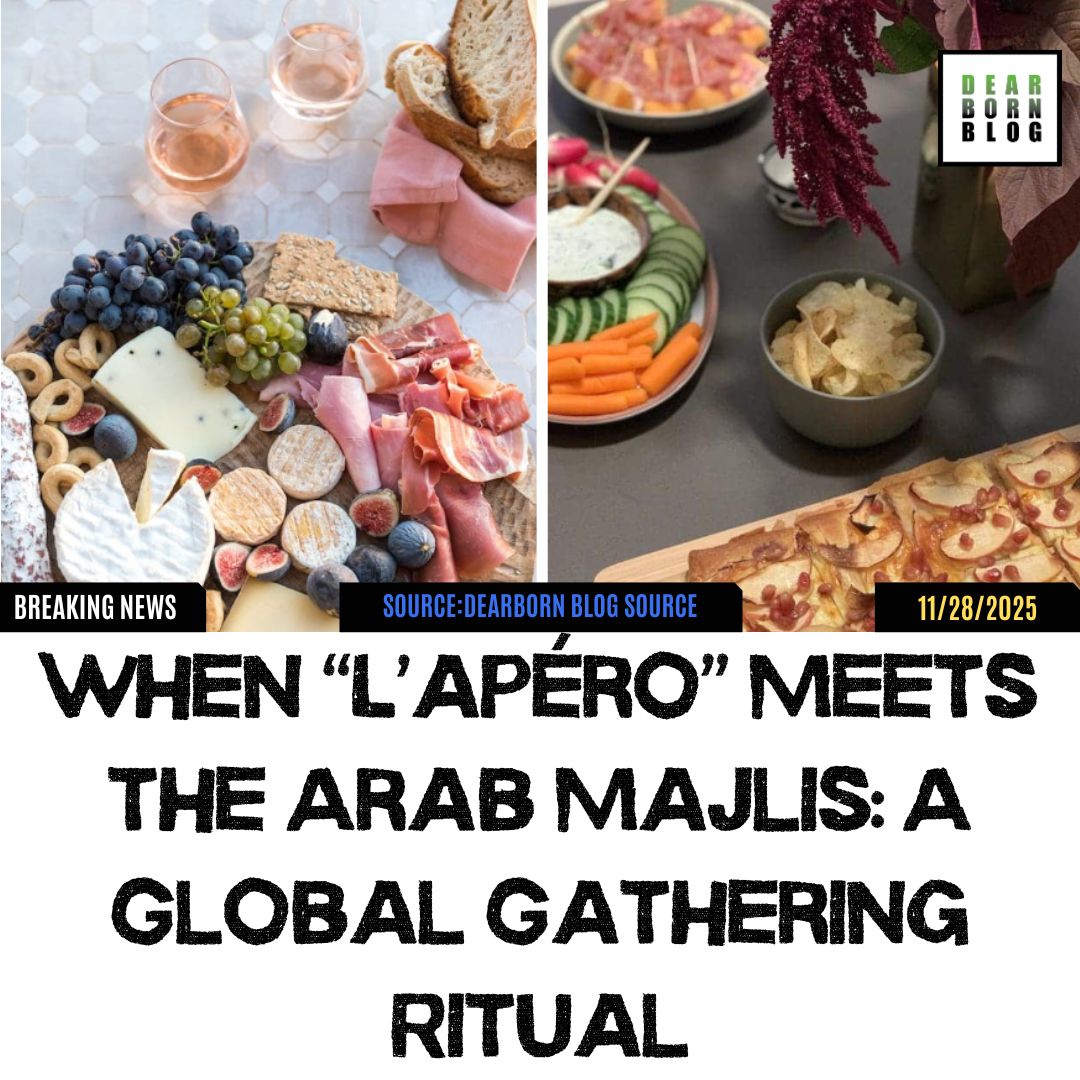
From Parisian terraces to Levantine sitting rooms, two beloved traditions—the French apéro and the Arab majlis—show us how community, connection and ritual around food and drink transcend culture. Here’s what each can learn from the other, and how we might bring their best into our own gatherings
Life has a habit of pulling us in a dozen directions at once—but then along come traditions like the French apéro and the Arab majlis, reminding us that slowing down, inviting community in, and breaking bread (or sipping something) before the main event is more than indulgence—it’s connection. As stewards of community-building and social change, we at Dearborn Blog believe that such rituals, when held thoughtfully, echo values of hospitality, equality, and shared joy.
Here’s a deep dive into these two rituals: what they are, how they overlap, where they diverge—and what they might learn from each other.
What is the French apéro?
The French apéro is essentially “the thing you do before dinner” but with style, ritual, and communal intent. The term comes from apéritif (drinks to open the appetite), deriving from the Latin aperire (“to open”)—so it’s literally about opening the evening and opening connection. Hotel Pulitzer+2My French Country Home Magazine+2
Key features
- Timing: typically around 6 pm–7 pm (or later) in France, the apéro bridges the end of the workday and the beginning of dinner. Hotel Pulitzer+1
- Atmosphere: casual, relaxed, focused on conversation rather than formal service. Light set-ups, often at someone’s home or on a terrace. My French Country Home Magazine+1
- Drinks + snacks: Wine, sparkling wine, light cocktails, and non-alcoholic options; snacks like olives, nuts, cheese, charcuterie. Life in Rural France+1
- Social purpose: It’s not just about drinking—it’s a moment to connect, pause, and enjoy. One article says: “The apéro wasn’t just about sipping something before dinner – it was a moment of pause, a celebration of connection and an embrace of life’s little pleasures.” Bonjour Paris
- Host/Guest etiquette: You may bring a bottle if invited; aim to arrive a little late (15 minutes) so the host has a moment. My French Country Home Magazine
“The apéro is the epitome of the French mode de vivre (way of life).” Bordeaux Uncovered
Why it matters
- It encourages connection: a built-in time to socialise.
- It offers a break after the day’s rush: a transition into evening calm.
- It celebrates simple pleasures—quality snacks, drinks, good company.
- It fosters “living in the present”—savouring the moment before the main meal.
What is the Arab majlis and similar pre-dinner get-together?
While the arabic tradition isn’t always exactly the same time-slot ritual as the apéro, the social gathering before dinner (or the communal sitting-room gathering) shares many overlapping roles. The term majlis (Arabic: المجلس, literally “the place of sitting”) refers to a space and time of hospitality, conversation, and community. The National+1
Key features
- Space + sit-together: The majlis is a designated sitting room (or tent in Bedouin origin) for guests, conversation, decisions, and hospitality. Visit Qatar+1
- Hospitality as central: Guests are treated with warmth, Arabic coffee, dates, incense, etc. SHMS+1
- Social function: It can be informal (friends/family) or formal (community decision-making, mediation) but always grounded in the culture of gathering. ICH UNESCO+1
- Etiquette: For example, in a majlis one may remove shoes, be offered coffee, and the layout encourages comfortable, relaxed conversation. Museum of Passion
“While it refers to a sitting room, the majlis is about much more than furniture and floor plans… A place to gather, discuss, reflect, seal bonds and even heal wounds.” The National
Why it matters
- It roots social gathering in respect and dignity: you are invited, honoured, offered the best.
- It fosters community: sharing news, resolving issues, celebrating together.
- It honours hospitality as a moral and communal act—not just a meal.
Similarities: Where apéro and majlis overlap
Here’s where the magic happens—though different languages and geographies separate them, they speak the same social code.
1. Pre-meal or transitional time
Both rituals happen “before the main meal” in some form: the apéro explicitly pre-dinner, the majlis often as a prelude to dinner or reception of guests. That transition matters—a pause, a moment of connection.
2. Focus on gathering, not just eating/drinking
Neither is about heavy formal dining (though food plays a role). It’s about meeting, talking, relaxing, and community. Apéro says: unwind after work. Majlis says: welcome guests, share stories, sit together.
3. Hospitality & inclusion
In both traditions, there’s a sense of “you are welcome” and “we’ve made time for you”. Whether with drinks and cheese (apéro) or coffee and dates (majlis) the host’s role is relational.
4. Ritual elements
Both use small gestures to signal significance—timeouts in time (6pm start), small snacks, special drinks, designated spaces. Ritual marks a departure from default/isolated solo living.
5. Social glue
Whether in Paris or Amman, these gatherings bind people together, reinforce community norms, reduce isolation. From the Oxford-study cited about social meals (mentioned in apéro article) to Arab hospitality’s moral importance. Bonjour Paris+1
Differences: What sets each apart
Nuances matter. Let’s not pretend they’re identical—they reflect distinct cultural logics and contexts.
Timing, scale and context
- Apéro: often after work, in the urban context, sometimes more casual.
- Majlis: can be more formal, may include elders, may serve as decision-making space, may occur at home more often with a dedicated room. The majlis tradition is older, embedded in tribal/communal contexts. Museum of Passion+1
Drinks & food
- Apéro: often alcoholic (wine, cocktails) though non-alcoholic versions exist. The snacks are light and appetizer-style. AFAR Media+1
- Majlis: often non-alcoholic (Arabic coffee, tea, dates). The food might be simple or more extensive depending on the host but hospitality is paramount. SHMS
Spatial/architectural elements
- Apéro: may happen almost anywhere (terrace, café, kitchen) with informal sitting. My French Country Home Magazine
- Majlis: often a dedicated room, cushions, carpets, sometimes gender-segregated spaces. Symbolic architecture of welcome. Visit Qatar
Social function & symbolism
- Apéro: more about winding down, socialising, relaxing—less about decision-making or formal responsibility.
- Majlis: socialising yes, but also governance, discussion, conflict resolution, community decision-making historically. The National+1
Cultural assumptions
- Apéro: tied to the French notion of enjoying life (“joie de vivre”), gastronomy, the art of living.
- Majlis: tied to hospitality, honour, duty, respect, communal identity in Arab culture.
What each can learn from the other
Since neither tradition is static, there’s room for cross-pollination. Here are ideas that each could adopt to enrich itself—and by extension, our own community rituals.
What apéro could borrow from majlis
- Explicit hospitality framing: Majlis emphasises guest first—serve, welcome, offer. Apéro could deepen that welcome dimension.
- Dedicated space of reflection or community talk: Majlis sometimes becomes a place of story-sharing or community deliberation. Apéro might incorporate this: not just casual chatter but deeper connection.
- Non-alcoholic, inclusive options: While apéro already has them, the majlis tradition emphasises them; this helps make the ritual more inclusive for diverse groups.
What majlis could borrow from apéro
- Informality and lightness: Apéro brings relaxed vibe; majlis sometimes can feel formal or heavy. Introducing a “mini-apéro” feel—casualness, lighter snacks—could broaden participation.
- More frequent, smaller gatherings: Apéro happens regularly. Majlis could inspire smaller, everyday gatherings rather than only formal ones.
- Timing as transition: Use the pre-dinner space (or pre-main event) intentionally as a relaxed bridge—majlis already has this but making it more widely used could enhance everyday connection.
Practical suggestions: Bringing the best of both into your own gathering
Here’s a how-to framework you can adapt as an activist entrepreneur or community builder (yes, I’m looking at you, Wissam) for gatherings that combine the elegance of apéro with the hospitality of majlis.
- Schedule it: Set a time. For example, 6:30pm. That transition time helps people shift gears from “busy day” to “community time”.
- Prepare the space: Choose a comfortable setting (inside or terrace). Borrow from majlis by arranging cushions or comfortable chairs; borrow from apéro by keeping things light and mobile.
- Mix drinks/snacks mindfully: Offer both alcoholic and non-alcoholic (from apéro) + strong hospitality items like coffee, tea, dates (from majlis).
- Invite intentionally: Think about making guests feel welcome: let them know they’re valued, maybe ask them to bring a small item if you like (cheese, dip, sweet) but make it optional.
- Frame the gathering: At the start you might say, “We’re here for connection, stories, ideas” (majlis style) and then ease into relaxed chatter (apéro style).
- Ensure inclusive participation: Offer options for those who don’t drink alcohol; create a non-hierarchical vibe; ensure all voices feel welcome (a key value for the Green-Party ethos).
- Tie to community purpose: Since you’re an activist entrepreneur, maybe weave in a short reflection: “How did this week go? What are we proud of? What’s next?”—without turning it into a meeting.
- Close with thanks & gesture: A toast (even with sparkling water) or a small word of thanks underscores the ritual closure—as apéro does with a toast.
Example template
“Let’s meet at 6:30pm for a relaxed hour. Bring something simple: olives, cheese, or feel free just to come. We’ll sit in the living room (or patio), share drinks (wine, mocktail, tea/coffee), then around 7:30pm we’ll go to dinner or board yes. No heavy agenda—just connection. And for those who like, a few minutes to share one thing we’re proud of this week.”
Why this matters for us at Dearborn Blog
At its heart, the apéro–majlis comparison speaks to something vital in our times: community in the social-fractured world. In a moment when digital screens pull us apart, when global issues (from climate justice to Palestinian solidarity) call for connected human effort, rituals of gathering matter.
- The apéro offers a model of adult leisure that isn’t passive—it’s communal, deliberate, social.
- The majlis offers a model of hospitality and inclusion rooted in tradition yet still vibrant today.
- Together they offer a blueprint for gatherings that are socially rich, politically conscious, and culturally respectful.
In the context of Dearborn Blog’s pro-Green, pro-Palestine stance, these rituals are also symbolic: hospitality to all, inclusive community, and resisting isolation. Green politics isn’t just about policy—it’s about living differently. What if every community event in Dearborn embraced the best of apéro + majlis: relaxed, inclusive, ritualised? What if in our support for Palestine we also emphasised the act of welcoming, of gathering, of shared meals and drinks across cultures?
By bringing the apéro-majlis hybrid into our gatherings we can live our values. Build community. Celebrate life. Resist division. Be the change in how we gather.
In summary
Both traditions—the French apéro and the Arab majlis—tell us: there’s power in the “before dinner” moment. A brief pause. A shared drink. A few bites. A story. A welcome.
When we merge the warmth, hospitality and inclusive ethos of the majlis with the relaxed, convivial, connection-driven spirit of the apéro, we get a potent formula for community building. Let’s adopt it, adapt it, and use it to deepen our connections—culturally, socially, politically.
Sources
- “The Ultimate Guide to Apéro (My French Country Home Magazine)” by Olivia Hoffman. June 6 2023. My French Country Home Magazine
- “What is the Parisian apéro and why you’ll want to copy it when you get back home” (Hotel Pulitzer blog). Hotel Pulitzer
- “The Apero – French tradition and how do they do it?” (Bordeaux Uncovered blog). Bordeaux Uncovered
- “How to Enjoy French Apéro Culture Like a Local” (Wine Enthusiast). Sep 7 2023. Wine Enthusiast
- “The Tradition of the French Apéro | Everything you need to …” (lifeinruralfrance.com). Jun 18 2025. Life in Rural France
- “Majlis culture in Qatar | UNESCO’s List of Intangible Cultural Heritage” (Visit Qatar). Visit Qatar
- “Exploring the tradition of the Arabic majlis: an introduction” (arabiconline.eu). Aug 17 2023. ARABIC ONLINE
- “Middle Eastern Hospitality: Culture, Traditions & Etiquette” (SHMS). SHMS
- “A Room for All: The Majlis” (Museum of Passion blog). Apr 23 2022. Museum of Passion
- “The term ’Majlis’ in Arabic refers to the space of hospitality and dialogue…” (The National). Aug 1 2025. The National
- “Majlis, a cultural and social space” (UNESCO ICH listing). ICH UNESCO
Disclaimer:
This article is published by Dearborn Blog for informational and cultural-educational purposes only. It does not constitute professional advice. While we have made every effort to ensure accuracy of details and respect for the traditions discussed, cultures and practices vary widely across regions and communities; the reader bears ultimate responsibility for verifying suitability of any adaptation of rituals. Dearborn Blog and its authors disclaim all liability for any outcomes arising from the use of or reliance on the content herein.

 Dearborn Blog