

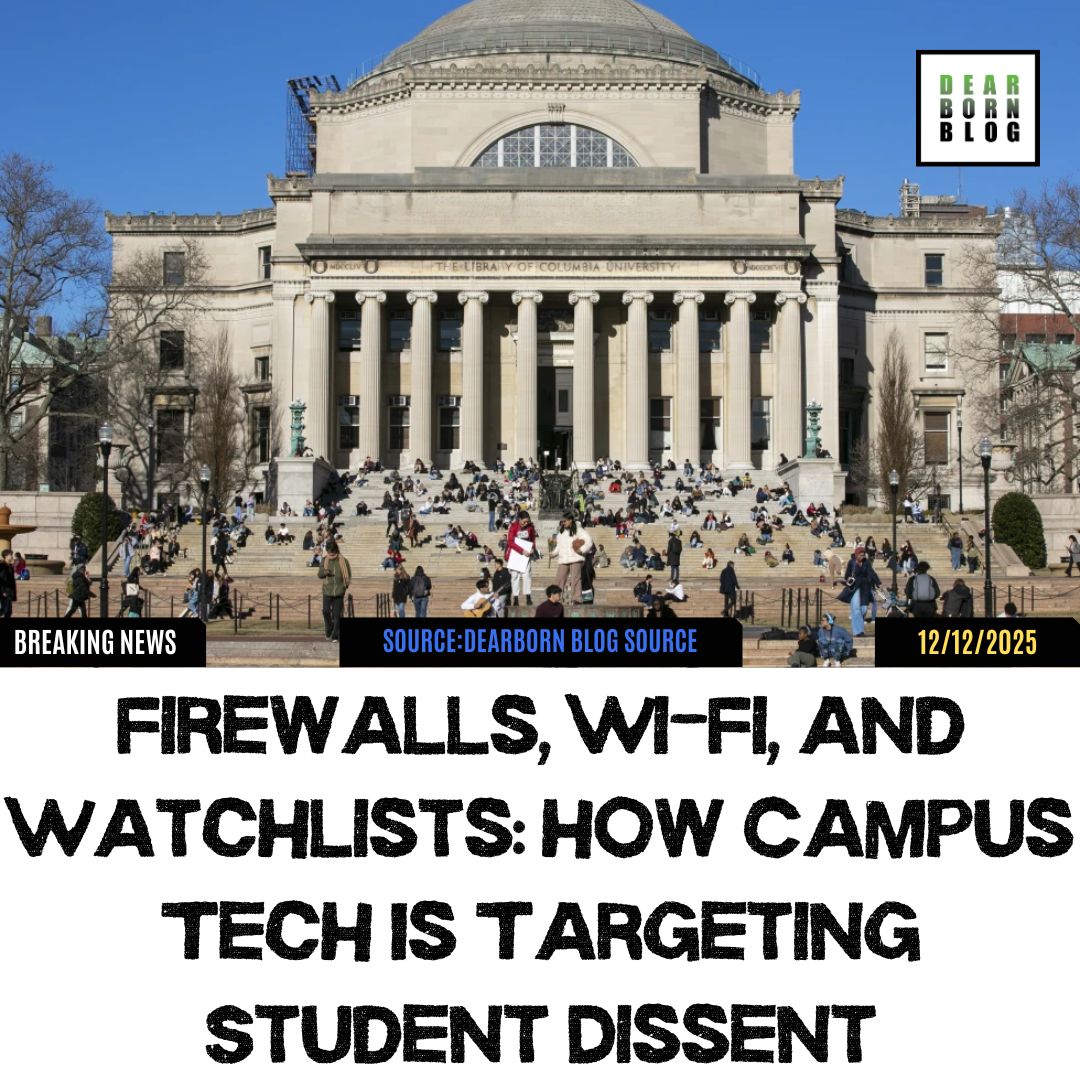
Across the U.S. and beyond, universities are quietly turning campus Wi-Fi, facial recognition, and immigration databases into tools of political control. A recent Amnesty International webinar pulled back the curtain on how students — especially those defending Palestinian rights — are being tracked, doxxed, detained, and even deported. This is a guide to what’s happening, why it matters in Dearborn and everywhere, and how students can fight back with campaigns like Amnesty’s Firewall for Freedom.
“Who Belongs on Campus?” When Speech Becomes a Security Risk
“What happened to me… is not simply only about Israel/Palestine… it’s about who gets to speak in a democracy. It’s about whether dissent is a right or a privilege.”
That’s how Mahmoud Khalil, a recent Palestinian graduate of Columbia University, described his case in Amnesty International USA’s webinar on the crackdown on student expression.
Khalil was lawfully organizing on campus against the genocide in Gaza when the U.S. government decided to make an example out of him. His green card was suddenly treated as negotiable, his activism recast as a “security threat,” and he spent over 100 days in ICE detention before massive global pressure helped win his release.[3][8]
He’s blunt about why:
“They start with visa holders, green card holders, then they go to citizens… It’s not about an isolated event. It’s part of a global pattern of repression.”
That pattern now runs straight through the university IT office.
From Protest Signs to Wi-Fi Logs
One of the most chilling moments in the webinar was a simple quiz:
Can your university track your location through campus Wi-Fi?
Over 90% of attendees said yes. They were right.
As Amnesty’s Hajira Maryam, an AI and strategic communications advisor, put it:
“Universities… can definitely track [you] and they can also see which websites you visit based on… your username.”
That’s not paranoia. It’s documented practice:
- In the U.S., colleges have adopted tools like Bluetooth-based attendance apps and Wi-Fi triangulation to track where students are and when, sometimes in real time, framing it as “student success” or “safety” while creating a massive behavioral data trail.[5]
- Investigations have shown universities using Wi-Fi and ID swipes to create detailed maps of students’ movements — from dorms to libraries to protests.[5]
- In August 2025, the University of Melbourne was found to have violated privacy law by using its campus Wi-Fi data — plus CCTV and ID photos — to identify and discipline students involved in a pro-Palestine sit-in.[7]
That’s not “just IT.” That’s political surveillance infrastructure, and it’s already being pointed at student movements.
When the Executive Branch Meets the Engineering Department
This isn’t only about curious deans or risk-averse general counsel. It’s also about the Executive Branch leaning on campuses — often hard.
Amnesty USA and over 30 civil rights groups recently warned that universities are under intense pressure from the Trump administration to “crack down” on alleged antisemitism and anti-Israel protests — pressure tied directly to federal funding and research money.[6]
At Columbia, for example, more than $220 million in federal research funds were reportedly entangled in negotiations over how the university would respond to protests.[6]
As Amnesty’s Nadia Daar put it during the webinar, the stakes go way beyond one campus or one cause:
“The student crackdown that we’re seeing in the United States is part of a deeply worrying global pattern of shrinking civic space… while this is where it starts on campuses with students, it’s not where it ends.”
So when campus police, federal immigration agents, and corporate data brokers form a triangle around student activism, we’re not just talking about “campus discipline.” We’re talking about state power, dressed up in Wi-Fi and student conduct codes.
The AI Behind the Curtain: Palantir, Babel Street, and Visa Crackdowns
Amnesty’s latest research shows that U.S. authorities are using AI-powered tools from Palantir and Babel Street to monitor migrants and track people who speak up for Palestinian rights.[2][8]
Here’s the rough architecture:
- Babel Street’s “Babel X”: a tool that scrapes and analyzes social media, assigning “sentiment” scores and building profiles that can be fed into immigration systems.[2]
- Palantir’s immigration case-management platform: used by ICE to combine immigration records, police data, and other databases into “cases” that can be automatically flagged for detention, deportation, or visa revocation.[2][5]
Amnesty has warned that these tools pose direct surveillance threats to pro-Palestine student protesters and other migrants, especially under the Trump administration’s “Catch and Revoke” initiative, which weaponizes visa revocations against political speech.[2][3][8]
During the webinar, Hajira described how these systems work together:
“Babel X conducts a sentiment analysis… and forwards [cases] to the State Department, who then decide if that particular visa can be revoked. Palantir supplies immigration case management systems to ICE… to automate and target individuals based on their case files.”
In other words:
Your campus protest photo, social media post, or name on an event flyer can travel — through surveillance tech and government databases — from a quad in Ann Arbor or Dearborn straight into an ICE case file.
“They Don’t Just Want Silence. They Want Obedience.”
Khalil describes how Columbia treated its own students like an occupied population:
- Students in the Gaza solidarity encampment were initially denied food and sleeping bags by the administration — he had to negotiate just to let supplies in.
- Flyers were distributed warning students to leave by a deadline “or face discipline,” eerily echoing the leaflets dropped on Palestinian neighborhoods before bombings.
“When a university calls police on its own students… it’s making a statement about who belongs on campus and who does not.”
He connects that directly to immigration enforcement:
“The same with the government when they target individuals for their speech… It’s making a statement on who belongs to this nation and who does not.”
Amnesty’s urgent action on foreign students notes that at least nine other students besides Mahmoud have been targeted, and thousands have had visas revoked or threatened for their protest activity.[3]
This is what it looks like when the Executive Branch uses immigration law and surveillance tech to do what the First Amendment forbids it to do directly: punish political speech.
Campus Tech as a Chilling Effect Machine
Students in the webinar described an atmosphere where self-censorship is becoming normalized:
- Professors and administrators privately admit there is “anti-Palestinian bigotry” and a manufactured hysteria about antisemitism — but are afraid to say so publicly, for fear of retaliation or doxxing.
- At Harvard, according to moderator Krupali Kumar, roughly 500 students have been doxxed since 2023 using facial recognition tools and online targeting campaigns. Many of those dossiers allegedly end up in the hands of federal authorities or employers.
Amnesty’s Ban the Scan campaign has already shown how facial recognition is used to track and intimidate protesters in New York City and how similar systems enforce what it calls “automated apartheid” in occupied Palestine.[3][4][15][27]
“Your safety is also your decision,” Hajira reminded students, after explaining that surveillance isn’t only digital: “Whatever you might post today or even five years ago might be surveilled today if you’re stepping out.”
That’s the point of this tech: not just to watch you, but to make you watch yourself.
Snapshot: How Universities Track You
Campus Surveillance, In Brief
- Wi-Fi & network logs – Track which access points your phone or laptop hits, when, and for how long; can often be tied to your student ID.[5][18]
- Bluetooth beacons & attendance apps – Tools like SpotterEDU and other services log whether your phone is physically in class or at an event.[5][14][22][26]
- ID swipes & building access – Every dorm, library, or lab entry can be turned into a location history.[5][18]
- CCTV + facial recognition – Cameras around campus can be linked to face databases, protest photos, or scraped social media; Amnesty has documented such use by police and private actors.[3][4][19]
- Data sharing with law enforcement – Under pressure from federal agencies, some campuses hand over footage, logs, or protest rosters; civil rights groups have publicly urged universities to stop.[6][19][40]
None of this is hypothetical anymore. It’s happening right now — including against students supporting Palestinian rights.
What Solidarity Looks Like When Everyone’s Being Watched
The webinar ended on something rare in a conversation this heavy: hope grounded in strategy.
Khalil described how the Columbia movement stayed strong because students invested in political education and community long before tents went up:
“The students did not only start with an encampment… they invested a lot in political education… and in building cross-movement partnerships with Black students, Jewish students, workers, and the Harlem community.”
Nadia emphasized agency, even in a tech-saturated security state:
“We are alumni, parents, community members, constituents… There are many different ways that we can play our part, have solidarity and have strength in this human rights movement.”
Hajira underlined that every struggle — climate justice, migrant rights, women’s rights, Palestinian liberation — is being hit by the same surveillance and repression tools, just pointed at different communities at different times.[2][4][19]
For Dearborn students and families, that should sound familiar. Our community has lived through decades of Islamophobia, “counter-terrorism” profiling, no-fly list nightmares, and FBI visits simply for knowing the wrong people. The new layer isn’t the hostility. It’s the software.
From Wi-Fi Logs to Firewalls for Freedom
So what do we actually do in the face of all this?
Amnesty’s campaign offers one concrete, campus-tested tool: the Firewall for Freedom resolution, developed with the ACLU.[1][6][10][16]
The resolution is a student-driven demand that universities:
- Refuse voluntary cooperation with Trump administration efforts to monitor, punish, or deport students for protected speech;
- Stop sharing protest data and surveillance feeds with law enforcement except where absolutely required by law;
- Protect masked protesters and anonymity, to reduce doxxing and retaliation;[6][40]
- Affirm students’ rights to freedom of expression, association, and assembly — including advocacy for Palestinian rights.
Students at campuses like the University of Nebraska at Omaha, American University, and UC Davis have already passed such resolutions, sending a clear message that their universities must stop acting as extensions of federal crackdowns and start acting like educational institutions again.[1][20][24]
You can download the full toolkit — including draft language, organizing tips, and a model resolution — here:
👉 https://www.amnestyusa.org/toolkits/firewall-for-freedom-campus-resolution-toolkit/
Once you’ve got it, bring it to:
- Your student government;
- Your campus Amnesty or civil liberties club;
- Unions, cultural orgs, and community groups who understand that today it’s Palestine — tomorrow it’s climate, abortion rights, migrant justice, or labor organizing.
As the toolkit itself says, this is a first step, not a final shield.[1][10][16]
Practical Digital Self-Defense (That Still Lets You Organize)
Hajira shared some simple, boring, extremely useful habits for anyone organizing under a microscope:
“Always install software updates… Use a passcode, not facial recognition… Turn off Bluetooth when you’re not using it… Use Signal to mobilize…”
Some core practices:
- Update your devices so you’re not walking around with known, unpatched security holes.
- Use strong passcodes, not face or fingerprint unlock, which can be compelled more easily by authorities.
- Turn off location services and Bluetooth when you don’t need them.
- Use end-to-end encrypted messaging apps like Signal or Wire for organizing.
- Review your social media history and privacy settings — especially public photos that can be fed into facial recognition systems.[3][4][7][15][19][27]
- If you’re doxxed, know that Google and Microsoft both have processes to request removal of certain sensitive personal data from search results.[2]
None of this will magically delete the surveillance state, but it does raise the cost of targeting you and your friends — and that matters.
Dearborn, This Is Our Fight Too
Whether you’re at U-M Dearborn, HFEC, Henry Ford, Wayne State, or any of the many campuses our community touches, this crackdown is not abstract. Our students:
- Are statistically more likely to be Muslim, Arab, Black, or immigrants — exactly the groups being targeted by AI-driven immigration enforcement and biased policing;[2][3][19]
- Are heavily involved in Palestine solidarity, racial justice, and climate organizing — the very movements being used as justification for “exceptional” surveillance;[2][3][6][40]
- Live in a city that knows what happens when we stay silent while someone else’s community is tested on.
Mahmoud closed with a line that deserves to be on every campus wall:
“They may have the power, but we have the people.”
The tech is scary. The laws are stacked. The Executive branch is overreaching. But none of that works if students, faculty, workers, and communities refuse to participate — and instead build their own firewalls for freedom: political education, cross-movement solidarity, and hard limits on what surveillance we accept in our schools.
Sources
[1] Amnesty International USA & ACLU, Firewall for Freedom: Campus Resolution Toolkit and related materials, April 2025. Facebook+4Amnesty International USA+4Amnesty International USA+4
[2] Amnesty International, USA/Global: Tech made by Palantir and Babel Street pose surveillance threats to pro-Palestine student protestors & migrants, Aug. 21, 2025, and related correspondence with Palantir. France 24+3Amnesty International+3Amnesty International+3
[3] Amnesty International USA, USA: Stop targeting foreign students for protest (urgent action on Mahmoud Khalil and others). Amnesty International USA
[4] Amnesty International & partners, Ban the Scan campaign materials on facial recognition and protest surveillance, including NYC and global context. STOP Surveillance Project+4Ban the Scan+4Amnesty International+4
[5] Reporting and analysis on campus location tracking, including Washington Post, The Markup, FIRE, and technical overviews of tracking apps and Wi-Fi monitoring. The Wispy+5Campus Safety Commission+5The Markup+5
[6] Coalition letter and coverage of privacy and civil rights groups urging U.S. universities to end campus surveillance and resist Trump administration pressure. AP News
[7] The Guardian, University of Melbourne breached students’ privacy by using Wi-Fi network to monitor pro-Palestine protest, Aug. 2025. The Guardian
[8] The Verge and other reporting on the ICE arrest and detention of Columbia graduate Mahmoud Khalil as part of pro-Palestine campus repression. The Verge+1
[9] Amnesty International USA & S.T.O.P. lawsuit materials on NYPD surveillance abuses against protesters and communities of color. Amnesty International USA+1
[10] Amnesty USA, Firewall for Freedom sign-up page and toolkit support information. Amnesty International USA+1
Disclaimer
This article is for informational and educational purposes only and does not constitute legal advice. Dearborn Blog does not warrant the completeness or accuracy of external information and is not responsible for actions taken based on this article or on linked resources. For any corrections, clarifications, or comments you would like reflected in this piece, please email info@dearbornblog.com.
Freedom of expression belongs to everyone in our community — online, on campus, and beyond. Defending it is a shared responsibility.


