

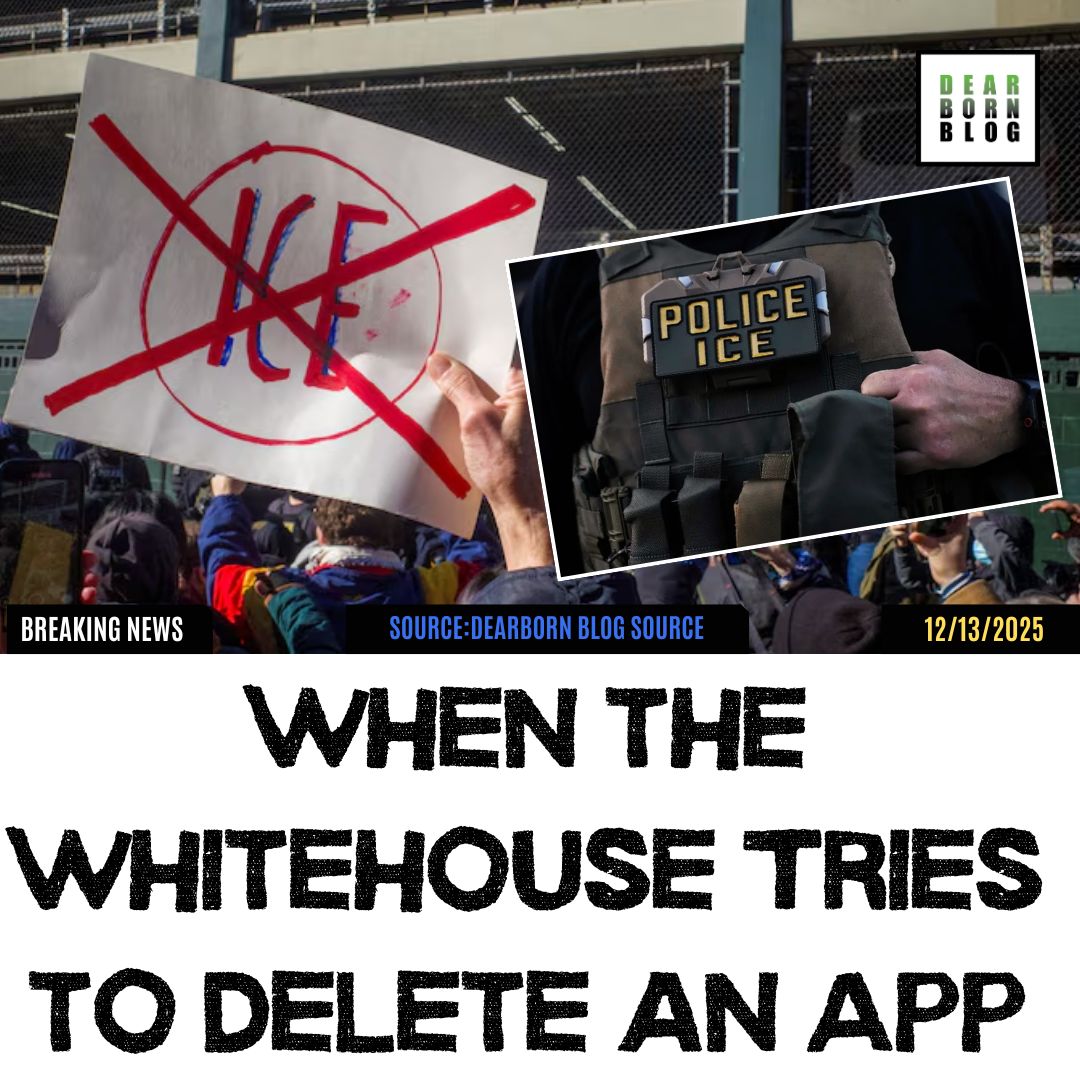
The First Amendment doesn’t vanish when our speech takes the form of code, maps, or phone alerts. When the Executive Branch leans on Apple or Google to erase tools that help communities see what government agents are doing in public, it’s not “app store housekeeping.” It’s censorship in a suit and tie.
In December 2025, a small Texas developer did something the Constitution actually expects of us: he pushed back.
Joshua Aaron, creator of the ICEBlock iPhone app, sued the Trump administration after Apple removed his app from the App Store following pressure from U.S. Attorney General Pam Bondi and other senior officials.[1][2] ICEBlock let users report publicly visible sightings of Immigration and Customs Enforcement (ICE) agents—essentially a crowdsourced warning system for communities at risk of raids.
At its peak, ICEBlock had over a million users and was the most popular ICE-tracking app in Apple’s store.[1][2] The Department of Justice and Homeland Security, however, framed the app as a threat to officer safety, and Bondi publicly bragged that her office “demanded” Apple remove it.[1][2] Google followed with its own purge of similar apps.[7]
The lawsuit doesn’t just ask a judge to put ICEBlock back online. It asks a deeper question with huge implications for Dearborn, Detroit, and every community that depends on organizing tools:
Can the Executive Branch use its power to quietly erase apps and movements that make government agents uncomfortable — and still pretend the First Amendment doesn’t apply?
Short answer: constitutionally, no. Or at least, it shouldn’t.
Apps are speech, not contraband
Lawyers like to argue about everything, but one idea is relatively settled: expression doesn’t stop being expression when you move it into new formats.
A protest sign, a newspaper, a TikTok video, a tweet-thread, a map full of user pins – all of these are ways of communicating information and ideas. ICEBlock is basically three protected activities wrapped into one:
- Recording public government activity – Courts have repeatedly recognized the right to document law enforcement officers in public spaces, so long as you’re not interfering with their work.[2]
- Sharing that information with others – Telling neighbors where ICE is operating is classic political speech about government conduct.
- Organizing community response – Even if that response is just “avoid this area today,” it’s an exercise of freedom of association and movement.
The Reuters coverage of Aaron’s lawsuit notes that legal experts see surveillance of immigration agents in public as “largely protected” under the Constitution, so long as no one blocks their work or encourages harm.[2] That matches decades of First Amendment doctrine.
So, if ICEBlock is fundamentally speech, the First Amendment restricts government attempts to shut it down. Yes, Apple is a private company. But when the Department of Justice and the Attorney General contact Apple, insist the app is “designed to put ICE agents at risk,” and talk publicly about “looking at” the developer himself,[1][7] that’s not a neutral product safety tip. That’s state power looming in the background.
This isn’t new: it’s “jawboning”
Civil liberties advocates have a term for this move: jawboning — when government officials don’t directly ban speech, but pressure private platforms and companies to do the dirty work for them.[6]
The Foundation for Individual Rights and Expression (FIRE) defines jawboning as “the use of official speech to inappropriately compel private action.”[6] If a government official implies that “nice platform you’ve got there, shame if something happened to it,” and the company then silences a speaker, that censorship is still driven by the state.
In NRA v. Vullo, the Supreme Court confronted exactly this kind of indirect coercion. New York’s financial regulator was accused of pressuring banks and insurers to cut ties with the National Rifle Association because she disliked its political advocacy. In a unanimous 2024 decision, the Court reaffirmed a 60-year-old rule: government cannot use third parties to censor speech it dislikes.[6]
That rule traces back to Bantam Books v. Sullivan (1963), where a Rhode Island “morality commission” sent “helpful” letters to book distributors listing “objectionable” titles and hinting that prosecutors might follow up. Distributors got the message and pulled the books. The Supreme Court struck the scheme down, calling it a system of informal censorship and making clear that these “informal sanctions” were still state action.[4]
In 2024, in Murthy v. Missouri, the Supreme Court dodged the heart of the jawboning debate on technical grounds (standing), but both the majority and dissent agreed that there’s a line between legitimate government persuasion and coercive pressure that violates the First Amendment.[7]
Put simply:
If the government can’t legally ban your speech, it also can’t strong-arm your platform into banning it for them.
That is the core principle at stake in the ICEBlock fight.
What the ICEBlock case shows about Executive overreach
Aaron’s lawsuit alleges that Bondi, Homeland Security Secretary Kristi Noem, ICE Acting Director Todd Lyons and White House “border czar” Tom Homan used their positions to threaten investigation and prosecution if he didn’t stop developing and distributing the app.[1][2]
At the same time, Apple’s takedown email said “information provided to Apple by law enforcement” showed ICEBlock’s purpose was to provide location data on officers that “could be used to harm” them, violating App Store rules.[1] The developer counters that the app didn’t show personal details, didn’t allow photos or video uploads, and functioned like Waze or other apps that show police presence to drivers.[1][7]
Here’s the key pattern we see:
- Executive officials publicly frame the app as dangerous to law enforcement.
- They privately or semi-privately reach out to Apple urging removal.
- Apple complies, citing law enforcement information and safety.
- The developer and users lose a tool for tracking public government activity.
That’s textbook jawboning territory. The government is using its bully pulpit plus regulatory shadow to chill speech it dislikes — specifically, speech that helps immigrant communities anticipate raids and assert their rights.
And remember: nothing in the lawsuit alleges that ICEBlock users were blocking officers, attacking them, or interfering with arrests. The core complaint from officials is that the app makes their work more visible and therefore more politically costly.[1][2][7]
From Hong Kong to ICEBlock: the global warning sign
Civil liberties advocates immediately noticed the parallel: this is exactly what authoritarian governments have pushed Western companies to do abroad.
In 2019, during Hong Kong’s mass protests, Apple pulled an app called HKmap.live that protesters used to track police movements through crowdsourced reports. The Chinese state media had attacked Apple for “protecting rioters” with a “poisonous app,” and shortly afterward Apple said it removed the tool for allegedly enabling ambushes and threatening public safety.[3]
The app’s creators denied that it was used for criminal activity and argued Apple’s move was a “political decision to suppress freedom and human rights.”[3] Sound familiar?
Today, critics of the ICEBlock takedown describe it as the same pattern, but imported back home: government pressure plus corporate compliance equals disappearing tools of dissent. One tech commentary bluntly called Apple and Google’s removal of ICE-tracking apps “a chilling precedent,” noting that immigration advocates fear a far-reaching “chilling effect” on speech and activism whenever officials decide certain speech makes their jobs harder.[7]
In other words, when Washington starts to look like Beijing in how it handles protest tech, something has gone seriously off the rails.
The Executive Branch’s limits: what it can’t do
To be clear, the Executive Branch is not powerless. Officials can:
- Warn the public about genuinely dangerous apps (malware, fraud, active incitement to violence).
- Enforce neutral laws against true threats, doxxing, or direct obstruction of law enforcement.
- Speak out against speech they dislike — public officials have their own First Amendment rights.
But the First Amendment, as interpreted by the Supreme Court, draws a bright line:
A government actor cannot threaten, coerce, or significantly pressure private actors to silence disfavored speech, especially core political speech, when the government itself could not constitutionally silence it directly.[4][6][7]
In cases like Bantam Books and NRA v. Vullo, the Court emphasized several warning signs of unconstitutional coercion:[4][6]
- The official has regulatory or enforcement power over the private actor.
- The communication includes threats of investigation, penalties, or “problems” if the request isn’t honored.
- The target reasonably understands the message as “do this or else.”
- The result is suppression of protected speech — not merely illegal conduct.
The ICEBlock story checks those boxes: the Attorney General and Homeland Security leadership have enormous power over Apple’s legal and regulatory environment; they explicitly framed the app as unlawful and dangerous; and Apple then blocked further downloads based on law enforcement “information.”[1][2][7]
At that point, we’re not talking about a private company’s purely independent content-moderation choice. We’re talking about a joint project between government and Big Tech to remove a specific form of dissenting or inconvenient speech. That is exactly the kind of collaboration the First Amendment was built to restrain.
Dearborn, movement, and digital self-defense
For Dearborn residents — especially Arab, Muslim, Black, immigrant, and working-class communities — all this is intensely practical, not theoretical.
Our neighborhoods have lived for decades with a “national security” gaze pointed our way: from FBI visits after global crises, to border-style surveillance at airports, to the constant fear that one traffic stop could snowball into something far worse for an undocumented neighbor.
Digital tools like ICEBlock grow out of that reality. They are modern versions of the phone trees and mosque whispers and text threads people have always used to say, “Hey, be careful, they’re out tonight.”
When the Executive Branch leans on Apple or Google to shut down those tools, it’s not just interfering with some abstract “app economy.” It’s constraining:
- Freedom of expression – sharing information about government activity in public spaces.
- Freedom of association – organizing rapid mutual aid and legal support.
- Freedom of movement – making informed decisions about where to go and how to stay safe.
The same values that animate Green politics — decentralizing power, protecting civil liberties, opposing militarized policing, defending migrants and refugees — are at stake here, even if the battleground is a line of code instead of a ballot box.
Protecting Palestinian lives abroad and protecting immigrant lives at home are part of the same moral horizon: who gets to live with dignity, without being disappeared by state power in the dark? Dearborn knows that question intimately.
Where do we go from here?
No single lawsuit will fix the relationship between government and platforms, but the ICEBlock case points toward a few essential principles:
1. Transparency first.
Any time federal agencies contact platforms about specific speech, apps, or accounts, those communications should be logged and, absent real security needs, made public. Secret censorship is the easiest censorship.[6][7]
2. Clear legal limits on jawboning.
Congress and the courts need to codify what NRA v. Vullo and Bantam Books already imply: regulators cannot use “suggestions” and “guidance” as fig leaves for coercion.[4][6]
3. Community tech that’s harder to kill.
Decentralized and open-source tools — maps, SMS networks, encrypted group chats — make it harder for any one company to flip a switch on an entire movement.
4. Local organizing that doesn’t wait for tech companies’ permission.
Know-your-rights trainings, court support teams, neighborhood watch (for the state, not just for “crime”), and rapid response networks can’t depend entirely on Silicon Valley’s mood.
In Dearborn and across southeast Michigan, we already have grassroots models for this: from mutual aid networks to Palestine solidarity coalitions to immigrant defense circles. The job now is to build digital infrastructure that matches that courage — and to insist that the Executive Branch stay on the constitutional side of the line.
Because the First Amendment doesn’t just protect the right to speak. It protects the right to see what government is doing, to share that information, and to move together in response. Whether that happens in a town square or inside an app shouldn’t matter.
Sources
[1] Matt O’Brien, “ICEBlock app maker sues Trump administration over its pressure on Apple to remove app,” Seattle Post-Intelligencer / Associated Press, Dec. 8, 2025. Seattle Post-Intelligencer
[2] Brad Brooks, “Trump administration sued over removal of app for tracking immigration agents’ whereabouts,” Reuters, Dec. 8, 2025. Reuters
[3] Erin Hale, “Hong Kong protests: Apple pulls tracking app after China criticism,” The Guardian, Oct. 10, 2019. The Guardian
[4] Michael P. Fix, “Bantam Books, Inc. v. Sullivan (1963),” First Amendment Encyclopedia, Free Speech Center at MTSU, updated Feb. 6, 2025. The Free Speech Center
[5] John R. Vile, “Murthy v. Missouri (2024),” First Amendment Encyclopedia, Free Speech Center at MTSU, June 26, 2024 (updated Feb. 28, 2025). The Free Speech Center
[6] “What is jawboning? And does it violate the First Amendment?”, Foundation for Individual Rights and Expression (FIRE), updated Nov. 8, 2024. FIRE
[7] Nick Papanikolopoulos, “Apple and Google Remove Apps That Crowdsourced ICE Sightings — A Chilling Precedent,” Gizchina, Oct. 5, 2025. Gizchina
Disclaimer
This article is provided for informational and educational purposes only and does not constitute legal advice. The views expressed here are based on publicly available sources and our good-faith understanding of current events at the time of publication. Facts, legal developments, and circumstances may change. Dearborn Blog, its writers, and its editors do not accept any responsibility or liability for actions taken or not taken based on this content.
For any corrections or comments that you would like inserted in the article, please email info@dearbornblog.com so we can review and update as appropriate.

 Dearborn Blog
I Think Nancy & Stephanie Sidley are an apologist for United States Immigration and Customs Enforcement
LikeLike
I Think United States Immigration and Customs Enforcement Is on the same level as the Proud Boys, Ku Klux Klan, Jewish Defense League, Jewish Defense League, Earth Liberation Front, The Covenant, The Sword, and the Arm of the Lord, Atomwaffen Division, Aryan Nations, Army of God, Animal Liberation Front, Alpha 66 and Omega 7, 764 and No Lives Matter, May 19 Communist Organization, The Order, Phineas Priesthood, Symbionese Liberation Army, United Freedom Front, Weather Underground,
LikeLike