

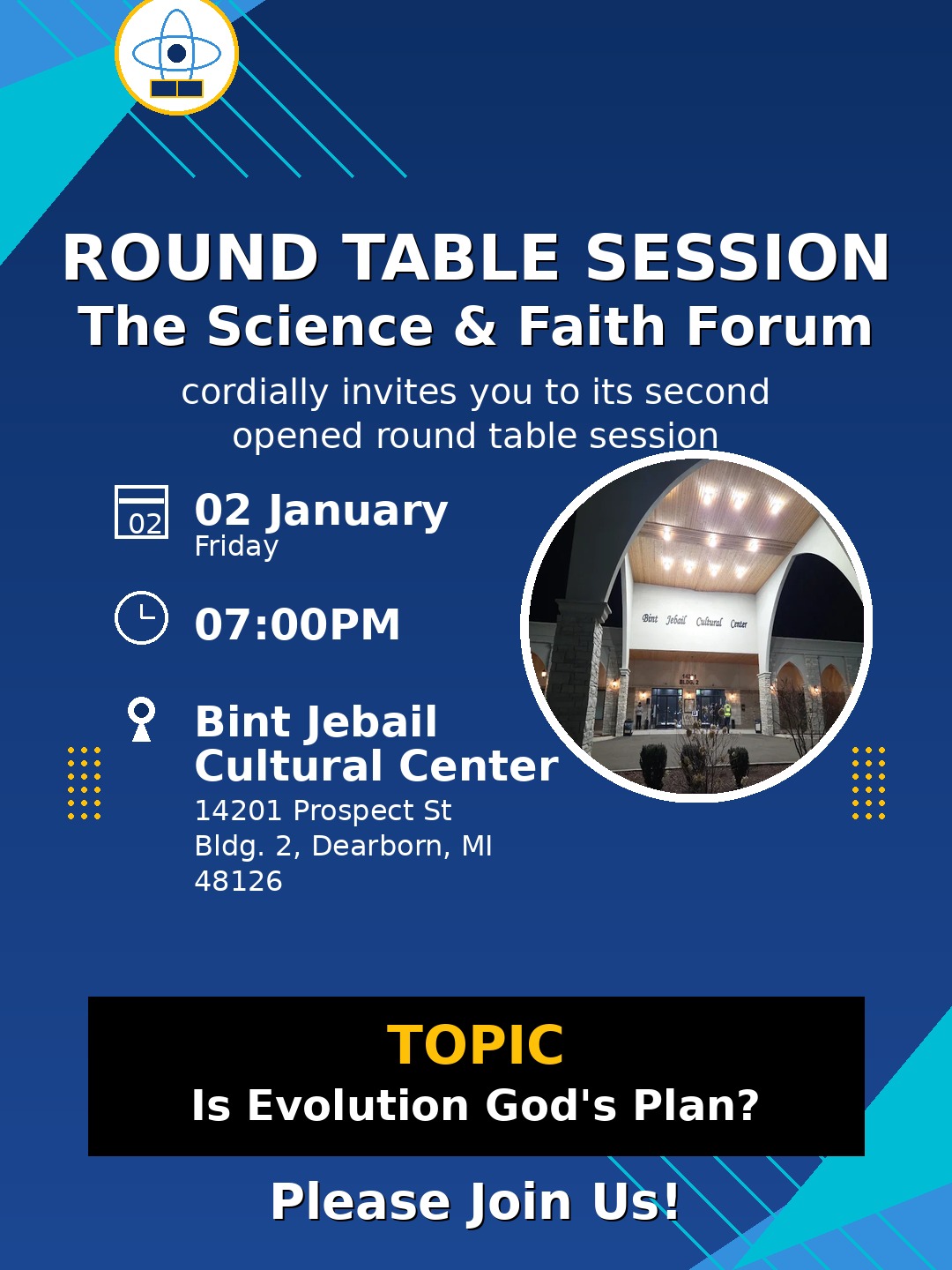
A new “Science & Faith Forum” round table is coming to Dearborn, hosted at the Bint Jebail Cultural Center. The topic is one of humanity’s greatest icebreakers (and occasional table-flipper): Is evolution God’s plan? Here’s what the flyer says, why the question matters, and how to show up ready for a real conversation—not a shouting match.
A round table… in Dearborn… about evolution and God
Some cities do “networking mixers.” Dearborn does something more interesting: community forums where big questions get unpacked face-to-face, with all our beautiful contradictions intact.
The flyer circulating this week invites the public to a second “opened round table session” by a “Science & Faith Forum,” hosted at the Bint Jebail Cultural Center (BJCC) in Dearborn. The question on the table is direct and deceptively simple: Is evolution God’s plan?
That sentence contains at least three loaded words—evolution, God, and plan—and each one means different things to different people. Which is exactly why a round-table format (where listening is supposed to be the point) can be a healthier choice than the usual internet cage match.
About the venue: Bint Jebail Cultural Center
The roundtable is set for the Bint Jebail Cultural Center at 14201 Prospect Street, Building 2, Dearborn. The BJCC is a longstanding community hub—cultural, charitable, and religious in its identity—and it publicly lists its location and contact information on its website. [1] Public nonprofit directories also list BJCC’s basic organizational details and address. [2]
In a city like Dearborn—where Arab and Muslim life is woven into the civic fabric, where churches and mosques and community centers anchor daily life—this venue choice matters. It signals something important: this isn’t “science people” lecturing “faith people,” or vice versa. It’s a community space saying: We can talk like grown-ups.
So… what are we actually debating when we debate “evolution”?
In science, evolution is not a vibe or a philosophy. It’s a framework biologists use to explain descent with modification—how populations change over generations, how species diversify, and why life shows patterns of relatedness. Major scientific bodies describe evolution as the only tested, comprehensive explanation for biological diversity that is supported by overwhelming evidence and widely accepted across the scientific community. [3]
And the evidence is not just “fossils, trust me bro.” It spans genetics, comparative anatomy, developmental biology, biogeography, and more. Even a basic science reference from the U.S. National Library of Medicine outlines how multiple lines of evidence support “descent with modification” and evolutionary theory’s core conclusions. [4]
“Evolution should be taught in science classes because it is the only tested, comprehensive scientific explanation… supported by overwhelming evidence and widely accepted by the scientific community.” [3]
Then where does “God” fit in?
This is where people talk past each other.
Science, as a method, is deliberately limited: it tests natural explanations using evidence and repeatable reasoning. That doesn’t automatically disprove God; it just means “God” isn’t something you can put in a test tube and measure with calipers. Organizations that work in science education have long noted that perceived conflict—more than the actual content of evolutionary biology—is what drives resistance and confusion. [5]
Religiously, there’s a whole spectrum of views. Three broad categories show up a lot in real life:
- Literalist creationism (including “young-earth” variants): interprets sacred texts as describing a relatively recent creation; often rejects mainstream evolutionary science.
- Old-earth creationism / progressive creationism: accepts an ancient Earth but may reject common ancestry or human evolution as typically described by biologists.
- Theistic evolution / evolutionary creation: accepts evolutionary science while believing God created and sustains reality, potentially working through natural processes. Christian organizations like BioLogos describe “evolutionary creation” as affirming God as creator while accepting evolution as the best scientific explanation for life’s relatedness. [6]
What’s easy to miss: many faith traditions and leaders have explicitly made room for evolutionary science. For example, Pope John Paul II told the Pontifical Academy of Sciences that accumulated knowledge points toward recognizing evolution as “more than a hypothesis.” [7]
What do Americans actually believe right now?
Beliefs on evolution aren’t a neat “religious vs. not religious” split. They’re more like a mosaic.
Pew Research Center’s recent reporting on religious/spiritual beliefs in the U.S. finds that most U.S. adults say humans evolved over time, including a large share who believe God (or a higher power) either guided or allowed the process—alongside another share who say God had no role. [8] Older Pew analysis similarly found majorities accepting evolution, with significant variation across religious groups and a meaningful portion describing evolution as guided by a supreme being. [9]
So if you show up to this Dearborn roundtable expecting a simple two-team debate, reality will disappoint you—in a good way. Most people don’t fit into clean boxes. They’re trying to reconcile family, scripture, science class, and their own conscience without losing their minds.
Why this roundtable matters in 2026’s America
We’re living in an era where scientific topics get politicized fast—public health, climate, even what books kids can read. Evolution is one of those subjects that keeps getting dragged into culture-war theater, especially around education.
The Associated Press recently highlighted how creationist movements remain influential in the U.S. a century after the Scopes “monkey trial,” even as courts and scientific institutions have repeatedly reinforced that evolution is foundational science. [10] That ongoing tension is exactly why community dialogue matters: the goal isn’t to “win,” it’s to build enough shared reality that we can make sane decisions together—about schools, health, and the kind of future we’re willing to fund.
From a Green Party-aligned perspective (and Dearborn Blog readers know where we tend to land), this is also about defending evidence-based education while respecting pluralism. A healthy society can do both: teach science accurately and protect people’s freedom of conscience. The enemy isn’t faith. The enemy is ignorance being weaponized—usually by people who want power without accountability.
What a good-faith night could look like
The flyer says “round table,” which implies conversation, not a lecture. That format can work brilliantly if the room agrees on some ground rules:
- Define your terms. Are we talking about evolution as a biological process, or “evolution” as a worldview label people slap on each other?
- Distinguish questions of meaning from questions of mechanism. “How does life diversify?” is different from “Why are we here?”
- Steelman, don’t strawman. Summarize the other person’s view in a way they’d recognize before disagreeing.
- Admit uncertainty like it’s a strength (because it is). The universe is not obligated to be simple.
Dearborn doesn’t need another debate where people perform certainty. It needs more rooms where people practice curiosity.
Dearborn context: why a “Science & Faith” forum belongs here
Dearborn is a city of builders—immigrants, autoworkers, shop owners, engineers, teachers, caregivers, activists. It’s also a city where identity is not theoretical. People here know what it means to be stereotyped, surveilled, simplified, and talked about instead of listened to.
That’s why a forum like this, hosted in a community cultural center, has potential. It says: we can be pro-science without being smug; pro-faith without being anti-evidence; pro-community without pretending we all believe the same things.
And there’s a deeper thread too: Bint Jbeil (the Lebanese town the center is named after) is a symbol of endurance and community under pressure—something our diaspora communities understand viscerally. In a world where Palestine remains under catastrophic assault and where Arab and Muslim communities often experience dehumanization in U.S. discourse, building spaces for dignified conversation is part of cultural survival. BJCC-style institutions are where that survival becomes tangible: meals, funerals, weddings, youth programs—and yes, difficult conversations. [1] [2]
Planning to attend? Here’s how to show up strong
Bring one honest question you actually want answered (not a “gotcha”).
Bring one source you trust—a book, a scholar, a faith leader, a scientific explainer—and be ready to summarize it without turning it into a sermon.
Bring respect for the room. People’s beliefs are tied to family, grief, and identity. If you treat it like a boxing match, you’ll just create more silence later.
For logistics, the BJCC publicly lists its phone number and email on its website if you need to confirm details or accessibility. [1]
Bottom line
The question “Is Evolution God’s Plan?” can be a trap if people use it to declare enemies. But it can also be a bridge if people use it to clarify what they mean by truth, purpose, evidence, and humility.
Dearborn has always been bigger than the stereotypes. We’re a city that can hold complexity—faith and science, tradition and change, grief and organizing, cultural pride and universal justice. That’s exactly the kind of place where this conversation should happen.
Sources
- Bint Jebail Cultural Center — Contact/location details (address, phone, email). BintJebailCulturalCenter.org. [1]
- Bint Jebail Cultural Center nonprofit profile. GuideStar. [2]
- Evolution Resources: why evolution is taught; overview of scientific consensus. National Academies. [3]
- Evidence Supporting Biological Evolution. NCBI Bookshelf (NIH/NLM). [4]
- “Science, Religion, and Evolution” (education context; perceived conflict and teaching challenges). National Center for Science Education (NCSE). [5]
- “What is Evolutionary Creation?” (faith + evolution framing). BioLogos. [6]
- “Message to the Pontifical Academy of Sciences” on evolution (“more than a hypothesis”). Pope John Paul II (archival document). [7]
- “Religious and spiritual beliefs” (U.S. views on evolution; role of God/higher power). Pew Research Center (Feb. 2025). [8]
- “Public’s Views on Human Evolution” (earlier Pew breakdown; guided vs natural processes). Pew Research Center (Dec. 2013). [9]
- Creationism’s persistence and the continuing culture battle around evolution education (Scopes legacy). Associated Press. [10]
Disclaimer: This article is based on the attached event flyer and publicly available information about the venue and broader science/faith context. Event details (including date/year, speakers, format, and any entry requirements) may change; please confirm directly with the organizers and/or the venue using the contact information listed by the Bint Jebail Cultural Center. Dearborn Blog is not responsible for last-minute changes, cancellations, or third-party errors. For corrections or comments you would like inserted in this article, please email info@dearbornblog.com.

 Dearborn Blog