

In the late nineteenth century, long before Zionism emerged as a structured political movement, Palestine existed within a very different social and cultural reality than the one often portrayed today. The land was not “without a people,” and Hebrew was not yet a spoken national language tied to a political identity.
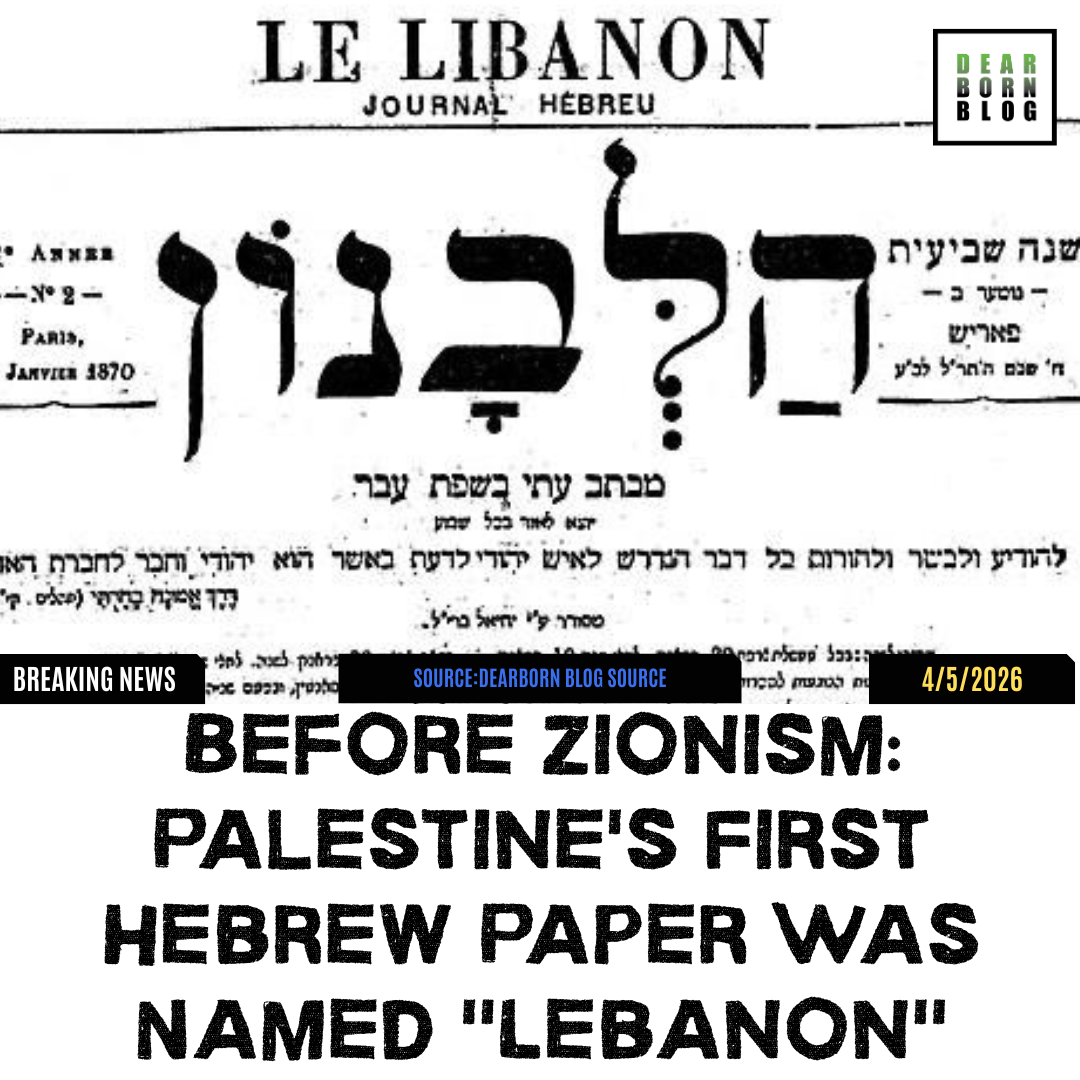
Instead, the region reflected a deeply interconnected, multi-religious society. One of the most revealing historical examples of this is the publication of the first Hebrew-language newspaper in Palestine—remarkably named “Lebanon” (Ha-Levanon).
This overlooked fact offers important insight into how language, identity, and geography were understood before they were reshaped by nationalist movements in the twentieth century.
“Ha-Levanon”: A Name That Tells a Story
The newspaper Ha-Levanon was first published in Jerusalem in 1863. Its name alone is striking. Rather than referencing a Jewish national identity or a concept tied specifically to Palestine, it invoked a broader regional identity—Lebanon, a term historically associated with the wider Levant.
This was not a coincidence.
At the time, the boundaries and identities we recognize today had not yet solidified. The choice of the name “Lebanon” reflected a worldview in which the region was seen as a connected cultural and geographic space, rather than divided into modern nation-states or exclusive ethnic territories.
In this sense, the newspaper’s title serves as a window into a pre-nationalist understanding of place and belonging.
Hebrew Before Zionism: A Sacred, Not National Language
Prior to the rise of Zionism, Hebrew was not used as a daily spoken language. Instead, it functioned primarily as:
- A sacred language for religious texts
- A medium for rabbinical scholarship and correspondence
- A literary language within religious communities
Jewish communities in Palestine at the time spoke a variety of other languages in everyday life, including:
- Arabic
- Yiddish
- Ladino
The use of Hebrew in Ha-Levanon was therefore not an attempt to revive it as a national language, but rather an extension of its traditional religious and intellectual role.
This distinction is crucial. It highlights that Hebrew’s transformation into a modern spoken language was not organic or inevitable—it was a later development closely tied to ideological efforts.
A Diverse Society, Not an Empty Land
The existence of a Hebrew newspaper published in Ottoman Palestine also challenges another persistent narrative: that the land was largely empty or undeveloped prior to Zionist settlement.
In reality, Palestine in the nineteenth century was home to:
- Muslim Arab communities
- Christian Arab communities
- Jewish communities integrated into local society
These groups interacted within shared urban and rural spaces, participating in trade, culture, and daily life. The Jewish population itself was not a monolith; it included long-established communities as well as newer arrivals, all of whom were embedded in the broader social fabric.
The publication of Ha-Levanon reflects this environment—one in which intellectual and religious life was active, interconnected, and rooted in the region.
Print Culture and Intellectual Life in Ottoman Palestine
The emergence of a Hebrew newspaper in 1863 also points to a vibrant intellectual climate.
Printing presses, religious scholarship, and cross-regional communication were already well established in cities like Jerusalem. Newspapers such as Ha-Levanon were part of a wider network of publications circulating ideas, debates, and religious discussions across the Jewish world.
Importantly, these publications were not initially political in the modern nationalist sense. Their focus was often:
- Religious discourse
- Community news
- Ethical and philosophical discussions
This reinforces the idea that the cultural life of the region cannot be reduced to later political narratives.
Reframing the Historical Narrative
Looking back at Ha-Levanon invites a reconsideration of commonly accepted historical assumptions.
It reminds us that:
- Hebrew existed long before Zionism—but in a different role
- Jewish life in Palestine was diverse and deeply rooted in the region
- Regional identity once extended beyond today’s national borders
- The transformation of language into a political tool was a later development
Understanding these distinctions does not erase later history, but it does complicate simplified narratives that project modern identities backward onto the past.
Conclusion
The story of Ha-Levanon, the first Hebrew newspaper in Palestine, is more than a historical curiosity. It is a powerful reminder that language, identity, and geography are not fixed—they are shaped by context, culture, and time.
Before Zionism redefined Hebrew as a national language and reframed the region through a political lens, there existed a different reality—one in which a Hebrew newspaper could be named “Lebanon” without contradiction.
That reality is essential for anyone seeking a deeper, more nuanced understanding of the region’s history.


