

A Monument Unveiled, A Storm Unleashed
On April 30, 2026, New York City unveiled Al Qalam: Poets in the Park — a $1.6 million public artwork by French-Moroccan artist Sara Ouhaddou, installed in Elizabeth H. Berger Plaza in Manhattan’s Financial District.1 The centerpiece is a luminous yellow three-dimensional sculpture representing the Arabic word al-qalam (the pen), its abstract calligraphy inspired by Islamic architectural geometry. Its surface bears the names of nine writers who once lived and wrote in that neighborhood — a place the early 20th-century press called “Little Syria.”2
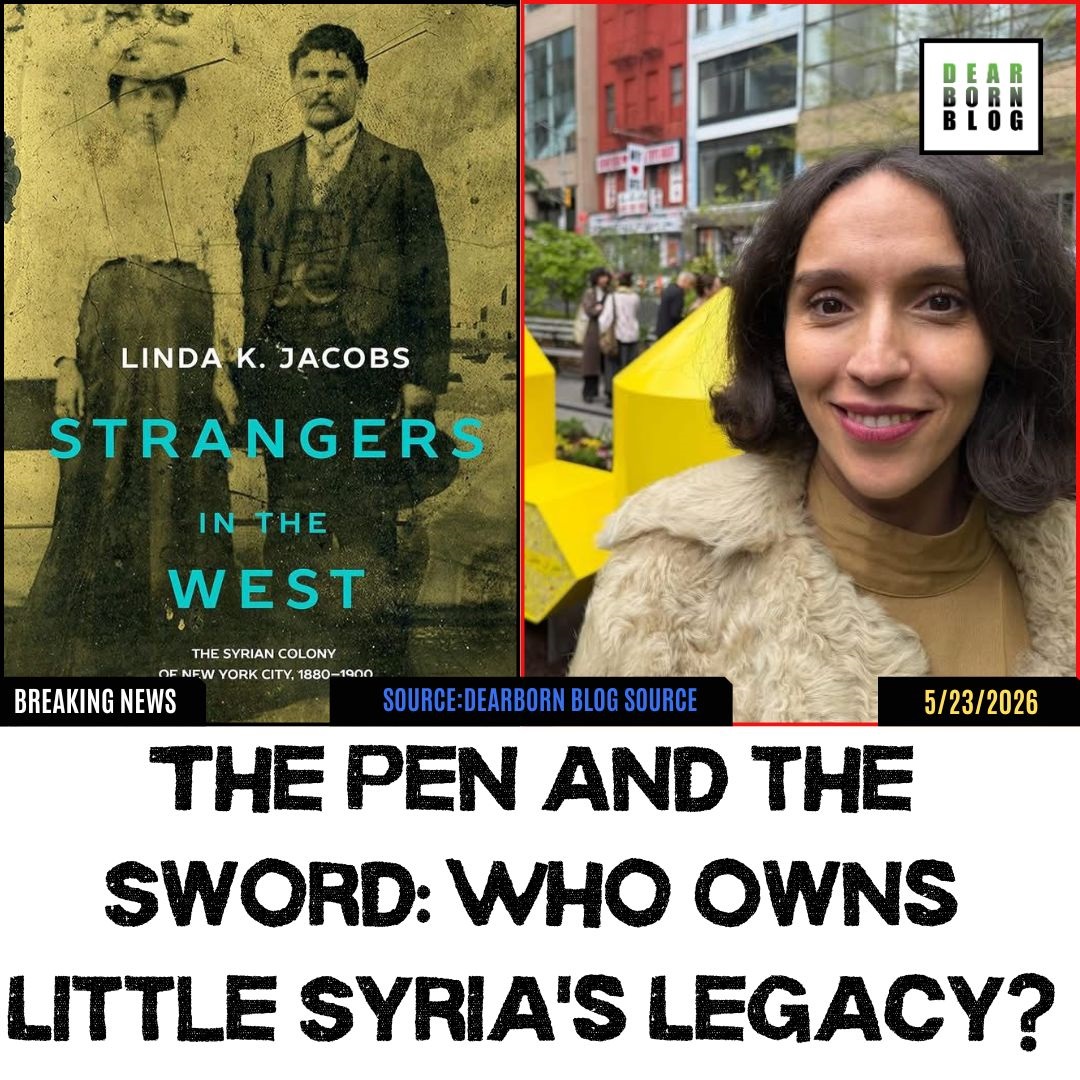
The monument is a culmination of more than fifteen years of work by the Washington Street Historical Society, led by Dr. Linda K. Jacobs, a scholar of Lebanese heritage whose grandparents lived in the very blocks the installation honors. The project was first conceived in 2011, chartered in 2013, and brought to completion in partnership with NYC Parks and the city’s Department of Cultural Affairs.3 Its purpose was singular and noble: to restore to public memory the story of the first Arabic-speaking community in the United States, and its towering literary legacy.
Within days, however, a political storm drowned out the celebration. Lebanese diaspora groups erupted online, accusing organizers of erasing Lebanese identity by labeling the neighborhood — and by extension the poets — as “Syrian.” Lebanese Foreign Minister Youssef Rajji formally intervened, directing diplomatic missions in New York and Washington to press city officials to amend the monument’s accompanying plaque.4 Within a week, Rajji announced on social media that the original plaque had been removed and would be replaced with one “reaffirming the Lebanese identity of these poets and writers.”5 A Change.org petition demanding corrections circulated widely, with some diaspora voices calling the monument’s framing “cultural appropriation” and “straight-up theft.”
📌 Key Facts: The monument honors nine writers, including Khalil Gibran, Mikhail Naimy, Ameen Rihani, and Elia Abu Madi. The neighborhood it commemorates — “Little Syria” — housed Arab immigrants from 1880 to the 1940s, when the area was demolished to build the Brooklyn-Battery Tunnel. Of the ten founding members of the Pen League (al-Rabita al-Qalamiyya), five were from what is today Lebanon, two from Syria, and three held dual or mixed Levantine origins.6
What “Syrian” Actually Meant in 1880
To understand why the monument uses the term “Syrian” — and why that choice is historically defensible — one must understand the world those immigrants left behind. When the first waves of Arab immigrants arrived on American shores between 1880 and 1924, the modern states of Lebanon, Syria, Palestine, and Jordan did not exist as separate political entities.7 The entire Levant was governed by the Ottoman Empire under a territorial arrangement known as “Greater Syria” (Bilad al-Sham). Lebanon would not emerge as an independent state until 1943.
The New York Public Library’s historical record is unambiguous: the neighborhood’s name derived from “Arabs arriving from Ottoman-controlled Greater Syria — covering what is now Syria, Lebanon, Palestine, Israel, and Jordan — in the Great Migration of 1880–1924, in which approximately 95,000 Arabs relocated to the United States.”8 By 1924, some 200,000 Arabs were living in the United States, with many concentrated in New York, Boston, Detroit, Chicago, and Cleveland. New York’s Lower Manhattan, centered on Washington and Rector Streets, functioned as what historians call the “Mother Colony” — the hub from which the broader Arab American diaspora spread.9
These immigrants were overwhelmingly Christian — Maronite, Orthodox, and Catholic — fleeing Ottoman oppression, economic hardship, and the collapse of the silk trade in Mount Lebanon. They arrived at Ellis Island, passed medical inspection, and walked directly to Washington Street where Arab wholesalers and shopkeepers had already established a foothold. The tenements they settled in were shared with Irish, German, Italian, and Chinese neighbors — some sixty nationalities crowded into a few square miles of lower Manhattan. In that environment, “Syrian” was not an act of erasure; it was a geographic description of origin, widely understood and self-applied.10
“‘Syria’ is something of a misnomer, because back then, Syria referred to the entire Levant region. Today, that would be modern-day Lebanon, Syria, Israel, Palestine, and maybe parts of Jordan.”— Asad Dandia, historian and founder of New York Narratives walking tours11
The Press, the Pen League, and the Politics of Identity
The name “Little Syria” did not emerge from thin air. It was coined and popularized by the Arabic-language press that was born in that very neighborhood. The first Arabic newspaper in North America — Kawkab America (“Star of America”) — was established on April 15, 1892, by brothers Ibrahim and Najeeb Arbeely, immigrants from Damascus.12 The paper identified itself as serving “Ottoman subjects scattered throughout Europe and the Americas,” and its geographic framing of the community as “Syrian” reflected that Ottoman reality. Al-Huda, arguably the most influential Arab American newspaper of its era, followed — with its first issue in 1898, a full ten years after Kawkab had already defined the community’s vocabulary.13
The associations that formed in Little Syria mirrored this naming convention. Groups such as the Syrian Ladies Aid Society, the Syrian Masonic Lodge, and the Syrian Youth Organization all adopted the “Syrian” label — not as a political statement against Lebanon, but as the most accurate available description of their shared Ottoman Levantine origin.14
📖 Historical Context: The Pen League (al-Rabita al-Qalamiyya) was first organized in 1916 and formally reconstituted in 1920. Of its ten founding members, five were of Lebanese origin — Ameen Rihani, Khalil Gibran, Rashid Ayyub, Mikhail Naimy, and Elia Abu Madi. Two were Syrian — Nasib Arida and Abd al-Masih Haddad. The remaining three — Wadi Bahout, William Catzeflis, and Nadra Haddad — held mixed or dual Levantine origins. The League deliberately chose no national affiliation in its founding charter.15
The League’s members held divergent political views. A minority supported the idea of Lebanese independence from Greater Syria. The majority favored a unified Greater Syria as a protective framework for minorities under Ottoman and later French rule. Ameen Rihani — himself from the Lebanese mountain village of Freike — navigated these tensions with characteristic elegance, famously describing himself as “a Lebanese in service of Arabism, and an Arab in service of humanity.”16 This ideological diversity was the League’s strength, not its weakness. It did not fracture their solidarity. They wrote, debated, and published together regardless of which national vision they favored.
Dr. Linda Jacobs and the Weight of Evidence
The scholar at the center of this controversy deserves recognition, not rebuke. Dr. Linda K. Jacobs holds a doctorate in Near Eastern Archaeology and Anthropology, and has spent decades reconstructing “Little Syria” street by street, building by building. Her research draws on the living memories of four of her own grandparents who resided in the neighborhood, combined with municipal archives, building permits, business licenses, and the full run of Arabic and English press from the era.17
Her landmark 2015 book Strangers in the West: The Syrian Colony of New York City, 1880–1900 (republished in a second edition in 2023) is recognized as the most authoritative account of the community’s founding generation. A subsequent volume, Captivating Strangers: Early Arab Immigrants in the United States (2024), extends and deepens that record.18 When she refers to the immigrants as “Syrian” — or when the monument uses that framing — she is not diminishing Lebanon. She is applying the only historically accurate label available for people who arrived before Lebanon existed as a sovereign state.
“This is two blocks from Washington Street and [the community] really was right there. The geographic connection is really important.”
— Dr. Linda K. Jacobs, President, Washington Street Historical Society19
Jacobs acknowledged the oversight and, under sustained pressure, committed to adjusting the plaque’s language to recognize Lebanese identity alongside Syrian identity. That is a reasonable accommodation. What is not reasonable is the diplomatic escalation that preceded it — a sitting Lebanese foreign minister mobilizing state resources to intervene in a community arts project in lower Manhattan, treating immigrant history as an extension of Beirut’s domestic political theater.
As Maya Mikdashi, editor of Jadaliyya, noted pointedly: “As Lebanon is being occupied, flattened, its people hunted and displaced, the Foreign Minister is very concerned about a plaque in New York commemorating ‘Little Syria,’ a diaspora community that predates the creation of the state of Lebanon.”20 The contrast between the urgency deployed over a bronze plaque and the silence over the devastation of Lebanon’s south speaks volumes.
Migration Is Not Nostalgia — And Legacy Is Not Property
What neither the politicians who intervened nor many of the online critics seem to grasp is the lived reality of migration. For the men and women who crossed the Atlantic between 1880 and 1924, leaving was not a lifestyle choice or an expression of love for the homeland. It was displacement — a rupture from everything familiar, driven by Ottoman repression, economic collapse, and the near-total failure of the political systems that governed their lives.21
These pioneers arrived in a city at the apex of its industrial power and settled in its most dangerous, most chaotic quarter. Tuberculosis moved through those tenements. Fires swept through wooden structures. The Irish gangs and nascent mafias that controlled Lower Manhattan’s streets posed constant threats. In that environment, “Syrian” identity — a broad communal solidarity — was a lifeline. It was the social infrastructure that substituted for the absent protections of law. To now argue that these people should have identified more precisely as Lebanese, or Syrian in the modern sense, or Palestinian, is to demand that they apply 2026 political maps to a world that did not yet have them.22
The immigrant adapts, grows, and acquires new dimensions that enrich their identity in a new society. The pioneering path — built with blood and tears — does not belong to the politicians of the home country who have spent generations dismantling it brick by brick.— Aoun Jaber
The Pen League’s own literary output reflects this complexity. Khalil Gibran’s The Prophet (1923) speaks no nation and claims no flag. Ameen Rihani’s The Book of Khalid (1911) — the first English-language novel published by an Arab American — tells the story of two Lebanese boys in New York, but frames their journey as universal. Mikhail Naimy wrote that the Pen League’s purpose was to make “literature into a messenger between the writer’s soul and the soul of others” — not a passport office for national identity claims.23
It is also worth noting that the very umbrella identity these writers inhabited — “Arab American” — was itself a political construction forged much later. The term gained institutional traction when former U.S. Senator James Abourezk, the first Arab American to serve in the U.S. Senate, founded the American-Arab Anti-Discrimination Committee (ADC) in 1980 — an organization created to combat anti-Arab racism and defend the civil liberties of an estimated 3.7 million Arab Americans.24 There is no Lebanese American literature, no Syrian American literature, no Egyptian American literature as separate bodies of work. There is Arab American literature — and that is the only honest framework within which these pioneers belong.
Division by Nostalgia: A Familiar Danger
The controversy over the Little Syria monument is not an isolated incident. It is one episode in a recurring pattern: Arab homeland governments and politicians extending their reach into diaspora communities, exploiting longing for the old country to advance domestic agendas, consolidate influence, and — too often — deepen existing fractures among communities that have spent generations learning to stand together.
Lebanon’s political system — built on sectarian distribution, clientelism, and the deliberate export of its citizens as a revenue model — has no moral standing to claim guardianship over the legacy of people who emigrated precisely to escape it. The immigrants of 1880–1924 did not leave because they loved their homeland less. They left because the systems that governed that homeland failed them utterly. Their creativity, their press, their literary societies, their civic organizations in America were built in spite of what they left behind — not as monuments to it.
📌 By the Numbers: Approximately 95,000 Arabs immigrated to the United States during the Great Migration of 1880–1924. By the time the Immigration Act of 1924 (Johnson-Reed Act) severely restricted entry — reducing Syrian immigration to just 100 people per year — some 200,000 Arabs were already living across the U.S. At its peak, Little Syria hosted roughly 300 Syrian-owned businesses in lower Manhattan alone.25
Instead of deploying diplomatic pressure over a plaque, Arab governments and their diaspora proxies would do far better to invest in translating and celebrating the hundreds of living Arab American artists, poets, novelists, and scholars whose work goes largely unrecognized outside their own communities. They might fund the preservation of Arabic-language archives. They might support institutions — like the Arab American National Museum in Dearborn, which has produced a landmark digital exhibition on the Pen League’s legacy — that do this work every day without diplomatic theatrics.26
What Little Syria Means to Dearborn
Dearborn, Michigan is home to the largest Arab American community in the United States — a city whose very character was shaped by successive waves of the same immigration story that began in Little Syria. Lebanese, Syrian, Palestinian, Yemeni, Iraqi: all of these communities found in Dearborn what those pioneers found on Washington Street in Manhattan — a place to rebuild, to belong, and to create something new without surrendering who they were.
The debate over the Little Syria plaque should resonate here not as a cause for tribal mobilization, but as a lesson in the dangers of political manipulation of community memory. Dearborn’s Arab American community has already demonstrated, through the 2024 “Uncommitted” primary movement, that it is capable of exercising collective power on its own terms — not as an extension of any homeland government’s agenda, but as a community with its own voice, its own priorities, and its own history rooted in this soil.27
The Arab American National Museum, located right here in Dearborn, has preserved the legacy of the Pen League through a landmark digital exhibition, bringing the stories of Gibran, Rihani, Naimy, and their contemporaries to new generations. That work — patient, scholarly, community-rooted — is the appropriate way to honor what those pioneers built. Not sword-rattling over a plaque. Not diplomatic ultimatums. Not social media outrage campaigns that serve the political interests of governments thousands of miles away.
The pen, after all, is what they chose as their symbol. It belongs to all of us — Lebanese, Syrian, Palestinian, Arab American — without borders, without conditions, and without permission from Beirut.
🌿 Green Party Perspective: The Green Party platform’s commitments to community self-determination, non-interventionism, and anti-imperialism apply not only to foreign military interventions but to political interference in diaspora communities. When governments exploit migrant nostalgia to extend their domestic power into communities abroad, they undermine the very autonomy and dignity those communities built through struggle. Dearborn’s Arab Americans deserve the right to define their own history — in solidarity with one another, free from manipulation by the same political classes whose failures drove their grandparents to emigrate in the first place. The Green Party’s vision of decentralized, community-owned civic life speaks directly to the need for diaspora communities to write their own stories.
Sources & Notes
1. Gothamist, “Financial District gets a colorful monument honoring its roots as ‘Little Syria,'” April 30, 2026. ↩
2. Hyperallergic, “Historic Monument Honors New York’s First Arabic-Speaking Community,” May 2026. ↩
3. Gothamist, op. cit. ↩
4. The National (UAE), “New York’s ‘Little Syria’ plaque sparks outrage in Lebanese community,” May 18, 2026. ↩
5. The New Arab, “Why are Lebanese furious over New York’s ‘Little Syria’ artwork?,” May 21, 2026. Quoting Lebanese FM Youssef Rajji’s post on X, May 21, 2026. ↩
6. Arab American National Museum, “Al-Rabita Al-Qalamiyya (The Pen League): A Digital Exhibition,” October 2020. ↩
7. New York Public Library, “Remembering Manhattan’s Little Syria,” November 19, 2015. ↩
8. NYPL, ibid. ↩
9. Arab America, “Keeping the Memory of Manhattan’s ‘Little Syria’ Alive,” February 12, 2016. ↩
10. Washington Street Historical Society, “History of Little Syria,” accessed May 2026. ↩
11. Downtown Alliance, “New Tour Explores Little Syria,” October 16, 2024. Quoting Asad Dandia, New York Narratives. ↩
12. Arab America, “‘Kawkab America’: The First Arab American Newspaper,” June 4, 2025. ↩
13. Turath, “Arabic-Language Press in America,” accessed May 2026. Note: Al-Huda‘s first issue appeared in 1898; Kawkab America launched April 15, 1892. ↩
14. Aoun Jaber, original Arabic essay (translated for this publication), citing historical records of Little Syria civic associations. ↩
15. Arab American National Museum, Pen League Digital Exhibition, op. cit. ↩
16. Khayrallah Center for Lebanese Diaspora Studies, NC State University, “Ameen Rihani,” accessed May 2026. ↩
17. Tenement Museum blog, “New York’s Best-Kept Secret: Manhattan’s Syrian Quarter,” April 14, 2025. Author bio for Dr. Linda K. Jacobs. ↩
18. Tenement Museum, ibid. Linda K. Jacobs, Strangers in the West: The Syrian Colony of New York City, 1880–1900 (2015; 2nd ed. 2023); Captivating Strangers (2024). ↩
19. Tribeca Trib, “Abstract Art Honoring Literary ‘Little Syria’ Gets Go-Ahead for Local Park,” August 30, 2023. ↩
20. The National, op. cit., quoting Maya Mikdashi, editor, Jadaliyya. ↩
21. Washington Street Historical Society, “History,” op. cit. ↩
22. New America, “Looking for Little Syria,” accessed May 2026. ↩
23. Arab American National Museum, Pen League Exhibition, op. cit., quoting Mikhail Naimy’s 1921 introduction to the League’s anthology. ↩
24. American-Arab Anti-Discrimination Committee (ADC), “About,” accessed May 2026. Sen. James Abourezk founded ADC in 1980. See also: History.com, “James Abourezk of South Dakota becomes first Arab American to serve in U.S. Senate,” January 3, 1973. ↩
25. NYPL, op. cit.; Arab America, op. cit. (citing New York Public Library records on 300 Syrian-owned businesses). ↩
26. Arab American National Museum, Dearborn, MI, Pen League Digital Exhibition, op. cit. ↩
27. Dearborn Blog archives, coverage of the 2024 “Uncommitted” primary movement in Dearborn, Michigan. ↩
Disclaimer: This article represents the opinion and analysis of its author, Aoun Jaber, and has been translated from Arabic and adapted for publication by Dearborn Blog. It does not constitute legal, diplomatic, or historical advice. While Dearborn Blog makes every effort to ensure accuracy and to link to credible, independently verifiable sources, readers are encouraged to consult primary sources directly. The views expressed herein are those of the author and do not necessarily reflect the positions of Dearborn Blog, its editors, or any affiliated organizations. Dearborn Blog assumes no liability for the use or interpretation of information contained in this article. All external hyperlinks are provided for reference purposes only; Dearborn Blog does not endorse the entirety of any linked third-party website or publication.


