

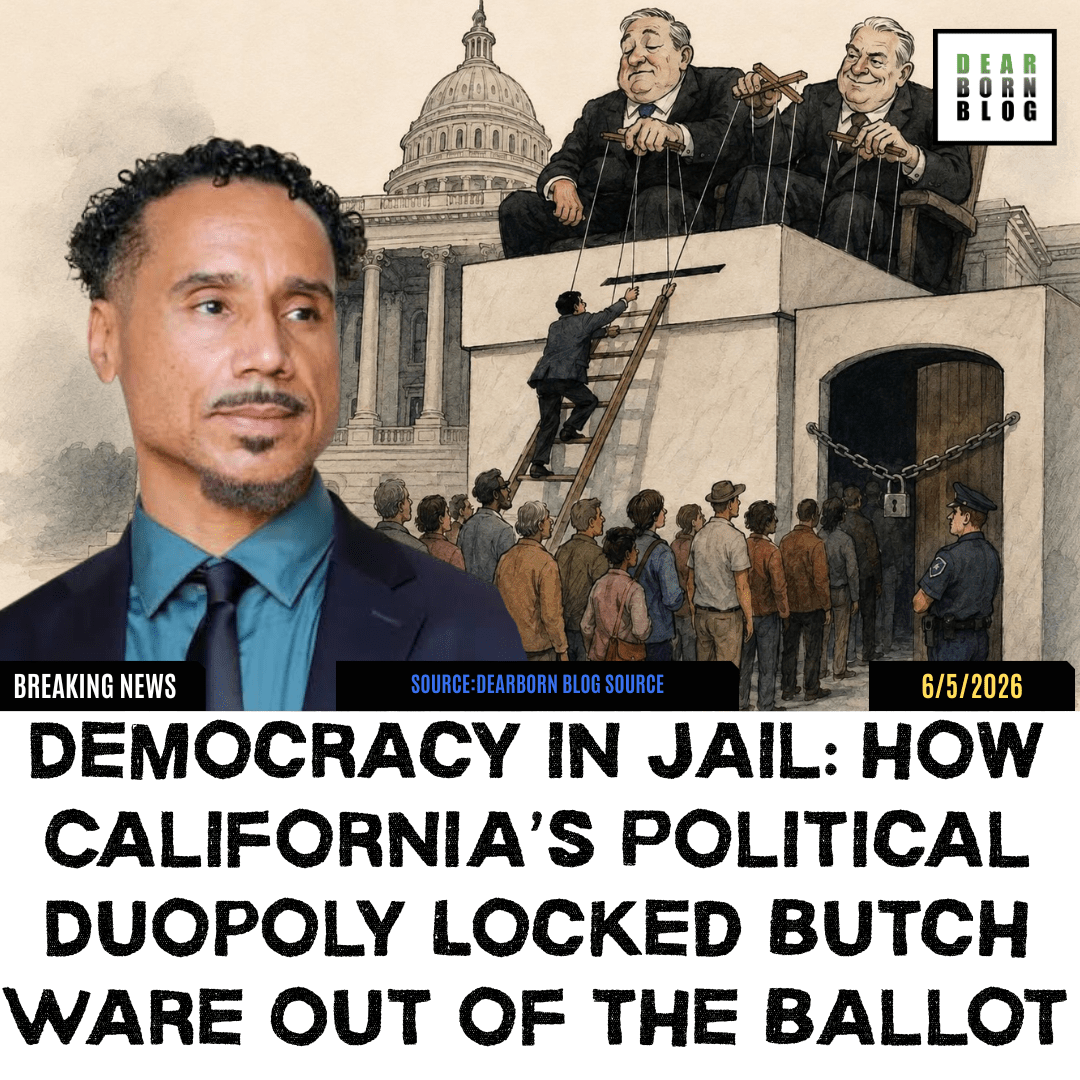
When a political system claims to defend democracy while actively restricting voter choice, the problem is no longer partisan corruption — it is structural decay. The battle surrounding Dr. Butch Ware’s removal from California’s gubernatorial ballot is not merely about one candidate. It is about whether Americans still live in a republic where democracy is allowed to breathe outside the suffocating grip of the Democratic-Republican duopoly.
There is a strange irony in American political culture.
The same political establishment that lectures the world about democracy often panics the moment actual democratic competition appears.
That contradiction exploded into public view when California Green Party gubernatorial candidate Dr. Rudolph “Butch” Ware was removed from the 2026 California primary ballot over what his campaign described as a technical paperwork issue involving tax return redactions. Ware, a respected historian, scholar, activist, and former Green Party vice-presidential nominee, argued that the Secretary of State’s office continuously shifted requirements and ultimately weaponized bureaucracy to keep him off the ballot.
The establishment response was revealing.
Not outrage.
Not concern.
Not even curiosity.
Mostly silence.
And silence is often the preferred language of managed democracy.
The “Technicality” That Became Political Exile
According to court filings and reporting, California officials claimed Ware’s submission contained improperly redacted information, including a phone number that allegedly remained visible due to software issues.
Ware argued that he corrected the issues and that the state repeatedly introduced new objections after earlier corrections had already been submitted. He further challenged the constitutionality of California’s requirement forcing gubernatorial candidates to disclose five years of tax returns in order to access the ballot.
The deeper issue was not merely whether forms were submitted correctly.
The deeper issue was selective enforcement.
Because in America, laws are often interpreted differently depending on whether you threaten power or protect it.
A minor clerical problem becomes “disqualifying” when the candidate exists outside the approved two-party structure.
Meanwhile, political machines that facilitate insider corruption, corporate lobbying, dark money influence, foreign policy disasters, mass surveillance, and economic collapse somehow remain fully “qualified” to govern.
That is the joke Americans are expected to take seriously.
“The fact that this broad daylight electoral robbery wasn’t covered in any national media outlet is criminal.” — Butch Ware
Democracy Is Welcomed — Until It Threatens the Cartel
The American political system functions less like a free democratic marketplace and more like a gated corporate franchise.
Republicans and Democrats compete theatrically with one another while jointly protecting the larger structure that preserves their monopoly.
Third parties are tolerated only when they remain symbolic and harmless.
The moment they begin gaining traction, barriers appear everywhere:
- Ballot access laws
- Signature requirements
- Debate exclusions
- Media blackouts
- Legal technicalities
- Funding disadvantages
- Administrative obstruction
The system calls this “election integrity.”
But ordinary people increasingly recognize it as institutional gatekeeping.
Ware’s supporters argue precisely this: that California officials moved the goalposts until it became impossible for his candidacy to survive bureaucratically.
Whether one supports Ware politically is almost beside the point.
The principle matters more.
If voters cannot freely choose candidates outside establishment approval, then democracy becomes performance art.
The Media’s Selective Blindness
Perhaps the most disturbing part of the controversy was not the legal battle itself.
It was the near-total national media silence surrounding it.
Independent media outlets, local Black media, Green Party circles, and dissident commentators discussed the case extensively. National corporate media largely ignored it.
That silence exposes a truth many Americans are finally beginning to understand:
Corporate media does not merely report political reality.
It curates acceptable political reality.
If a Republican candidate were removed from the ballot under suspicious procedural circumstances in a swing state controlled by Democrats, the story would dominate cable news for weeks.
If a Democrat were removed by Republicans, every editorial board in America would scream about fascism.
But when an anti-establishment third-party candidate is sidelined?
Crickets.
Because the corporate media ecosystem itself is deeply invested in maintaining the illusion that only two legitimate political choices exist.
Anything beyond that threatens the business model.
A System Designed to Exhaust Outsiders
One detail from Ware’s account stood out sharply.
According to interviews and supporters, his campaign allegedly received notice late in the day that an issue needed immediate in-person correction within an almost impossible timeframe.
This is how modern institutional suppression often works.
Not with dramatic authoritarian spectacles.
Not with tanks in the streets.
But through procedural exhaustion.
Endless technicalities.
Paperwork labyrinths.
Deadline manipulation.
Administrative ambiguity.
Modern liberal democracies have perfected a cleaner form of exclusion: bureaucracy as political warfare.
No dramatic coup required.
Just enough friction to ensure outsiders never gain traction.
“There is no depth to which they will not sink in order to stop Green candidates.” — Butch Ware interview commentary
The Fear Behind the Suppression
Why would the political establishment fear candidates like Butch Ware?
Because figures like Ware expose something dangerous:
Americans across ideological divides are becoming disillusioned with the duopoly itself.
The old Republican-versus-Democrat theater no longer satisfies millions of voters who feel economically abandoned, culturally manipulated, politically voiceless, and permanently trapped between two corporate-managed parties.
The establishment’s greatest fear is not left versus right.
Its greatest fear is people realizing they are both being managed by the same donor architecture.
That realization breaks the spell.
And once the spell breaks, third parties stop being symbolic protests and start becoming viable insurgencies.
That possibility terrifies institutional power.
The Constitutional Question Nobody Wants to Discuss
Ware’s lawsuit also raised a broader constitutional issue: can states impose additional qualifications on candidates beyond those already outlined constitutionally?
Interestingly, California’s attempt to require presidential candidates to release tax returns was previously struck down by courts years earlier.
Yet the gubernatorial requirement remained.
This inconsistency matters.
Because selective constitutional interpretation often reveals political motives more than legal principles.
In America, constitutionality frequently becomes flexible depending on whose interests are affected.
Democracy Without Choice Is Branding
Americans are repeatedly told they live in the “greatest democracy in the world.”
But democracy is not measured by patriotic slogans.
It is measured by political openness.
Can dissidents access ballots?
Can outsiders compete fairly?
Can voters choose beyond elite-approved options?
Can media platforms fairly cover anti-establishment candidates?
If the answer becomes “no,” then elections become branding exercises for power rather than genuine expressions of public will.
And increasingly, many Americans feel exactly that.
They feel trapped inside a political prison where the guards wear different colored ties but answer to the same donors.
The Dangerous Normalization of Anti-Democratic Behavior
One of the most alarming trends in American politics is how normalized anti-democratic behavior has become when used against disfavored groups.
People excuse suppression if it targets someone they dislike politically.
That is a fatal mistake.
Because once democratic principles become conditional, democracy itself becomes conditional.
Today it may target Greens.
Tomorrow it targets independents.
Next it targets journalists.
Then activists.
Then dissidents.
History shows repeatedly that systems built to suppress “fringe” actors rarely stay limited to them.
Power always expands its tools once society accepts them.
The Real Issue Is Bigger Than Butch Ware
This story is not ultimately about one man.
It is about a decaying political culture terrified of authentic competition.
A political order so fragile it cannot tolerate dissenting candidates without deploying procedural warfare.
A media class so compromised it ignores potential electoral suppression when it conflicts with establishment interests.
And a democratic system increasingly functioning like a private club masquerading as a republic.
The tragedy is that millions of Americans already know this instinctively.
They feel it every election cycle.
They feel it when candidates disappear from debates.
When grassroots movements are suffocated.
When donor-backed mediocrity dominates politics.
When citizens are told their only choices are two increasingly unpopular institutions.
That is not democratic vitality.
That is democratic exhaustion.
And exhausted democracies become vulnerable to collapse.
History is filled with examples.
America is not magically exempt.
Sources
- Ballot Access News — “California Secretary of State Removes Butch Ware, Green Party Gubernatorial Candidate, from Ballot”
- CalMatters / Santa Barbara Independent — “Judge Rejects Green Party Candidate’s Bid to Appear on California Governor Ballots”
- Ballot Access News — “Butch Ware Files Federal Lawsuit Against California Law Requiring Gubernatorial Candidates to Submit Income Tax Returns”
- Sacramento Bee — “Judge Rejects Green Party Candidate’s Bid to Get on Governor Ballot”
- Ballot Access News — “U.S. District Court Won’t Put Butch Ware on California Primary Ballot”
- Public discussions and commentary surrounding Ware’s ballot-access case


