

By Wissam Charafeddine | Dearborn Blog
Excerpt:
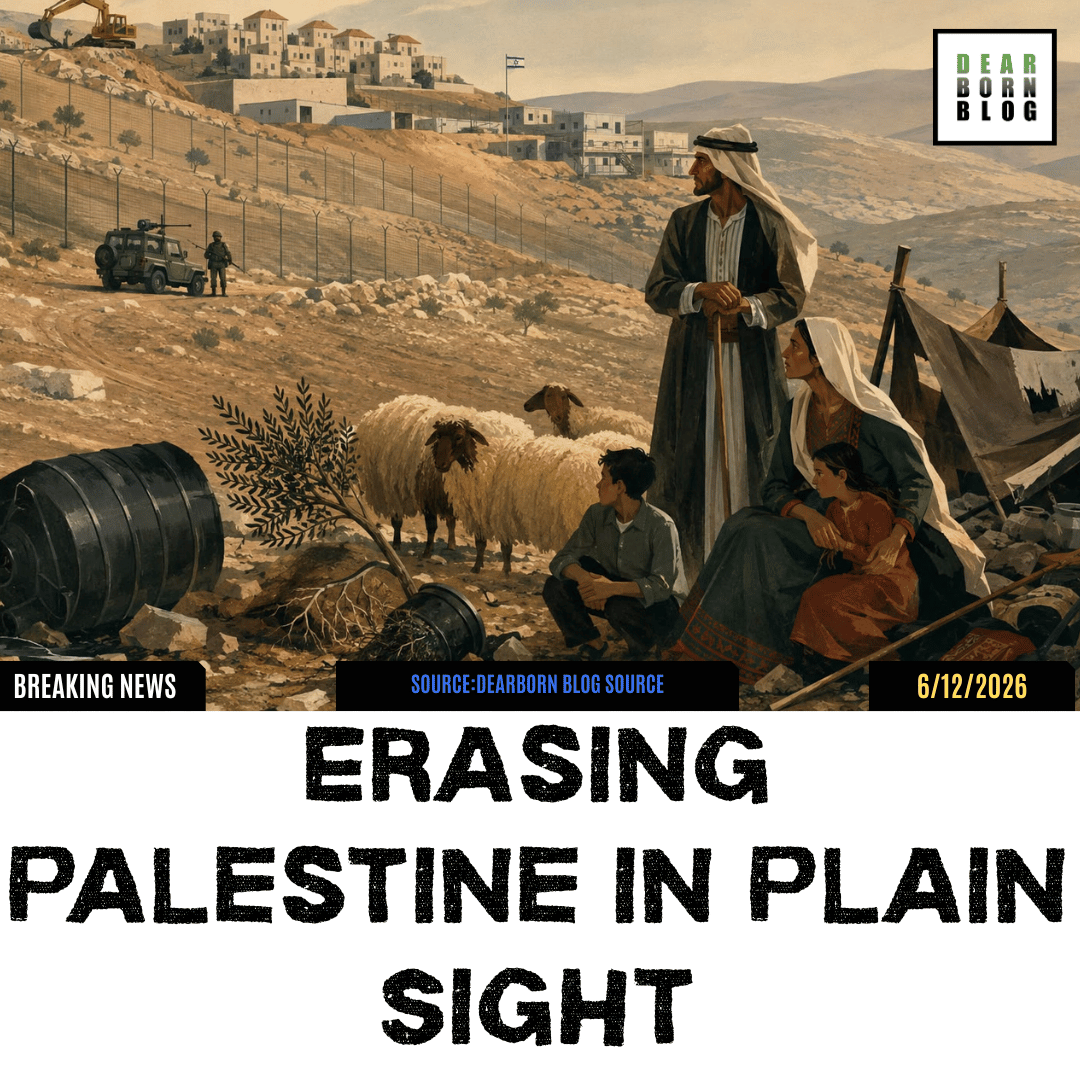
A new Amnesty International report accuses Israel of carrying out a state-backed campaign of ethnic cleansing against Palestinian Bedouin and herding communities in Area C of the occupied West Bank. The report argues that what is often described as “settler violence” is not random, not isolated, and not merely the work of a few extremists, but part of a broader policy of annexation, displacement, and erasure.
There are reports that document abuse, and then there are reports that remove the last excuse for pretending not to know.
Amnesty International’s new 149-page report, titled Erasing Anything Palestinian: Israel’s Ethnic Cleansing of West Bank Bedouin and Herding Communities, belongs in the second category. It is not a vague political statement. It is a long, detailed, evidence-based human rights investigation into how Palestinian Bedouin and herding communities in Area C of the occupied West Bank are being pushed off their land through settler violence, state policy, discriminatory planning rules, settlement expansion, home demolitions, restrictions on grazing, attacks on livestock, and a machinery of impunity that turns Palestinian life into a daily negotiation with fear. [1]
The title itself is devastating because it names the goal: not simply control, not merely occupation, not just “security,” but erasure. Amnesty opens its report with the testimony of Muntasir al-Maliki, a resident of Kufr Malik, who described what is happening as the erasure of “humans, trees and stones, and anything that is Palestinian.” [1] That sentence should haunt every government that still sends Israel weapons, every official who hides behind procedural language, and every media outlet that treats the destruction of Palestinian communities like a weather event: unfortunate, inevitable, nobody’s fault.
It is not nobody’s fault. Amnesty says the evidence points to a state-driven campaign.
And that is the heart of the report.
What Amnesty Found
According to Amnesty International, 117 predominantly Bedouin and herding Palestinian communities in the occupied West Bank faced full or partial displacement due to settler attacks and related access restrictions between January 2023 and April 2026. Approximately 5,910 people were forced to leave their homes, leaving behind depopulated areas in a territory where land, water, grazing routes, and geographic continuity are everything. [1]
Most of the affected communities are in Area C, which makes up more than 60% of the West Bank and remains under full Israeli military and administrative control under the Oslo framework. [1] This is not a technical footnote. Area C is the map beneath the story. It includes much of the West Bank’s agricultural land, grazing space, water resources, settlement blocs, military zones, and strategic corridors. In other words: whoever controls Area C controls whether a Palestinian future remains geographically possible.
Amnesty’s conclusion is direct: the violations it documents amount to the war crime of unlawful deportation and transfer and the crime against humanity of forcible transfer or deportation, committed as part of a policy to ethnically cleanse Area C of Palestinian Bedouin and herding communities while expanding illegal settlements at their expense. [1]
That phrase, “ethnic cleansing,” is not used casually. Amnesty explains that while ethnic cleansing is not a standalone crime under international law, the term describes a deliberate policy to remove one ethnic or religious group from a geographic area through violent and terror-inspiring means. [1] In this case, Amnesty argues that the pattern is clear: Palestinians are pressured until staying becomes impossible, then blocked or attacked when they try to return.
Zanuta: A Village Turned Into a Warning
One of the report’s central examples is Khirbet Zanuta, a Palestinian Bedouin village in the South Hebron Hills. Amnesty writes that Palestinian Bedouins lived there for generations, sustaining themselves through herding, farming, and dairy production. The community was designated as part of Area C under Oslo II, placing it under full Israeli control. [1]
The report says that in 2021, Israeli settlers established the unauthorized outpost known as Meitarim Farm about one kilometer from Zanuta. What followed, according to Amnesty, was a sustained campaign of attacks and threats: tents and classrooms set on fire, homes broken into, residents beaten, stones thrown, solar panels and windows smashed, water tanks emptied, and sewage pumped onto farmland. [1]
By October 2023, after another raid involving settlers accompanied by Israeli forces, the residents fled. Amnesty notes that Israel’s Supreme Court ordered police and military authorities in July 2024 and February 2025 to facilitate the community’s return and protect residents. But Amnesty says those rulings were ignored, and that attempts to return were met with further settler violence and Israeli military acquiescence. By March 2025, the report says, digital evidence, interviews, and satellite imagery confirmed the result: Zanuta had been forcibly depopulated and extensively destroyed. [1]
This is what erasure looks like in practice. First comes the outpost. Then the attacks. Then the impossible choice. Then the empty land. Then, very often, the retroactive legalization, funding, roads, infrastructure, and official language that pretends history began after Palestinians were removed.
The bulldozer does not always arrive first. Sometimes it waits until fear has done the paperwork.
The Machinery: Violence, Bureaucracy, Money
Amnesty’s report is powerful because it does not treat settler attacks as isolated incidents. It connects the violence to a wider machinery.
First, there is settlement expansion. Amnesty says Israel’s 37th government, formed in December 2022 under Benjamin Netanyahu with far-right coalition partners including Bezalel Smotrich and Itamar Ben-Gvir, marked a major acceleration in annexation-oriented measures. The report says the government openly embraced a settler movement vision that treats the entire territory from the Mediterranean Sea to the Jordan River as part of “Greater Israel.” [1]
Second, there is the transfer of power over key aspects of West Bank civilian administration. Amnesty details how authority over settlement planning and approvals shifted in ways that consolidated power in the hands of Smotrich and a new Settlement Administration. This matters because bureaucracy can be just as violent as a rifle when it decides who may build a home, who may access water, whose sheep may graze, and whose land becomes “state land.” [1]
Third, there is funding. Amnesty reports that government resources were channeled into settlement infrastructure, unauthorized outposts, security equipment, ATVs, drones, cameras, night-vision equipment, and organizations involved in the settlement enterprise. [1] This is where the “few bad apples” argument collapses. Bad apples do not usually arrive with state budgets, military protection, legal impunity, and road infrastructure. At that point, we are no longer discussing apples. We are discussing an orchard.
Fourth, there is impunity. Amnesty cites years of failure by Israeli law enforcement to investigate or prosecute settler attacks effectively. The report also notes that Palestinians who report settler violence have sometimes found themselves interrogated, fined, detained, or treated as suspects. [1]
That is the cruelest circle: Palestinians are attacked, then asked to trust the same system that protects the attackers.
The Legal Context: Occupation, Annexation, Apartheid
Amnesty’s report lands in a wider legal and political context that the world can no longer pretend is ambiguous.
In July 2024, the International Court of Justice issued an advisory opinion declaring Israel’s continued presence in the Occupied Palestinian Territory unlawful. The ICJ said Israel must end its unlawful presence, cease new settlement activity, evacuate settlers from the occupied territory, and make reparations for damage caused. [4]
In September 2024, the UN General Assembly adopted a resolution demanding that Israel end its unlawful presence in the Occupied Palestinian Territory within 12 months. The resolution called for Israel to comply with international law, withdraw military forces, cease settlement activity, evacuate settlers, and dismantle parts of the separation wall built inside the occupied West Bank. [5]
Amnesty’s new report builds on that legal landscape. It argues that the forced displacement of Palestinian Bedouin and herding communities is part of Israel’s broader system of apartheid and unlawful occupation. Amnesty had already concluded in its 2022 apartheid report that Israel imposes a system of domination and oppression over Palestinians. [7] This new report focuses on one brutal front of that system: the rural communities whose existence blocks annexation by their mere presence.
In plain English: Palestinian life on the land is treated as an obstacle to Israeli control of the land.
That is why the attack on Bedouin and herding communities is so strategic. These communities are small, often isolated, and dependent on access to grazing land, water sources, and open space. If settlers block grazing routes, steal or kill livestock, attack shepherds, destroy water tanks, and make children afraid to sleep at night, the community’s economy collapses. Once the economy collapses, displacement becomes the “choice” that was engineered all along.
What Israel Says
A serious article must also note the other side’s position, not because “both sides” are equal in power, but because accuracy matters.
Israel rejects accusations that its West Bank policies amount to ethnic cleansing and generally argues that the West Bank is disputed territory whose final status should be resolved through negotiations. [3] Amnesty’s report also says the Israeli military spokesperson’s unit responded to Amnesty’s findings by claiming that Israeli forces respond to settler attacks, detain suspects when necessary, and investigate failures to comply with orders or intervene. Amnesty states that the evidence it documented shows a different reality. [1]
That distinction matters. Journalism is not stenography for power. It is also not propaganda by volume. The responsible way to read this report is to state the allegations clearly, present the evidence, note the denial, and then ask whether the facts on the ground support the denial.
The facts on the ground are the displaced families, the destroyed homes, the dead livestock, the expanding outposts, the blocked returns, the demolished schools, the emptied communities, and the maps that keep changing in one direction.
Why This Matters to Dearborn
For Dearborn, this report is not foreign policy trivia. It is personal.
Dearborn is home to Palestinians, Arabs, Muslims, Christians, people of conscience, immigrants, refugees, workers, students, small business owners, union families, and neighbors whose lives are tied to the Middle East not as an abstract “issue,” but as family history. When a village in the West Bank is erased, somebody in Dearborn may know the cousin, the grandfather, the shepherd, the teacher, the land, the olive tree, or the road.
But this is bigger than identity. Dearborn understands what it means when powerful systems try to define a community without listening to it. Dearborn understands surveillance, profiling, political scapegoating, and the exhausting demand that oppressed people prove their humanity one tragedy at a time. Dearborn also understands resilience. We have seen communities build schools, businesses, mosques, churches, cultural centers, newspapers, and political movements while being told to stay quiet.
That is why this Amnesty report should matter to anyone who believes in international law, human rights, and real democracy. It should matter to Green Party voters and supporters because the Green platform has long emphasized peace, demilitarization, human rights, ecological justice, and accountability for state violence. It should matter to Democrats and Republicans who still believe law should mean something. It should matter to independents who are tired of being told that every atrocity comes with a lobby-approved excuse.
And yes, it should especially matter to Americans, because U.S. military, diplomatic, and financial support gives Israel extraordinary protection from consequences. When Washington says “rules-based order” in one sentence and funds the destruction of Palestinian life in the next, the rules start to look less like law and more like furniture: moved around whenever powerful people need space.
What Amnesty Is Asking the World to Do
Amnesty International’s recommendations are not symbolic. They are concrete.
The organization calls on third states to ban trade, investment, and activities that contribute to or are directly linked to Israel’s unlawful occupation, apartheid system, and ethnic cleansing of Palestinians. It calls for bans on assistance to organizations integral to the settlement enterprise. It urges the European Union to suspend its association agreement with Israel and suspend visa-free access to Israeli settlers living in the Occupied Palestinian Territory. [1]
Amnesty also calls for targeted sanctions against senior Israeli officials it identifies as directly implicated in the campaign, including Benjamin Netanyahu, Itamar Ben-Gvir, Israel Katz, Bezalel Smotrich, and Orit Strock. These sanctions would include travel bans, asset freezes, and financial restrictions. [1]
Finally, Amnesty calls on Israeli authorities to immediately stop the forcible transfer of Palestinian Bedouin and herding communities, dismantle all Israeli settlements and outposts, allow displaced Palestinians to return home, meet the humanitarian needs of displaced civilians, provide reparations, and hold perpetrators accountable. [1]
These are not radical demands. They are the minimum demands of a world that still wants to pretend international law is alive.
The Moral Bottom Line
The Amnesty report forces one basic question: what do we call it when a state helps create conditions that make Palestinian life impossible, then takes the land once Palestinians are gone?
Amnesty calls it ethnic cleansing.
Some politicians will call it complicated. Some pundits will call it ancient conflict. Some lobbyists will call it security. Some will mumble about “both sides” like that phrase is a magic spell that makes bulldozers disappear.
But the people of Zanuta, Ein Samia, Al-Farisiya, Ein al-Hilweh, Makhoul, and countless other Palestinian communities know what it is. They know it in the sound of settlers arriving at night. They know it in the price of animal feed after grazing land is blocked. They know it in the demolished classroom, the empty water tank, the confiscated sheep, the child who asks whether soldiers are coming again, and the elder who has lived through one Nakba only to see another version arrive with drones and paperwork.
The world does not suffer from a lack of information. It suffers from a lack of courage.
Dearborn Blog stands with the human right of Palestinians to remain on their land, return to their homes, live free from occupation and apartheid, and be treated not as a demographic problem but as a people with dignity, history, and rights.
Palestinian existence is not illegal.
The land remembers. The people remember. And now, with reports like this, the record remembers too.
Sources
[1] Amnesty International, Erasing Anything Palestinian: Israel’s Ethnic Cleansing of West Bank Bedouin and Herding Communities, June 2026. Full PDF: https://www.amnestyusa.org/wp-content/uploads/2026/06/Erasing-Anything-Palestinian-Israels-Ethnic-Cleansing-of-West-Bank-Bedouin-and-Herding-Communities.pdf
[2] Amnesty International USA, “Erasing Anything Palestinian: Israel’s Ethnic Cleansing of West Bank Bedouin and Herding Communities,” June 10, 2026. https://www.amnestyusa.org/reports/erasing-anything-palestinian-israels-ethnic-cleansing-of-west-bank-bedouin-and-herding-communities/
[3] Associated Press, “Amnesty accuses Israel’s government of ‘ethnic cleansing’ of Palestinians from the West Bank,” June 10, 2026. https://apnews.com/article/c6eadbaf0a002a91765509a0df126744
[4] International Court of Justice, “Summary of the Advisory Opinion of 19 July 2024,” Legal Consequences arising from the Policies and Practices of Israel in the Occupied Palestinian Territory, including East Jerusalem. https://www.icj-cij.org/node/204176
[5] United Nations Geneva, “UN General Assembly demands Israel end ‘unlawful presence’ in Occupied Palestinian Territory,” September 18, 2024. https://www.ungeneva.org/en/news-media/news/2024/09/97644/un-general-assembly-demands-israel-end-unlawful-presence-occupied
[6] OCHA, “Humanitarian Situation Report | 25 May 2026,” May 25, 2026. https://www.ochaopt.org/content/humanitarian-situation-report-25-may-2026
[7] Amnesty International, Israel’s Apartheid Against Palestinians: Cruel System of Domination and Crime Against Humanity, February 2022. https://www.amnestyusa.org/wp-content/uploads/2022/01/Full-Report.pdf
[8] Amnesty International, “Israel’s ethnic cleansing of West Bank Palestinian communities demands global action,” June 2026. https://www.amnesty.org/en/latest/research/2026/06/israel-west-bank-ethnic-cleansing/
Disclaimer
This article is an opinion and analysis piece based on publicly available human rights reporting, legal documents, news coverage, and the Amnesty International report cited above. Dearborn Blog is not a court, and references to alleged crimes, violations, or responsibility are based on the findings and terminology of cited organizations and legal bodies. Individuals and institutions named in this article may dispute these findings. Readers are encouraged to review the original sources and reach their own conclusions. For corrections, clarifications, or comments that you would like inserted in the article, please email info@dearbornblog.com.


